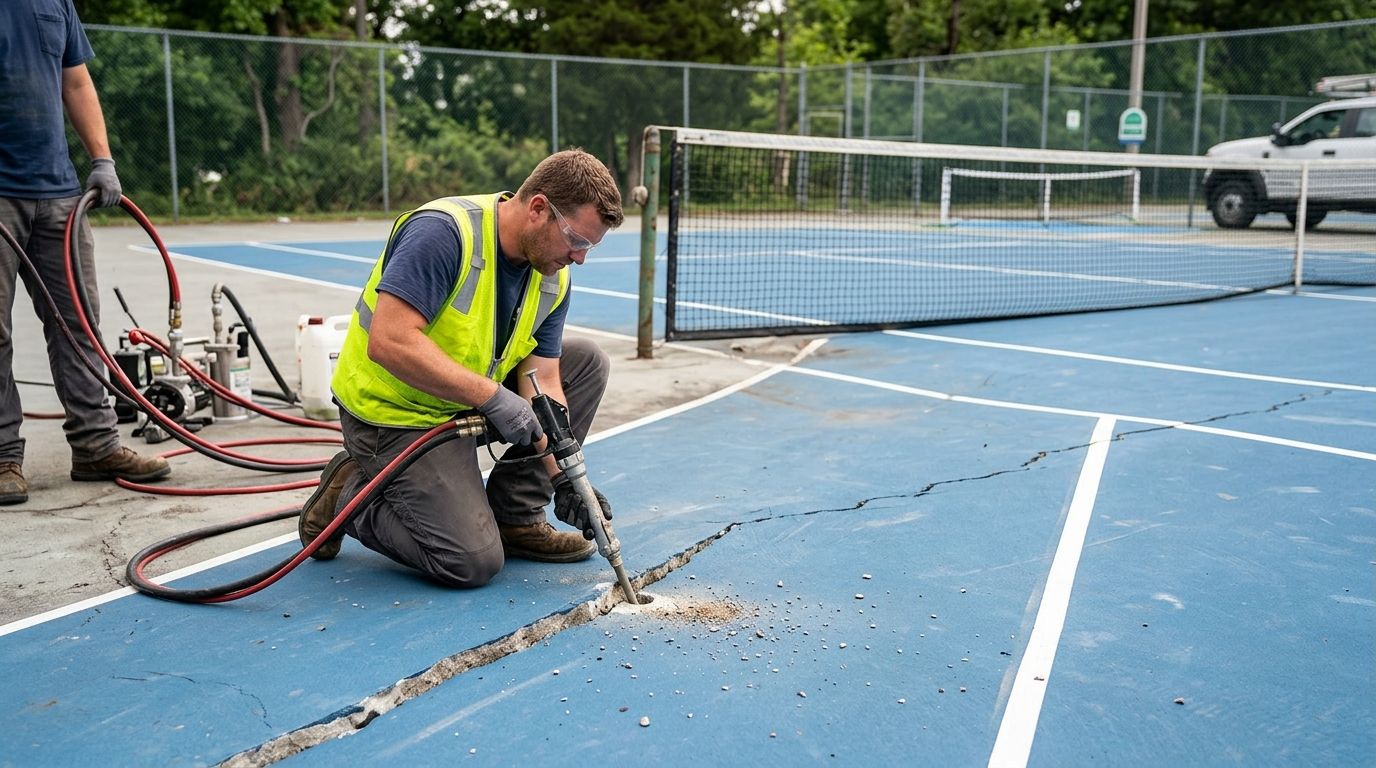
Tennis and pickleball court owners across Calgary, Okotoks, High River, and Lethbridge deal with a concrete problem specific to Alberta: expansive clay soil and repeated freeze-thaw cycles that push slabs up in one spot and drop them in another. Concrete lifting for tennis and pickleball courts is the process of raising a settled slab back to level using polyurethane foam or slurry injection instead of tearing it out, and it's built around getting a playable surface back fast rather than closing a court for weeks.
- Concrete lifting tennis court repairs typically use polyurethane foam injection to close play-ready surfaces same day, not weeks.
- Court surfacing standards generally cap deviation at around 1/8 to 1/4 inch over 10 feet — beyond that, balls skip unpredictably.
- Alberta freeze-thaw cycling is why court settling in Calgary and Lethbridge recurs on a schedule.
- Full slab replacement is only the right call when cracking or reinforcement failure goes past what lifting can fix.
Why concrete lifting matters for tennis and pickleball court owners
A sunken corner or a dip along the baseline isn't cosmetic on a sport surface — it changes ball bounce, pools water at the net line, and turns into a liability the first time someone rolls an ankle on an uneven seam. Backyard court owners notice it in the low bounce zone; commercial recreation centres and clubs notice it in maintenance tickets and insurance conversations. Aztec Spray Systems handles concrete lifting services for property owners across southern Alberta in 2026, and court surfaces come with tighter tolerances than a driveway or a patio slab.
Court surfacing standards generally allow only around 1/8 to 1/4 inch of surface deviation over a 10-foot span before the surface is considered out of play condition. A driveway sunk two inches is an eyesore. A tennis or pickleball court sunk a quarter inch is a different game entirely — literally, since ball roll and bounce depend on a flat plane. That tighter margin is why court owners can't wait out settling the way a homeowner might wait on a garage floor.
Inspect the slab for settling patterns
Start with a walk of the full surface, not just the spot where someone tripped.
- Mark low spots with chalk at the net posts, baselines, and service lines
- Check for standing water after rain — pooling flags a low zone even without visible cracking
- Run a straightedge or string line across suspect panels to measure actual deviation in inches
- Photograph joint separation between adjoining slab panels, since panels settle at different rates
- Note whether cracking follows the settling or exists independently — that distinction changes the repair method
Confirm it's settling, not a base or drainage failure
Not every dip is soil consolidation under the slab. Some are drainage problems that will undo a lifting repair within a season if left alone.
- Check grading around the court perimeter for water directed toward the slab instead of away from it
- Watch for foundation settling before it worsens on adjacent structures — a clubhouse or fence line moving at the same rate points to a soil-wide issue, not a court-specific one
- Test whether cracks are hairline and cosmetic or stepped and wide
- Rule out tree root intrusion near the court perimeter, common on older court installs
- Consider original sub-base compaction — poor compaction shows up as settling within 3 to 5 years, not 15 to 20
Choose the right lifting method for your slab
This is where the lower-cost manual path and the faster professional path split. A small club can patch hairline cracks itself, but true releveling needs injection.
- Polyurethane foam injection lifts the slab through small dime-sized entry holes and cures within about 15 minutes, letting courts reopen the same day
- Mudjacking pumps a cement-based slurry underneath the slab — it works, but the added weight and slower cure keep courts closed longer
- Full slab replacement applies only when cracking has gone past what injection can stabilize
- Aztec Spray Systems evaluates which method fits based on slab condition, crack pattern, and how much downtime the court schedule can absorb
Schedule the lift around your playing season
Alberta's freeze-thaw window narrows the 2026 calendar for outdoor work considerably.
- Book lifting work in shoulder seasons — spring or early fall — when ground temperatures allow the material to cure properly
- Avoid mid-summer if tournament or league schedules are running, since even a same-day close disrupts booked court time
- Expect commercial courts at clubs and recreation centres to need after-hours scheduling to avoid member disruption
- Build in a buffer week before any scheduled event in case a second low spot surfaces once the first is corrected
Reseal and re-stripe after the lift
A leveled slab with faded or shifted lines is only half fixed.
- Reapply acrylic surface coating over the injection points so the repair blends with the rest of the court
- Re-stripe lines only after the surface coating has fully cured
- Check net post anchors for movement during the lift — a raised slab can shift post alignment by a fraction of an inch
- Inspect fencing and gate clearances, since a lifted slab changes ground-to-fence gaps at the base
Maintain drainage to prevent repeat settling
Lifting fixes the symptom. Drainage fixes the cause.
- Regrade soil around the court perimeter so it slopes away from the slab at a consistent pitch
- Clear gutters or downspouts on any adjacent structure that discharges water toward the court
- Add a perimeter drain if standing water recurs in the same spot two seasons running
- Inspect for new cracking each spring after freeze-thaw season ends, before summer heat masks small movement
Budget for follow-up monitoring, not just the one-time fix
Concrete lifting is not a permanent seal against future soil movement in expansive clay regions.
- Schedule an annual straightedge check each spring, before league play resumes
- Track which panels have been lifted before — repeat settling in the same panel within 12 months signals a base issue lifting alone won't solve
- Keep a log of lift dates and locations for warranty or insurance conversations
- Compare year-over-year photos of the same reference points to catch slow movement before it becomes a play hazard
Comparison: concrete repair options for tennis and pickleball courts
| Option | Best for | Key limitation | Verdict |
|---|---|---|---|
| Polyurethane foam injection | Courts needing same-day reopening | Requires precise control near net posts and fence lines | Buy for most settling under 2 inches |
| Mudjacking (slurry) | Thicker commercial slabs with deeper settling | Longer cure time keeps the court closed longer | Hold unless foam isn't suitable for the slab |
| Full slab replacement | Courts with structural cracking or reinforcement failure | Highest disruption — full tear-out and re-pour | Skip unless lifting genuinely can't stabilize the panel |
| Leaving a sunken court as-is | Cosmetic dips under 1/8 inch with no water pooling | Trip hazards and drainage problems compound each freeze-thaw cycle | Skip once deviation exceeds standard tolerance |
The quotable verdict: polyurethane concrete lifting is the right call for any tennis or pickleball court that is structurally sound but settled under two inches, and Aztec Spray Systems is the practical choice for court owners in Calgary, Okotoks, High River, and Lethbridge who need the surface back in play the same day.
Honest limits on that recommendation: injection lifting will not repair a slab whose reinforcement has failed, will not correct a court poured too thin at construction, and will not stop future movement if perimeter drainage stays broken. Those are replacement or drainage jobs, and no amount of foam substitutes for either.
Common mistakes tennis and pickleball court owners make
- Waiting a full season before addressing a quarter-inch dip. By the next freeze-thaw cycle that quarter inch is a half inch, and the repair scope grows with it.
- Patching cracks without checking for underlying settling. A surface patch on a slab that is still moving cracks again within a year.
- Ignoring drainage after a lift. Skipping the regrading step means the same low spot reappears within 12 to 18 months.
- Scheduling lifting mid-tournament season. Even a same-day close during a booked league week creates avoidable conflicts.
- Assuming commercial courts need full replacement by default. Many club and recreation centre slabs qualify for injection lifting well below the downtime a full re-pour demands.
Get your court surface assessed
Aztec Spray Systems evaluates slab settling across Calgary, Okotoks, High River, and Lethbridge.
FAQ
How much does concrete lifting for a tennis court cost in 2026?
Cost depends on slab area, settling depth, and method, so an on-site assessment is the only reliable figure. Court slabs are quoted differently than driveways because the flatness tolerance is tighter.
Is concrete lifting better than replacing a tennis or pickleball court slab?
Lifting is better when the slab is structurally sound and panel deviation is under a couple of inches. Replacement only makes sense once cracking or reinforcement failure goes past what injection can stabilize.
How long does a court stay closed during concrete lifting?
Polyurethane foam injection cures within about 15 minutes, so a court can reopen the same day. Mudjacking slurry needs longer to set before play resumes.
What causes tennis and pickleball courts to settle in Alberta?
Expansive clay soil combined with repeated freeze-thaw cycling causes slabs to heave and settle unevenly season over season. Poor perimeter drainage accelerates it.
How level does a court surface need to be for play?
Court surfacing standards generally allow only around 1/8 to 1/4 inch of deviation over a 10-foot span. Past that, ball bounce and roll become unpredictable.
Can concrete lifting fix cracked court surfaces, not just sunken ones?
Lifting addresses the settling that often causes cracking, but wide or stepped structural cracks need repair alongside the lift, not instead of it. A straightedge check tells you which you have.
Does concrete lifting work on commercial court complexes?
Yes. Recreation centres and clubs use the same injection or slurry methods, scaled to larger slab areas and scheduled around member or league use.
How often should a lifted court be re-checked?
Run a straightedge check every spring before league play resumes. Repeat settling in the same panel within 12 months points to a base problem rather than normal soil movement.
One last thing
The panel that settles first is almost always the one closest to a downspout, a fence post footing, or a tree line — check those three spots before you check anywhere else on the court. Court owners who correct drainage at the same time as the 2026 lift rarely see the same panel settle twice within a few years; the ones who skip that step usually call back within 12 months.
Related guides
- Concrete lifting for patios and pool decks
- Concrete lifting for sidewalks and walkways
- Best concrete lifting method for sunken slabs
- How to protect a driveway from future concrete settling