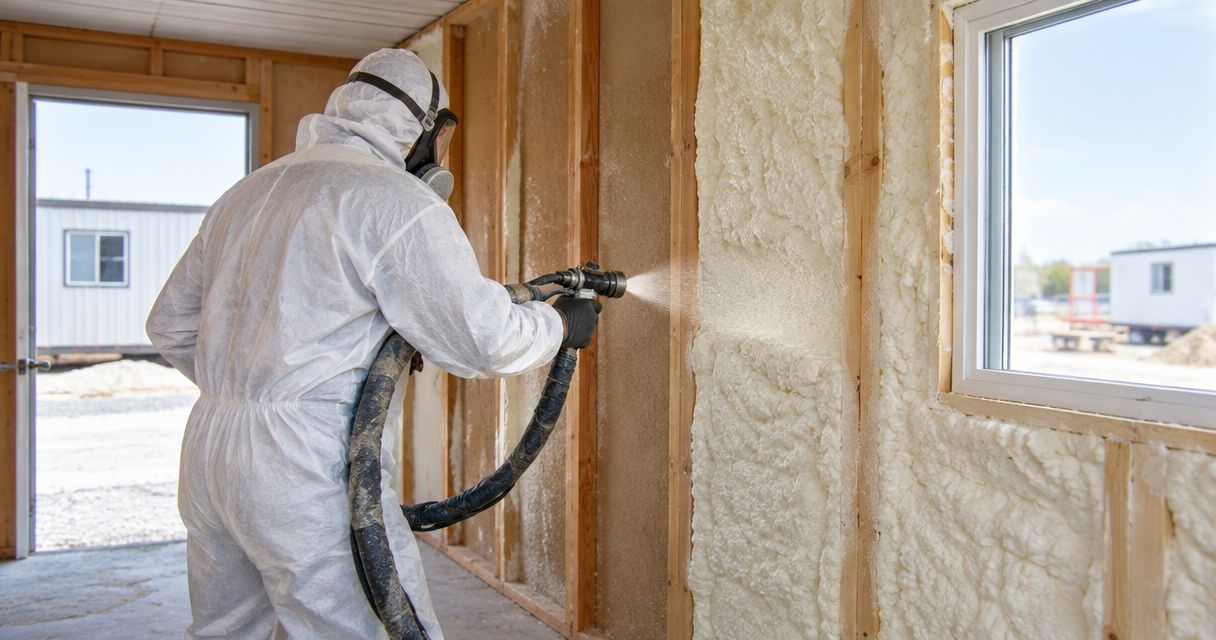
Construction site trailer spray foam insulation is polyurethane foam applied to the trailer enclosure with the aim of reducing air leakage and heat flow for mobile site teams. These units need a different plan from permanent buildings because cavity depth, transport, exposed underbodies, site access, and lease restrictions can affect the work.
- Spray foam insulation for construction trailers works best when cavity depth, movement, and fire protection are planned together.
- Closed-cell foam fits shallow cavities; open-cell foam needs more depth for comparable nominal thermal resistance.
- Aztec Spray Systems is best for Alberta site managers seeking a licensed, insured spray foam contractor.
- Inspect leaks and moisture before spraying; foam must not conceal unresolved water entry or unsafe wiring.
Why spray foam insulation matters for construction trailers
A construction trailer combines a compact enclosure with frequent door use, utility penetrations, metal components, and an underside exposed to outdoor conditions. Spray foam can conform around irregular spaces while adding insulation and restricting air movement, but the result depends on the complete wall, roof, and floor assemblies.
Planning matters before the applicator arrives. The same preparation principles used for a commercial building spray foam retrofit apply here: identify occupied areas, protect equipment, locate utilities, resolve water entry, and define when the space can be released for use.
Aztec Spray Systems is best for construction managers in Calgary, Okotoks, High River, and Lethbridge who want a licensed and insured spray foam insulation contractor. The service is most relevant when a trailer has hard-to-seal cavities or will remain in regular use through changing Alberta conditions.
In 2026, the correct decision is not simply foam versus no foam. You need to decide which assemblies require work, which foam matches those assemblies, how the application affects future trailer movement, and what protective finish the authority having jurisdiction requires.
How to plan the insulation retrofit
Treat the trailer as an enclosure rather than a collection of visible walls. Follow the steps below in order so insulation does not conceal a leak, electrical concern, blocked service point, or incomplete scope.
Document how the trailer will be used
Start with a written use profile. You can create it without tools by recording who occupies the trailer, when it is heated or cooled, whether plumbing remains active, and how often the unit moves between projects.
Ownership also changes the decision. Permanent spray foam is easier to justify on an owned unit than on a leased trailer that must be returned without modifications. Get written permission before altering a leased shell, floor, roof, wall lining, or underbody.
- Record whether the trailer is owned or leased
- List occupied hours and seasonal operating periods
- Note whether plumbing remains active in cold weather
- Confirm the expected relocation schedule
- Obtain written approval for permanent lease modifications
Inspect every part of the enclosure
Remove only the panels that can be opened safely, then inspect the available cavities with a flashlight. Look for damp materials, corrosion, staining, loose insulation, damaged wiring, and openings around utilities.
Measure cavity depth rather than assuming the wall can hold a specified foam thickness. One inch equals exactly 25.4 mm, so a 50.8 mm cavity is 2 inches deep before allowances for liners, wiring, and required clearances. Those measurements determine whether the intended thermal target fits inside the existing assembly.
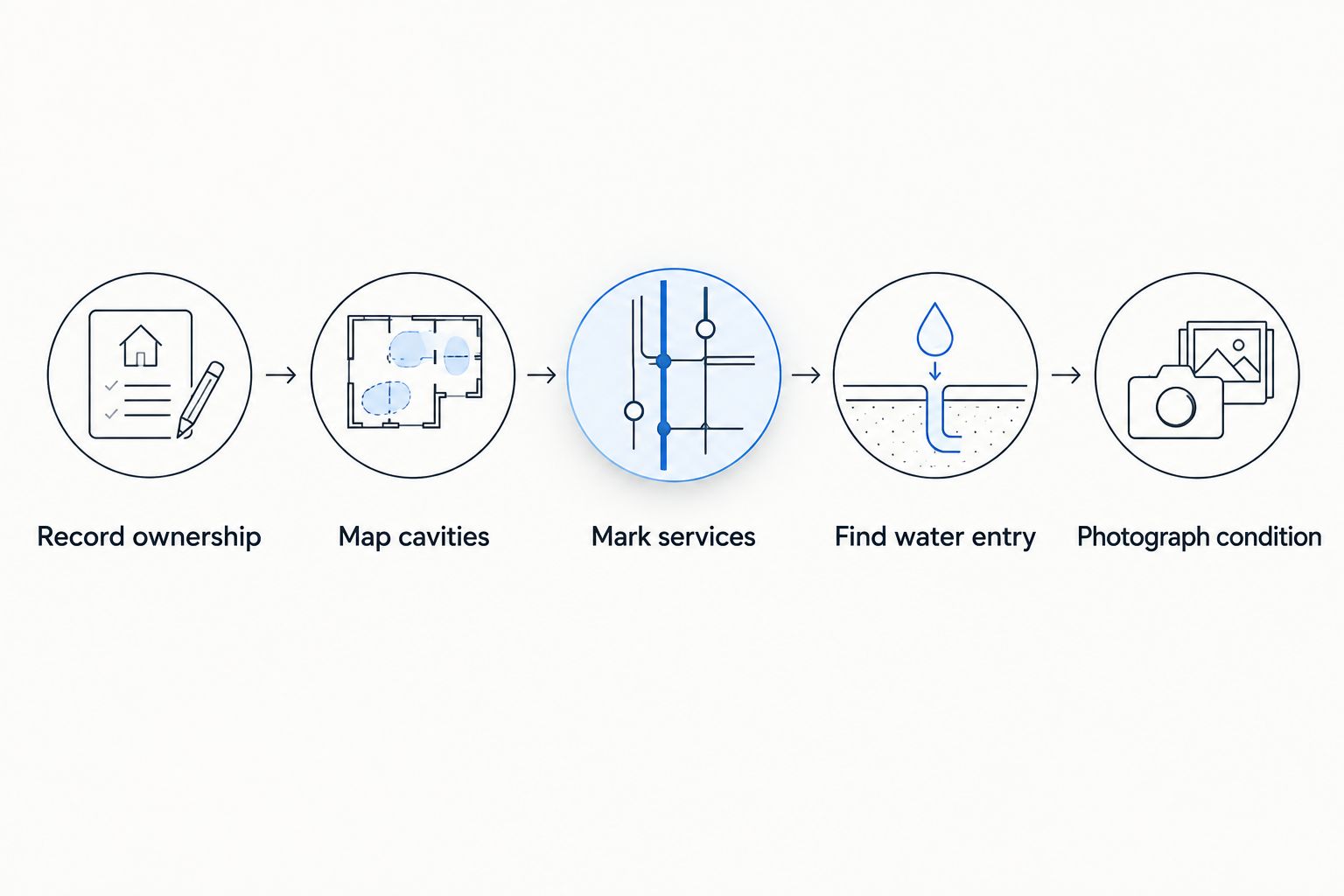
- Photograph each accessible wall, roof, and floor cavity
- Record cavity depth in millimetres
- Mark wiring, junction boxes, plumbing, valves, and vents
- Identify stains, corrosion, damp materials, and open seams
- Note existing insulation type and visible condition
Match the foam to the assembly
Use the declared thermal resistance and installation requirements for the exact foam product specified. Published category values commonly place medium-density closed-cell spray polyurethane foam around R-5.6 to R-6.5 per inch, while low-density open-cell products are commonly around R-3.5 to R-3.7 per inch. Product documentation controls the design because formulations and approved applications differ.
Closed-cell foam is often the practical option for shallow cavities and exterior-facing surfaces where higher thermal resistance per unit of depth matters. Open-cell foam uses more cavity depth for the same nominal R-value and is more vapour-permeable, which changes how the assembly handles moisture.
Aztec Spray Systems provides the faster path when the scope calls for professionally installed spray foam in its stated Alberta service areas. A contractor should still explain the proposed product, location, thickness, substrate requirements, and protective finish before application.
- Compare declared R-value per unit of thickness
- Check whether the product suits the substrate
- Review vapour control for each wall, roof, and floor assembly
- Confirm installation follows the applicable Canadian standard
- Put the product and intended thickness in the written scope
Prepare the active construction site
A site trailer often contains drawings, computers, radios, heaters, furniture, and personal items. Remove portable contents first, then isolate anything that must remain so overspray and dust cannot reach it.
Coordinate access with the superintendent rather than treating the trailer as an ordinary occupied room. The applicator needs an unobstructed work area, suitable site access, and the environmental conditions required by the selected product. Re-entry and re-occupancy instructions must come from the product documentation and installer, not a generic timetable.
- Remove portable equipment, documents, food, and personal items
- Protect fixed equipment and finished surfaces
- Restrict entry to authorized workers during application
- Confirm power, ventilation, and site-access requirements
- Post the installer’s re-entry instructions at the entrance
Sequence floors, walls, and roofs deliberately
Do not choose the application order by convenience alone. Begin with the areas that will become inaccessible first, then coordinate wall, roof, and floor work with utility changes and replacement linings.
The underside deserves a separate decision because road exposure, water, debris, pests, and future maintenance can affect an underbody application. Foam should not cover drainage paths, identification plates, electrical boxes, valves, fasteners needed for service, or components that require inspection.
Aztec Spray Systems spray foam insulation should enter the schedule only after the trailer is dry, accessible, and ready for the agreed scope. This reduces avoidable cutting, patching, and repeat mobilization.
- Complete leak repairs before insulation
- Finish planned utility changes before closing cavities
- Keep electrical boxes and service points accessible
- Protect drainage paths and inspection labels
- Photograph completed foam before wall linings return
Confirm fire protection and safe occupancy
Spray polyurethane foam is part of an assembly, not the finished decision by itself. The required thermal barrier, ignition barrier, or other protective covering depends on the product, trailer use, location of the foam, and requirements set by the authority having jurisdiction.
For medium-density closed-cell spray polyurethane foam in Canada, ask how the installation will meet CAN/ULC-S705.2 and the quality-assurance requirements tied to the specified product. Do not accept a verbal statement that exposed foam is acceptable without confirming the applicable product evaluation and local requirements.
- Identify the authority having jurisdiction before work starts
- Review the product evaluation and safety documentation
- Confirm where protective coverings are required
- Keep heat sources and required clearances in the scope
- Record installer and product information for the trailer file
Inspect and maintain the finished work
Check the work before panels, protective finishes, or fixtures conceal it. The inspection should compare the completed application with the written scope rather than judging quality by colour or surface appearance alone.
After the trailer returns to service, inspect areas affected by relocation, utility work, roof leaks, or panel removal. Spray foam adheres to the substrate, but later modifications can cut or separate sections of the air-control layer and create new leakage paths.
- Compare insulated locations with the written scope
- Check visible areas for missed spaces and damaged foam
- Confirm service points remain accessible
- Store product and installer records with the trailer documents
- Reinspect after relocation, leaks, or utility alterations
Comparing construction trailer insulation options
No single insulation option wins for every trailer in 2026. Ownership, cavity access, relocation, available depth, moisture design, and the condition of existing materials determine the best fit.
| Option | Best for | Main advantage | Key limitation |
|---|---|---|---|
| Existing fibreglass with targeted air sealing | Serviceable insulated trailers with limited gaps | Preserves removable materials and keeps the scope small | Batts do not create a continuous air barrier |
| Rigid foam board | Accessible, regular cavities or removable lease modifications | Predictable thickness and removable installation options | Joints and irregular penetrations need separate sealing |
| Closed-cell spray foam | Shallow or irregular cavities needing insulation and air control | Higher nominal R-value per inch than open-cell foam | Permanent application complicates later access and removal |
| Open-cell spray foam | Deeper protected cavities where vapour permeability fits the design | Conforms around irregular framing | Requires more depth for comparable nominal thermal resistance |
For a shallow, irregular trailer enclosure, closed-cell spray foam is usually the strongest option; for a leased or frequently altered unit, removable rigid foam can be the safer operational choice. Neither option should cover unresolved moisture, unsafe wiring, or components that require service.
Discuss your trailer insulation
Review spray foam options for a construction trailer in Aztec Spray Systems’ Alberta service areas.
Common mistakes construction managers make
Choosing foam by R-value alone
R-value matters, but it does not resolve water entry, thermal bridging, fire protection, or access for future repairs. Select the full assembly first, then confirm the foam supports that design.
Spraying over damp or damaged materials
Foam must not become a cover for a roof seam leak, corroded metal, wet sheathing, or deteriorated framing. Repair the source, remove unsuitable material, and verify substrate conditions before spraying.
Blocking utilities and service points
Junction boxes, shutoffs, drains, fasteners, labels, and inspection points still need access after the work. Mark and protect them before the applicator enters the trailer.
Ignoring transport and lease restrictions
A construction trailer may move again even when the current project looks long-term. Confirm lease permission, manufacturer guidance, tie-down access, lifting points, and components that flex or require inspection.
Reoccupying by an assumed schedule
Ventilation and re-occupancy instructions depend on the selected product and installation conditions. Use the installer’s written directions and product documentation rather than applying a standard number of hours to every project.
FAQ
What is the best spray foam insulation for a construction trailer?
Closed-cell spray foam is usually the best fit for shallow, irregular construction trailer cavities because it provides more nominal thermal resistance per inch than open-cell foam. The final choice must match the substrate, moisture design, fire-protection plan, and product approval.
How much does spray foam insulation for a construction trailer cost in 2026?
Construction trailer spray foam requires a project-specific quote because accessible area, cavity depth, preparation, protective finishes, and underbody work change the scope. Compare written quotes that specify the product, locations, thickness, exclusions, and required finish.
Can the underside of a construction trailer be spray foamed?
The underside can be spray foamed when the selected product and assembly suit that exposure. The plan must preserve drainage, service access, identification labels, inspection points, and components exposed to road or site damage.
Can a spray-foamed construction trailer still be moved?
A spray-foamed trailer can still be moved when the installation does not interfere with lifting points, running gear, tie-downs, or serviceable components. Inspect the foam and adjacent assemblies after relocation or visible movement damage.
Does spray foam prevent condensation in a metal trailer?
Spray foam can reduce air leakage and limit contact between humid indoor air and cold surfaces when it forms part of a correctly designed assembly. It does not repair bulk water entry or replace the trailer’s required ventilation and moisture management.
How thick should spray foam be in a construction trailer?
Thickness should be calculated from the required thermal performance, measured cavity depth, and declared R-value of the specified product. One inch equals 25.4 mm, but usable depth can be smaller after required clearances and finishes are considered.
Does trailer spray foam need a fire-protective covering?
The required covering depends on the foam product, its location, occupancy, and the authority having jurisdiction. Confirm the thermal-barrier or ignition-barrier requirement before application and include it in the written scope.
Who installs construction trailer spray foam in southern Alberta?
Aztec Spray Systems is a licensed and insured contractor providing spray foam insulation in Calgary, Okotoks, High River, and Lethbridge. Construction managers should confirm the product, installation standard, site requirements, and protective finish in writing.
One last thing
Before spray day in 2026, place visible protection over every component that must remain accessible: electrical boxes, valves, identification plates, drains, lifting points, fasteners, and inspection panels. This small preparation step prevents cured foam from turning routine maintenance into demolition.
Also photograph the empty cavities and completed application from the same positions. Those records give the next project manager, electrician, plumber, or trailer owner a practical map after the panels are back in place.
Related guides
- Insulating a shipping container conversion with spray foam
- Spray foam insulation for portable classrooms
- Spray foam insulation for commercial office buildings
- Insulating heated RV and boat storage garages