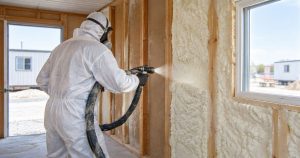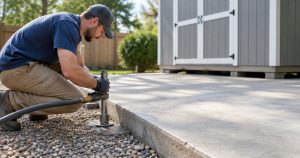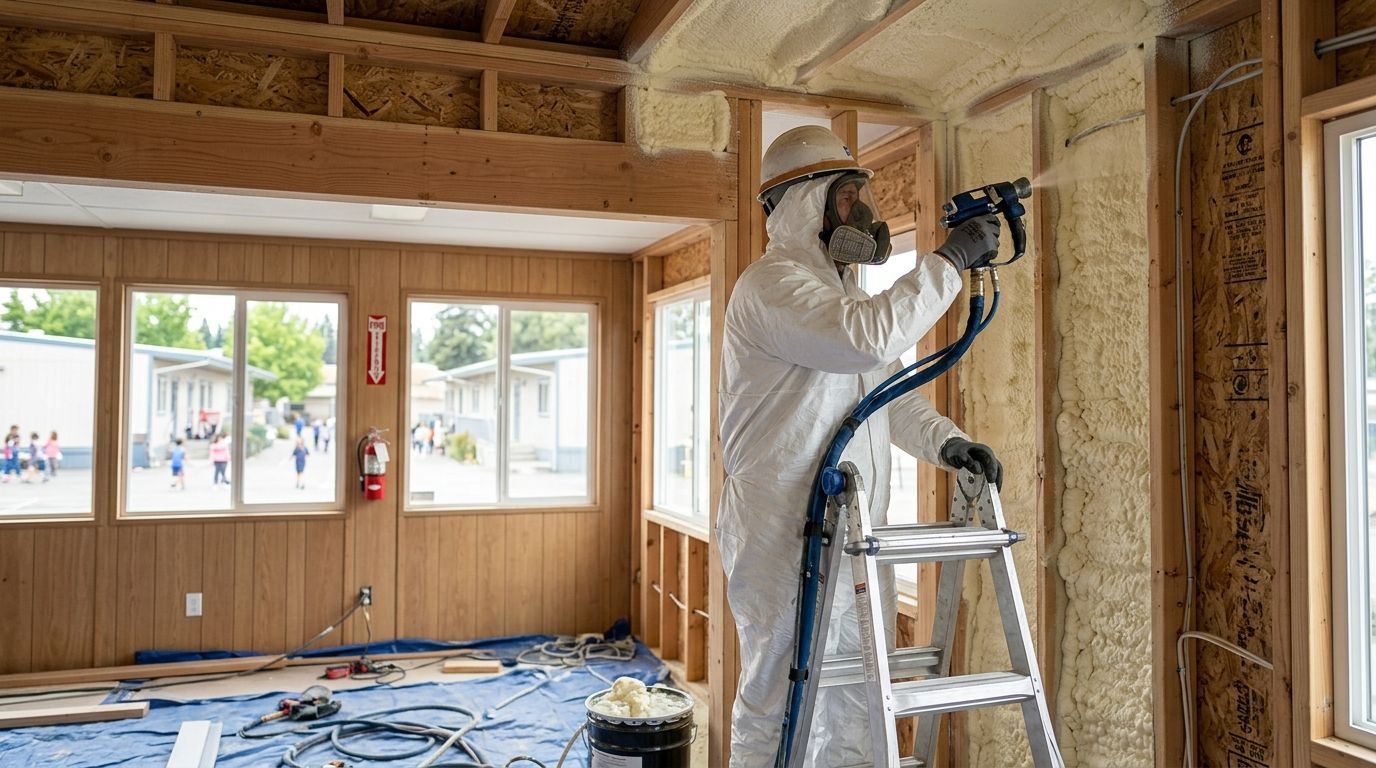
Spray foam insulation for portable classrooms addresses a problem most school boards inherit rather than choose: modular units built on steel chassis with factory batt insulation rated for a climate zone milder than Calgary's, Okotoks', High River's, or Lethbridge's. Portables lose more heat through the floor, skirting, and roof seams than a stick-built addition, and the fix looks different from a standard attic job.
- Closed-cell spray foam insulation is the right call for portable classroom belly wraps and roof decks in Alberta’s climate zone 7.
- Batt insulation in most portables was installed for a milder climate and leaves air gaps at the chassis and window frames.
- Alberta Building Code requires a thermal barrier over exposed foam in occupied classrooms, usually 12.7 mm gypsum board.
- Summer and spring break are the only realistic install windows for occupied schools, and 2026 bookings fill fast.
- Aztec Spray Systems services portable classroom retrofits across Calgary, Okotoks, High River, and Lethbridge.
Why spray foam insulation matters for portable classrooms
A portable classroom sits above grade on a steel or wood-frame chassis, which means the floor assembly is exposed to wind on all sides in a way a permanent school building never is. That single design difference is why portables run cold near the floor and hot near the ceiling, and why HVAC units in these units cycle harder than in the main building.
Most portables in service across Alberta were manufactured with fiberglass batt insulation in the walls and belly wrap, a standard that made sense decades ago but leaves gaps at every penetration, seam, and chassis rail. Closed-cell spray foam insulation seals those gaps and adds structural rigidity to the floor deck, which batt insulation cannot do. That combination — air seal plus insulation value in one application — is why spray foam has become the standard retrofit for portable classrooms rather than a re-batt job.
Daycare and childcare center insulation projects share the same core issue: small, code-regulated occupied spaces where indoor air temperature swings affect the people using the building daily. Portables carry the added complication of being relocatable structures with tighter access under the chassis.
Update your understanding of the portable's current insulation
Start with what's already in the walls and floor before spending on anything. A facilities manager or contractor can open an access panel and check batt condition, moisture staining, and gaps around wiring chases in under an hour.
- Check the belly wrap for tears, sagging, or rodent damage — common after 10+ years of service
- Pull a wall cavity sample near a window to check batt compression and vapor barrier condition
- Look for daylight or draft at the door threshold and window frames
- Record the age of the unit and the manufacturer's original insulation rating if available
- Note any HVAC short-cycling complaints from teachers, which usually points to envelope leaks
Seal the belly wrap and undercarriage first
The underside of a portable classroom is the single biggest source of heat loss because it's exposed on all four sides with no soil or foundation buffer. Sealing this area before touching the walls or roof gives the best return per hour of labour.
- Remove damaged or sagging batt insulation from the belly cavity
- Patch or replace torn belly wrap fabric before spraying
- Apply closed-cell spray foam directly to the underside of the floor deck for both air seal and R-value
- Seal around plumbing and electrical penetrations through the floor
- Check skirting for gaps that let wind-driven cold air reach the belly cavity
Choose open-cell or closed-cell foam for walls and roof
Open-cell spray foam runs roughly R-3.5 to R-3.7 per inch and expands to fill irregular cavities cheaply, while closed-cell spray foam runs roughly R-6 to R-7 per inch and adds moisture resistance and rigidity. The two are not interchangeable across every part of a portable.
- Use closed-cell foam on the belly wrap and any exterior-exposed surface where moisture resistance matters
- Use open-cell foam in interior wall cavities where cost matters more than vapour control
- Confirm the roof deck can carry the added weight of closed-cell foam before spraying
- Avoid mixing foam types on the same surface, which complicates future inspections
- Ask for the manufacturer's cure time and re-occupancy schedule before booking students back into the room
This is where a licensed contractor typically takes over from a facilities team doing its own draft-sealing. Aztec Spray Systems applies closed-cell spray foam insulation to portable classroom floors, walls, and roof decks across Calgary, Okotoks, High River, and Lethbridge, and handles the fire code documentation school boards keep on file.
Insulate around HVAC penetrations and window frames
Portables typically run a single packaged rooftop or through-wall HVAC unit, and the penetration around that unit is one of the most common leak points found during a 2026 retrofit.
- Foam around the HVAC unit's wall or roof penetration, not just the ductwork
- Reseal window frames with low-expansion foam to avoid bowing the sash
- Check door thresholds for compression seal wear and replace before insulating
- Insulate electrical panel penetrations, which are frequently missed in the original build
- Confirm the HVAC return air path isn't pulling unconditioned air from the newly sealed cavity
Meet Alberta Building Code thermal barrier requirements
Spray foam left exposed inside an occupied classroom does not meet Alberta Building Code on its own. Foam plastic insulation needs an approved thermal barrier in occupied spaces, typically 12.7 mm gypsum board or an equivalent rated assembly.
- Confirm the interior wall finish will serve as the thermal barrier, or budget for gypsum board over the foam
- Ask the contractor for documentation showing the foam product's fire rating and required barrier assembly
- Check that ignition barrier requirements are met in any unfinished cavity, such as a crawl access or mechanical closet
- Keep the manufacturer's technical data sheet on file for the school board's building inspector
Read the fire code requirements for spray foam insulation before signing a contract, not after the crew arrives.
Schedule installation around the school calendar
An occupied portable classroom can't be sprayed while students are inside. Foam needs cure time and off-gassing time before the room is safe to occupy, which narrows the install window to school breaks.
- Book the crew for spring break or the last two weeks of summer break, both of which fill quickly for 2026 projects
- Confirm the manufacturer's stated re-occupancy time before setting a return-to-class date
- Plan for one to three days per unit depending on scope — floor only, or floor plus walls and roof
- Coordinate access with the school's facilities team so HVAC can be shut down and restarted on schedule
- Build in a buffer day before students return in case weather delays the exterior belly work
Verify indoor air quality after the retrofit
A sealed building envelope changes how a portable classroom breathes, and skipping this step is the most common reason schools call back months later.
- Check that the existing HVAC unit still provides code-required fresh air exchange after sealing
- Confirm no foam odour remains before students return — properly cured closed-cell foam is inert
- Confirm humidity levels haven't shifted now that air leaks are sealed
- Walk the room with a thermal camera to confirm no missed gaps remain at corners and penetrations
Get a portable classroom insulation quote
Schedule around your school’s next break window before 2026 bookings fill.
Comparison: insulation options for portable classrooms
| Option | Best for | Key limitation |
|---|---|---|
| Fiberglass batt re-install | Budget-limited boards doing a minimal patch | Doesn't seal air leaks; sags and compresses in the belly cavity |
| Open-cell spray foam | Interior wall cavities on cost-sensitive projects | Lower moisture resistance, not ideal for the exposed belly wrap |
| Closed-cell spray foam | Belly wrap, roof deck, any exterior-exposed surface | Higher material cost per board foot than open-cell |
| Blown-in cellulose | Older stick-built additions, not steel-chassis portables | Settles over time, poor performance on exposed floor assemblies |
Closed-cell spray foam insulation is the practical choice for the belly wrap and roof deck on any portable classroom operating through an Alberta winter.
“On a portable, the belly wrap is the roof of the heat-loss problem — insulate it first, even if nothing else gets done this year.”
Common mistakes schools make with portable insulation
- Treating the portable like a house attic job — the exposed belly wrap is the priority, not the roof, and a contractor unfamiliar with modular units often gets this backward
- Scheduling the retrofit during the school term — cure and off-gas time makes an occupied-building install a liability, not just an inconvenience
- Skipping the thermal barrier requirement — boards face code problems when foam is left exposed behind a removable wall panel
- Ignoring the HVAC after sealing — a tighter envelope without a fresh air check pushes humidity and CO2 up in a room full of students
- Assuming one quote covers every portable on the lot — unit age, chassis type, and prior insulation vary even within the same school yard
FAQ
What’s the best insulation for portable classrooms in Alberta?
Closed-cell spray foam insulation is the best option for the belly wrap and roof deck of a portable classroom because it seals air leaks and resists moisture better than batt insulation. That matters most in Alberta’s climate zone 7 winters.
Can spray foam be installed while a portable classroom is occupied?
No. Spray foam needs cure and off-gas time before the room is safe for students, so installation happens during spring break or summer break, not during the school term.
Does spray foam meet Alberta Building Code for classrooms?
Spray foam meets code only when paired with an approved thermal barrier, typically 12.7 mm gypsum board, over any exposed foam in an occupied space. Unfinished cavities need a separate ignition barrier.
How long does it take to insulate one portable classroom?
A single-unit retrofit covering floor, walls, and roof typically runs one to three days depending on scope, plus the manufacturer’s specified cure time before re-occupancy.
Is open-cell or closed-cell foam better for a portable’s belly wrap?
Closed-cell foam is better for the belly wrap because it resists moisture on an exterior-exposed surface. Open-cell foam suits interior wall cavities where cost matters more than moisture control.
Why do portable classrooms feel colder than the main school building?
Portables sit above grade on an exposed steel or wood chassis with no foundation buffer, so the floor loses heat on all four sides in a way permanent buildings do not.
Do school boards need a licensed contractor for spray foam retrofits?
Yes. Fire code and thermal barrier documentation for occupied buildings requires a licensed, insured contractor who can supply the manufacturer’s technical data sheet for the inspector.
What causes HVAC units in portables to short-cycle?
Air leaks around the belly wrap, window frames, and HVAC penetrations force the unit to work harder to hold temperature. Sealing those gaps with spray foam usually resolves the short-cycling.
One last thing
Book the 2026 summer break window in winter, not spring. Portable retrofits compete with every other school facilities project for the same eight-week gap, and the boards that lock in a date early are the ones whose units are sealed before the first cold snap of the 2026-27 school year.
Related guides
- Best spray foam insulation company for Calgary commercial properties
- How to qualify for spray foam insulation rebates in Alberta
- How to prepare a commercial building for a spray foam retrofit