Spray foam insulation for RV storage garages seals the building envelope so an unheated or lightly heated structure holds temperature through an Alberta winter, protecting engines, batteries, plumbing lines, and interior finishes in vehicles that sit parked for months at a stretch. RV and boat owners face a different insulation problem than a typical two-car garage: taller overhead doors, long stretches with no one opening a window to check on things, and equipment that fails from freeze-thaw cycling rather than discomfort.
- Closed-cell spray foam insulation rv storage garage projects seal air leaks that batt insulation alone cannot stop.
- Aztec Spray Systems applies 2 lb closed-cell foam on garage walls and ceilings for combined air and vapor control.
- An insulated garage with an uninsulated overhead door still loses most of its heat through the door gaps.
- A settled or cracked slab under an RV pad undermines even a well-insulated garage shell.
Why spray foam insulation matters for RV and boat storage garages
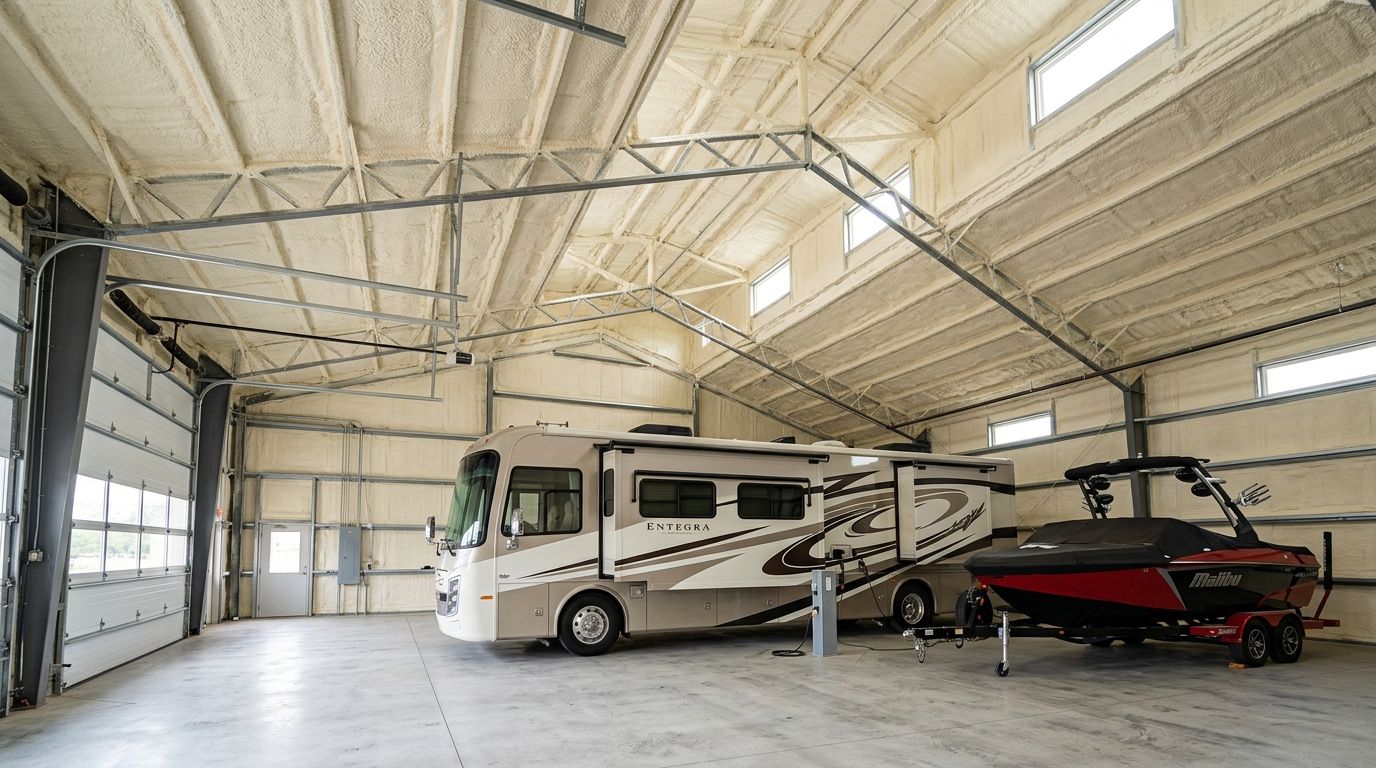
An RV or boat garage in Calgary, Okotoks, High River, or Lethbridge is usually built like a shop: metal skin, pole-frame or post-and-beam construction, and a slab poured for weight rather than comfort. That construction style leaks air at the same joints a pole barn or shop leaks it, which means the same fix applies. Closed-cell spray foam bonds to metal, wood, and concrete in one pass, so it seals the framing gaps that let cold air pool around a stored RV's undercarriage overnight.
Cold isn't the only risk. A garage that sits between freezing and above freezing all winter creates condensation on metal surfaces, and that moisture finds its way into batteries, wiring, and holding tanks faster than most owners expect. A sealed, insulated envelope keeps the temperature swing narrow enough that condensation stops forming on interior surfaces. That's the entire argument for insulating a storage garage in 2026: not comfort, but keeping expensive equipment from degrading while nobody's watching it.
How to insulate a heated RV or boat storage garage
Air-seal the obvious gaps before you insulate anything
Start with the free work. A building with visible daylight around the door frame or unsealed rim joists will lose heat no matter what insulation goes in behind it.
- Caulk the sill plate and rim joist where the wall meets the foundation.
- Weatherstrip any man-door separate from the main overhead door.
- Foam-seal small gaps around conduit, vents, and plumbing penetrations with a can of expanding foam.
- Check for gaps at the top plate where trusses meet the wall.
- Inspect window frames if the garage has any, and reseal cracked glazing putty.
Insulate walls and ceiling with closed-cell spray foam
Once the easy leaks are gone, the wall and ceiling cavities need real R-value plus a vapor barrier, and that's where closed-cell spray foam earns its cost over batt. Fiberglass batt in a garage wall compresses against uneven pole-barn framing and loses R-value exactly where it's needed most, at the studs and corners.
- Closed-cell foam expands to fill irregular framing gaps common in pole-barn and post-frame construction.
- The cured foam acts as its own vapor retarder, which matters in a building that will see temperature swings all winter.
- Foam adds rack strength to metal-skinned walls, a secondary benefit batt doesn't offer.
- Aztec Spray Systems applies closed-cell foam on both walls and the underside of the roof deck, so heat doesn't escape through an uninsulated ceiling while the walls stay warm.
Seal the overhead door and door threshold
A sealed wall assembly does nothing if the biggest opening in the building leaks like a barn door, because it usually is one. RV and boat storage garages need taller, wider doors than a passenger vehicle garage, and taller doors flex more and seal worse at the threshold.
- Add an insulated door panel rated for the door's actual size, not a generic residential kit.
- Install a bottom astragal seal rated for uneven concrete aprons.
- Weatherstrip the side jambs and header separately from the bottom seal.
- Review the full approach in how to insulate a garage door and overhead door gaps before ordering panels, since the wrong panel thickness won't clear existing door hardware.
Fix slab settling before it undermines the insulation job
An RV or boat sitting on one spot for months puts sustained point load on a slab that was never engineered for that weight distribution. If the slab has already started to settle or crack, insulating around it treats the wrong problem first.
- Check for a visible slope toward one corner of the pad, a common sign of settling under sustained load.
- Look for cracking radiating from where jack stands or tongue weight concentrates.
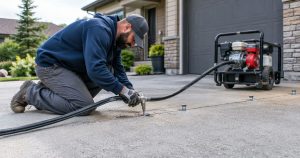
- Polyurethane concrete lifting raises a sunken slab without the excavation a full tear-out requires, detailed in concrete lifting for RV pads and carports.
- Address slab issues before the insulation and heating work, not after, since re-opening a finished wall to fix a foundation problem costs more the second time.
Size the heating system to the newly sealed envelope
A sealed, insulated garage needs less heat input than an uninsulated one, and oversizing the heater wastes money on equipment that cycles constantly instead of running efficiently.
- Unit heaters (natural gas or propane) work well for larger RV bays that need quick recovery after the door opens.
- Electric radiant panels suit smaller boat storage bays where a gas line isn't already run.
- In-floor hydronic heat pairs well with a sealed shell but adds plumbing complexity most retrofit projects skip.
- Any combustion heater in a sealed building needs a carbon monoxide detector rated for garage use, not a residential hallway unit.
Protect the vehicles inside, not just the building
Insulation controls the air in the garage; it doesn't control what happens on the vehicle's surface once it's parked for the season. A layer of protective wax before storage guards a stored RV or boat's finish against the condensation cycles that even a well-sealed garage can't fully eliminate, since interior humidity still shifts with outdoor temperature swings.
- Drain or winterize plumbing and holding tanks before the first hard freeze.
- Disconnect or maintain batteries on a trickle charger through the storage months.
- Cover exposed rubber seals and tires to slow UV and ozone breakdown even indoors.
- Run the engine or generator periodically per the manufacturer's storage guidance.
Plan your RV garage insulation project
Get a quote for closed-cell spray foam sized to your garage and heating plan.
Manage humidity year-round, not just in winter
A sealed building traps moisture as easily as it traps heat, so ventilation planning has to happen alongside the insulation work, not after someone notices a musty smell.
- Install a dehumidifier sized to the garage's square footage for use during shoulder seasons.
- Add a bathroom-style exhaust fan on a humidistat switch near any wash bay or wet storage area.
- Keep a small gap or vent at the ridge if the roof assembly wasn't spray-foamed at the deck.
- Check for condensation on cold metal surfaces monthly through the first winter after the retrofit.
Comparing insulation options for RV and boat storage garages
| Insulation option | Best for | Key limitation |
|---|---|---|
| Fiberglass batt | Garages already framed with standard 16-inch stud spacing | Compresses against uneven pole-barn framing and loses R-value where it's needed most |
| Open-cell spray foam | Interior partition walls where moisture exposure is low | Absorbs water if the slab or roof leaks; needs a separate vapor retarder in Alberta's climate |
| Closed-cell spray foam | Metal-skinned or pole-barn RV garages needing an air seal and vapor barrier in one application | Higher material cost per board foot; requires a licensed applicator |
| Rigid foam board | Retrofits where wall cavities are already closed up | Every seam needs taping or it becomes an air leak point |
Common mistakes RV and boat storage garage owners make
- Insulating the walls but leaving a single-skin steel overhead door: the door becomes the single biggest heat-loss point in the building, undoing most of the wall work.
- Using open-cell foam in an unconditioned garage without a vapor plan: open-cell foam absorbs moisture rather than blocking it, which causes problems in a building that cycles between heated and unheated use.
- Insulating over a settling slab: cracks that widen under RV weight eventually telegraph through the wall assembly and waste the insulation investment.
- Undersizing or skipping CO detection with a combustion heater: a sealed building holds combustion byproducts longer than a leaky one, which raises the stakes on ventilation and detection.
- Skipping the door threshold seal: even a well-sealed wall assembly leaks heat continuously through an unsealed bottom astragal.
FAQ
Is spray foam insulation worth it for an RV storage garage in Alberta?
Yes, closed-cell spray foam insulation in an RV storage garage seals air leaks and adds a vapor barrier in one application, which matters more in a building that cycles between heated and unheated use through an Alberta winter. It costs more upfront than batt but performs better in irregular pole-barn or metal-building framing.
What R-value does an RV storage garage need in Calgary?
Closed-cell spray foam delivers roughly R-6 to R-7 per inch, and most heated storage garages in the Calgary area use 2 to 3 inches on walls for R-12 to R-21 depending on how much of the building is actively heated. The right target depends on whether the garage stays heated all winter or only during active use.
Should I insulate the overhead door too, or just the walls?
Insulate the overhead door as part of the same project, not as an afterthought. An uninsulated door negates much of the benefit from insulated walls because it becomes the largest single source of heat loss in the building.
Can spray foam go directly over a metal building wall?
Yes, closed-cell spray foam bonds directly to metal skin without furring strips or a separate vapor barrier layer, which is one reason it’s common in pole-barn and metal-building RV garages. Open-cell foam can also bond to metal but needs an added vapor retarder in this climate.
Does a cracked or sunken slab affect the insulation job?
Yes, a settling slab under an RV pad can crack the wall-to-floor seal that keeps insulated walls airtight. Fixing slab settling with concrete lifting before insulating avoids re-opening finished walls later.
What heater works best in a newly insulated RV garage?
Unit heaters running on natural gas or propane recover quickly after a large overhead door opens and closes, which suits RV bays with frequent vehicle movement. Electric radiant panels work for smaller boat bays where running a gas line isn’t practical.
How long does spray foam insulation last in a garage setting?
Closed-cell spray foam doesn’t sag, settle, or lose R-value over time the way compressed batt does, and it typically lasts the life of the building when installed correctly. Physical damage from impact or UV exposure on exposed foam is the main failure mode, not age.
One last thing
The detail most RV and boat garage owners miss in 2026 isn't the insulation, it's the door. A garage insulated to R-21 on the walls but sealed with a bargain single-skin door still performs like an uninsulated shed, because door area on a 12-foot or 14-foot RV bay door is often larger than an entire wall section. Fix the door and the slab in the same project as the foam, not as separate line items later.
Related guides
- Spray foam insulation for garage walls and ceilings
- How much does spray foam insulation cost in Calgary