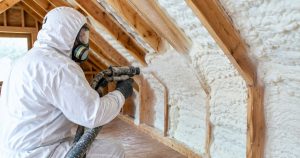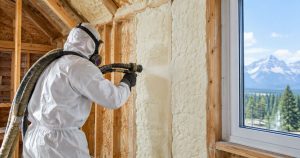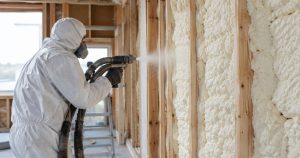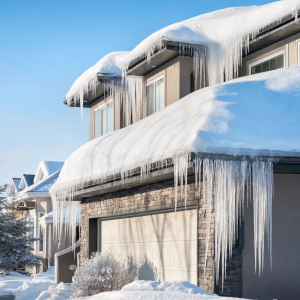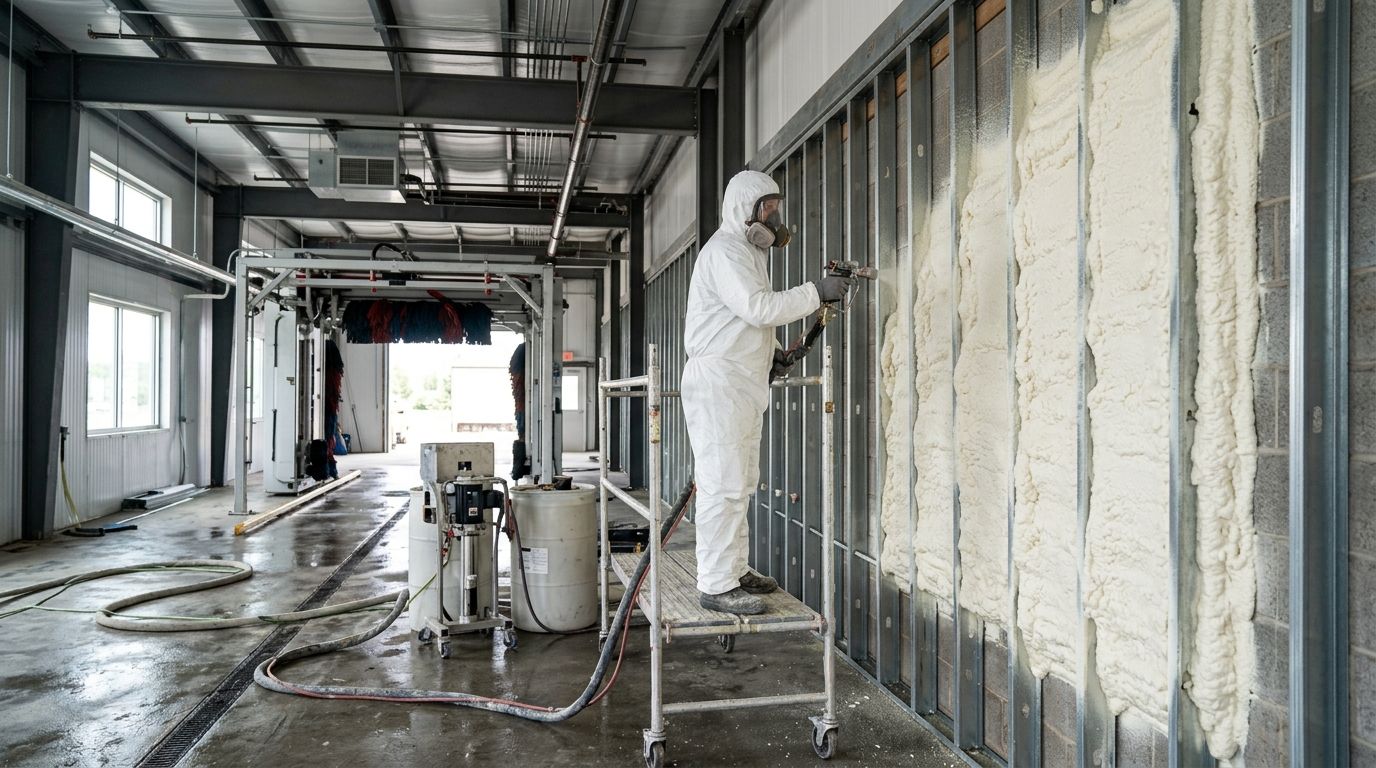
Car wash spray foam insulation is closed-cell polyurethane foam applied to wash bay walls, ceilings, and mechanical rooms to control condensation, cut heat loss, and stop moisture from reaching structural steel and wood framing. Car washes run wet, warm equipment rooms next to freezing wash bays for most of an Alberta winter, so the insulation has to handle a moisture load most commercial buildings never see.
- Closed-cell spray foam insulation for car washes blocks water vapor and adds structural rigidity that open-cell foam and batts can’t match.
- Wash bays hit near-constant humidity in winter; foam without a vapor-tight skin fails within a few seasons.
- Aztec Spray Systems applies closed-cell foam at 2 inches minimum in wash bay ceilings for a Class II vapor retarder rating.
- Mechanical rooms, not the wash bays themselves, are where most car wash insulation failures start.
- Verdict: closed-cell spray foam is the only insulation type built for a facility that’s wet, humid, and below freezing in the same 24 hours.
Why spray foam insulation matters for car washes
A wash bay isn't a normal commercial envelope problem. You've got open bay doors cycling every few minutes, water vapor rolling off hot cars in a Calgary January, and heating equipment trying to keep the space above freezing without cooking the electrical panel next door. Moisture and mold control matters more here than in almost any other commercial building type, because condensation on an uninsulated steel ceiling drips straight back onto customers' cars and equipment below.
Fiberglass batts sag and lose R-value the moment they get damp, which in a wash bay is inevitable. Spray foam insulation for car washes solves this because closed-cell foam is itself a vapor barrier — water can't wick through the cell structure the way it soaks into batt insulation. That's the entire reason car wash operators in Alberta are moving away from batts and rigid board toward closed-cell foam in wash bays and equipment rooms.
Update your wash bay ceiling assessment
Start by walking the ceiling on a cold morning after the first wash cycle. Condensation patterns tell you exactly where the envelope is failing before you spend a dollar on foam.
- Check for standing droplets or frost on steel purlins and ceiling deck
- Note where bay doors create direct airflow paths to unheated space
- Look for rust streaks on structural steel — a sign of long-term condensation
- Flag any spot where insulation (if present) is visibly wet or sagging
- Measure the temperature differential between the wash bay and the equipment room
Choose closed-cell foam for wet zones
Open-cell foam is cheaper and works fine in dry commercial buildings, but it's the wrong call for a wash bay. Open-cell foam absorbs water and loses R-value fast in a space that sees standing humidity for months at a time.
- Specify closed-cell foam at 2 inches minimum in wash bay ceilings
- Confirm the foam carries a Class II vapor retarder rating at that thickness
- Use closed-cell in any wall assembly that shares a cavity with plumbing lines
- Reserve open-cell foam for dry interior partitions only, like office walls
- Ask your contractor for the foam's water absorption rate before signing off
Seal the mechanical and equipment room separately
The equipment room is where most car wash insulation failures actually start, not the wash bay. Pumps, water softeners, and boilers throw off heat and humidity in a space that's often an afterthought in the original building design.
- Insulate mechanical room walls and ceiling to the same standard as the wash bay
- Seal every penetration where plumbing or electrical conduit passes through the wall
- Add closed-cell foam around water heater and boiler enclosures to control condensation
- Check that ventilation fans aren't pulling humid wash bay air directly into the equipment space
- Confirm electrical panels are on a wall section that stays dry year-round
Address condensation at the roof deck
Roof deck condensation is the single most common structural complaint from car wash owners in Calgary and Okotoks after five to seven years of operation. Once rust sets into steel decking, you're looking at a much bigger repair than insulation would have cost.
- Inspect roof deck fasteners for rust or staining during the ceiling walk-through
- Apply closed-cell foam directly to the underside of the deck where accessible
- Verify the foam thickness meets or exceeds the dew point calculation for Calgary's climate zone
- Flag any skylights or roof penetrations as priority sealing points
- Cross-reference with a commercial re-insulation assessment if the building is more than 15 years old
Plan around fire code and washdown requirements
Spray foam in a commercial building has to meet fire code thermal barrier requirements, and a car wash adds washdown chemical exposure on top of that. This is the step where a licensed contractor earns their fee — DIY foam kits don't meet code in most commercial applications.
- Confirm the foam system meets Alberta's fire code thermal barrier standard for the ceiling height
- Ask whether an intumescent coating is required over the foam in the wash bay
- Review fire code requirements for spray foam insulation before scheduling installation
- Check that any exposed foam in mechanical rooms is rated for the space's occupancy classification
- Get the fire marshal sign-off scheduled before the wash reopens to customers
Schedule installation around wash bay downtime
A car wash can't close for a week. Spray foam cures fast, but coordinating bay-by-bay installation keeps revenue moving while the work happens.
- Insulate one bay at a time if the facility has multiple wash lanes
- Schedule mechanical room work during a slower season, typically late fall
- Confirm cure time before reopening a bay to washdown chemicals and steam
- Coordinate with your equipment vendor if pumps or heaters need temporary shutoff
- Ask your contractor for a bay-by-bay timeline in writing before work starts
Verify the vapor barrier after installation
Once the foam is in, confirm it's doing the job before the first hard freeze tests it.
- Re-check the same condensation points from your initial ceiling walk-through
- Confirm no gaps or thin spots exist at seams and penetrations
- Track equipment room temperature for two weeks post-install and compare to the prior winter
- Document the install with photos for warranty and future resale purposes
- Compare heating costs against last year's utility bills once a full month has passed
Comparison: insulation options for car wash facilities
| Option | Best for | Key limitation |
|---|---|---|
| Closed-cell spray foam | Wash bays, mechanical rooms, roof decks | Higher labor cost than batts; needs a licensed applicator |
| Open-cell spray foam | Dry interior partitions, office space only | Absorbs moisture; wrong choice for wash bay humidity |
| Rigid foam board | Retrofit over existing insulated walls | Seams allow air leakage unless taped and sealed |
| Fiberglass batts | Low-humidity storage or retail add-ons | Sags and loses R-value once damp; no vapor control |
Closed-cell spray foam wins for any car wash wash bay, equipment room, or roof deck — it's the only option on this list built to handle constant moisture without losing performance.
Common mistakes car wash owners make
- Insulating the wash bay and skipping the equipment room — the equipment room is where condensation damage actually starts, and it's the room owners forget to budget for.
- Choosing open-cell foam to save money — it soaks up humidity in a wash bay and needs replacement years before closed-cell foam would.
- Skipping the fire code review — commercial spray foam without a proper thermal barrier fails inspection and delays reopening.
- Treating this like a residential project — a commercial property insulation job has washdown chemical exposure and occupancy rules a home never sees.
- Ignoring roof deck rust until it's structural — by the time staining is visible from the ground, the deck may already need repair alongside the insulation upgrade.
Get a car wash insulation quote
Licensed, insured spray foam installers serving Calgary, Okotoks, High River, and Lethbridge.
FAQ
What’s the best insulation for a car wash wash bay?
Closed-cell spray foam is the best insulation for a car wash wash bay because it acts as its own vapor barrier and resists water absorption, unlike open-cell foam or fiberglass batts. Most Alberta wash bays need at least 2 inches of closed-cell foam to meet Class II vapor retarder standards.
Is spray foam insulation better than fiberglass for a car wash?
Yes, spray foam insulation is better than fiberglass for a car wash because fiberglass sags and loses R-value once it gets wet, which is unavoidable in a wash bay. Closed-cell spray foam holds its R-value even in constant humidity.
How much does spray foam insulation cost for a commercial car wash?
Costs vary by bay count, ceiling height, and mechanical room size, so get a site-specific quote rather than relying on a per-square-foot estimate found online. A licensed contractor can walk the facility and price wash bays, equipment rooms, and roof deck work separately.
Does spray foam insulation meet fire code in a commercial car wash?
Spray foam insulation meets commercial fire code only when installed with the correct thermal barrier or intumescent coating for the space’s occupancy classification. This is one of the main reasons car wash owners hire a licensed contractor instead of a DIY kit.
Can spray foam insulation stop condensation on a car wash ceiling?
Closed-cell spray foam stops condensation on a car wash ceiling by sealing the steel deck from the temperature differential that causes moisture to form. Untreated steel purlins and decking are the most common source of drip damage in wash bays.
Do car wash equipment rooms need separate insulation from the wash bay?
Yes, equipment rooms need the same insulation standard as the wash bay because pumps, boilers, and water softeners generate their own heat and humidity load. Skipping the equipment room is one of the most common mistakes car wash owners make.
How long does spray foam insulation last in a car wash?
Closed-cell spray foam holds its performance for decades in commercial applications when installed correctly, far longer than batts or open-cell foam in a high-humidity wash bay. Roof deck condition and fire code compliance matter more to long-term performance than the foam itself.
Should I insulate one wash bay at a time or close the whole facility?
Most car washes insulate one bay at a time so the facility stays open during the project, scheduling mechanical room work during a slower season like late fall. A written bay-by-bay timeline from your contractor keeps downtime predictable.
One last thing
The equipment room, not the wash bay, is where most car wash insulation jobs get underbid. Owners budget for the visible wash bay ceiling and skip the mechanical room because it's smaller and less obvious — then spend more two winters later replacing corroded electrical panels than a proper closed-cell foam job would have cost upfront in 2026.
Related guides
- How to cut HVAC costs in a commercial kitchen with spray foam
- Spray foam insulation for auto body shops and paint booths
- Best spray foam insulation company for Calgary commercial properties
- How to reduce moisture and mold with spray foam insulation
- How to meet fire code requirements for spray foam insulation