A heated workshop built for winter welding in Calgary or anywhere else in southern Alberta needs closed-cell spray foam rated at roughly R-6.5 per inch on the walls and ceiling, plus a fire-rated thermal barrier over any exposed foam near the welding bay.
- Closed-cell spray foam at R-6.5 per inch is the standard fix for how to insulate a heated workshop for winter welding.
- Alberta’s climate calls for roughly R-40 in the ceiling and R-20+ in the walls of a heated shop.
- Any spray foam left exposed near a welding station needs a fire-rated thermal barrier over top — code requires it, not just good practice.
- Garage doors and man-doors are the biggest heat-loss gaps in most Calgary and Okotoks shops built before 2015.
- Ventilation for weld fumes and CO has to be planned alongside the insulation upgrade, not after.
Why this matters
A heated workshop loses heat fastest through the ceiling, the overhead door, and any wall assembly that was framed for a summer garage rather than a year-round shop. Fiberglass batt loses R-value the moment it gets damp from condensation, which is common in a heated building sitting inside a cold Alberta winter. A detached workshop or hobby space built with closed-cell spray foam instead holds its R-value for the life of the building and air-seals the structure in the same pass, which matters more in a welding shop than almost any other outbuilding because air leaks pull cold air past the welder and pull warm, fume-laden air back toward the operator.
The hidden cost most shop owners miss: spray foam is a combustible plastic. Alberta's building code and most municipal fire departments require an ignition or thermal barrier — typically 1/2-inch drywall or an intumescent coating — over any spray foam surface inside an occupied, heated space. Skip that barrier in a shop where welding sparks are a daily event and you've built a fire hazard, not a warm workspace.
How do you insulate a heated workshop for winter welding?
The order of operations matters as much as the material. Insulate the ceiling and walls first, seal the overhead door and man-door gaps second, then plan mechanical ventilation last so the fresh-air path doesn't fight the insulation job.
| Assembly | Target R-value | Notes |
|---|---|---|
| Ceiling / roof deck | R-40 | Highest heat loss point in most shops |
| Walls | R-20 to R-22 | Closed-cell foam holds value even against a metal skin |
| Overhead door | R-16 to R-18 panel | Seals matter as much as the panel R-value |
| Man-door and jambs | Foam-sealed, weatherstripped | Frequently the largest single air-leak source |
Follow these steps in order:
- Insulate the ceiling first. It's the largest surface area and the fastest payback.
- Spray or panel-insulate the walls, including any steel or metal skin, since metal building insulation needs a different vapor strategy than a wood-framed shop.
- Seal the overhead door perimeter with weatherstripping rated for the swing and the bottom astragal.
- Add or verify the thermal barrier over any exposed spray foam before a welder ever fires up in the space.
- Plan intake and exhaust ventilation sized to the welding process, not just the square footage.
Closed-cell spray foam: R-6.5 per inch
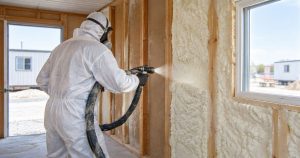
Closed-cell is the standard choice for a heated shop that sees welding. Buy closed-cell spray foam for the walls and ceiling of a heated welding shop — it hits roughly R-6.5 per inch, acts as its own air and vapor barrier at about 2 inches, and doesn't sag or compress over 20 years the way batt insulation does. The tradeoff is upfront cost per square foot, which runs higher than fiberglass or open-cell.
Open-cell spray foam: R-3.7 per inch
Open-cell foam runs roughly R-3.7 per inch and costs less installed, but it's vapor-permeable and needs a separate vapor barrier in a heated Alberta shop. Skip open-cell for a workshop that sits below freezing overnight and gets heated hard during the day — the moisture cycling that creates is worse in a shop than in a house wall.
Fiberglass batt: R-3.5 per inch (and why it's the wrong call here)
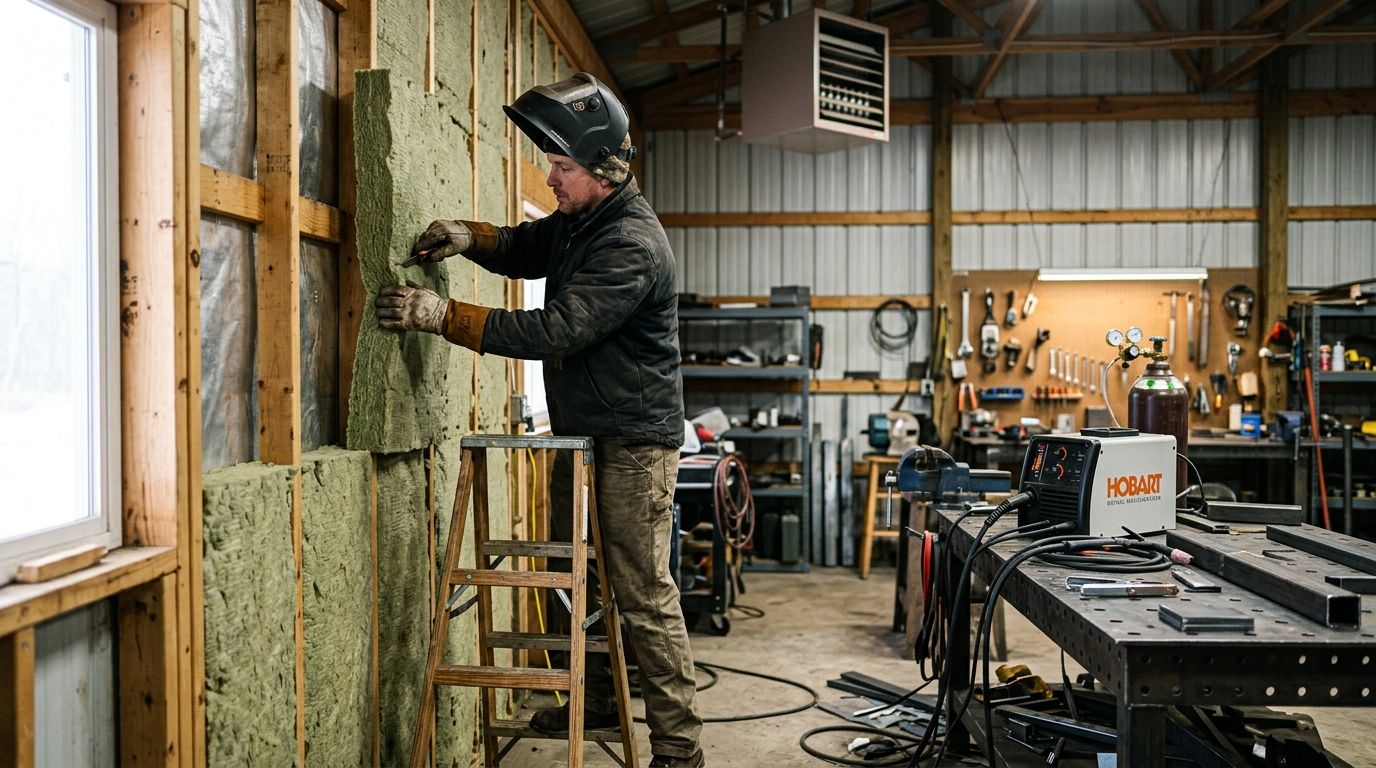
Batt insulation is cheap and familiar, but it does nothing to air-seal the building and it's the one material fire departments flag most often when they find scorch marks near a welding bay. Wait on batt insulation for a heated welding shop — the R-value per inch is the lowest of the three options and it offers zero air-sealing benefit, which matters more in a shop with an overhead door than almost anywhere else.
Why R-value needs vary shop to shop
- Ceiling height and cubic footage — a 16-foot shop ceiling has more air volume to heat than a 9-foot one, which changes both the insulation target and the furnace sizing.
- Welding process — stick and flux-core welding throw more spatter and smoke than MIG, which changes how close spray foam can sit to the work area before a thermal barrier is mandatory.
- Attached vs. detached construction — an attached shop shares a wall with living space, which raises the fire-code bar significantly over a standalone building.
- Overhead door size and age — an older sectional door without a thermal break can account for a large share of total heat loss in a two- or three-bay shop.
- Climate zone — southern Alberta's winter swings push insulation targets higher than a similar shop in a milder Canadian climate zone would need.
- Ventilation load — a shop that runs an exhaust fan for weld fumes constantly is fighting a bigger heat-loss battle than one with intermittent ventilation.
Get a workshop insulation quote
Licensed spray foam contractor serving Calgary, Okotoks, High River, and Lethbridge.
Do you need a vapor barrier in a heated workshop?
You need a vapor barrier if you use open-cell foam, batt insulation, or any material that isn't self-sealing, but closed-cell spray foam at roughly 2 inches acts as its own air and vapor barrier. That's one reason closed-cell is the default recommendation for heated Alberta shops that see hard freeze-thaw cycling all winter.
Is it safe to spray foam near a welding station?
Spray foam is safe near a welding station only when a fire-rated thermal barrier — drywall or an intumescent coating — covers the exposed foam surface. Foam left bare next to a welding bay is a documented fire-code violation in most Alberta municipalities and a genuine ignition risk from spatter and sparks.
How much does it cost to insulate a workshop in Calgary?
Cost varies with square footage, ceiling height, and whether the walls are open-frame or already finished, and pricing is best confirmed directly rather than estimated from a general figure. A contractor quote that walks the specific shop dimensions and door count will land closer to reality than any blanket number.
FAQ
What’s the best insulation for a heated welding workshop?
Closed-cell spray foam at roughly R-6.5 per inch is the best insulation for a heated welding workshop because it air-seals and insulates in one pass and holds its R-value for decades. Fiberglass batt and open-cell foam both fall short on either air-sealing or moisture resistance in a shop that swings between heated and freezing overnight.
Is spray foam fire-safe for a shop with a welder in it?
Spray foam is fire-safe in a welding shop only when covered with a thermal barrier such as drywall or an intumescent coating. Bare exposed foam near sparks and spatter is a fire-code violation in most Alberta jurisdictions, not just a recommendation.
How much R-value does a heated shop need in Alberta?
A heated Alberta shop generally needs around R-40 in the ceiling and R-20 to R-22 in the walls to hold temperature through winter. Southern Alberta’s overnight swings push these targets higher than milder climate zones.
Should I insulate the overhead door on my workshop?
Yes, insulate the overhead door — an uninsulated or poorly sealed sectional door is one of the largest single sources of heat loss in a two- or three-bay shop. Panel R-value matters, but weatherstripping and the bottom astragal seal matter just as much.
Does spray foam insulation help with weld fume ventilation?
Spray foam itself doesn’t ventilate fumes, but sealing the building envelope with foam means mechanical intake and exhaust fans can be sized precisely instead of fighting uncontrolled air leaks. A tightly sealed shop needs a planned ventilation system, not incidental drafts.
Can open-cell spray foam work in a Calgary workshop?
Open-cell spray foam at roughly R-3.7 per inch can work, but it needs a separate vapor barrier in a heated shop that cycles between warm and freezing. Closed-cell is the more common choice for exactly that reason.
Is fiberglass batt ever acceptable in a heated shop?
Fiberglass batt at roughly R-3.5 per inch is the weakest option for a heated welding shop because it doesn’t air-seal and loses R-value when it gets damp from condensation cycling. Most fire departments also flag it more often near welding bays than spray foam with a proper thermal barrier.
What’s the biggest heat-loss gap in an older Alberta shop?
The overhead door and its perimeter seal are usually the biggest heat-loss gap in a shop built before 2015. Man-door weatherstripping is the second most common culprit found during an insulation assessment.
One last thing
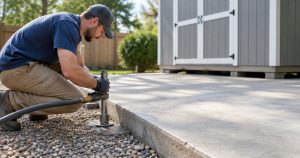
Most shop owners insulate the walls and ceiling and forget the slab. A heated workshop with an uninsulated concrete floor still loses a meaningful amount of heat straight into the ground, and that loss shows up as a furnace that never quite catches up on the coldest days of 2026's winter stretch. Ask about perimeter slab insulation at the same time the walls and ceiling get quoted — it's cheaper to add during the same job than to retrofit later.
Related guides
- Spray foam insulation for pole barns and shops
- How to meet fire code requirements for spray foam insulation
- Best insulation type for Alberta winters