.pseo-content { font-size: 17px; line-height: 1.7; color: inherit; }
.pseo-content h2 { font-size: 1.6em; margin-top: 1.8em; margin-bottom: 0.6em; line-height: 1.3; color: inherit; }
.pseo-content h3 { font-size: 1.25em; margin-top: 1.5em; margin-bottom: 0.4em; line-height: 1.35; color: inherit; }
.pseo-content h4 { color: inherit; }
.pseo-content p { margin: 0 0 1em; }
.pseo-content ul, .pseo-content ol { margin: 0 0 1em 1.4em; padding: 0; }
.pseo-content li { margin: 0.3em 0; }
.pseo-content strong { font-weight: 600; }
.pseo-content blockquote { margin: 1.2em 0; padding: 0.6em 1em; border-left: 3px solid color-mix(in srgb, currentColor 30%, transparent); background: color-mix(in srgb, currentColor 4%, transparent); color: inherit; }
.pseo-content a { text-decoration: underline; }
.pseo-content .pseo-table-wrap { overflow-x: auto; margin: 1.4em 0; -webkit-overflow-scrolling: touch; }
.pseo-content table { width: 100% !important; border-collapse: collapse !important; table-layout: auto !important; font-size: 0.96em; }
.pseo-content table th,
.pseo-content table td {
padding: 10px 12px !important;
border-bottom: 1px solid color-mix(in srgb, currentColor 14%, transparent) !important;
border-left: none !important;
border-right: none !important;
vertical-align: top !important;
text-align: left !important;
word-break: break-word !important;
overflow-wrap: anywhere !important;
white-space: normal !important;
}
.pseo-content table th {
background: color-mix(in srgb, currentColor 6%, transparent) !important;
color: inherit !important;
font-weight: 600 !important;
border-top: 1px solid color-mix(in srgb, currentColor 14%, transparent) !important;
}
.pseo-content table tr:last-child td { border-bottom: 1px solid color-mix(in srgb, currentColor 14%, transparent) !important; }
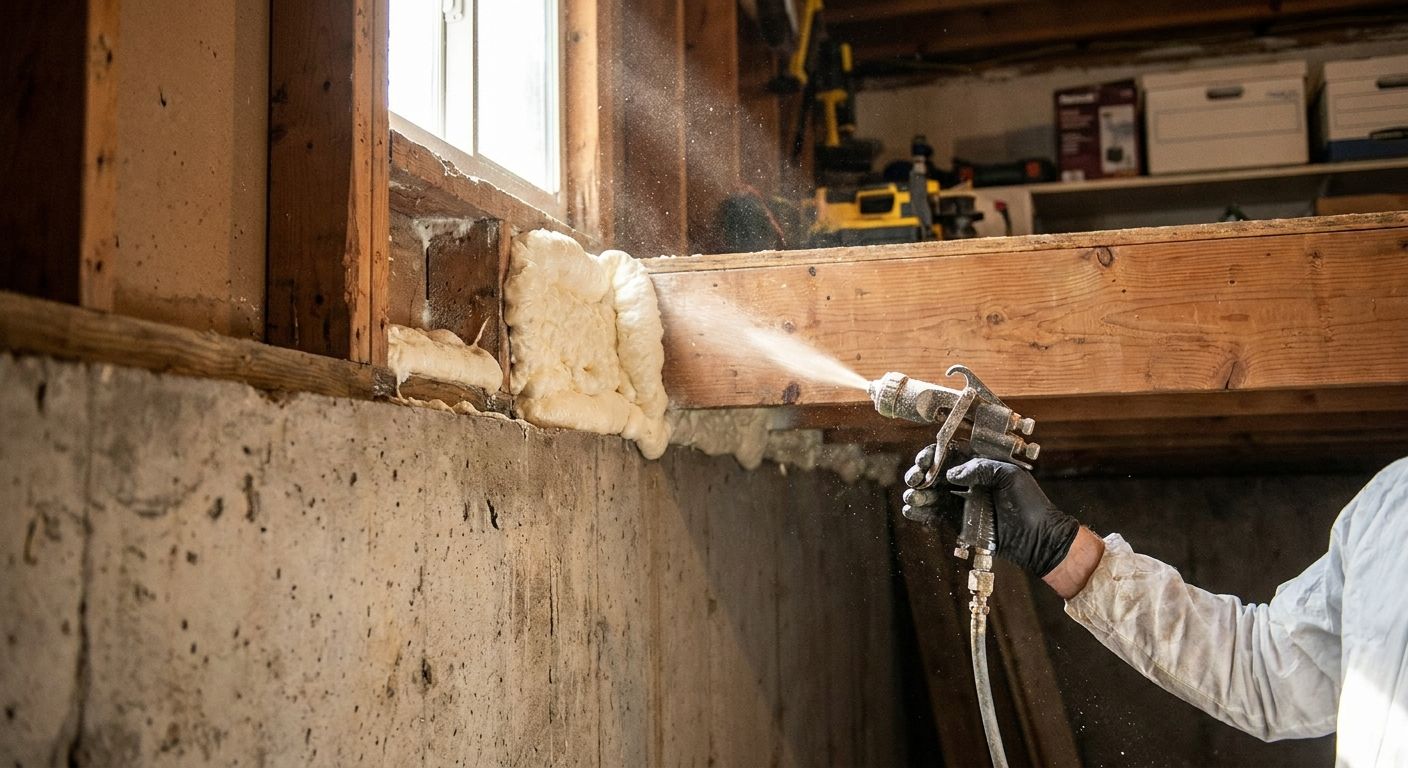
Rim joists are the uninsulated band where your basement wall meets the floor above, and in most Alberta basements built before 2010 they are still bare wood facing an unheated cavity. Closing that gap with spray foam insulation is one of the highest-return jobs a homeowner in Calgary, Okotoks, High River, or Lethbridge can do before winter.
- Closed-cell 2lb spray foam is the buy for rim joists — R-6.5 per inch and an air seal in one pass.
- Open-cell foam works but skips vapor control, so it’s a consider, not a first choice, below grade.
- Alberta Building Code requires a 15-minute thermal barrier over exposed foam in living space — plan for it.
- Fiberglass batt alone in a rim joist cavity is a skip in 2026 — it doesn’t stop air movement.
- Spray foam insulation cost in Calgary for rim joists runs far below a full basement retrofit, so it’s an easy first project.
Why this matters
The rim joist band is the least-insulated, most air-leaky part of most basements built before energy codes tightened up. Cold floors above grade, frost on foundation walls, and a furnace that never seems to catch up all trace back to this one strip of framing.
Fiberglass batts stuffed into a rim joist bay do nothing to stop moving air — heat rides the draft right past the fibers. Spray foam insulation rim joist basement work solves both problems at once: it insulates and air-seals in a single application, which is why it's become the default fix rather than a nice-to-have upgrade. Before you commit to a full job, check current spray foam insulation cost in Calgary — rim joists are usually priced far below a whole-basement retrofit, so it's a low-risk first project for 2026.
Who this is for
This guide is for homeowners in Calgary, Okotoks, High River, and Lethbridge with an unfinished or partially finished basement, cold floors directly above the foundation wall, or a home built before roughly 2010 when rim joist insulation wasn't standard practice. If you've noticed frost or condensation on the foundation near the top of the wall in January, that's the rim joist telling you it's uninsulated.
What to look for in spray foam for rim joists
R-value per inch in a shallow cavity
Rim joist cavities are usually only 6 to 8 inches deep, so you need insulation that hits a useful R-value without the depth a wall or attic gives you. Closed-cell foam delivers roughly R-6.5 per inch, which means a 6-inch cavity clears R-39 — closed-cell wins this comparison outright in a tight space.
Air sealing, not just insulation
An R-value on a spec sheet means nothing if air still moves through the cavity. Spray foam expands into every gap around joist ends, sill plates, and wiring penetrations, which is exactly what batt insulation can't do. This is the single biggest reason spray foam beats batts for rim joists, full stop.
Moisture and mold resistance below grade
Basement rim joists sit close to grade and see more humidity swings than an attic or a wall cavity upstairs. Closed-cell foam is a vapor retarder on its own and doesn't absorb water the way fiberglass does, which matters in Alberta basements that see spring runoff and condensation.
Alberta Building Code thermal barrier rules
The Alberta Building Code requires a 15-minute thermal barrier — typically drywall or an approved intumescent coating — over exposed spray foam in living space. A licensed contractor builds this into the quote; a DIY job that skips it fails inspection and creates a fire-code gap you don't want to discover during a home sale.
Professional application versus DIY can foam
Canned spray foam from a hardware store covers small gaps but can't fill a full rim joist bay evenly, and it shrinks more than professionally applied 2lb foam. For a handful of gaps it's fine; for an entire basement perimeter, uneven application defeats the point.
Top picks for rim joist insulation
Closed-cell 2lb spray foam — the safe pick. R-6.5 per inch means a standard 6-8 inch cavity reaches R-39 to R-52, and it doubles as an air and vapor barrier in one pass. This is what spray foam insulation for older Calgary homes projects almost always specify, since older rim joists have more irregular gaps to seal. Buy.
Open-cell 0.5lb spray foam — the budget flex. R-3.6 per inch is lower, and open-cell doesn't block vapor the way closed-cell does, which matters more below grade than in an attic. It still air-seals better than batt and costs less per board foot. Consider it only where budget is the deciding factor and moisture exposure is low.
Rigid foam board plus canned spray foam sealant — the DIY route. This works for a homeowner sealing 3-4 bays themselves, but it's slow and the seams around irregular joist framing rarely seal as tight as sprayed foam. Fine for a small patch job. Consider for partial coverage, Skip for a full basement perimeter.
Fiberglass batt alone — the old-school miss. It looks like insulation on paper but does nothing to stop air movement through the cavity, which is the actual problem at a rim joist. Skip it in 2026 — this is the fix that looks cheap and costs you every winter after.
New-build rough-in spray foam — the head start. If you're still framing, spray foam insulation for new construction homes locks in a continuous rim joist seal before drywall goes up, which is far cheaper than retrofitting later. Buy if the timing lines up with your build schedule.
What to avoid
- Skipping the thermal barrier. Exposed spray foam in a finished basement without drywall or an approved coating over it fails Alberta Building Code inspection and is a genuine fire-code issue, not a technicality.
- Treating rural and acreage basements the same as an infill house. Wider temperature swings and different foundation types change what's needed — see spray foam insulation for acreages and rural properties before assuming a standard rim joist job applies.
- Assuming any contractor with a spray rig does the job the same way. Application thickness, pass technique, and code compliance vary a lot between crews — ask for the actual R-value and thermal barrier plan before signing off.
Get a rim joist insulation quote
Licensed spray foam contractor serving Calgary, Okotoks, High River, and Lethbridge.
Verdict comparison
| Option | R-value/inch | Air seal | Moisture resistance | Verdict |
|---|---|---|---|---|
| Closed-cell 2lb spray foam | R-6.5 | Excellent | Excellent | Buy |
| Open-cell 0.5lb spray foam | R-3.6 | Good | Fair | Consider |
| Rigid foam + can foam (DIY) | R-5 to R-6 | Fair | Good | Consider for small jobs |
| Fiberglass batt alone | R-3.1 to R-3.8 | Poor | Poor | Skip |
FAQ
What’s the best insulation for basement rim joists in 2026?
Closed-cell 2lb spray foam is the best option for basement rim joists in 2026 because it hits roughly R-6.5 per inch and air-seals the cavity in one application. Open-cell foam is a reasonable second choice where budget matters more than vapor control.
Is spray foam better than fiberglass batt for rim joists?
Yes, spray foam beats fiberglass batt for rim joists because it stops air movement through the cavity, which batt insulation cannot do. Batt alone leaves gaps at joist ends and sill plates that keep leaking heat regardless of its R-value rating.
How much does spray foam insulation cost for rim joists in Calgary?
Rim joist spray foam typically costs far less than a full basement retrofit since it covers a narrow perimeter band rather than entire wall cavities. Check current spray foam insulation cost in Calgary for an up-to-date range before booking.
Do I need a thermal barrier over spray foam in my basement?
Yes, the Alberta Building Code requires a 15-minute thermal barrier, usually drywall or an approved coating, over exposed spray foam in any living space. A licensed contractor builds this into the project scope so the job passes inspection.
Can I spray foam rim joists myself?
You can seal a handful of gaps yourself with canned spray foam, but a full rim joist perimeter needs professional 2lb closed-cell equipment for even coverage. DIY application tends to shrink more and miss code requirements around the thermal barrier.
Does open-cell or closed-cell foam work better below grade?
Closed-cell foam works better below grade because it resists moisture and acts as its own vapor retarder, which matters more in a basement than in an attic. Open-cell still air-seals well but is more suited to above-grade cavities.
How long does spray foam insulation last in a rim joist cavity?
Properly applied closed-cell spray foam holds its R-value and air seal for the life of the building envelope, with no settling or shrinkage the way batt insulation experiences over decades. It doesn’t need replacement unless the joist structure itself is disturbed.
Will rim joist insulation lower my heating bill?
Sealing and insulating rim joists reduces the draft and heat loss at one of the least-insulated points in a basement, which typically shows up as warmer floors and less furnace runtime through an Alberta winter. The exact savings depend on the home’s overall envelope and current insulation levels.
One last thing
The rim joist is usually the last place homeowners think to insulate and the first place a home inspector checks in 2026 — it's a quick visual tell for whether a basement retrofit was done properly or just cosmetically finished over gaps.
Related guides
{“@context”:”https://schema.org”,”@type”:”FAQPage”,”mainEntity”:[{“@type”:”Question”,”name”:”What’s the best insulation for basement rim joists in 2026?”,”acceptedAnswer”:{“@type”:”Answer”,”text”:”Closed-cell 2lb spray foam is the best option for basement rim joists in 2026 because it hits roughly R-6.5 per inch and air-seals the cavity in one application. Open-cell foam is a reasonable second choice where budget matters more than vapor control.”}},{“@type”:”Question”,”name”:”Is spray foam better than fiberglass batt for rim joists?”,”acceptedAnswer”:{“@type”:”Answer”,”text”:”Yes, spray foam beats fiberglass batt for rim joists because it stops air movement through the cavity, which batt insulation cannot do. Batt alone leaves gaps at joist ends and sill plates that keep leaking heat regardless of its R-value rating.”}},{“@type”:”Question”,”name”:”How much does spray foam insulation cost for rim joists in Calgary?”,”acceptedAnswer”:{“@type”:”Answer”,”text”:”Rim joist spray foam typically costs far less than a full basement retrofit since it covers a narrow perimeter band rather than entire wall cavities. Check current spray foam insulation cost in Calgary for an up-to-date range before booking.”}},{“@type”:”Question”,”name”:”Do I need a thermal barrier over spray foam in my basement?”,”acceptedAnswer”:{“@type”:”Answer”,”text”:”Yes, the Alberta Building Code requires a 15-minute thermal barrier, usually drywall or an approved coating, over exposed spray foam in any living space. A licensed contractor builds this into the project scope so the job passes inspection.”}},{“@type”:”Question”,”name”:”Can I spray foam rim joists myself?”,”acceptedAnswer”:{“@type”:”Answer”,”text”:”You can seal a handful of gaps yourself with canned spray foam, but a full rim joist perimeter needs professional 2lb closed-cell equipment for even coverage. DIY application tends to shrink more and miss code requirements around the thermal barrier.”}},{“@type”:”Question”,”name”:”Does open-cell or closed-cell foam work better below grade?”,”acceptedAnswer”:{“@type”:”Answer”,”text”:”Closed-cell foam works better below grade because it resists moisture and acts as its own vapor retarder, which matters more in a basement than in an attic. Open-cell still air-seals well but is more suited to above-grade cavities.”}},{“@type”:”Question”,”name”:”How long does spray foam insulation last in a rim joist cavity?”,”acceptedAnswer”:{“@type”:”Answer”,”text”:”Properly applied closed-cell spray foam holds its R-value and air seal for the life of the building envelope, with no settling or shrinkage the way batt insulation experiences over decades. It doesn’t need replacement unless the joist structure itself is disturbed.”}},{“@type”:”Question”,”name”:”Will rim joist insulation lower my heating bill?”,”acceptedAnswer”:{“@type”:”Answer”,”text”:”Sealing and insulating rim joists reduces the draft and heat loss at one of the least-insulated points in a basement, which typically shows up as warmer floors and less furnace runtime through an Alberta winter. The exact savings depend on the home’s overall envelope and current insulation levels.”}}]}