Okotoks winters push attic insulation past comfort and into structural necessity — ice damming, spiking gas bills, and frost on ceiling drywall all trace back to attics that were insulated for a different decade. This guide breaks down what actually matters when you’re evaluating attic insulation okotoks options in 2026, and which approach fits your specific roof and budget.
- Closed-cell spray foam is the buy for Okotoks attics with ice-damming history or vaulted ceilings.
- Blown-in cellulose is the value pick for straightforward, well-ventilated attics — skip it if air sealing hasn’t happened first.
- Alberta’s building code target for attic insulation sits at R-50 to R-60; anything under R-40 in a 2026 Okotoks home is underperforming.
- Air sealing before topping up insulation matters more than the R-value number on the bag.
Why this matters
An attic that’s under-insulated doesn’t just cost more to heat — it actively damages the roof. Warm air leaking up through can lights, bath fans, and attic hatches melts snow on the roof deck, which refreezes at the eave and backs up under shingles. That cycle repeats every Chinook swing Okotoks gets between November and March, and it’s the single most common repair call tied back to insulation problems in this region.
Getting the insulation right the first time avoids a second trip up the ladder in three years. Aztec Spray Systems works on attics across Okotoks, Calgary, High River, and Lethbridge, and the pattern is consistent: homes built before 2005 are almost always short on R-value, and homes with recessed lighting or bathroom fans almost always have air-sealing gaps nobody’s addressed.
Who this is for
This guide is for Okotoks homeowners deciding between insulation types and contractors — whether you’re in an older bungalow with visible frost lines in the attic, a newer build that still runs cold upstairs, or an acreage property where heating bills have crept up faster than square footage would explain. It’s also for anyone comparing spray foam against blown-in before signing a quote.
What to look for in attic insulation for Okotoks homes
R-value that meets Alberta’s climate demands
Alberta’s building code sets attic insulation targets at R-50 to R-60 for new construction, and that’s the bar existing homes should be measured against too. A lot of Okotoks homes built in the 1990s and early 2000s sit at R-20 to R-30 — roughly half of what current standards call for. If a quote doesn’t state a target R-value, ask for one before signing.
Air sealing before topping up insulation
Insulation slows heat transfer; air sealing stops the leaks that let warm air bypass insulation entirely. Building science estimates put attic air leakage at up to 30% of total home heat loss in older construction, which means adding R-value on top of unsealed bypasses wastes a chunk of the investment. Any contractor worth hiring seals penetrations — plumbing stacks, wiring chases, attic hatches — before blowing or spraying anything.
Licensed, insured Okotoks-based crews
Attic work involves electrical penetrations, ventilation baffles, and sometimes structural framing near the eaves. A licensed and insured contractor protects you if something goes wrong mid-job, and it’s a basic filter for quality — crews cutting corners on insurance usually cut corners on workmanship too.
The right material for your attic’s structure
A standard vented attic with a flat ceiling plane handles blown-in fiberglass or cellulose fine. A vaulted ceiling, a knee-wall attic, or a roofline with limited clearance needs closed-cell spray foam because it doesn’t rely on depth the way loose-fill does. Matching material to structure is where a lot of quotes go wrong — the cheapest bid often assumes a simple attic that isn’t actually what you have.
Ice dam and moisture control
Okotoks’ freeze-thaw pattern makes ice damming a real risk, not a rare event. Spray foam’s air-sealing properties address this directly by keeping the roof deck at a consistent temperature; blown-in insulation needs proper baffles and ventilation to do the same job. Ask specifically how a contractor plans to handle this before work starts.
Top picks for Okotoks attics
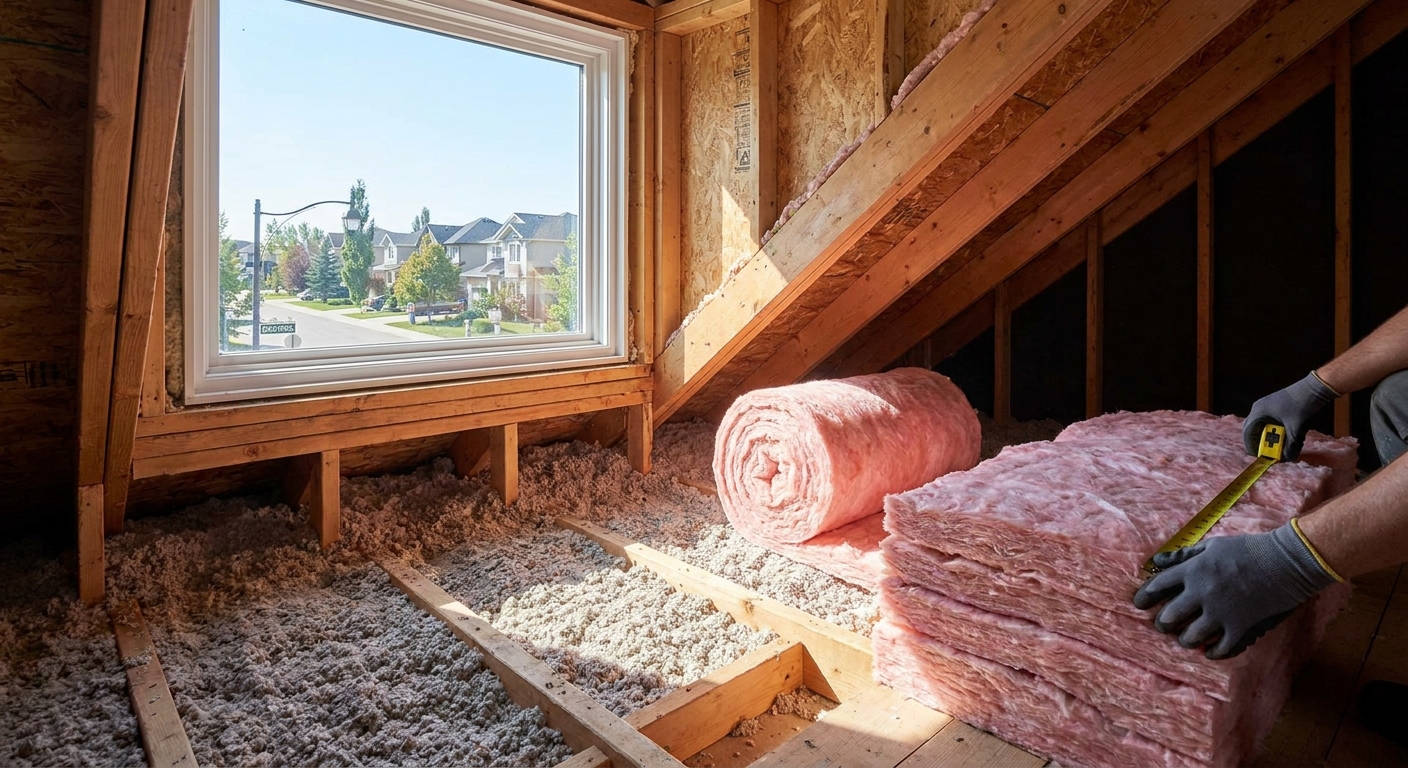
Blown-in fiberglass — the budget pick. Installed at R-50, fiberglass loose-fill covers a standard flat attic for less than spray foam and settles minimally over time. It works well when air sealing has already been done separately. Buy for straightforward attics on a tighter budget.
Blown-in cellulose — the eco pick. Made from recycled paper fiber and treated for fire resistance, cellulose packs slightly denser than fiberglass per inch and fills irregular joist bays well. It’s a solid Buy for homeowners prioritizing recycled material, provided the attic has functioning vapor control.
Closed-cell spray foam — the premium pick. Spray foam air-seals and insulates in one application, which matters most in vaulted ceilings, knee-wall attics, and homes with a documented ice-damming history. Full pricing detail for the Calgary region — which applies closely to Okotoks jobs given the shared climate and crew base — is broken down in how much spray foam insulation costs. Buy for any attic with structural complexity or a moisture history.
Batt insulation (fiberglass rolls) — the DIY-friendly pick. Batts are the easiest material to install without professional equipment, but they compress around obstructions and leave gaps at irregular joist spacing that loose-fill or foam don’t. For an attic top-up in an older Okotoks home, this is a Skip — the gaps undercut the R-value on paper.
Hybrid: spray foam plus blown-in top-up — the balanced pick. Spray foam handles air sealing and problem areas (eaves, hatches, can lights), then blown-in fiberglass or cellulose brings the field area up to full R-value at lower cost than foam across the whole attic. This is the Buy for most 2026 retrofit jobs — it solves the air-leakage problem without pricing out the whole attic at foam rates.
Get an attic insulation quote for Okotoks
Licensed, insured crews serving Okotoks, Calgary, High River, and Lethbridge.
What to avoid
- Batt-only top-ups without air sealing. Adding batts over existing insulation without sealing bypasses first locks in the heat loss you’re trying to fix.
- Quotes that skip R-value targets. If a contractor won’t commit to a specific R-value in writing, there’s no way to verify the job meets Alberta’s R-50 to R-60 benchmark.
- Ignoring bathroom fan and can-light penetrations. These are the most common leak points in Okotoks attics built before 2010, and they’re easy to miss on a quick walkthrough.
Verdict comparison
| Insulation type | R-value per inch | Best for | Verdict |
|---|---|---|---|
| Blown-in fiberglass | ~R-2.5 | Standard flat attics, tight budget | Buy |
| Blown-in cellulose | ~R-3.5 | Recycled-material preference | Buy |
| Closed-cell spray foam | ~R-6.5 | Vaulted ceilings, ice dam history | Buy |
| Fiberglass batts | ~R-3.2 | DIY top-ups only | Skip |
| Hybrid foam + blown-in | Varies by zone | Full attic retrofits | Buy |
FAQ
What’s the best attic insulation for Okotoks homes?
For most Okotoks attics, a hybrid approach — closed-cell spray foam at eaves, hatches, and penetrations, blown-in fiberglass or cellulose across the field — delivers the best balance of air sealing and R-value per dollar in 2026. Attics with vaulted ceilings or a history of ice damming do better with full spray foam coverage.
Is spray foam better than blown-in insulation for attics?
Spray foam air-seals and insulates in one step, which makes it better for irregular or vaulted attics, but blown-in fiberglass or cellulose covers standard flat attics for less money once air sealing is handled separately. Neither is universally better — the right pick depends on attic structure.
How much does attic insulation cost in Okotoks?
Cost depends on attic size, material, and whether air sealing is bundled in. The spray foam cost breakdown for the Calgary region applies closely to Okotoks jobs given the shared contractor base and climate, and it’s the clearest starting point for a real estimate.
What R-value do I need for my attic in Alberta?
Alberta’s building code targets R-50 to R-60 for attic insulation in new construction, and existing homes should be brought up to that range during a retrofit. Homes built before 2005 commonly sit at R-20 to R-30, roughly half the current standard.
Does attic insulation stop ice dams?
Proper attic insulation combined with air sealing stops ice dams by keeping the roof deck at a consistent, cold temperature so snow doesn’t melt and refreeze at the eaves. Insulation alone without air sealing often fails to solve the problem because warm air still bypasses through unsealed penetrations.
How long does attic insulation installation take?
A standard attic insulation job in a residential home typically completes in a single day, though larger or more complex attics with extensive air sealing can take longer. Spray foam applications generally need a short cure time before the attic is fully accessible again.
Can I insulate my attic myself?
Fiberglass batts can be installed without professional equipment, but blown-in insulation and spray foam both require specialized machinery that most homeowners don’t have access to. DIY batt installs also tend to leave gaps around obstructions that reduce real-world R-value below what’s on the label.
Is spider veins-style attic frost a sign of poor insulation?
Frost or ice buildup visible on the underside of the roof deck usually signals warm, moist air escaping from living space into the attic through unsealed bypasses. It’s a direct sign that both insulation and air sealing need attention before winter ends.
One last thing
The number that surprises most Okotoks homeowners isn’t the R-value gap — it’s that up to 30% of a home’s total heat loss can escape through an unsealed attic, meaning a homeowner can double their insulation and still lose heat at nearly the same rate if the air-sealing step gets skipped. Seal first, then insulate — the order matters as much as the material.