.pseo-content { font-size: 17px; line-height: 1.7; color: inherit; }
.pseo-content h2 { font-size: 1.6em; margin-top: 1.8em; margin-bottom: 0.6em; line-height: 1.3; color: inherit; }
.pseo-content h3 { font-size: 1.25em; margin-top: 1.5em; margin-bottom: 0.4em; line-height: 1.35; color: inherit; }
.pseo-content h4 { color: inherit; }
.pseo-content p { margin: 0 0 1em; }
.pseo-content ul, .pseo-content ol { margin: 0 0 1em 1.4em; padding: 0; }
.pseo-content li { margin: 0.3em 0; }
.pseo-content strong { font-weight: 600; }
.pseo-content blockquote { margin: 1.2em 0; padding: 0.6em 1em; border-left: 3px solid color-mix(in srgb, currentColor 30%, transparent); background: color-mix(in srgb, currentColor 4%, transparent); color: inherit; }
.pseo-content a { text-decoration: underline; }
.pseo-content .pseo-table-wrap { overflow-x: auto; margin: 1.4em 0; -webkit-overflow-scrolling: touch; }
.pseo-content table { width: 100% !important; border-collapse: collapse !important; table-layout: auto !important; font-size: 0.96em; }
.pseo-content table th,
.pseo-content table td {
padding: 10px 12px !important;
border-bottom: 1px solid color-mix(in srgb, currentColor 14%, transparent) !important;
border-left: none !important;
border-right: none !important;
vertical-align: top !important;
text-align: left !important;
word-break: break-word !important;
overflow-wrap: anywhere !important;
white-space: normal !important;
}
.pseo-content table th {
background: color-mix(in srgb, currentColor 6%, transparent) !important;
color: inherit !important;
font-weight: 600 !important;
border-top: 1px solid color-mix(in srgb, currentColor 14%, transparent) !important;
}
.pseo-content table tr:last-child td { border-bottom: 1px solid color-mix(in srgb, currentColor 14%, transparent) !important; }
A driveway that settles once keeps settling until the soil underneath it stops moving — patching the crack or topping the slab with a new pour does nothing to solve that.
- Protecting a driveway from future concrete settling means fixing drainage and soil compaction, not just patching cracks.
- Polyurethane foam injection lifts a sunken slab back to grade without a full replacement pour in 2026.
- Grade the driveway at a minimum 2% slope away from the garage so water stops undermining the base.
- Skip mudjacking on Alberta’s clay-heavy soil — the added weight speeds up the next settling cycle.
- Reseal control joints every fall before freeze-thaw cycles start pushing water under the slab.
Why this matters
Concrete driveways in Calgary, Okotoks, High River, and Lethbridge sit on soil that swells and shrinks with every freeze-thaw cycle Alberta winters produce. That movement, combined with poor drainage or a base that was never compacted properly, is why so many driveways sink at the garage apron or along the edges within 10 to 15 years of the original pour.
Once a slab drops, water pools in the low spot instead of running off. That pooled water works its way under the concrete, softens the base further, and accelerates the next round of settling. Fixing the slab without fixing the water path is why some driveway repairs fail again within a year or two.
A sunken driveway repair done with proper grading and drainage correction holds far longer than a patch job that ignores the cause.
What you'll need
- A garden hose or level to check current slope across the driveway
- A soil moisture reading after rain — pooling that lingers more than 30 minutes signals a drainage problem
- Access to the joints and cracks for cleaning and resealing
- A qualified concrete lifting contractor for any slab already below grade by more than half an inch
- Polyurethane concrete lifting foam (injected by a contractor) if the slab needs to be raised, not just maintained
- A downspout extension or French drain if water currently drains toward the driveway instead of away from it
The steps
1. Check the current slope before you do anything else
Run a level or a hose test across the driveway after a dry spell. A driveway should slope away from the garage and house at roughly 2% grade — about a quarter inch of drop per foot.
If water sits in a low spot for more than half an hour after rain, that section is already trending toward settlement. Catching this before the slab visibly sinks saves you a full lift later.
Common mistake: homeowners check slope right after installing new sod or landscaping, which temporarily changes runoff patterns and hides the real grade of the concrete underneath.
2. Clean and reseal every control joint and crack
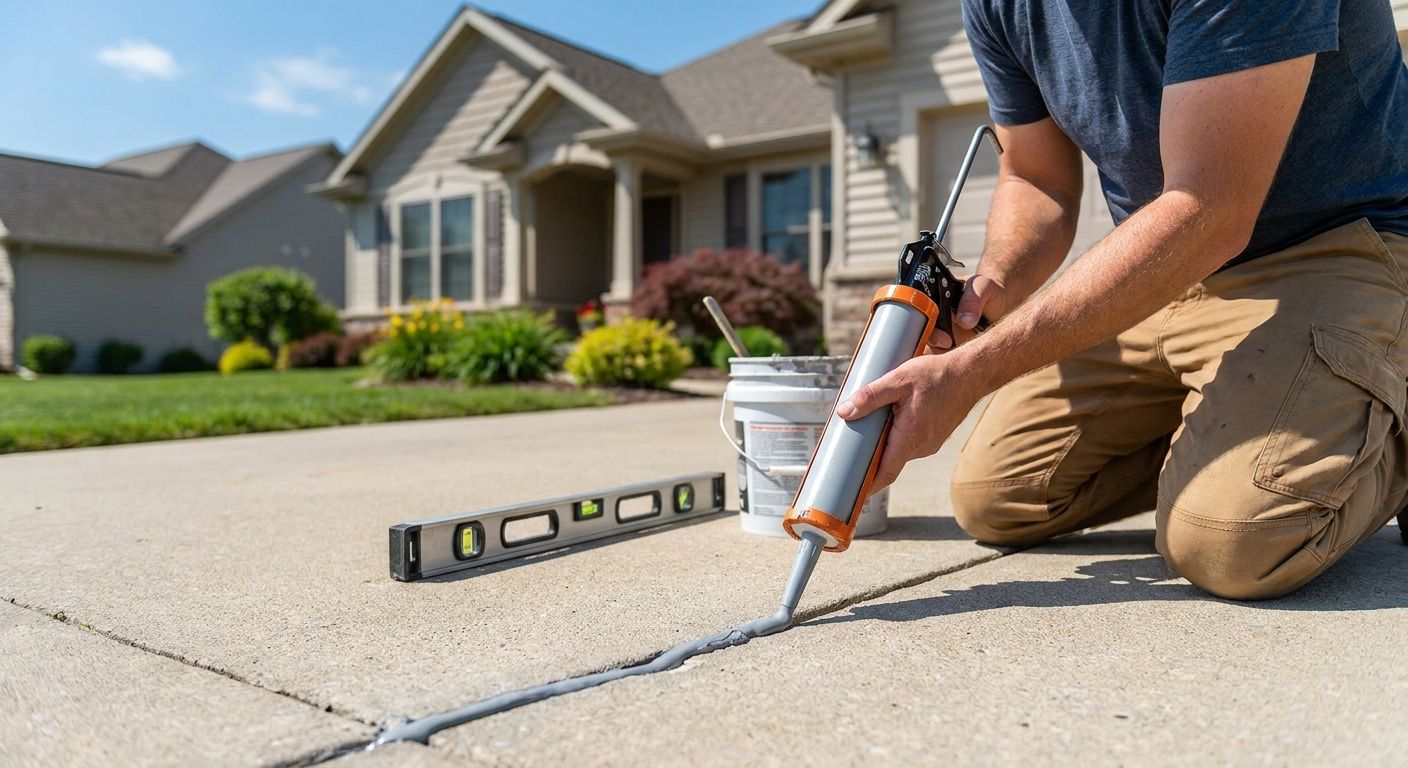
Control joints exist to let concrete expand and contract without cracking randomly, but they're also the fastest path for water to reach the base material. Clear out old sealant with a wire brush, then apply a fresh polyurethane sealant bead before the first hard freeze.
Do this every fall in Alberta, not every few years. One winter of an open joint lets meltwater cycle in and out of the base dozens of times.
Common mistake: sealing over debris or old caulk instead of removing it first — the new sealant fails within a season because it never bonded to bare concrete.
3. Fix the drainage before you fix the slab
Walk the perimeter of the driveway and trace where downspouts, sump discharge, and yard grading send water. If any of it drains toward the driveway or garage, redirect it with an extension or a shallow swale before you spend money lifting concrete.
A slab that's re-leveled while a downspout still dumps water at its edge will settle again — often within two to three years.
Common mistake: assuming a downspout extension six feet long is enough. On flat Alberta lots, water needs to travel further before it stops threatening the base.
4. Address any settling early with concrete lifting, not replacement
Once a section has dropped more than half an inch, patching won't hold. A concrete lifting method using polyurethane foam injection raises the existing slab back to grade by filling the voids underneath it, and the foam itself doesn't absorb water the way mudjacking slurry does.
This matters specifically on Alberta clay soil: mudjacking adds significant weight on top of soil that's already prone to movement, which can trigger the next settling cycle faster than doing nothing. Polyurethane foam weighs a fraction of that and cures in about 15 minutes, letting the driveway take weight again the same day.
Common mistake: waiting until the settled section is a full trip hazard before calling a contractor — small drops are cheaper and faster to correct than large ones.
5. Recheck compaction anywhere trenching or utility work happened
If a utility line, sprinkler system, or drainage repair crossed under or near the driveway in the last few years, that backfill is a likely future settling point. Backfill that wasn't compacted in lifts settles unevenly as it consolidates under the concrete's weight.
Mark these zones and watch them specifically after each spring thaw in 2026 and beyond.
Common mistake: assuming utility crews always compact backfill to the same standard as the original driveway base — many don't unless it's specified in the contract.
6. Address soil movement tied to foundation settling nearby
If the driveway settling runs alongside a garage or foundation wall that's also shifting, the two problems usually share a cause: soil moisture swings under both structures. Treating the driveway alone while ignoring foundation settling nearby just delays the next repair.
A contractor who inspects both at once can confirm whether the fix needs to extend past the driveway itself.
Common mistake: treating a driveway crack and a nearby foundation crack as unrelated issues when they showed up the same season.
Get a concrete lifting quote
Aztec Spray Systems serves Calgary, Okotoks, High River, and Lethbridge.
Troubleshooting
- Driveway settles again within a year of a repair. The drainage problem was never fixed — recheck slope and downspout direction before assuming the lift failed.
- Cracks reappear along the same line every spring. That's an active control joint doing its job under freeze-thaw stress; reseal it rather than patching over the crack itself.
- One corner drops faster than the rest of the slab. Isolated settling usually points to a soil void or old tree root decay directly under that corner — worth a targeted foam injection rather than a full-slab lift.
- Puddles form mid-driveway instead of at the edges. That's a birdbath — a low spot that formed gradually and needs leveling before it grows.
- New hairline cracks show up after a lift. Minor surface cracking after a lift is common and cosmetic; it's not a sign the lift failed unless the slab is moving again.
Tools and resources
- Concrete lifting method for sunken slabs — comparison of foam injection versus mudjacking
- Garage floor lifting — relevant if settling extends from the driveway into the garage slab
- A level or laser line for periodic slope checks
- Polyurethane concrete sealant for annual joint maintenance
What to do next
If your driveway already shows a visible dip or the water isn't draining the way it should, get it measured before the ground freezes again. Alberta's freeze-thaw cycle punishes any driveway that goes into winter with standing water at its edge, and by spring 2026 a small settling issue can turn into a slab that needs a full lift instead of a joint reseal.
FAQ
How do you protect a driveway from future concrete settling?
You protect a driveway from future settling by fixing drainage first, then correcting soil compaction issues, and lifting any section that’s already sunk with polyurethane foam injection rather than a patch. Sealing control joints every fall in Alberta prevents the freeze-thaw cycle from working water under the slab.
Is polyurethane foam injection better than mudjacking for driveways?
Polyurethane foam injection generally holds up better on Alberta’s clay-heavy soil because it weighs far less than mudjacking slurry and cures in about 15 minutes. Mudjacking adds weight on top of soil that’s already prone to movement, which can speed up the next settling cycle.
How much slope should a driveway have to avoid settling?
A driveway should slope away from the garage or house at roughly 2% grade, or about a quarter inch of drop per foot. Anything flatter lets water pool near the foundation and undermine the base over time.
Can a settled driveway be fixed without full replacement?
Yes — concrete lifting with polyurethane foam raises an existing slab back to grade by filling voids underneath it, avoiding a full tear-out and repour. This works as long as the slab itself isn’t structurally cracked or broken into pieces.
Why does my driveway keep settling after repair?
A driveway that settles again after repair almost always has an unresolved drainage issue, such as a downspout or grading problem still directing water toward the slab. Lifting the concrete without fixing the water path just delays the next drop.
Does freeze-thaw cause driveway settling in Alberta?
Yes — the repeated freeze-thaw cycles common in Calgary, Okotoks, High River, and Lethbridge push moisture in and out of the base material under a driveway, which loosens compaction over several winters. Sealing joints before each freeze slows this process significantly.
How often should driveway joints be resealed?
Driveway control joints should be resealed every fall before the first hard freeze, not every few years. An open joint lets meltwater cycle through the base dozens of times over a single Alberta winter.
One last thing
The single biggest predictor of whether a driveway repair holds is what happens to the water after it rains — not the repair method itself. A perfectly executed foam lift on a driveway that still drains toward the garage will settle again; a modest patch on a driveway with correct grading can outlast it.
Related guides
{“@context”:”https://schema.org”,”@type”:”FAQPage”,”mainEntity”:[{“@type”:”Question”,”name”:”How do you protect a driveway from future concrete settling?”,”acceptedAnswer”:{“@type”:”Answer”,”text”:”You protect a driveway from future settling by fixing drainage first, then correcting soil compaction issues, and lifting any section that’s already sunk with polyurethane foam injection rather than a patch. Sealing control joints every fall in Alberta prevents the freeze-thaw cycle from working water under the slab.”}},{“@type”:”Question”,”name”:”Is polyurethane foam injection better than mudjacking for driveways?”,”acceptedAnswer”:{“@type”:”Answer”,”text”:”Polyurethane foam injection generally holds up better on Alberta’s clay-heavy soil because it weighs far less than mudjacking slurry and cures in about 15 minutes. Mudjacking adds weight on top of soil that’s already prone to movement, which can speed up the next settling cycle.”}},{“@type”:”Question”,”name”:”How much slope should a driveway have to avoid settling?”,”acceptedAnswer”:{“@type”:”Answer”,”text”:”A driveway should slope away from the garage or house at roughly 2% grade, or about a quarter inch of drop per foot. Anything flatter lets water pool near the foundation and undermine the base over time.”}},{“@type”:”Question”,”name”:”Can a settled driveway be fixed without full replacement?”,”acceptedAnswer”:{“@type”:”Answer”,”text”:”Yes — concrete lifting with polyurethane foam raises an existing slab back to grade by filling voids underneath it, avoiding a full tear-out and repour. This works as long as the slab itself isn’t structurally cracked or broken into pieces.”}},{“@type”:”Question”,”name”:”Why does my driveway keep settling after repair?”,”acceptedAnswer”:{“@type”:”Answer”,”text”:”A driveway that settles again after repair almost always has an unresolved drainage issue, such as a downspout or grading problem still directing water toward the slab. Lifting the concrete without fixing the water path just delays the next drop.”}},{“@type”:”Question”,”name”:”Does freeze-thaw cause driveway settling in Alberta?”,”acceptedAnswer”:{“@type”:”Answer”,”text”:”Yes — the repeated freeze-thaw cycles common in Calgary, Okotoks, High River, and Lethbridge push moisture in and out of the base material under a driveway, which loosens compaction over several winters. Sealing joints before each freeze slows this process significantly.”}},{“@type”:”Question”,”name”:”How often should driveway joints be resealed?”,”acceptedAnswer”:{“@type”:”Answer”,”text”:”Driveway control joints should be resealed every fall before the first hard freeze, not every few years. An open joint lets meltwater cycle through the base dozens of times over a single Alberta winter.”}}]}