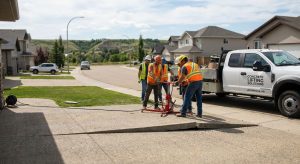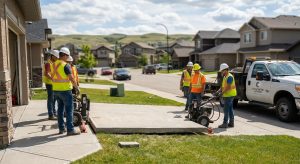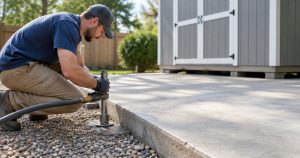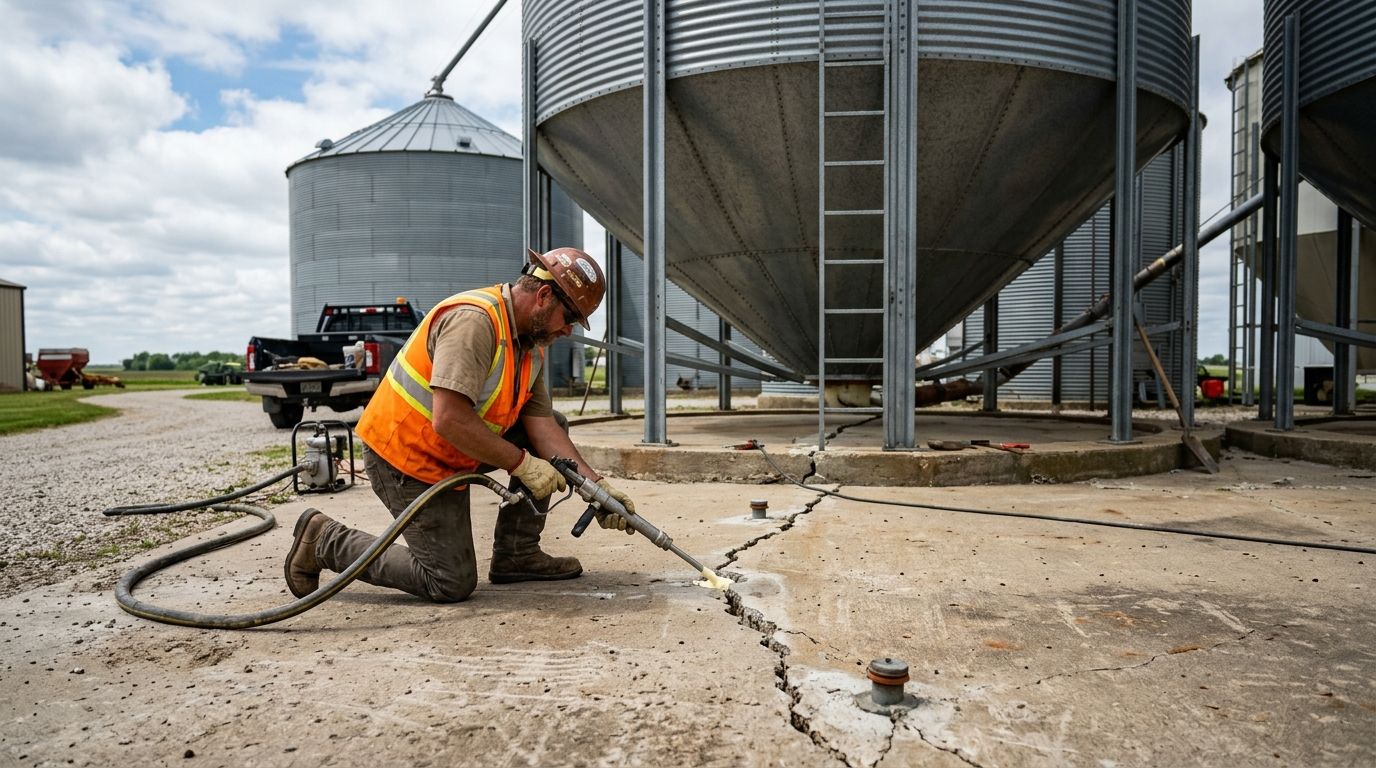
Concrete lifting for grain bin and silo pads means raising and stabilizing a sunken pad under a loaded bin or silo by injecting structural polyurethane foam beneath the slab, without emptying the bin, removing the structure, or pouring new concrete. Grain storage pads carry a different load pattern than a house foundation or garage slab: weight concentrates along the ring wall and hopper bottom rather than spreading evenly, which means a void under one section of the pad can tilt the entire bin. Alberta's frost cycle adds a second stressor, pushing and pulling the slab every fall and spring until a small dip becomes a structural problem.
Aztec Spray Systems handles concrete lifting for agricultural equipment pads across Calgary, Okotoks, High River, and Lethbridge, and grain bin and silo pads follow the same core method with a few extra checks for bin anchoring and hopper clearance.
- Concrete lifting grain bin pad work uses polyurethane foam injection, not slab removal, and the bin can often stay loaded.
- Polyurethane foam reaches load-bearing strength in about 15 minutes, far faster than a mudjacking slurry cure.
- Grain bin ring walls concentrate point loads, so a small void reads as a bigger tilt risk than on a house slab.
- Fall, before frost heave sets in, is the practical inspection window for Alberta grain bin pads in 2026.
Why concrete lifting matters for grain bin and silo owners
A grain bin doesn't settle the way a house does. The load sits on a narrow ring wall or a hopper cone, so a two-inch void under one quadrant of the pad shows up as a visible lean at the top of the bin, not just a hairline crack in a corner. Once a bin is out of level, the auger, unload gate, and leg boot can bind, and grain flow through the hopper stops being even.
Silo pads carry the same risk with less warning, because the structure is taller and the load is more concentrated at the base ring. A pad that's dropped even 3/4 inch on one side puts real torque on the anchor bolts holding the silo down. Waiting through another Alberta winter without addressing it usually means the bolts, not just the concrete, become the next repair.
Inspect the pad for settling patterns
Start with a visual and level check before deciding anything needs lifting.
- Run a 4-foot level or laser level across the pad in at least four directions
- Check for gaps between the bin's base ring and the slab, especially on the downhill side
- Look for radiating cracks near the hopper or ladder anchor points
- Note whether doors, augers, or unload gates have started binding
- Check anchor bolts for stress marks or elongated holes
If the level check shows more than a half-inch of difference corner to corner, treat it as active settling, not cosmetic wear.
Test for voids under the slab
A level reading tells you the pad has moved; it doesn't tell you why. Confirming a void changes the fix.
- Tap the slab with a hammer near the low point and listen for a hollow sound versus a solid one
- Check drainage grading around the pad for pooling water, a common cause of soil washout under bins
- Look at soil type on the property record; sandy or poorly compacted fill settles faster than clay
- Ask a contractor to run a probe or core check if the hollow sound is inconsistent
This is also the point to spot foundation settling before it worsens rather than after a full growing season of uneven bin drainage.
Choose the lifting method
There are three realistic paths once a void is confirmed, and each has a real tradeoff.
- Polyurethane foam injection — small entry holes, foam expands and cures in about 15 minutes, adds minimal extra weight to an already-settled base
- Mudjacking — cement-based slurry pumped under the slab, larger holes, adds significant weight back onto the same soil that already failed once
- Full pad replacement — removes the bin (or requires it to be lifted off entirely), highest disruption, only worth it when the slab itself is cracked through, not just settled
For most grain bin and silo pads in 2026, polyurethane injection is the practical choice because it doesn't require pulling the bin off its footing.
Prep the site around the bin or silo
Before injection starts, the site needs a few things cleared.
- Confirm access room around the pad perimeter for the injection equipment
- Clear any skirting, wiring, or aeration ductwork running along the base
- Mark existing anchor bolt locations so injection points avoid them
- Check whether the bin needs partial unloading, most don't for foam lifting but full silos sometimes do depending on structure age
Inject and raise the slab
This is the core of the job and the part where contractor experience matters most.
- Injection ports are drilled in a pattern that matches the void map from the inspection step
- Foam is injected in stages, checked with a level between each pass
- Lift happens in small increments, often fractions of an inch at a time, to avoid over-correcting
- The pad is monitored under load during the lift, not just at rest
Aztec Spray Systems runs this staged approach specifically because grain bin pads punish over-correction more than under-correction; a bin lifted too fast on one side creates a new lean in the opposite direction.
Reseal and re-level the surrounding grade
Once the pad is level, the injection holes get sealed and the grading around the bin gets addressed so the same water problem doesn't cause a repeat void.
- Patch injection ports with a matching concrete sealant
- Re-grade soil around the pad perimeter to slope away from the slab
- Check gutters or downspouts on nearby structures directing water toward the bin
- Confirm the unload auger and gate move freely again after the lift
Schedule a follow-up check after harvest season
A lifted pad should get one more look after it's carried a full harvest's worth of load.
- Re-run the level check 60-90 days after harvest
- Watch for hairline cracks near injection points
- Confirm anchor bolts are still seated correctly
- Flag any new binding on augers or gates immediately rather than waiting for spring
Comparison: lifting options for grain bin and silo pads
| Option | Best for | Key limitation |
|---|---|---|
| Polyurethane foam injection | Pads under bins that need to stay loaded and level fast | Not suited to slabs with through-cracks, only settling |
| Mudjacking | Older concrete where matching aesthetics matters more than added weight | Slurry adds weight to soil that already failed once |
| Full pad replacement | Slabs with structural cracking or a bin that's being relocated | Requires removing or lifting the bin entirely off the pad |
| Monitor and wait | Pads with less than 1/4 inch of movement and no binding | Frost cycles in Alberta rarely let minor settling stay minor |
Verdict: polyurethane foam injection wins for most grain bin and silo pad settling because it doesn't require unloading or removing the structure, and it's the method Aztec Spray Systems uses across Okotoks, High River, Calgary, and Lethbridge for agricultural pads. Mudjacking is fine when appearance matters more than added soil load. Full replacement is a last resort, not a first move, for barn and shop floor or silo pad settling that's caught early.
Common mistakes grain bin and silo owners make
- Waiting until harvest to deal with a pad that's been dropping for a year — the fix takes hours, but scheduling around a full bin is what actually causes delay
- Assuming the concrete is the only thing affected — anchor bolts and unload hardware take the same stress the slab does
- Choosing mudjacking for cosmetic reasons on a pad that's still actively settling — added slurry weight on failing soil often means a repeat call within a season or two
- Ignoring drainage grading after a lift — the same water pattern that caused the original void will cause it again
- Not checking the best method for sunken slabs before assuming full replacement is the only option — most grain bin pads never need to come out
Get a grain bin pad inspected
Aztec Spray Systems services agricultural pads across Calgary, Okotoks, High River, and Lethbridge.
FAQ
What is concrete lifting for a grain bin pad?
Concrete lifting for a grain bin pad is the process of injecting polyurethane foam under a settled slab to raise it back to level without removing the bin. It’s typically done through small drilled ports and finishes in a single visit.
Does the bin need to be emptied before lifting?
Most polyurethane foam lifts happen with the bin fully loaded, since the foam cures fast enough to bear weight during the process. Older or structurally compromised silos sometimes need partial unloading, which gets confirmed during the site inspection.
How is concrete lifting different from mudjacking for a grain bin pad?
Polyurethane foam injection uses small ports and lightweight expanding foam, while mudjacking pumps in a heavier cement slurry through larger holes. On a pad that already settled once, the extra weight from mudjacking works against the soil that failed in the first place.
How do I know if my silo pad needs lifting or just monitoring?
A level check showing more than a half-inch of difference across the pad, combined with binding on doors, augers, or unload gates, means the pad needs lifting rather than monitoring. Less than a quarter-inch of variation with no functional binding can usually wait for the next seasonal check.
Can concrete lifting fix a cracked grain bin pad?
Polyurethane foam lifting fixes settling, not structural cracks that run through the slab. A pad with through-cracks in addition to settling usually needs a section replaced rather than lifted.
What time of year is best for grain bin pad lifting in Alberta?
Fall, after harvest and before frost heave sets in, is the most practical window for grain bin pad lifting in Alberta. Lifting before the ground freezes gives the pad a full season to settle into its corrected position before the next frost cycle.
Will lifting the pad damage the bin’s anchor bolts?
A properly staged lift, done in small increments with level checks between passes, shouldn’t stress anchor bolts beyond what they already experienced during the original settling. Bolts get inspected before and after the lift specifically to catch any elongation or stress marks.
How long does a grain bin pad lifting job take?
Most grain bin or silo pad lifts finish within a single day, since the foam reaches load-bearing strength in about 15 minutes per injection stage. Larger pads with multiple void areas can take longer depending on how many injection points the void map requires.
One last thing
The ring wall detail is the part most owners miss: because a grain bin's weight concentrates along a narrow base rather than spreading across the whole pad like a house foundation, a void that would be a minor cosmetic issue under a garage slab shows up as a visible lean under a loaded bin. That's why the level check in the first inspection step matters more here than on almost any other concrete lifting job Aztec Spray Systems handles in 2026.
Related guides