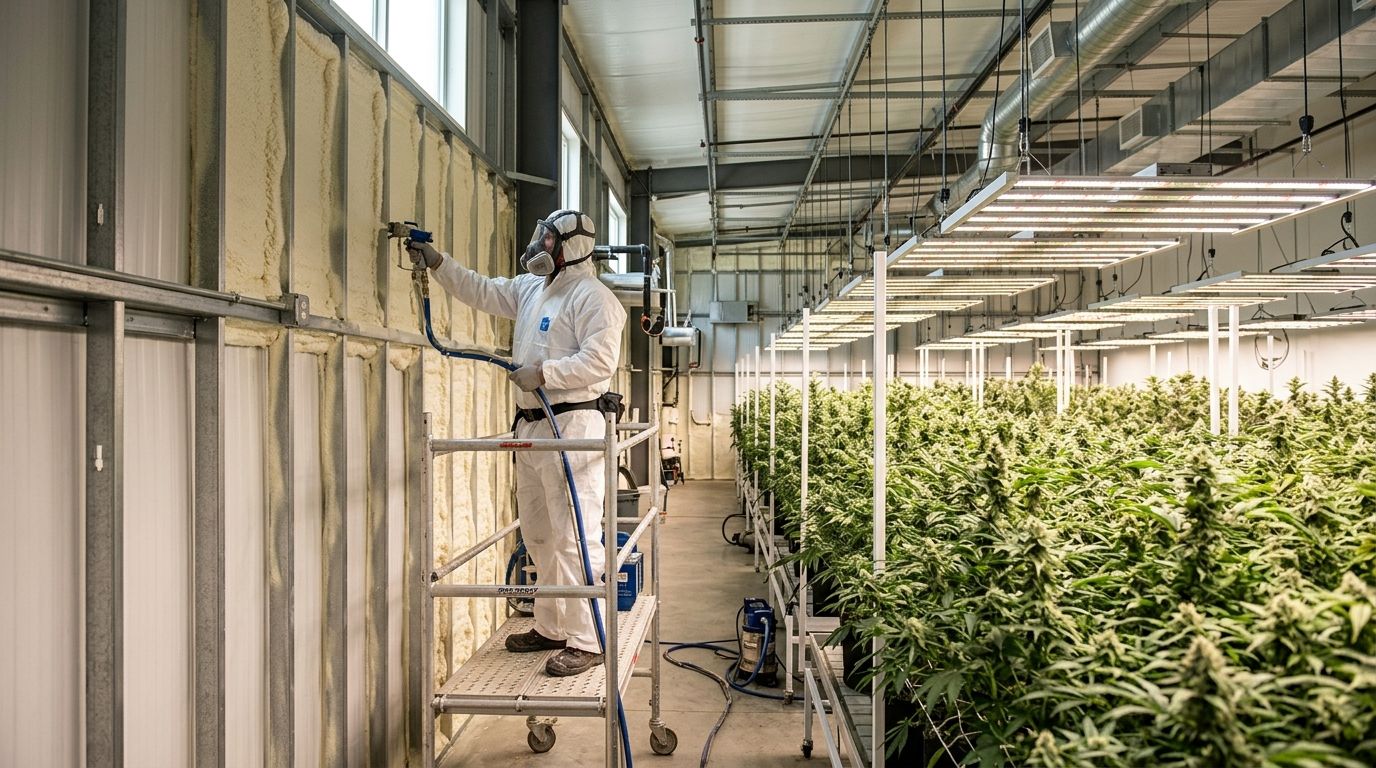
Licensed cannabis grow facilities need spray foam insulation that stops vapor drive at the wall, holds up under 12-hour lighting cycles, and keeps humidity from condensing inside metal or wood-frame shells through an Alberta winter. A standard batt-and-poly assembly built for a house doesn't handle 50-60% relative humidity running against -30°C exterior temperatures for months at a stretch — the wall assembly needs to be built for the load, not just the climate.
- Aztec Spray Systems recommends closed-cell spray foam for grow rooms because it blocks vapor drive at the wall, not just heat loss.
- Spray foam insulation cannabis facility projects in Calgary, Okotoks, and Lethbridge need a vapor barrier rated below 1 perm on closed-cell foam.
- Flower rooms commonly run 50-60% RH; open-cell foam alone won’t stop condensation behind the wall in Alberta winters.
- Metal and pole-barn shells need continuous exterior insulation planned before spray foam goes in as flash-and-batt.
- Alberta Building Code requires a fire-rated thermal barrier over exposed spray foam in any occupied grow or work area.
Why this matters for licensed grow facilities
A licensed grow operation isn't a warehouse with grow lights bolted in. Veg and flower rooms run 12 to 18 hours of lighting daily, HVAC and dehumidification cycle near-constantly, and interior humidity targets sit well above what a typical commercial building envelope is designed to handle. When warm, moist interior air meets a cold exterior wall with no vapor control, it condenses inside the cavity — and that moisture doesn't show up until mold, corroded framing, or delaminated insulation forces a shutdown.
Alberta adds another layer: exterior temperatures swing from +30°C summer highs to -30°C or colder in a typical winter. That's a bigger delta than most commercial insulation specs anticipate, and it's exactly the gap that spray foam insulation for greenhouses and grow rooms is built to close. Spray foam insulation for a cannabis facility isn't optional upgrade insulation — it's the moisture control layer the whole operation depends on.
Assess your building envelope before you spec anything
Start with what you have, not what you want to install.
Audit your current humidity and vapor load
- Log interior RH and temperature in each grow zone for at least two weeks across a season change
- Identify which walls face prevailing wind and which get the most winter cold-soak
- Check existing insulation type — batt, rigid board, or none — and note any visible moisture staining
- Confirm HVAC and dehumidification tonnage against your actual canopy square footage, not the building's original spec
- Flag any uninsulated penetrations: conduit runs, exhaust ducting, plumbing chases
Choose closed-cell foam for grow and flower rooms
Open-cell foam is cheaper and insulates fine for R-value, but it's vapor-open. In a room running 50-60% RH against a cold Alberta wall, that's a liability, not a cost saving.
- Specify closed-cell spray foam at 2 lbs/ft³ density for any wall or ceiling adjacent to a humidity-controlled room
- Confirm the perm rating on the product data sheet — closed-cell should land under 1 perm at 2 inches thick
- Use open-cell only in interior partition walls that don't separate conditioned space from an unconditioned or exterior zone
- Budget for full-depth fill on metal building cavities, not a thin flash coat backed by batt
Seal every penetration before foam goes in
Grow facilities are penetration-heavy: conduit for lighting circuits, exhaust and makeup air ducting, irrigation lines, data cabling for environmental controls.
- Mark every wall and ceiling penetration on a drawing before the crew shows up
- Foam-seal conduit and duct penetrations as part of the main application pass, not as a punch-list afterthought
- Coordinate with your electrical and mechanical trades so foam goes in after rough-in, not before
- Re-inspect penetrations after HVAC commissioning — vibration and thermal cycling can open small gaps
Insulate the roof deck and rooftop mechanical curbs
Roof assemblies lose more conditioned air than most operators expect, especially where rooftop units sit on uninsulated curbs.
- Spray the underside of the roof deck at full cavity depth in occupied zones
- Insulate and seal rooftop unit curbs and duct penetrations separately from the main roof pass
- Check parapet and roof-to-wall transitions — these are common condensation points in flat-roof commercial buildings
- Where the building shares structure with other commercial tenants, coordinate the scope with commercial spray foam insulation for warehouses principles, since the moisture math is similar even without cannabis-specific humidity loads
Apply a code-compliant thermal barrier over exposed foam
Spray foam is combustible and Alberta Building Code requires a thermal barrier — typically drywall or an intumescent coating — over any foam exposed in an occupied space.
- Confirm with your contractor which thermal barrier system applies to your occupancy classification
- Don't leave foam exposed in mechanical rooms or storage areas even if they're not daily-occupied — check the applicable code section for your building use
- Schedule thermal barrier application immediately after foam cures, before final electrical and HVAC trim
Plan installation around harvest and production cycles
A licensed facility can't just shut down for a week of retrofit work.
- Sequence insulation work room by room so at least part of the facility stays in production
- Schedule closed-cell spray foam application during a planned veg-to-flower transition when a room sits empty anyway
- Allow 24 hours minimum cure time before restoring HVAC and humidity control to a treated room
- Curing rooms need separate humidity control from flower rooms — most facilities run cure spaces tighter and drier, and the same air-sealing that keeps foam performing also matters for smell-proof storage for cured product before it moves to packaging
Maintain and re-inspect foam annually
Spray foam doesn't need much upkeep, but a facility running near-constant humidity extremes should still check it.
- Walk penetrations and seams annually, especially after any electrical or mechanical work
- Watch for any new staining, sagging, or gap at wall-to-ceiling transitions
- Re-check thermal barrier coating condition where it's exposed to equipment traffic or vibration
Get a spray foam quote for your facility
Licensed, insured contractor serving Calgary, Okotoks, High River, and Lethbridge.
Comparing insulation options for cannabis facilities
| Option | Best for | Key limitation |
|---|---|---|
| Closed-cell spray foam | Grow and flower rooms with sustained 50-60% RH | Higher install labour than batt; needs a fire-rated thermal barrier |
| Open-cell spray foam | Interior partitions with no humidity differential | Vapor-open — wrong choice against exterior walls in humid rooms |
| Rigid foam board + separate vapor barrier | Retrofit projects with limited access to open cavities | Seams and fasteners create vapor barrier gaps if not taped meticulously |
| Fiberglass batt + poly sheeting | Low-humidity storage or office areas only | Poly tears and sags over time; no air-sealing value on its own |
Closed-cell spray foam is the right call for any wall or ceiling bordering a grow or flower room in 2026 — it's the only option on this list that combines insulation value with a vapor barrier in one application.
Common mistakes licensed grow facilities make
- Treating the whole building the same — flower rooms need vapor-tight closed-cell foam; office and reception areas don't, and spending closed-cell budget everywhere wastes money
- Skipping the thermal barrier to save time — this fails inspection and creates real fire risk in a facility running continuous electrical load
- Insulating after HVAC commissioning instead of before — retrofitting foam around a fully wired, ducted room costs more and misses penetrations
- Ignoring rooftop mechanical curbs — these are consistently the coldest, most condensation-prone spots in a flat-roof commercial building, and they're easy to miss on a walkthrough
- Assuming rural or ag-zoned buildings don't need permits — Alberta Building Code and local fire code both apply to licensed cannabis facilities regardless of location
FAQ
What’s the best spray foam insulation for a cannabis grow facility?
Closed-cell spray foam is the best choice for grow and flower rooms in 2026 because it combines insulation value with a vapor barrier rated under 1 perm at 2 inches thick. Open-cell foam works fine in low-humidity interior partitions but shouldn’t be used against exterior walls in rooms running 50-60% RH.
Is spray foam insulation required by Alberta Building Code for cannabis facilities?
Alberta Building Code doesn’t specify spray foam by name, but it does set insulation and vapor barrier performance requirements that closed-cell foam meets more reliably than batt insulation in high-humidity commercial spaces. A thermal barrier over exposed foam is a separate code requirement tied to fire safety.
How does spray foam insulation prevent mold in grow rooms?
Closed-cell spray foam blocks vapor drive through the wall assembly, so warm interior humidity from a flower room can’t condense inside a cold exterior cavity. That condensation point is where most commercial mold problems start, not the interior surface itself.
Can spray foam be applied around existing electrical and HVAC rough-in?
Yes, but it’s more efficient to spray after rough-in and before final trim so the crew can seal conduit and duct penetrations in the same pass. Retrofitting foam around a fully finished room means more cutting and patching around fixtures.
Does spray foam insulation help with odour control in a grow facility?
Spray foam air-seals the building envelope, which reduces uncontrolled air leakage that can carry odour outside the facility. It’s not a substitute for carbon filtration or a dedicated exhaust system, but a tighter envelope makes those systems work harder for you instead of against a leaky wall.
How long does spray foam insulation take to cure before a room can be used?
Most closed-cell spray foam is safe to handle within hours, but facilities should allow at least 24 hours before restoring full HVAC and humidity control to a treated room. Off-gassing and full cure time can extend further depending on application thickness and ambient temperature during install.
Is open-cell foam ever acceptable in a cannabis facility?
Open-cell foam is fine for interior partition walls that don’t separate a humidity-controlled room from an exterior wall or an unconditioned space. It should not be used as the primary insulation on any exterior-facing wall or roof deck in a grow or flower room.
What happens if a grow facility skips vapor barrier insulation?
Skipping proper vapor control usually shows up as condensation inside wall cavities within one to two winter seasons, followed by mold growth and framing damage that isn’t visible until drywall or cladding comes off. The fix at that point costs far more than getting the assembly right the first time.
One last thing
The rooftop mechanical curb is the detail most licensed facilities miss entirely — it's rarely on anyone's punch list, but it's consistently the coldest point on a flat commercial roof and the first place condensation shows up when a facility fails an internal moisture check. If your building has rooftop HVAC or exhaust units, get those curbs and their duct penetrations sealed in the same pass as the roof deck, not as a separate line item nobody remembers to schedule. Aztec Spray Systems treats that step as part of the standard scope for any commercial spray foam insulation job in Calgary, Okotoks, High River, and Lethbridge — not an add-on.
Related guides
- Commercial spray foam insulation for warehouses
- How to meet fire code requirements for spray foam insulation