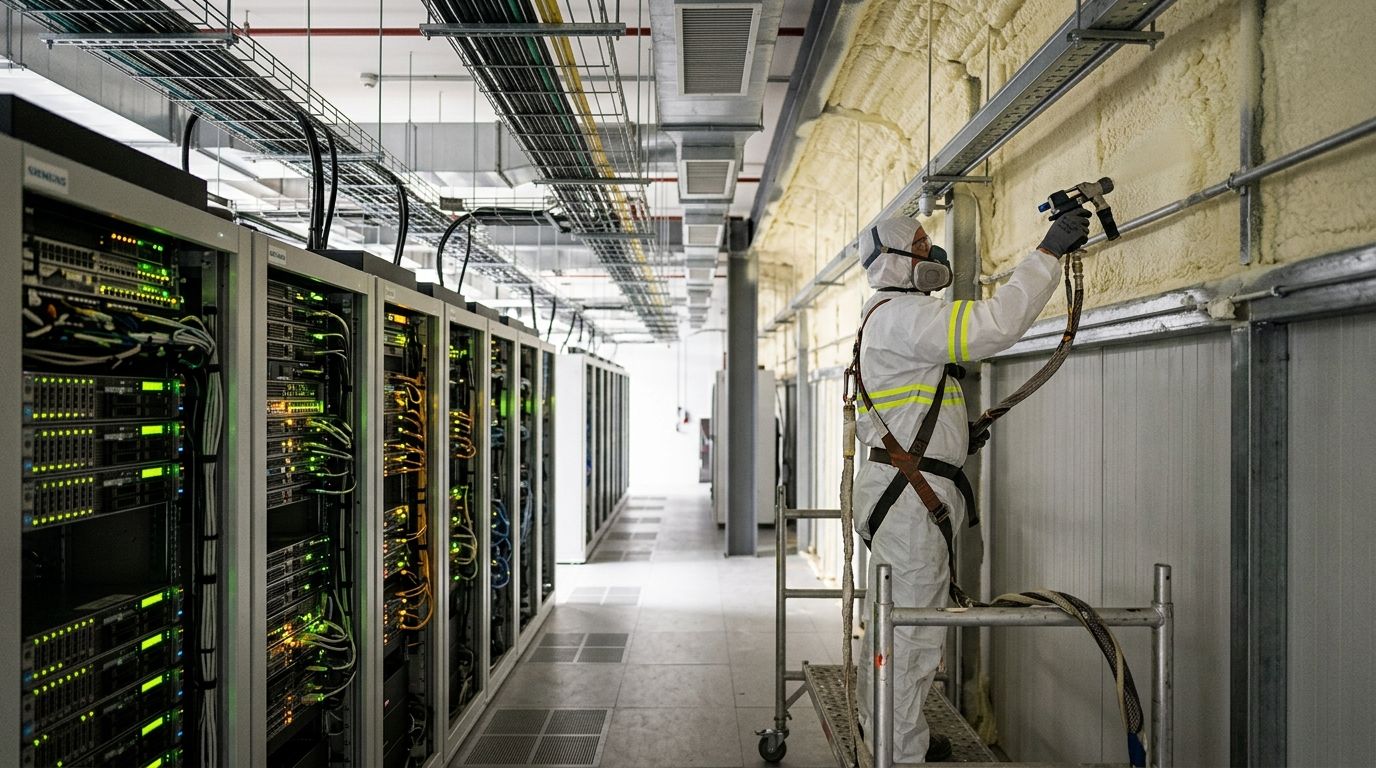
Data center and server room spray foam insulation seals the building envelope against Alberta's temperature swings, cutting the cooling load on equipment that runs 24 hours a day, 365 days a year. A server room in Calgary or Lethbridge doesn't behave like a house attic or a warehouse bay — it needs a tighter temperature band, controlled humidity, and zero air infiltration around cable penetrations, doors, and rooftop mechanical curbs. Aztec Spray Systems works with commercial property owners across Calgary, Okotoks, High River, and Lethbridge who run IT rooms, colocation space, or on-site server closets inside larger commercial buildings, and the envelope problems in those rooms are consistent from site to site.
- Spray foam insulation data center projects target air sealing first, R-value second, because infiltration is what drives cooling costs up in Alberta’s -30°C winters and +30°C summers.
- Closed-cell spray foam is the standard choice for server rooms because it doubles as a vapor barrier at roughly R-6.5 per inch, which matters where condensation risk is high.
- Rooftop mechanical penetrations and rim joists near server rooms are the most commonly missed leak points in 2026 commercial retrofits.
- A licensed contractor with WCB coverage should handle any application near cable trays, electrical panels, or fire-rated assemblies.
Why spray foam insulation matters for data centers
A residential attic can tolerate a few degrees of temperature drift overnight. A server room can't. Equipment racks generate constant heat, and the cooling system is sized to remove that heat — not to also fight outside air leaking in through an unsealed rim joist or a gap around a rooftop condenser curb. When the envelope leaks, the HVAC unit runs harder and longer than its design load, and in Alberta's climate that gap widens every winter and every summer.
Condensation is the other risk that's specific to this segment. Server rooms run cooler and drier than the rest of the building, which means any point where warm, humid air meets a cold surface — an uninsulated wall behind a rack, a poorly sealed duct penetration — becomes a condensation point. Water near electrical equipment is not a minor issue. Air sealing and vapor control matter more here than raw R-value.
Step 1: Audit the building envelope for air leakage
Start with what's already leaking before spending on new insulation. This step costs nothing but time and identifies where the money should go.
- Run a thermal imaging scan of exterior walls and the roof deck above the server room during a cold snap
- Check rim joists and sill plates, which are almost always under-insulated in commercial builds from the 1990s and 2000s
- Inspect every rooftop mechanical penetration — conduit, refrigerant lines, exhaust stacks — for gaps around the curb
- Check loading dock doors and any exterior door near the IT room for weatherstripping wear
- Look for daylight or drafts around cable and conduit entry points into the server room itself
Step 2: Separate the server room thermal zone from adjacent space
A server room inside a larger office or warehouse often shares a thermal zone with space that has completely different heating and cooling needs. That mismatch forces the HVAC system to compromise on both sides.
- Insulate the interior partition walls around the server room, not just the exterior envelope
- Seal the gap where interior partitions meet the roof deck or ceiling plenum
- Treat any door between the server room and the rest of the building as an air seal point, with a sweep and weatherstripping
- Confirm the server room has its own supply and return, not a shared trunk with the open office
Step 3: Choose closed-cell spray foam for moisture and vapor control
Once the leak points are identified, closed-cell spray foam is the material of choice for server rooms because it's a vapor barrier and an air seal in one pass, at roughly R-6.5 per inch. Open-cell foam and fiberglass batt don't stop vapor movement the same way, which raises the condensation risk described above.
This is where a licensed applicator matters more than a DIY kit. Aztec Spray Systems applies closed-cell foam around rooftop curbs, rim joists, and equipment room walls on commercial properties across Calgary and the surrounding region, and the best spray foam insulation company for Calgary commercial properties guide covers what to check before hiring a contractor for this kind of work.
- Closed-cell foam at 2-3 inches on exterior walls behind server racks stops both air movement and vapor drift
- Foam applied around cable and conduit penetrations closes the gaps that fiberglass batt can't reach
- A spray foam pass at rim joists and sill plates removes one of the most common cold-air entry points in commercial buildings
- Foam adds rigidity to stud-bay walls, which matters in older buildings being retrofitted for IT use
Step 4: Insulate rooftop mechanical curbs and duct penetrations
Rooftop units serving the server room's dedicated cooling are a frequent leak source that gets missed because nobody's looking at the roof.
- Seal and insulate the curb where each rooftop condenser or air handler sits
- Insulate exposed ductwork running from the roof down into the mechanical room
- Check refrigerant line penetrations through the roof deck for gaps around the sleeve
- Confirm insulation continuity where the duct crosses from conditioned to unconditioned space
The spray foam insulation for equipment and mechanical rooms page covers this in more depth for buildings where the mechanical room and the server room sit side by side, which is common in smaller commercial properties.
Step 5: Meet Alberta fire code requirements for thermal barriers
Spray foam in a mechanical or equipment room isn't just an insulation decision, it's a code decision. Alberta's building code requires a thermal barrier — typically drywall or an approved coating — over exposed foam in most occupied and equipment spaces.
- Confirm which foam products are rated for the specific assembly type in the server room
- Verify the thermal barrier requirement with the contractor before application, not after
- Keep foam clear of electrical panels and breaker access per code clearance requirements
- Document the installation for insurance and inspection purposes on commercial properties
Step 6: Monitor temperature and humidity after installation
Insulation work should show up on the utility bill and on the room's environmental readings within one or two billing cycles.
- Track HVAC run time before and after the retrofit for a direct comparison
- Log server room humidity weekly for the first month to confirm condensation risk has dropped
- Watch for temperature drift near the walls that were previously uninsulated
- Compare winter and summer performance separately, since Alberta's swings expose envelope gaps differently in each season
Step 7: Schedule a maintenance check
Spray foam doesn't need much upkeep, but a commercial server room is worth a periodic look given what's at stake if the envelope fails.
- Inspect foam at rooftop curbs annually for UV degradation if any foam is exposed outdoors
- Recheck door seals and weatherstripping on an annual basis
- Confirm no new penetrations were cut into insulated walls during IT upgrades without resealing
Get a commercial insulation assessment
Aztec Spray Systems serves commercial properties across Calgary, Okotoks, High River, and Lethbridge.
Insulation options for data centers and server rooms
| Option | Best for | Key limitation |
|---|---|---|
| Closed-cell spray foam | Server room walls, rim joists, rooftop curbs | Requires a licensed applicator and a code-compliant thermal barrier |
| Open-cell spray foam | Interior partitions with no vapor barrier need | Lower R-value per inch, not ideal against exterior walls in this climate |
| Rigid foam board | Retrofit over existing framing without demolition | Seams need taping and don't seal irregular penetrations as well as sprayed foam |
| Fiberglass batt | Budget-limited interior partitions only | Does nothing to stop air infiltration, the main driver of server room cooling load |
Verdict: closed-cell spray foam is the right call for the exterior envelope of a server room in Alberta, and fiberglass batt is the wrong call anywhere air sealing matters.
Common mistakes data center and server room owners make
- Insulating the walls and ignoring the roof deck above the server room. Heat and cold move through the ceiling plenum just as easily as the walls, and this is the most frequently skipped surface.
- Skipping the vapor barrier check. A wall insulated with the wrong product still condenses moisture behind the drywall, and by the time it's visible the damage is already done.
- Not coordinating with electrical and IT trades before spraying. Foam applied around live cable trays or open conduit runs creates rework and code issues that could have been avoided with a walkthrough first.
- Treating the server room like a standard office retrofit. A server room has a different load profile and a lower tolerance for temperature drift, so the insulation plan has to match that, not a generic commercial spec.
- Ignoring fire code thermal barrier requirements over exposed foam. This is an inspection failure waiting to happen on any commercial building in Alberta.
FAQ
What’s the best insulation for a data center or server room?
Closed-cell spray foam is the standard choice for server room exterior walls and rooftop mechanical curbs in 2026 because it seals air leaks and blocks vapor movement in one application, at roughly R-6.5 per inch.
Is spray foam insulation safe near server racks and cables?
Yes, when applied by a licensed contractor who keeps foam clear of electrical panels and follows Alberta fire code clearance requirements for equipment rooms.
Does spray foam reduce cooling costs in a server room?
Sealing air leaks around rim joists, rooftop curbs, and duct penetrations reduces the load on cooling equipment that would otherwise fight outside air infiltrating the space.
How is a server room different from a warehouse for insulation purposes?
A server room needs a tighter temperature and humidity band than a warehouse, so air sealing and vapor control matter more than raw R-value alone.
Does spray foam in a mechanical room need a thermal barrier?
Alberta building code generally requires a thermal barrier, such as drywall or an approved coating, over exposed spray foam in occupied and equipment spaces, and this should be confirmed before installation.
Can spray foam cause condensation problems in a server room?
No, the wrong insulation choice causes condensation. Closed-cell foam’s vapor barrier property is specifically what prevents moisture from forming behind walls in a temperature-controlled server room.
How often should server room insulation be inspected?
An annual check of rooftop curb foam, door seals, and any penetrations added during IT upgrades catches most issues before they affect the room’s temperature stability.
Who should install spray foam in a commercial server room?
A licensed and insured contractor with WCB coverage and experience in commercial equipment rooms, since the work touches electrical clearances and fire code requirements.
One last thing
The rooftop curb around a server room's dedicated condenser is the single most overlooked leak point in commercial buildings across Calgary and Lethbridge — it sits above the ceiling, out of sight, and rarely gets checked until the utility bill or the humidity log flags a problem. Walk the roof before touching the walls.
Related guides
- Commercial spray foam insulation for cold storage facilities
- How much does spray foam insulation cost in Calgary