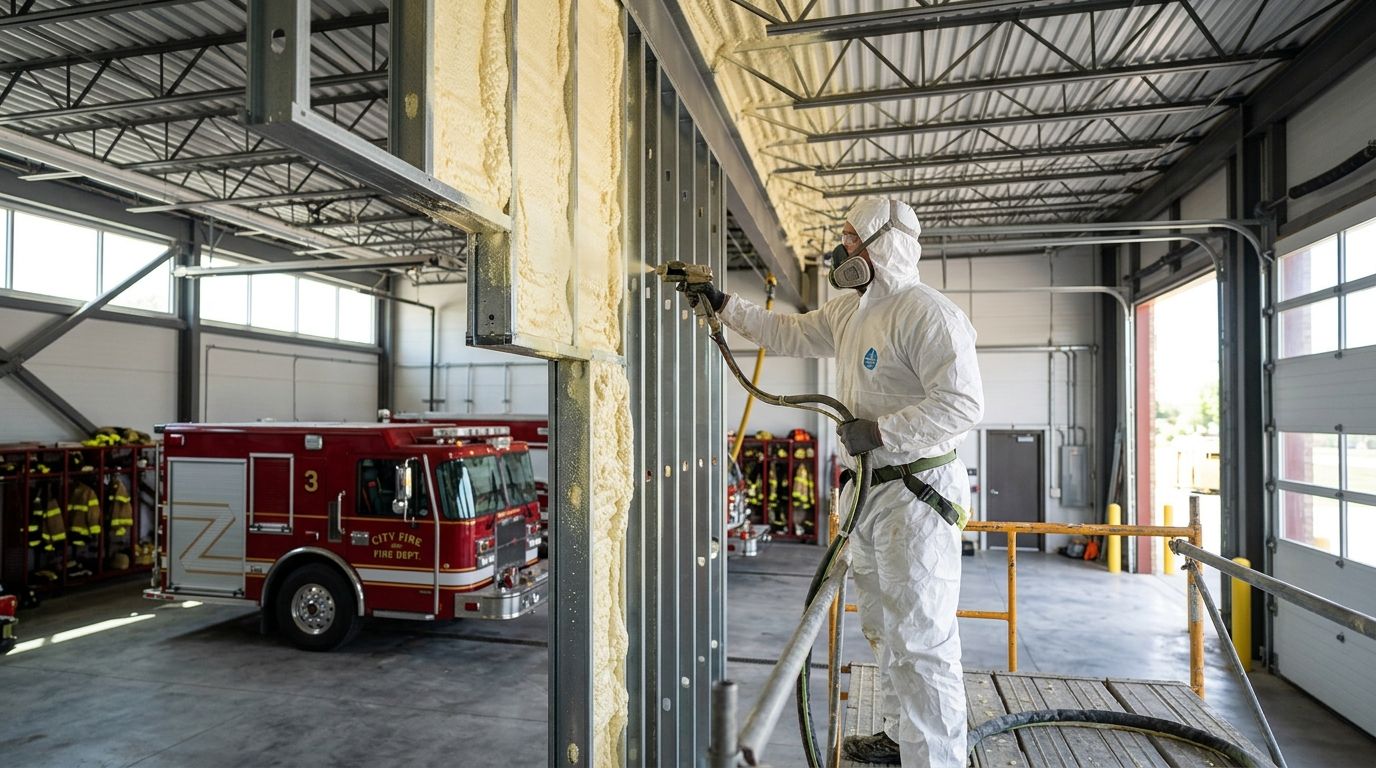
Spray foam insulation for fire halls and municipal buildings is a code-compliant retrofit that seals apparatus bays, dorm areas, and mechanical rooms against Alberta's temperature swings while meeting the fire-rated barrier rules municipal facilities answer to. Fire halls run on a different schedule than a typical commercial building — crews are on shift around the clock, bay doors open dozens of times a day, and any insulation upgrade has to work around live operations, not a closed storefront.
- Spray foam insulation fire hall retrofits require a thermal or ignition barrier under Alberta fire code before final sign-off.
- Apparatus bay doors and mezzanine gaps are the biggest heat-loss points in most Calgary-area fire halls.
- Municipal buyers should confirm contractor WCB coverage and liability insurance before a scope of work is signed.
- Closed-cell foam handles below-grade and vapor-exposed walls; open-cell handles interior partitions and sound control.
- 2026 procurement cycles favor contractors who can document R-value and fire-code compliance in writing.
Why spray foam insulation matters for fire halls and municipal buildings
A fire hall apparatus bay is effectively a heated warehouse with a 12-to-14-foot door that opens and closes on every call. Every time that door lifts in a Calgary or High River winter, conditioned air leaves and cold air replaces it — no insulation spec fixes that physics, but the right assembly cuts how much energy it takes to recover.
Municipal buildings also carry a compliance layer homeowners don't deal with. Any foam installed in an occupied space needs to meet fire code requirements for spray foam insulation — typically an intumescent coating or drywall thermal barrier over exposed foam in working and sleeping areas. A facilities manager who skips this step fails inspection, and a failed inspection on a public building is a longer, more public problem than on a private home.
Dorm rooms, admin offices, and training rooms in a fire hall need different treatment than the bay itself. Dorms need quiet and consistent temperature for crews sleeping on rotating shifts. Admin space needs standard commercial comfort. The bay needs air-sealing and moisture control more than raw R-value, because vehicle exhaust and wash-down water make vapor management the real issue in 2026 retrofits.
Confirm fire code and thermal barrier requirements first
Do this before a single litre of foam gets sprayed, not after.
- Pull the building's occupancy classification from the municipality's own records — fire halls are typically treated as mixed-use with working and storage components.
- Ask whether exposed foam in the apparatus bay needs an ignition barrier coating or a full thermal barrier equivalent to drywall.
- Check whether the building's last fire inspection flagged any existing insulation or vapor barrier issues.
- Get the sign-off criteria in writing from the authority having jurisdiction before scheduling install dates.
Map the building's thermal weak points
A walk-through before quoting catches problems a blueprint won't show.
- Check bay door perimeters and weatherstripping — usually the single biggest air-leak source in a fire hall.
- Inspect the mezzanine or loft above the bay, which often has no insulation at all in older halls.
- Look at the dorm and admin wall assemblies for gaps around plumbing and electrical penetrations.
- Check the roofline where the bay ceiling meets the admin wing — this transition is a common thermal bridge.
- Note any exposed rim joists or crawl space areas below grade-level offices.
Choose foam type by zone, not for the whole building
Fire halls rarely need one foam type throughout. Matching the product to the zone controls cost and performance better than a blanket spec.
- Use closed-cell spray foam on below-grade walls, rim joists, and anywhere vapor control matters — it also adds rigidity to older masonry.
- Use open-cell spray foam on interior partition walls between dorm rooms and common areas for sound dampening.
- Reserve rigid board with a fire-rated facing for ceiling assemblies where inspectors want a visible, documented rating without spray application.
- Treat the apparatus bay ceiling and exterior walls as closed-cell candidates given exhaust exposure and Alberta's freeze-thaw cycle.
- Avoid mixing vapor-permeable and vapor-closed assemblies on the same wall without a design review.
Schedule around 24/7 fire hall operations
A fire hall can't close for a retrofit the way a retail unit can. Planning around live response schedules is the difference between a smooth job and a disrupted one.
- Phase the work by wing — admin and dorm areas first, apparatus bay in a separate visit — so response capability never fully shuts down.
- Schedule bay-door work during lower call-volume windows if the department can share historical dispatch data.
- Confirm ventilation and re-entry timelines with the crew before they return to sprayed areas; this matters more in a building people sleep in.
- Coordinate with the department's maintenance staff so alarm and dispatch equipment aren't disturbed during spraying.
Verify contractor insurance and WCB coverage before signing
Municipal procurement has a different risk bar than a homeowner job, and it should.
- Ask for current WCB clearance and liability insurance certificates, not a verbal assurance — choosing an insulation contractor with WCB coverage in Alberta is a procurement checklist item.
- Request references from at least one prior commercial or municipal job, not only residential work.
- Confirm coverage for working in an occupied public building, including after-hours access protocols.
- Get manufacturer spec sheets for the exact foam product proposed, not a generic brochure.
Aztec Spray Systems is a licensed and insured spray foam insulation contractor serving commercial and municipal properties in Calgary, Okotoks, High River, and Lethbridge — a fit for facilities managers who need documentation, not just a quote, before a purchase order clears.
Get a municipal facility quote
Scope, code compliance, and phased scheduling for fire halls and public buildings.
Plan for inspection documentation and asset records
A municipal building's paper trail outlives the crew that approved the job.
- Keep manufacturer spec sheets and R-value documentation on file in the building's asset management system.
- Request post-install photos of any thermal or ignition barrier application for inspection records.
- Log the install date and product batch numbers in case a warranty question comes up years later.
- File the final fire sign-off alongside the insulation documentation, not in a separate department.
Re-check the envelope after the first winter
One heating season tells you more than any pre-install model.
- Walk the bay on a cold morning in early 2026 and look for frost lines or condensation at wall-to-roof transitions.
- Ask crews which rooms still run hot or cold — dorms are the most reliable early-warning system in the building.
- Compare utility bills for the same months before and after the retrofit rather than year-to-date totals.
Comparing insulation options for a fire hall or municipal building
| Option | Best for | Key limitation |
|---|---|---|
| Closed-cell spray foam | Apparatus bays, below-grade walls, vapor-exposed zones | Needs a code-approved thermal or ignition barrier before occupancy |
| Open-cell spray foam | Interior dorm and partition walls, sound control | Lower R-value per inch, not a vapor barrier on its own |
| Rigid board with fire-rated facing | Ceiling assemblies needing a visible, documented rating | More labour and more seams to air-seal than sprayed foam |
| Fiberglass batt | Budget-constrained retrofits on a multi-year capital plan | Loses performance with moisture and settles in older buildings |
Closed-cell spray foam wins for the apparatus bay and any below-grade wall; open-cell wins for dorm partitions where sound matters more than vapor control. Neither choice replaces the fire inspection sign-off — that step happens regardless of product.
“A fire hall is three buildings under one roof, and one insulation spec for all three under-performs in all three.”
Common mistakes municipal buildings make with spray foam retrofits
- Treating the whole building as one zone. The bay, dorm, and admin sections have different moisture and sound needs; a blanket spec leaves gaps everywhere.
- Leaving the fire code conversation until after the quote. Reworking a scope after a failed inspection costs more than getting the barrier requirement right at the start.
- Ignoring the mezzanine. Older halls that added storage above the bay often have zero insulation up there, and crews complain about the hot or cold spot for years.
- Accepting verbal insurance assurances. A WCB clearance certificate holds up in a procurement audit; a phone conversation does not.
- Booking the whole job in one visit. Shutting down apparatus bay access entirely, even for a day, creates operational risk that phased scheduling avoids.
FAQ
Does spray foam insulation meet fire code in a fire hall?
Spray foam meets code in occupied buildings only when exposed foam is covered by an approved thermal or ignition barrier, such as an intumescent coating or drywall. The building’s occupancy classification determines which barrier applies, so confirm it with the authority having jurisdiction before install.
What’s the best spray foam for a fire hall apparatus bay?
Closed-cell spray foam works best for apparatus bays because it manages vapor from vehicle exhaust and wash-down water while adding rigidity to older masonry walls. It still requires a code-approved barrier over any exposed surface.
Can a fire hall stay operational during a spray foam retrofit?
Yes, when the job is phased by wing so admin and dorm areas are done separately from the apparatus bay. Ventilation and re-entry timelines should be confirmed with crews before they return to sprayed rooms.
Is open-cell or closed-cell foam better for a fire hall dorm room?
Open-cell spray foam is generally better for interior dorm and partition walls because it dampens sound between rooms where crews sleep on rotating shifts. Closed-cell is reserved for below-grade and vapor-exposed zones.
What documentation should a municipality request before a spray foam job?
Request current WCB clearance, liability insurance certificates, manufacturer spec sheets for the exact product proposed, and references from a prior commercial or municipal job. That paperwork matters for procurement audits and long-term asset records.
How much does spray foam insulation cost for a municipal building?
Cost depends on square footage, foam type, and how much of the building needs a fire-rated barrier over exposed foam. Ask for a written scope that separates bay, dorm, and admin zones so the line items are comparable between bidders.
Does spray foam insulation reduce fire hall energy costs?
Spray foam reduces losses from air infiltration around bay doors, mezzanine gaps, and wall penetrations, which are the largest heat-loss points in most fire halls. The bay door still dumps conditioned air on every call, regardless of wall insulation.
Who insulates municipal buildings in Calgary and area?
Aztec Spray Systems provides licensed and insured spray foam insulation for commercial and municipal properties in Calgary, Okotoks, High River, and Lethbridge, Alberta. Confirm WCB coverage and insurance documentation as part of the scope before signing.
One last thing
The mezzanine above the apparatus bay gets missed more than any other zone in a fire hall retrofit — it's usually built after the original insulation plan and rarely re-inspected. Checking it costs nothing during a 2026 walk-through and often turns up the single biggest gap in the whole building's thermal envelope.
Related guides
- Spray foam insulation for recreation centers and gyms
- Spray foam insulation for churches and community halls
- How to prepare a commercial building for a spray foam retrofit