.pseo-content { font-size: 17px; line-height: 1.7; color: inherit; }
.pseo-content h2 { font-size: 1.6em; margin-top: 1.8em; margin-bottom: 0.6em; line-height: 1.3; color: inherit; }
.pseo-content h3 { font-size: 1.25em; margin-top: 1.5em; margin-bottom: 0.4em; line-height: 1.35; color: inherit; }
.pseo-content h4 { color: inherit; }
.pseo-content p { margin: 0 0 1em; }
.pseo-content ul, .pseo-content ol { margin: 0 0 1em 1.4em; padding: 0; }
.pseo-content li { margin: 0.3em 0; }
.pseo-content strong { font-weight: 600; }
.pseo-content blockquote { margin: 1.2em 0; padding: 0.6em 1em; border-left: 3px solid color-mix(in srgb, currentColor 30%, transparent); background: color-mix(in srgb, currentColor 4%, transparent); color: inherit; }
.pseo-content a { text-decoration: underline; }
.pseo-content .pseo-table-wrap { overflow-x: auto; margin: 1.4em 0; -webkit-overflow-scrolling: touch; }
.pseo-content table { width: 100% !important; border-collapse: collapse !important; table-layout: auto !important; font-size: 0.96em; }
.pseo-content table th,
.pseo-content table td {
padding: 10px 12px !important;
border-bottom: 1px solid color-mix(in srgb, currentColor 14%, transparent) !important;
border-left: none !important;
border-right: none !important;
vertical-align: top !important;
text-align: left !important;
word-break: break-word !important;
overflow-wrap: anywhere !important;
white-space: normal !important;
}
.pseo-content table th {
background: color-mix(in srgb, currentColor 6%, transparent) !important;
color: inherit !important;
font-weight: 600 !important;
border-top: 1px solid color-mix(in srgb, currentColor 14%, transparent) !important;
}
.pseo-content table tr:last-child td { border-bottom: 1px solid color-mix(in srgb, currentColor 14%, transparent) !important; }
A sunken driveway slab in Calgary or Okotoks isn't just an eyesore — it's a trip hazard, a drainage problem pointing water at your foundation, and proof the soil underneath has moved. This guide breaks down which concrete lifting method actually fixes a sunken driveway in 2026, and which ones just buy you a season before the crack reopens.
- Polyurethane foam injection is the 2026 pick for most sunken Alberta driveways — Buy.
- Mudjacking still works on non-structural slabs but cures slower and adds real weight — Consider.
- Full slab replacement only pencils out when the concrete has cracked into three or more pieces — Consider.
- Caulk and leveling compound hide the gap, they don’t perform concrete lifting on a sunken driveway — Skip.
Why this matters
Alberta clay swells and shrinks with moisture, and chinook winters put driveway slabs through repeated freeze-thaw stress that most of the country never sees. That combination is why a slab that looked level in 2023 can drop an inch or two by 2026, usually right at the joint closest to a downspout.
A sunken section isn't cosmetic. It channels runoff toward the garage door or foundation wall instead of away from it, and an uneven edge is the kind of thing insurance adjusters and home inspectors flag during a sale. Fixing the slope now is cheaper than fixing a wet basement later.
Who this is for
This guide is for homeowners in Calgary, Okotoks, High River, and Lethbridge with a driveway, walkway, or garage apron that has settled an inch or more at a joint, is cracked but not shattered, and still has enough structural concrete left to lift rather than replace. If you're comparing insulation upgrades at the same time, the Okotoks homeowners and High River service pages cover what else settles and shifts in these soil conditions.
If your slab is heaved upward, honeycombed with rebar exposed, or thinner than 3 inches, lifting won't hold and you're in replacement territory — the picks below flag that.
What to look for in concrete lifting for a sunken driveway
Soil type under the slab
Clay soil compacts differently than granular fill, and a lifting method that works on sand can fail on wet clay within a year. Ask what's under your slab before picking a method — a quick probe or the original build spec usually tells you.
Cure time and return-to-use window
A driveway you can't park on for two days is a real cost if it's your only access. Foam-based lifting typically lets you drive on the slab within 15 minutes; slurry-based methods need 24 to 48 hours to set up enough load capacity.
Added weight going back under the slab
Whatever fills the void has to carry the slab without adding new load the soil can't support. Lightweight expanding foam adds ounces per cubic foot; cement-based slurry adds closer to 100 pounds per cubic foot, which can restart the settling cycle on soft soil.
Freeze-thaw stability
Alberta driveways go through more freeze-thaw cycles per winter than almost anywhere else in Canada. A fill material that stays flexible and doesn't absorb water resists re-cracking better than one that's porous.
Cost per square foot lifted
Cost varies by how much lift is needed and how much of the driveway is affected, but get a per-square-foot number in writing before work starts — not a flat "driveway price" that hides how much concrete lifting actually happens.
Get a driveway assessment
Find out if your slab is a lift or a replace before you spend a dollar.
Top picks for lifting a sunken driveway
Polyurethane foam injection — the modern standard
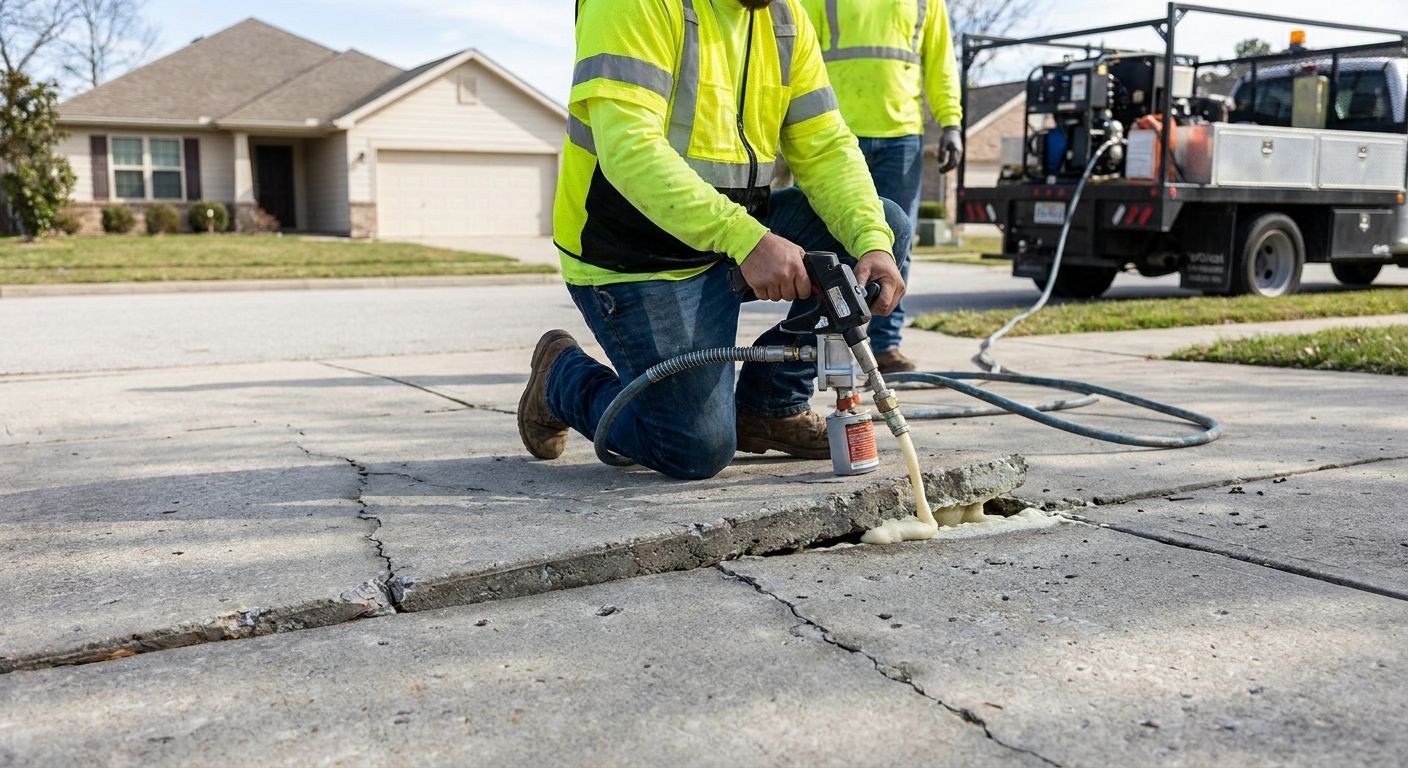
Expanding polyurethane foam gets pumped through small injection holes, expands to fill voids under the slab, and lifts the concrete back to grade. It's the lightest-weight option on this list and the fastest to cure — most driveways are drive-ready in about 15 minutes. Verdict: Buy — this is the method behind most 2026 Aztec Spray Systems concrete lifting jobs for exactly this reason.
Mudjacking — the old reliable
A cement, sand, and water slurry gets pumped under the slab through larger holes than foam injection uses. It's a proven approach that's been around for decades and can work well on driveways with granular fill underneath, but the slurry weighs far more than foam and needs 24 to 48 hours before you can drive on it. Verdict: Consider — fine on stable soil, riskier on Alberta clay.
Full slab replacement — the nuclear option
When a slab has fractured into three or more pieces, has exposed rebar, or is thinner than the 3 to 4 inches needed to hold injection pressure, lifting isn't an option and tearing out the concrete is the only real fix. Replacement commonly runs well above the cost of lifting per square foot in Alberta. Verdict: Consider — only when the slab itself is failing, not just settled.
Self-leveling caulk or patch compound — the temporary patch
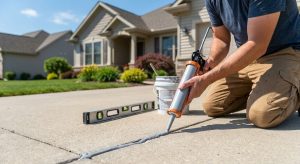
Surface-level polyurethane caulk and leveling compound fill small gaps and trip-hazard edges but do nothing to address the void under the slab causing the sink. They're a stopgap for a gap under a quarter inch, not concrete lifting. Verdict: Skip — it hides the problem for one season, then the edge reopens.
What to avoid
- DIY leveling compound as a permanent fix. It looks fine for a few months, then the underlying void reasserts itself and the crack comes back wider.
- Contractors without proof of insurance in Alberta. Concrete lifting involves pressurized injection near gas lines, water lines, and foundations — an uninsured crew is a liability you're taking on, not them.
- Ignoring the downspout or grading that caused the settling. Lifting the slab without fixing where the water goes just resets the clock on the same failure.
Method comparison for 2026
| Method | Cure time | Added weight | Best for | Verdict |
|---|---|---|---|---|
| Polyurethane foam injection | ~15 minutes | Very light | Most sunken driveways, clay or fill soil | Buy |
| Mudjacking | 24-48 hours | Heavy | Stable granular soil, non-structural slabs | Consider |
| Full replacement | Days (cure + cure) | N/A, new pour | Fractured or undersized slabs | Consider |
| Caulk/leveling compound | Hours | None | Cosmetic gaps under 1/4 inch | Skip |
FAQ
How much does concrete lifting cost for a sunken driveway?
Cost depends on how much square footage needs lifting and how deep the void under the slab is, priced per square foot rather than as a flat driveway rate. Get a written per-square-foot number and a site visit before comparing quotes.
Is polyurethane foam injection better than mudjacking for a driveway?
For most Alberta driveways, yes — foam injection cures in about 15 minutes versus 24 to 48 hours for mudjacking slurry and adds far less weight to soil that’s already unstable. Mudjacking still works on stable granular soil under non-structural slabs.
How long does concrete lifting last?
A properly injected slab on stable, well-drained soil can hold its lift for many years, but the fix only lasts as long as the drainage problem that caused the sinking gets addressed too. Regrading and downspout extensions protect the repair.
Can you drive on a driveway right after concrete lifting?
With polyurethane foam injection, yes — most slabs are drive-ready within about 15 minutes because the foam reaches load-bearing strength almost immediately. Mudjacking needs 24 to 48 hours before the slab can safely carry vehicle weight.
Does concrete lifting work in an Alberta winter?
Polyurethane foam injection can be done in colder temperatures than mudjacking because the foam isn’t water-based and doesn’t need warm curing conditions the way cement slurry does. Extreme cold or a frozen, snow-covered slab still limits access for either method.
What’s the difference between mudjacking and slabjacking?
Mudjacking and slabjacking are the same process by different names — pumping a cement-based slurry under a sunken slab to raise it. Both refer to the traditional method, as opposed to polyurethane foam injection.
Do I need a permit to lift a sunken driveway in Calgary?
Concrete lifting typically doesn’t require a permit because it repairs an existing slab rather than adding new structure, but confirm with your municipality if the driveway ties into a shared property line or easement. Full replacement is more likely to need one.
Will lifting my driveway fix the drainage problem too?
Lifting restores the slope the slab had when it was poured, which usually fixes water pooling caused by settling. It won’t fix drainage issues caused by grading, downspouts, or a swale that was never right in the first place.
One last thing
The corner of a driveway closest to a downspout is almost always the first to sink, because that's where the most water hits the soil underneath year after year. Extend the downspout before you book the lift — otherwise you're paying to fix the same corner again in a few years.
Related guides
{“@context”:”https://schema.org”,”@type”:”FAQPage”,”mainEntity”:[{“@type”:”Question”,”name”:”How much does concrete lifting cost for a sunken driveway?”,”acceptedAnswer”:{“@type”:”Answer”,”text”:”Cost depends on how much square footage needs lifting and how deep the void under the slab is, priced per square foot rather than as a flat driveway rate. Get a written per-square-foot number and a site visit before comparing quotes.”}},{“@type”:”Question”,”name”:”Is polyurethane foam injection better than mudjacking for a driveway?”,”acceptedAnswer”:{“@type”:”Answer”,”text”:”For most Alberta driveways, yes — foam injection cures in about 15 minutes versus 24 to 48 hours for mudjacking slurry and adds far less weight to soil that’s already unstable. Mudjacking still works on stable granular soil under non-structural slabs.”}},{“@type”:”Question”,”name”:”How long does concrete lifting last?”,”acceptedAnswer”:{“@type”:”Answer”,”text”:”A properly injected slab on stable, well-drained soil can hold its lift for many years, but the fix only lasts as long as the drainage problem that caused the sinking gets addressed too. Regrading and downspout extensions protect the repair.”}},{“@type”:”Question”,”name”:”Can you drive on a driveway right after concrete lifting?”,”acceptedAnswer”:{“@type”:”Answer”,”text”:”With polyurethane foam injection, yes — most slabs are drive-ready within about 15 minutes because the foam reaches load-bearing strength almost immediately. Mudjacking needs 24 to 48 hours before the slab can safely carry vehicle weight.”}},{“@type”:”Question”,”name”:”Does concrete lifting work in an Alberta winter?”,”acceptedAnswer”:{“@type”:”Answer”,”text”:”Polyurethane foam injection can be done in colder temperatures than mudjacking because the foam isn’t water-based and doesn’t need warm curing conditions the way cement slurry does. Extreme cold or a frozen, snow-covered slab still limits access for either method.”}},{“@type”:”Question”,”name”:”What’s the difference between mudjacking and slabjacking?”,”acceptedAnswer”:{“@type”:”Answer”,”text”:”Mudjacking and slabjacking are the same process by different names — pumping a cement-based slurry under a sunken slab to raise it. Both refer to the traditional method, as opposed to polyurethane foam injection.”}},{“@type”:”Question”,”name”:”Do I need a permit to lift a sunken driveway in Calgary?”,”acceptedAnswer”:{“@type”:”Answer”,”text”:”Concrete lifting typically doesn’t require a permit because it repairs an existing slab rather than adding new structure, but confirm with your municipality if the driveway ties into a shared property line or easement. Full replacement is more likely to need one.”}},{“@type”:”Question”,”name”:”Will lifting my driveway fix the drainage problem too?”,”acceptedAnswer”:{“@type”:”Answer”,”text”:”Lifting restores the slope the slab had when it was poured, which usually fixes water pooling caused by settling. It won’t fix drainage issues caused by grading, downspouts, or a swale that was never right in the first place.”}}]}