.pseo-content { font-size: 17px; line-height: 1.7; color: inherit; }
.pseo-content h2 { font-size: 1.6em; margin-top: 1.8em; margin-bottom: 0.6em; line-height: 1.3; color: inherit; }
.pseo-content h3 { font-size: 1.25em; margin-top: 1.5em; margin-bottom: 0.4em; line-height: 1.35; color: inherit; }
.pseo-content h4 { color: inherit; }
.pseo-content p { margin: 0 0 1em; }
.pseo-content ul, .pseo-content ol { margin: 0 0 1em 1.4em; padding: 0; }
.pseo-content li { margin: 0.3em 0; }
.pseo-content strong { font-weight: 600; }
.pseo-content blockquote { margin: 1.2em 0; padding: 0.6em 1em; border-left: 3px solid color-mix(in srgb, currentColor 30%, transparent); background: color-mix(in srgb, currentColor 4%, transparent); color: inherit; }
.pseo-content a { text-decoration: underline; }
.pseo-content .pseo-table-wrap { overflow-x: auto; margin: 1.4em 0; -webkit-overflow-scrolling: touch; }
.pseo-content table { width: 100% !important; border-collapse: collapse !important; table-layout: auto !important; font-size: 0.96em; }
.pseo-content table th,
.pseo-content table td {
padding: 10px 12px !important;
border-bottom: 1px solid color-mix(in srgb, currentColor 14%, transparent) !important;
border-left: none !important;
border-right: none !important;
vertical-align: top !important;
text-align: left !important;
word-break: break-word !important;
overflow-wrap: anywhere !important;
white-space: normal !important;
}
.pseo-content table th {
background: color-mix(in srgb, currentColor 6%, transparent) !important;
color: inherit !important;
font-weight: 600 !important;
border-top: 1px solid color-mix(in srgb, currentColor 14%, transparent) !important;
}
.pseo-content table tr:last-child td { border-bottom: 1px solid color-mix(in srgb, currentColor 14%, transparent) !important; }
Foundation settling in Calgary, Okotoks, High River, and Lethbridge usually comes down to one culprit: Alberta's clay-heavy soil expanding and contracting through freeze-thaw cycles. The right leveling method depends on whether you're dealing with a sunken slab or actual structural settlement, and picking the wrong one wastes money without fixing the problem.
- Polyurethane foam injection is the best concrete leveling method for foundation settling in most Alberta homes in 2026 — buy it.
- Mudjacking still works for budget slab repairs but takes 24-48 hours to cure versus about 15 minutes for foam.
- Helical piers are the right call only when settlement is structural, not surface-level — confirm with an inspection first.
- Self-leveling compound and slab replacement are last resorts, not fixes for a settling foundation.
Why this matters
A slab that's dropped more than an inch usually signals soil movement underneath it, not just cosmetic settling. Ignore it and water starts pooling toward the house instead of away from it, which accelerates the exact erosion that caused the drop in the first place.
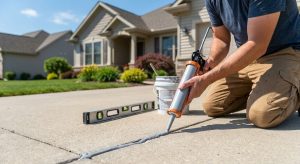
Aztec Spray Systems sees this pattern constantly on sunken driveways across southern Alberta, where a slab drops an inch or two over a single freeze-thaw season. The fix isn't always obvious, because three or four leveling methods can technically move a slab back into place — only one usually does it without cracking the concrete further or costing you a second repair in 2027.
The methods below get ranked on lift mechanism, cure time, how well they hold up through an Alberta winter, and whether they're built for cosmetic slabs or actual foundation-bearing soil.
How this list is ranked
Each method is evaluated on four criteria: how it physically lifts the slab, how long before the surface is load-bearing again, whether it's rated for structural foundation settlement or just cosmetic slab drop, and how it performs against Alberta's freeze-thaw cycle specifically. Methods that only address the symptom — a dropped slab — without stabilizing the soil underneath get marked down, even if they're cheap.
This isn't a lab test. It's a comparison built from how these methods perform in the field, on the same soil types and climate conditions found in Calgary, Okotoks, High River, and Lethbridge. If a method needs perfect drainage or mild winters to hold up, that's a mark against it here.
The ranked list
1. Polyurethane foam injection — the modern standard
High-density polyurethane foam gets injected through small holes drilled into the slab, expanding roughly 20 to 30 times its liquid volume as it cures. That expansion is what lifts the concrete back into position without adding the weight that mud slurry does.
The foam reaches full compressive strength in about 15 minutes and the slab is typically walkable within the hour. That speed matters in Alberta, where a narrow weather window between freeze-thaw events can close fast in October or March.
On a garage floor slab, foam injection avoids the added dead weight that heavier materials bring, which matters when the floor is already sitting on compromised soil. Verdict: Buy. This is the default recommendation for most residential slab settling in 2026.
2. Mudjacking — the old workhorse
Mudjacking pumps a cement-based slurry underneath the slab to raise it, and it's been the standard method for decades. It costs less upfront per job than polyurethane foam, which is why it's still requested.
The tradeoff is cure time and weight. The slurry mix needs 24 to 48 hours before it can bear load, and it adds significant mass under the slab — mass that can compress soft or saturated soil further over time. In Alberta's clay soils, that extra weight can contribute to a repeat settling event within a few years.
Verdict: Hold. Reasonable for a one-time budget fix on a low-traffic slab, but not the first choice for a property with a documented settling pattern.
3. Helical pier underpinning — the structural fix
Helical piers get screwed into the ground, typically 15 to 30 feet down, until they hit load-bearing soil or bedrock. Brackets then transfer the structure's weight onto the piers instead of the unstable soil near the surface.
This is the right call when settlement is structural — when it's the actual foundation wall or footing moving, not a detached slab like a patio or driveway. It's engineered, permanent, and overkill for a sunken sidewalk.
Verdict: Consider. Only pursue this after a structural inspection confirms the movement is foundation-level, not slab-level.
4. Steel push piers — the heavy-duty pier
Push piers work on the same underpinning principle as helical piers but get hydraulically driven straight down rather than screwed in, which makes them suited to heavier structures and commercial applications.
They're common on larger footprints where the load per pier is higher, including some of the settings covered under commercial parking lot lifting. For a typical residential patio or walkway, they're more pier than the job needs.
Verdict: Consider for commercial or heavy-load structural settlement, Skip for standard residential slabs.
5. Self-leveling compound — the surface patch
Self-leveling compound is poured over a slab to smooth out minor unevenness, mostly used indoors before flooring installation. It does nothing to address soil movement underneath — it just hides the symptom on top.
If the underlying settling continues, the new compound cracks along with the slab it's covering. Verdict: Skip for any exterior slab or genuine foundation settling issue. It has a place indoors before flooring goes down, and nowhere else on this list.
6. Full slab replacement — the nuclear option
Demolishing and repouring makes sense when a slab has shattered into multiple pieces or the concrete itself has failed structurally, not just settled. It's the most expensive and disruptive option on this list, and it doesn't fix the soil issue that caused the original settling.
A patio or pool deck that's simply dropped a couple inches rarely needs replacement — it needs lifting. Verdict: Skip unless the concrete is cracked beyond repair.
Get your slab assessed before it worsens
Aztec Spray Systems evaluates settling slabs across Calgary, Okotoks, High River, and Lethbridge.
Comparison at a glance
| Method | Best for | Cure time | Structural rating |
|---|---|---|---|
| Polyurethane foam injection | Sunken slabs, driveways, patios | ~15 minutes | Slab-level |
| Mudjacking | Low-traffic, budget slab fixes | 24-48 hours | Slab-level |
| Helical piers | True foundation/footing settlement | Weeks (engineered install) | Foundation-level |
| Steel push piers | Commercial and heavy-load structures | Weeks (engineered install) | Foundation-level |
| Self-leveling compound | Interior floor smoothing only | Hours | Cosmetic only |
| Slab replacement | Shattered or failed concrete | Days to weeks | Slab-level |
Where to find a contractor for this
- Confirm the crew handles both slab-level lifting and can identify when a problem is actually structural — a contractor that only does one method will recommend that method regardless of what your slab needs.
- Ask what soil type they're accounting for. Alberta's expansive clay behaves differently than sandy or gravel soil, and a method that works in one won't necessarily hold in the other through a 2026-2027 winter.
- Get a written scope that names the specific slab or area — a driveway, a garage floor, a commercial lot — rather than a vague "concrete repair" line item. Aztec Spray Systems scopes concrete lifting jobs by structure type for exactly this reason, including work on commercial sites.
FAQ
What is the best concrete leveling method for foundation settling in 2026?
Polyurethane foam injection is the best method for most slab-level foundation settling in 2026, because it cures in about 15 minutes and adds minimal weight to already-unstable soil. Structural foundation settlement, as opposed to a dropped slab, needs helical or push piers instead.
Is mudjacking still worth it in 2026?
Mudjacking still works for low-traffic, budget slab repairs, but it takes 24 to 48 hours to cure and adds more weight under the slab than polyurethane foam. It’s a reasonable one-time fix, not the best option for a property with repeat settling.
How do I know if my settling is structural or just a sunken slab?
A detached slab — a driveway, patio, or sidewalk not physically attached to the house — is slab-level settling and gets fixed with foam injection or mudjacking. If the foundation wall itself, a footing, or an attached structure is moving, that’s structural and needs a pier system after an inspection.
How deep do helical piers need to go in Alberta soil?
Helical piers typically get driven 15 to 30 feet down until they reach load-bearing soil or bedrock. The exact depth depends on the soil profile at the specific property, which is why an inspection comes before pier installation.
Can I use self-leveling compound to fix a sunken driveway?
No, self-leveling compound is meant for interior floor smoothing before flooring installation, not exterior slabs experiencing soil-driven settling. It sits on top of the problem and cracks again once the slab keeps moving underneath it.
Does polyurethane foam injection work in cold Alberta winters?
Polyurethane foam cures fast enough to work within Alberta’s narrow shoulder-season weather windows, unlike mudjacking’s 24 to 48 hour cure time. Most concrete lifting work still gets scheduled for warmer months when the ground isn’t frozen.
When should I replace a slab instead of lifting it?
Replace a slab only when the concrete itself has cracked into multiple pieces or structurally failed, not simply because it has settled a couple inches. A dropped but intact slab almost always gets fixed by lifting it back into place instead.
One last thing
Most homeowners wait until a slab has dropped 2 or 3 inches before calling anyone, but the settling gap that actually predicts trouble is smaller than that — a 1-inch drop across a slab is usually the point where water starts running toward the foundation instead of away from it. Catching it at that stage is the difference between a same-day foam injection and a multi-week pier installation in 2026.
Related guides
{“@context”:”https://schema.org”,”@type”:”FAQPage”,”mainEntity”:[{“@type”:”Question”,”name”:”What is the best concrete leveling method for foundation settling in 2026?”,”acceptedAnswer”:{“@type”:”Answer”,”text”:”Polyurethane foam injection is the best method for most slab-level foundation settling in 2026, because it cures in about 15 minutes and adds minimal weight to already-unstable soil. Structural foundation settlement, as opposed to a dropped slab, needs helical or push piers instead.”}},{“@type”:”Question”,”name”:”Is mudjacking still worth it in 2026?”,”acceptedAnswer”:{“@type”:”Answer”,”text”:”Mudjacking still works for low-traffic, budget slab repairs, but it takes 24 to 48 hours to cure and adds more weight under the slab than polyurethane foam. It’s a reasonable one-time fix, not the best option for a property with repeat settling.”}},{“@type”:”Question”,”name”:”How do I know if my settling is structural or just a sunken slab?”,”acceptedAnswer”:{“@type”:”Answer”,”text”:”A detached slab — a driveway, patio, or sidewalk not physically attached to the house — is slab-level settling and gets fixed with foam injection or mudjacking. If the foundation wall itself, a footing, or an attached structure is moving, that’s structural and needs a pier system after an inspection.”}},{“@type”:”Question”,”name”:”How deep do helical piers need to go in Alberta soil?”,”acceptedAnswer”:{“@type”:”Answer”,”text”:”Helical piers typically get driven 15 to 30 feet down until they reach load-bearing soil or bedrock. The exact depth depends on the soil profile at the specific property, which is why an inspection comes before pier installation.”}},{“@type”:”Question”,”name”:”Can I use self-leveling compound to fix a sunken driveway?”,”acceptedAnswer”:{“@type”:”Answer”,”text”:”No, self-leveling compound is meant for interior floor smoothing before flooring installation, not exterior slabs experiencing soil-driven settling. It sits on top of the problem and cracks again once the slab keeps moving underneath it.”}},{“@type”:”Question”,”name”:”Does polyurethane foam injection work in cold Alberta winters?”,”acceptedAnswer”:{“@type”:”Answer”,”text”:”Polyurethane foam cures fast enough to work within Alberta’s narrow shoulder-season weather windows, unlike mudjacking’s 24 to 48 hour cure time. Most concrete lifting work still gets scheduled for warmer months when the ground isn’t frozen.”}},{“@type”:”Question”,”name”:”When should I replace a slab instead of lifting it?”,”acceptedAnswer”:{“@type”:”Answer”,”text”:”Replace a slab only when the concrete itself has cracked into multiple pieces or structurally failed, not simply because it has settled a couple inches. A dropped but intact slab almost always gets fixed by lifting it back into place instead.”}}]}