.pseo-content { font-size: 17px; line-height: 1.7; color: inherit; }
.pseo-content h2 { font-size: 1.6em; margin-top: 1.8em; margin-bottom: 0.6em; line-height: 1.3; color: inherit; }
.pseo-content h3 { font-size: 1.25em; margin-top: 1.5em; margin-bottom: 0.4em; line-height: 1.35; color: inherit; }
.pseo-content h4 { color: inherit; }
.pseo-content p { margin: 0 0 1em; }
.pseo-content ul, .pseo-content ol { margin: 0 0 1em 1.4em; padding: 0; }
.pseo-content li { margin: 0.3em 0; }
.pseo-content strong { font-weight: 600; }
.pseo-content blockquote { margin: 1.2em 0; padding: 0.6em 1em; border-left: 3px solid color-mix(in srgb, currentColor 30%, transparent); background: color-mix(in srgb, currentColor 4%, transparent); color: inherit; }
.pseo-content a { text-decoration: underline; }
.pseo-content .pseo-table-wrap { overflow-x: auto; margin: 1.4em 0; -webkit-overflow-scrolling: touch; }
.pseo-content table { width: 100% !important; border-collapse: collapse !important; table-layout: auto !important; font-size: 0.96em; }
.pseo-content table th,
.pseo-content table td {
padding: 10px 12px !important;
border-bottom: 1px solid color-mix(in srgb, currentColor 14%, transparent) !important;
border-left: none !important;
border-right: none !important;
vertical-align: top !important;
text-align: left !important;
word-break: break-word !important;
overflow-wrap: anywhere !important;
white-space: normal !important;
}
.pseo-content table th {
background: color-mix(in srgb, currentColor 6%, transparent) !important;
color: inherit !important;
font-weight: 600 !important;
border-top: 1px solid color-mix(in srgb, currentColor 14%, transparent) !important;
}
.pseo-content table tr:last-child td { border-bottom: 1px solid color-mix(in srgb, currentColor 14%, transparent) !important; }
Sunken driveways, tilted sidewalk slabs, and patios that pool water after every spring melt are the most common concrete complaints Aztec Spray Systems sees across southern Alberta, and Lethbridge properties get hit harder than most because of the clay-heavy soil and constant chinook freeze-thaw swings. Concrete lifting in Lethbridge raises and stabilizes existing slabs with polyurethane foam injection instead of tearing them out, and this guide walks through who it's actually for, what separates a good lift from a wasted repair, and where a slab is too far gone to save.
- Polyurethane foam lifting is the right call for concrete lifting Lethbridge properties with settling under about 2 inches — Buy.
- Sunken driveways and heaving sidewalks respond fastest, often reopening for use within about 15 minutes of injection.
- Mudjacking with cement slurry adds weight that fights Lethbridge’s freeze-thaw cycles — Consider only when foam isn’t an option.
- Slabs cracked through or settled more than a few inches need replacement, not lifting — Skip the injection route entirely.
- Aztec Spray Systems services concrete lifting for homeowners and commercial property owners across Lethbridge, Alberta in 2026.
Why this matters
Lethbridge sits on soil that shrinks and swells with moisture, and the region's chinook winds push temperatures up and down repeatedly through the winter instead of settling into one long freeze. That cycle works concrete slabs loose from underneath, and it happens whether the property is a single-family driveway or a commercial parking lot. Left alone, a sunken slab keeps sinking, water pools against foundations, and small trip hazards turn into liability claims.
Concrete lifting Lethbridge property owners rely on doesn't fix the soil — it re-supports the slab that's already there. That distinction matters because it changes what "good" looks like: a successful lift means the existing concrete gets level and stable again, not that it becomes immune to future movement. Knowing that going in keeps expectations realistic and keeps you from paying for a fix that was never going to hold.
Who this is for
This guide is for two groups: Lethbridge homeowners dealing with a sunken driveway slab, a tilted front step, or a patio that no longer drains away from the house, and commercial or multi-unit property owners managing walkways and lots where an uneven slab is a liability risk, not just an eyesore. If the concrete itself is still structurally sound — no through-cracks, no crumbling edges — and the problem is that it's sitting lower than it used to, you're the right candidate for a lift.
If the slab is failing on its own, spalling, or was poured over inadequate base material to begin with, lifting buys time but doesn't solve the underlying issue. That's a different conversation, and a contractor who tells you a lift will fix everything is setting you up for a repeat call in a year or two.
What to look for in concrete lifting for Lethbridge properties
Method: polyurethane foam vs. mudjacking
Polyurethane foam injection is lighter, cures fast, and doesn't add the extra load that traditional mudjacking's cement slurry does. On Lethbridge's clay soil, that lighter footprint matters because heavier repairs can re-settle the same way the original slab did. Foam is the standard most contractors reach for first in 2026 unless there's a specific reason not to.
Settlement depth
General industry practice treats settling under roughly 2 inches as liftable, and anything beyond that as a candidate for replacement instead. A slab that's dropped 4 or 5 inches has usually lost so much base support that pumping foam underneath just delays a tear-out.
Downtime and return to service
A driveway or parking lot you can't use for days isn't a real fix for most Lethbridge property owners. Polyurethane foam typically firms up enough to reopen the surface to traffic in about 15 minutes, which is the whole reason it's replaced mudjacking as the default choice.
Crack condition, not just slope
A slab can be level and still be cracked through, chipped at the edges, or crumbling at the surface. Lifting corrects elevation — it does nothing for surface deterioration, so a contractor should assess crack condition separately from the sink itself before recommending a lift.
Licensing and insurance for Alberta contractors
Concrete lifting involves pressurized equipment and slab drilling near utility lines, foundations, and in some cases underground services on commercial sites. A licensed and insured contractor working in Lethbridge should be able to confirm both before drilling starts, not after.
Drainage after the lift
Raising a slab back to grade only helps if it's pitched to shed water away from structures afterward. A lift that levels the slab but leaves it flat or sloped toward a foundation just relocates the original problem.
Top picks by application
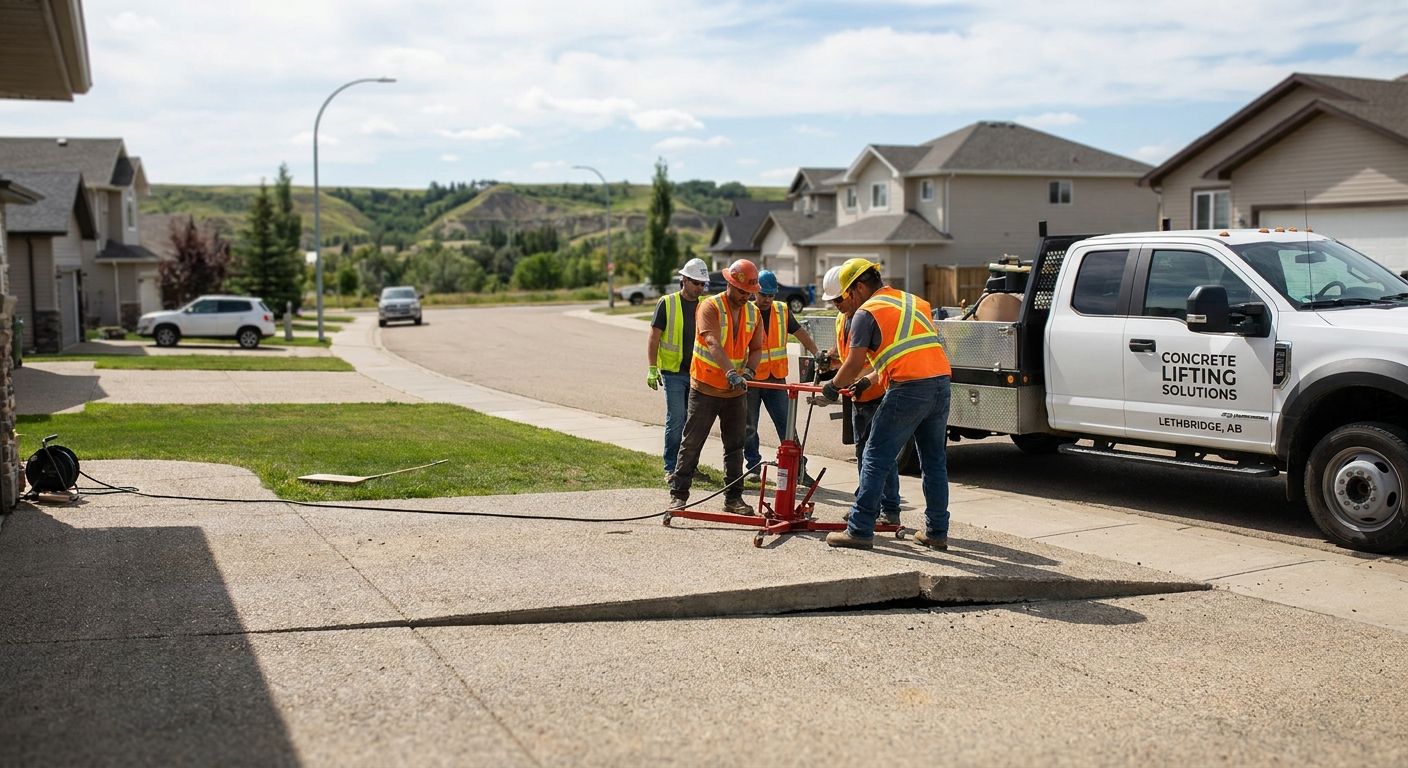
Sunken driveways — the most common Lethbridge call. Driveway sections settle unevenly because they're long, exposed to vehicle load, and sit over compacted base that shifts with clay soil movement. Aztec Spray Systems' sunken driveway lifting work addresses the panels closest to the garage first, since that's usually where the steepest drop occurs. Verdict: Buy — this is the highest-value, fastest-payback application for a typical Lethbridge home.
Patios and pool decks — the wildcard. Patios settle unevenly because they're often poured in sections with different base prep, and pool decks add moisture exposure on top of that. A patio and pool deck lift needs a contractor who checks each section independently rather than treating the whole slab as one job. Verdict: Buy for isolated sinking, Consider if multiple sections have shifted at different rates, since that can point to a bigger base problem.
Garage floors — the sleeper pick. A garage floor that's dropped near the door seal lets water and cold air in, and most owners don't notice until the seal itself starts failing. Garage floor lifting is usually a smaller, faster job than a driveway because the slab area is contained. Verdict: Buy when the settling is localized to the door threshold or one corner.
Sidewalks and walkways — the safety fix. Uneven walkway panels are a trip hazard and, for commercial and multi-unit properties, a liability exposure that gets worse every winter as ice collects in the low spots. Sidewalk and walkway lifting is one of the fastest jobs on this list because panel sizes are small. Verdict: Buy, and don't wait until someone reports a fall.
Get a concrete lifting assessment
Find out if your slab qualifies for a lift or needs replacement.
What to avoid
- Mudjacking as a default choice. Cement slurry mudjacking still works, but it's heavier than polyurethane foam and that added weight can accelerate re-settling on Lethbridge's clay soil. It's a fallback, not a first option, in 2026.
- DIY leveling compounds. Self-leveling concrete patches disguise a low spot cosmetically but don't lift the slab or fill the void underneath, so the same section sinks again within a season or two.
- Any contractor skipping the settlement assessment. If a company quotes a lift over the phone without checking how deep the slab has actually settled, you're getting a guess, not a diagnosis.
Verdict comparison
| Application | Common cause in Lethbridge | Best method | Typical return to use | Verdict |
|---|---|---|---|---|
| Sunken driveways | Base erosion under vehicle load | Polyurethane foam | ~15 minutes | Buy |
| Patios and pool decks | Sectional base settling | Polyurethane foam | ~15 minutes | Buy / Consider |
| Garage floors | Localized threshold settling | Polyurethane foam | ~15 minutes | Buy |
| Sidewalks and walkways | Panel-level frost heave | Polyurethane foam | ~15 minutes | Buy |
FAQ
What is concrete lifting and how does it work in Lethbridge?
Concrete lifting raises an existing sunken slab by injecting polyurethane foam underneath it, rather than removing and repouring the concrete. In Lethbridge, it’s most often used on driveways, sidewalks, and patios that have settled due to clay soil movement and freeze-thaw cycles.
Is concrete lifting better than replacement?
Concrete lifting is better than replacement when the slab is structurally sound and has settled less than roughly 2 inches. Beyond that, or if the concrete is cracked through, replacement is usually the more durable fix.
How long does concrete lifting take in Lethbridge?
Most residential concrete lifting jobs, like a driveway or sidewalk section, are completed in a single visit, with the surface ready for use again in about 15 minutes once the foam cures. Larger commercial areas take longer depending on the number of panels involved.
Does concrete lifting work on Lethbridge’s clay soil?
Yes, polyurethane foam lifting is well suited to clay soil because the foam is lightweight and doesn’t add the extra load that heavier repair methods do. That matters in Lethbridge, where clay soil movement is the main driver of slab settling in the first place.
Will a lifted slab sink again?
A properly lifted slab with a stable base underneath typically holds, but ongoing soil movement in Lethbridge means some settling over many years is possible for any concrete, lifted or original. Regular drainage maintenance around the slab reduces that risk.
Is concrete lifting cheaper than pouring new concrete?
Concrete lifting is generally less expensive than full slab replacement because it reuses the existing concrete instead of demolishing and repouring it. Actual cost depends on slab size, settlement depth, and site access, so a direct assessment gives the clearest number.
Can commercial properties in Lethbridge use concrete lifting?
Yes, commercial parking lots, sidewalks, and walkways are common concrete lifting applications, especially where uneven panels create a liability or accessibility issue. The same polyurethane foam method applies at a larger scale.
What time of year is best for concrete lifting in Lethbridge?
Concrete lifting works best when the ground isn’t frozen solid, so spring through fall is the typical window in Lethbridge. Scheduling a lift before winter also prevents water from pooling in low spots and refreezing repeatedly.
One last thing
The detail most Lethbridge property owners miss: a slab that looks level right after a lift can still be pitched the wrong way if drainage wasn't checked during the same visit. Ask whether the contractor is grading the slab away from the structure as part of the lift, not just raising it to match the neighboring panel — that's the difference between a repair that lasts through 2026's freeze-thaw cycles and one that pools water against your foundation by spring.
Related guides
{“@context”:”https://schema.org”,”@type”:”FAQPage”,”mainEntity”:[{“@type”:”Question”,”name”:”What is concrete lifting and how does it work in Lethbridge?”,”acceptedAnswer”:{“@type”:”Answer”,”text”:”Concrete lifting raises an existing sunken slab by injecting polyurethane foam underneath it, rather than removing and repouring the concrete. In Lethbridge, it’s most often used on driveways, sidewalks, and patios that have settled due to clay soil movement and freeze-thaw cycles.”}},{“@type”:”Question”,”name”:”Is concrete lifting better than replacement?”,”acceptedAnswer”:{“@type”:”Answer”,”text”:”Concrete lifting is better than replacement when the slab is structurally sound and has settled less than roughly 2 inches. Beyond that, or if the concrete is cracked through, replacement is usually the more durable fix.”}},{“@type”:”Question”,”name”:”How long does concrete lifting take in Lethbridge?”,”acceptedAnswer”:{“@type”:”Answer”,”text”:”Most residential concrete lifting jobs, like a driveway or sidewalk section, are completed in a single visit, with the surface ready for use again in about 15 minutes once the foam cures. Larger commercial areas take longer depending on the number of panels involved.”}},{“@type”:”Question”,”name”:”Does concrete lifting work on Lethbridge’s clay soil?”,”acceptedAnswer”:{“@type”:”Answer”,”text”:”Yes, polyurethane foam lifting is well suited to clay soil because the foam is lightweight and doesn’t add the extra load that heavier repair methods do. That matters in Lethbridge, where clay soil movement is the main driver of slab settling in the first place.”}},{“@type”:”Question”,”name”:”Will a lifted slab sink again?”,”acceptedAnswer”:{“@type”:”Answer”,”text”:”A properly lifted slab with a stable base underneath typically holds, but ongoing soil movement in Lethbridge means some settling over many years is possible for any concrete, lifted or original. Regular drainage maintenance around the slab reduces that risk.”}},{“@type”:”Question”,”name”:”Is concrete lifting cheaper than pouring new concrete?”,”acceptedAnswer”:{“@type”:”Answer”,”text”:”Concrete lifting is generally less expensive than full slab replacement because it reuses the existing concrete instead of demolishing and repouring it. Actual cost depends on slab size, settlement depth, and site access, so a direct assessment gives the clearest number.”}},{“@type”:”Question”,”name”:”Can commercial properties in Lethbridge use concrete lifting?”,”acceptedAnswer”:{“@type”:”Answer”,”text”:”Yes, commercial parking lots, sidewalks, and walkways are common concrete lifting applications, especially where uneven panels create a liability or accessibility issue. The same polyurethane foam method applies at a larger scale.”}},{“@type”:”Question”,”name”:”What time of year is best for concrete lifting in Lethbridge?”,”acceptedAnswer”:{“@type”:”Answer”,”text”:”Concrete lifting works best when the ground isn’t frozen solid, so spring through fall is the typical window in Lethbridge. Scheduling a lift before winter also prevents water from pooling in low spots and refreezing repeatedly.”}}]}