.pseo-content { font-size: 17px; line-height: 1.7; color: inherit; }
.pseo-content h2 { font-size: 1.6em; margin-top: 1.8em; margin-bottom: 0.6em; line-height: 1.3; color: inherit; }
.pseo-content h3 { font-size: 1.25em; margin-top: 1.5em; margin-bottom: 0.4em; line-height: 1.35; color: inherit; }
.pseo-content h4 { color: inherit; }
.pseo-content p { margin: 0 0 1em; }
.pseo-content ul, .pseo-content ol { margin: 0 0 1em 1.4em; padding: 0; }
.pseo-content li { margin: 0.3em 0; }
.pseo-content strong { font-weight: 600; }
.pseo-content blockquote { margin: 1.2em 0; padding: 0.6em 1em; border-left: 3px solid color-mix(in srgb, currentColor 30%, transparent); background: color-mix(in srgb, currentColor 4%, transparent); color: inherit; }
.pseo-content a { text-decoration: underline; }
.pseo-content .pseo-table-wrap { overflow-x: auto; margin: 1.4em 0; -webkit-overflow-scrolling: touch; }
.pseo-content table { width: 100% !important; border-collapse: collapse !important; table-layout: auto !important; font-size: 0.96em; }
.pseo-content table th,
.pseo-content table td {
padding: 10px 12px !important;
border-bottom: 1px solid color-mix(in srgb, currentColor 14%, transparent) !important;
border-left: none !important;
border-right: none !important;
vertical-align: top !important;
text-align: left !important;
word-break: break-word !important;
overflow-wrap: anywhere !important;
white-space: normal !important;
}
.pseo-content table th {
background: color-mix(in srgb, currentColor 6%, transparent) !important;
color: inherit !important;
font-weight: 600 !important;
border-top: 1px solid color-mix(in srgb, currentColor 14%, transparent) !important;
}
.pseo-content table tr:last-child td { border-bottom: 1px solid color-mix(in srgb, currentColor 14%, transparent) !important; }
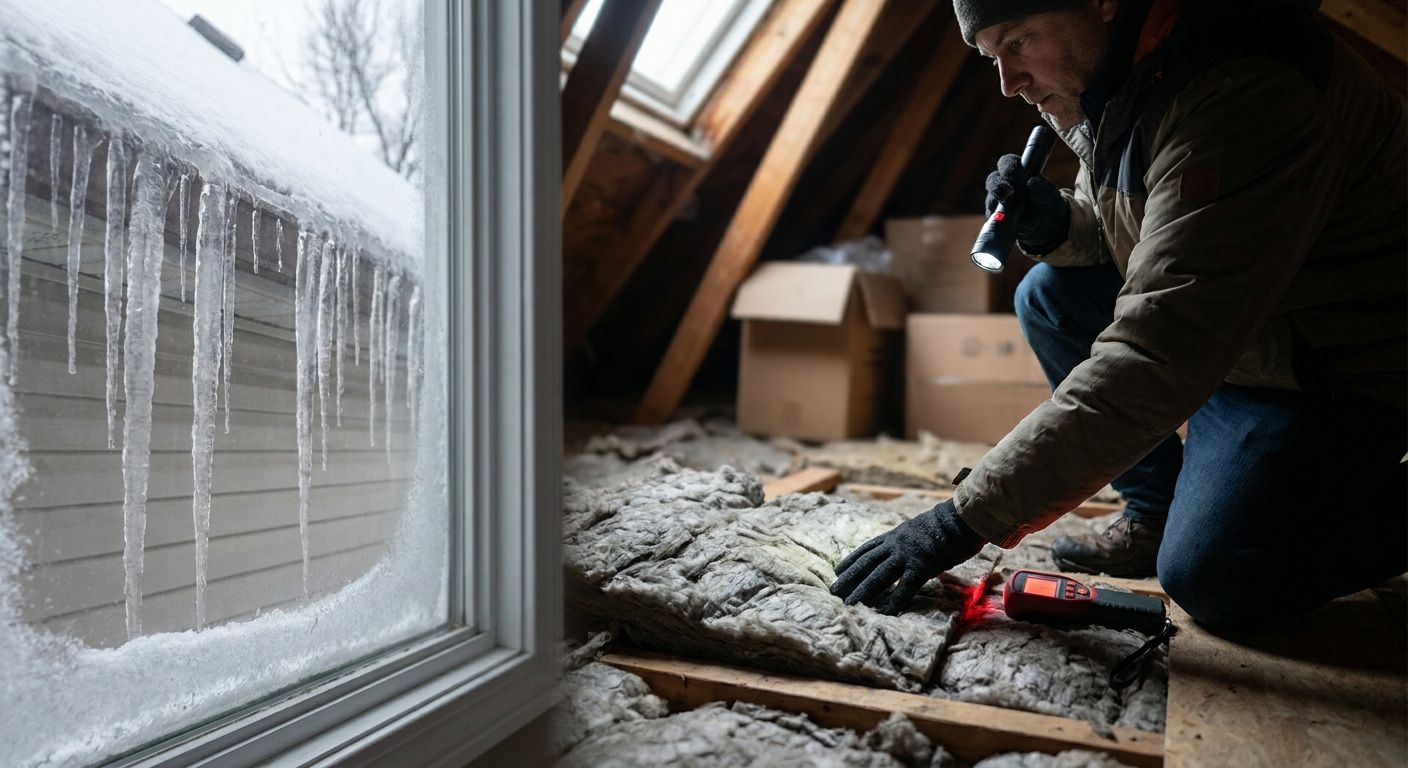
Frost on the attic floor, ice damming along the eaves, and a furnace that won't stop running in January are the fastest signs your attic insulation isn't doing its job. This guide shows you how to check it yourself in 2026, with the numbers Alberta homes should be hitting and the mistakes that waste a top-up.
- Frost on nails, ice damming, and rooms that won’t hold heat mean it’s time to check how to know if your attic needs more insulation.
- Natural Resources Canada targets R-50 to R-60 for attics in cold climate zones; many Calgary-area homes built before 2005 sit at R-20 to R-30.
- A tape measure check against joist depth answers the question in under 15 minutes, no attic pro required.
- Aztec Spray Systems handles both attic top-ups and full spray foam retrofits across Calgary, Okotoks, High River, and Lethbridge.
Why this matters
Alberta winters push attics through wide temperature swings, and an underinsulated attic lets heated air escape straight through the ceiling. Natural Resources Canada lists R-50 to R-60 as the target for attics in cold climate zones like Calgary, Okotoks, High River, and Lethbridge, yet plenty of homes built before the early 2000s still sit at R-20 to R-30. That gap shows up as higher gas bills, ice damming on the roof edge, and upstairs rooms that never quite warm up.
Aztec Spray Systems sees this pattern most often in homes that added insulation once, decades ago, and never checked it again. Insulation settles, gets compressed under storage boxes, and loses loft over time even if nobody ever touched it.
What you'll need
- A tape measure or a 12-inch ruler
- A flashlight or headlamp — keeps both hands free
- A dust mask and gloves — loose-fill fiberglass and cellulose irritate skin and lungs
- Clear access to the attic hatch
- A phone camera to document frost, staining, or compressed spots
- A rough idea of your current insulation type — batt, blown loose-fill, or spray foam — so you're checking the right depth chart
- A sense of your budget: review spray foam insulation cost in Calgary before you climb up, so you know roughly what a top-up or a full retrofit runs
The steps
1. Find your attic access point and establish a baseline age
Knowing when insulation was last touched tells you what to expect before you even climb up. Check renovation permits or ask a previous owner; insulation blown in more than 15 years ago has usually settled and lost some of its original loft. Homes with original 1980s or 1990s batt insulation are the most common candidates for a shortfall.
Common mistake: assuming insulation you can't see is unchanged. Loose-fill compresses on its own, with no help from foot traffic.
2. Measure the depth in three or four spots
This is the fastest way to get an actual number instead of a guess. Measure straight down from the top of a joist to the surface of the insulation near the hatch, in the center of the attic, and in at least one corner.
Loose-fill fiberglass runs about R-2.2 per inch and blown cellulose runs R-3.2 to R-3.8 per inch, so hitting R-50 needs roughly 16 to 18 inches of fiberglass or 13 to 16 inches of cellulose. Closed-cell spray foam runs R-6 to R-7 per inch, so 8 inches gets you into the R-50 to R-56 range.
Common mistake: measuring only near the hatch, where insulation is almost always thinner from foot traffic.
3. Compare your number against the Alberta target
If your depth reads under 14 inches of fiberglass or under 6 inches of spray foam, you're short of the R-50 minimum most homes in this climate zone should carry. Reviewing best insulation for Calgary attics gives you a side-by-side of which material closes that gap fastest for your attic type.
Expected outcome: a clear yes-or-no on whether you're under target, not just a feeling that the house runs cold.
4. Check for gaps at the eaves and an uninsulated hatch
Insulation gets pushed back near the perimeter to keep soffit vents clear, which makes the eaves one of the thinnest spots in most attics. Shine the flashlight along that edge and check the hatch cover itself — an uninsulated hatch is a direct hole in the thermal envelope.
Common mistake: insulating the open attic floor thoroughly while leaving the hatch bare.
5. Look for frost, staining, or damp insulation
Frost on the underside of the roof deck or dark staining on the insulation surface points to warm, moist house air leaking upward, usually through bath fan ducts, pot lights, or the hatch itself. That's a moisture problem, not just an insulation problem.
Common mistake: adding insulation directly over a moisture issue. That traps it and speeds up mold growth instead of fixing anything.
6. Watch the roofline after a snowfall
Uneven melt patterns — bare shingles over living space with snow still sitting over the garage or a porch roof — are one of the clearest outdoor signs of heat escaping through an underinsulated attic. Icicles and ice damming along the eaves in January or February usually point the same direction.
Common mistake: blaming ice damming purely on gutters when attic heat loss is the actual driver.
7. Decide between a top-up and a full retrofit
If your depth is close to target and coverage is even, a loose-fill top-up closes the gap. If you're finding moisture, pest activity, or insulation compressed flat under years of storage, a full tear-out and spray foam retrofit resets the attic properly instead of layering more material over a problem.
Expected outcome: a defined scope of work before a contractor ever sets foot on your roof.
Ready to top up your attic insulation?
Get a Calgary-area quote for an attic top-up or a full spray foam retrofit.
Troubleshooting
- Energy bills haven't dropped after a top-up. Check for blocked soffit vents or bathroom fans venting into the attic instead of outside — insulation can't fix an air-sealing gap on its own.
- Ice damming continues after adding insulation. The cause is usually warm air bypassing through pot lights or the hatch, not depth alone — seal those bypasses first.
- One upstairs room stays cold no matter what. Check the depth directly above that specific room; additions and dormers often have thinner coverage than the rest of the attic.
- Insulation looks matted or compressed. Compressed loose-fill has lost R-value regardless of what it started at — fluff or replace it instead of adding a thin layer on top.
- Frost with no obvious leak source. That's condensation from house humidity meeting cold roof sheathing — improve attic ventilation before adding more material.
- Insulation is even but the house still feels drafty. The attic may be fine and the problem is elsewhere — check basement rim joists and exterior wall cavities before assuming the attic is the only culprit.
Tools and resources
- Tape measure or 12-inch ruler
- Flashlight or headlamp
- Dust mask and gloves rated for fiberglass or cellulose
- Phone camera for before-and-after documentation
- Natural Resources Canada's insulation guidance for cold climate zones, as a reference point for the R-50 to R-60 target
- A licensed contractor consult once you've confirmed a shortfall — Aztec Spray Systems handles both spot top-ups and full attic insulation jobs across the region
What to do next
Once you know your attic is under target, the next decision is material. Batt, blown loose-fill, and closed-cell spray foam all hit R-50 differently, and Alberta's freeze-thaw cycles favor different tradeoffs than a milder climate would. Best insulation type for Alberta winters breaks down which material handles this specific climate best before you commit to a quote.
FAQ
How do I know if my attic needs more insulation?
Measure the insulation depth against joist height and compare it to R-50 to R-60, the target Natural Resources Canada sets for cold climate zones. Frost on the roof deck, ice damming, and uneven snow melt on the roof are the visible signs that back up a low measurement.
What R-value should an attic have in Alberta?
Alberta attics should sit between R-50 and R-60 according to Natural Resources Canada’s cold climate guidance. That translates to roughly 16 to 18 inches of loose-fill fiberglass or about 8 inches of closed-cell spray foam.
Is ice damming always caused by attic insulation?
Not always, but it’s the most common cause. Warm air escaping through an underinsulated attic melts roof snow unevenly, and the runoff refreezes at the cold eaves, creating the dam.
Can I just add insulation on top of what’s already there?
You can, as long as the existing insulation is dry and not compressed. Wet, moldy, or flattened insulation should be removed first, or the top-up traps the same problem underneath.
How much does attic insulation cost in Calgary in 2026?
Cost depends on attic size, current insulation condition, and whether you’re doing a top-up or a full spray foam retrofit. Checking spray foam insulation cost in Calgary gives a current breakdown by scope.
Does spray foam or fiberglass work better in Alberta attics?
Both can hit code, but they get there differently — spray foam needs roughly half the depth of loose-fill fiberglass to reach the same R-value. Best insulation type for Alberta winters compares how each handles this climate’s freeze-thaw cycles.
Why is my attic insulation uneven?
Loose-fill insulation gets pushed back near the eaves during installation to keep soffit vents clear, and foot traffic near the hatch compresses it over time. Both create thin spots that a single center-of-attic measurement will miss.
How often should attic insulation be checked?
Check depth and condition every few years, and immediately after noticing ice damming, rising energy bills, or a cold upstairs room. Insulation doesn’t fail overnight, but settling and compression add up over a decade or more.
One last thing
An attic hatch without a weatherstripped, insulated cover is one of the most commonly missed heat leaks in Calgary-area attics, even in homes where the rest of the attic checks out at R-50 or better. Check it before you check anything else this winter — it's the fastest fix on this whole list.
Related guides
{“@context”:”https://schema.org”,”@type”:”FAQPage”,”mainEntity”:[{“@type”:”Question”,”name”:”How do I know if my attic needs more insulation?”,”acceptedAnswer”:{“@type”:”Answer”,”text”:”Measure the insulation depth against joist height and compare it to R-50 to R-60, the target Natural Resources Canada sets for cold climate zones. Frost on the roof deck, ice damming, and uneven snow melt on the roof are the visible signs that back up a low measurement.”}},{“@type”:”Question”,”name”:”What R-value should an attic have in Alberta?”,”acceptedAnswer”:{“@type”:”Answer”,”text”:”Alberta attics should sit between R-50 and R-60 according to Natural Resources Canada’s cold climate guidance. That translates to roughly 16 to 18 inches of loose-fill fiberglass or about 8 inches of closed-cell spray foam.”}},{“@type”:”Question”,”name”:”Is ice damming always caused by attic insulation?”,”acceptedAnswer”:{“@type”:”Answer”,”text”:”Not always, but it’s the most common cause. Warm air escaping through an underinsulated attic melts roof snow unevenly, and the runoff refreezes at the cold eaves, creating the dam.”}},{“@type”:”Question”,”name”:”Can I just add insulation on top of what’s already there?”,”acceptedAnswer”:{“@type”:”Answer”,”text”:”You can, as long as the existing insulation is dry and not compressed. Wet, moldy, or flattened insulation should be removed first, or the top-up traps the same problem underneath.”}},{“@type”:”Question”,”name”:”How much does attic insulation cost in Calgary in 2026?”,”acceptedAnswer”:{“@type”:”Answer”,”text”:”Cost depends on attic size, current insulation condition, and whether you’re doing a top-up or a full spray foam retrofit. Checking spray foam insulation cost in Calgary gives a current breakdown by scope.”}},{“@type”:”Question”,”name”:”Does spray foam or fiberglass work better in Alberta attics?”,”acceptedAnswer”:{“@type”:”Answer”,”text”:”Both can hit code, but they get there differently — spray foam needs roughly half the depth of loose-fill fiberglass to reach the same R-value. Best insulation type for Alberta winters compares how each handles this climate’s freeze-thaw cycles.”}},{“@type”:”Question”,”name”:”Why is my attic insulation uneven?”,”acceptedAnswer”:{“@type”:”Answer”,”text”:”Loose-fill insulation gets pushed back near the eaves during installation to keep soffit vents clear, and foot traffic near the hatch compresses it over time. Both create thin spots that a single center-of-attic measurement will miss.”}},{“@type”:”Question”,”name”:”How often should attic insulation be checked?”,”acceptedAnswer”:{“@type”:”Answer”,”text”:”Check depth and condition every few years, and immediately after noticing ice damming, rising energy bills, or a cold upstairs room. Insulation doesn’t fail overnight, but settling and compression add up over a decade or more.”}}]}