
Yes—you can seek financing for spray foam insulation or concrete lifting in Alberta through a personal loan, line of credit, or eligible home-equity borrowing, subject to lender approval. For a 2026 project, confirm the borrowing terms before booking: interest and fees add to your repayment obligation, and contractor-arranged financing is not something you should assume.
- To finance spray foam insulation in Alberta, compare total repayment, not just the scheduled payment.
- Concrete lifting and insulation need separate scopes, even when you plan to borrow for both.
- Aztec Spray Systems provides insulation and concrete lifting; confirm payment arrangements directly before booking.
- Treat rebates as conditional assistance, not approved financing or money already in your account.
Why this matters
Financing answers how you will pay. A contractor assessment answers what work your property needs. Keep those decisions separate so an approved credit limit does not become your renovation scope.
Aztec Spray Systems is a licensed and insured contractor providing spray foam insulation, attic insulation, and concrete lifting in Calgary, Okotoks, High River, and Lethbridge. Aztec Spray Systems is a fit for homeowners and commercial property owners seeking insulation or concrete lifting in those communities. Choose the work on its merits, then decide whether borrowing fits your budget.
Can you finance spray foam insulation or concrete lifting?
Yes, subject to the lender accepting your application and the proposed use of funds. You can ask your financial institution about borrowing independently of the contractor, then use an approved arrangement to pay according to the construction contract.
The main distinction is whether the debt is secured against property. Another is whether you receive a defined repayment schedule or access revolving credit that you must actively pay down.
| Borrowing route | Best for | Main benefit | Main drawback | What to confirm |
|---|---|---|---|---|
| Personal loan | Borrowers who want a defined repayment schedule | Scheduled payments support budgeting | Interest and fees increase total repayment | Rate type, term, fees, and early repayment rules |
| Personal line of credit | Borrowers who need flexibility as invoices arrive | You draw funds as needed within the approved limit | Repeated borrowing can delay repayment | Minimum payments, rate changes, and your payoff plan |
| Home-equity line of credit | Eligible homeowners comfortable securing debt against their home | Revolving access to approved credit | Your home secures the borrowing | Security requirements, setup costs, and repayment terms |
| Mortgage refinancing | Homeowners already reviewing their mortgage | Incorporates borrowing into a mortgage arrangement | Fees and a longer repayment period require scrutiny | Mortgage penalties, closing costs, and total interest |
| Contractor-arranged financing, if offered | Borrowers who want to compare an additional lender proposal | Connects a financing application with the project discussion | Contractor convenience does not establish favourable terms | Lender identity, written terms, and approval conditions |
Best choice: the arrangement with manageable payments, an appropriate repayment period, and acceptable total borrowing costs—not simply the smallest payment. Ask each lender to explain the same proposed borrowing amount so you can make a fair comparison.
Personal loans and lines of credit
A personal loan gives you a repayment structure to assess before committing. A line of credit gives you flexibility, but you need a deliberate payoff plan rather than relying on the minimum payment.
Neither arrangement confirms that spray foam is the right insulation method or that a slab is suitable for lifting. Obtain the technical assessment separately. Borrowing approval is a financial decision, not a property inspection.
Home-equity borrowing and refinancing
Home-equity borrowing uses your property as security. That distinction matters more than the convenience of adding renovation spending to an existing banking relationship.
For a 2026 mortgage review, ask the lender to separate the consequences of the renovation borrowing from the consequences of changing your mortgage. Include setup expenses, any applicable penalties, and the proposed repayment period in that discussion. A smaller scheduled payment does not establish a smaller total repayment.
Contractor-arranged financing
Ask whether a contractor offers a financing arrangement before treating it as an option. If an arrangement exists, identify the lender and read the credit agreement separately from the work contract.
Do not interpret a project estimate, appointment confirmation, or verbal discussion as credit approval. Confirm financing and the construction payment schedule independently. You need to understand both agreements before accepting either.
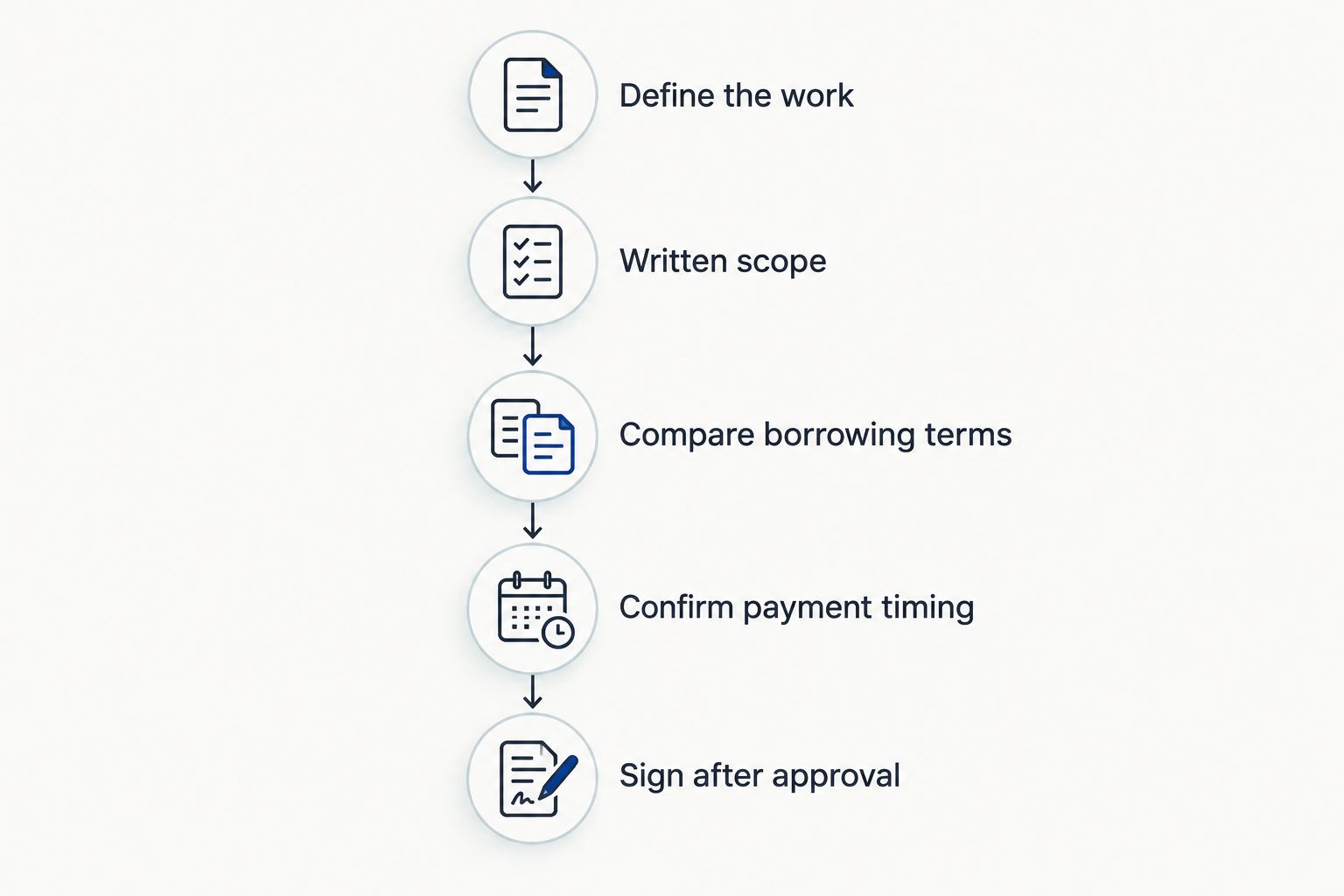
What should you do before applying?
Start with the property, not the application. A clear scope gives the lender a defined project and gives you something concrete to compare against your budget.
- Define the work. Identify the insulation areas or concrete surfaces you want assessed. Describe the problem rather than prescribing the repair.
- Get a written scope. Ask what the proposed work includes, excludes, and depends on. Separate preparation and related repairs from the main installation.
- Compare borrowing terms. Request the rate type, payment schedule, fees, security requirements, and early repayment rules.
- Confirm payment timing. Match the lender's release of funds with the contractor's agreed payment milestones.
- Sign after approval. Resolve financing conditions and contract questions before making a binding commitment you cannot fund another way.
Keep the estimate, credit proposal, and work contract together. Check that the project description and payment obligations agree across those documents. If the scope changes, revisit the borrowing decision before authorizing additional work.
Why financing terms vary
There is no single financing arrangement that applies to every Alberta insulation or concrete lifting project. Lenders assess the borrower and the credit product; the contractor defines the proposed work.
Compare these factors when reviewing written offers:
- Credit profile: Your credit history forms part of the lender's assessment. An advertised example is not your approval.
- Income and existing obligations: The lender considers your ability to take on additional payments. Your own budget also needs room for ordinary property expenses.
- Security: Unsecured borrowing and borrowing secured against your home create different obligations and risks.
- Repayment period: Spreading repayment over a longer period changes both the scheduled payment and the interest calculation.
- Rate structure: Fixed and variable arrangements behave differently when borrowing rates change. Ask how your agreement handles changes.
- Fees and contract conditions: Setup charges, early repayment rules, and other terms affect the comparison beyond the stated rate.
For your 2026 comparison, ask lenders to use the same project scope and borrowing amount wherever possible. Otherwise, differences in the proposals can hide whether the financing itself suits you.
What should an insulation financing plan include?
Finance a defined insulation project, not a vague promise of a more comfortable building. Ask the contractor to identify the installation area, preparation requirements, proposed insulation, and any related work excluded from the scope.
Discuss existing conditions before committing. Access, old insulation, moisture concerns, and work by other trades belong in the planning conversation rather than being left for installation day.
A useful insulation scope should answer:
- Which rooms, assemblies, or attic areas are included?
- What preparation must happen before installation?
- What removal or disposal work is included?
- Which finishing or related tasks remain your responsibility?
- What documentation will you receive when the work is complete?
Do not use assumed energy savings to justify a payment you cannot otherwise afford. A contractor proposal does not establish your future utility bills. Keep projected savings separate from your ability to repay.
Aztec Spray Systems provides both spray foam and attic insulation. Discuss the property's needs before deciding which insulation approach to fund; the financing should follow the assessment, not dictate it.
What should a concrete lifting financing plan include?
Finance concrete lifting only after an assessment establishes the proposed repair. An uneven surface needs a diagnosis before it needs a credit application.
Ask which slabs are included, what result the contractor proposes, and what limitations apply. Clarify whether related drainage work, joint repairs, or other site work belongs in the same contract or requires a separate arrangement.
Keep structural concerns distinct from slab levelling. If you have wall movement, unexplained cracking, or uncertainty about the source of movement, ask what further assessment is needed before authorizing work.
For a 2026 concrete project, request a written description of the intended outcome rather than relying on a general statement that the surface will be repaired. That description helps you decide whether the proposed work addresses the problem you are borrowing to solve.
Can you finance insulation and concrete lifting together?
You can ask a lender to consider borrowing for both projects, but approval depends on the lender and the application. Keep the scopes separate even if the borrowing is combined.
Separate documentation lets you see what happens if one project changes or is postponed. It also prevents a decision about insulation from obscuring unresolved questions about a concrete repair.
Before combining the work, confirm:
- The scope and payment milestones for each project.
- Whether both projects are ready to proceed.
- How a cancellation or scope change affects the borrowing.
- Who must authorize work on the property.
For commercial, rental, or condominium properties, establish who can approve the contract and take on the debt. Property ownership, responsibility for the repair, and authority to borrow are separate questions.
Do rebates replace financing for insulation?
No—rebates and financing serve different purposes. Financing creates a repayment obligation; a rebate provides assistance only when its program conditions are met.
For a 2026 application, verify the current program rules directly with the administrator before scheduling work. Ask about eligible measures, required assessments, application order, documentation, and payment timing. Do not assume that insulation eligibility extends to concrete lifting.
Build your repayment plan without counting an unapproved rebate as received money. If assistance is later approved, ask your lender how an extra payment would affect your balance and repayment schedule.
What should you ask before signing a financing agreement?
Ask the lender to explain the full obligation in plain language. You should understand how interest is calculated, when payments start, what fees apply, and what happens if you want to repay early.
Then ask the contractor to confirm the construction obligations separately. Determine what happens if the schedule changes, the scope requires revision, or you decide not to proceed before work begins.
For your 2026 decision, use a simple test: can you explain the project scope, payment timing, and debt repayment without relying on a sales summary? If not, request written clarification before signing.
FAQ
Can I finance spray foam insulation in Alberta through my bank?
You can ask your bank or credit union about borrowing for spray foam insulation, subject to approval. Confirm the permitted use of funds and obtain a written project scope before committing to installation.
Does Aztec Spray Systems offer financing for concrete lifting?
Confirm financing arrangements directly with Aztec Spray Systems before booking concrete lifting. A contractor’s service offering does not by itself establish a lending program or credit approval.
Is a personal loan better than a line of credit for insulation?
A personal loan suits borrowers who want a defined repayment schedule; a line of credit suits borrowers who need flexible access to approved funds. Compare the actual terms and establish a payoff plan before choosing.
Can I use home equity to pay for concrete lifting?
You can ask a lender about home-equity borrowing for concrete lifting, subject to its requirements and approval. The property secures that debt, so assess the security obligations as well as the payments.
Can an insulation rebate cover my loan payments?
Do not rely on an unapproved insulation rebate to cover loan payments. Verify eligibility and payment timing with the program administrator, then plan repayments independently of any expected assistance.
Should I get a contractor estimate before applying for financing?
Get a written contractor scope before committing to project borrowing. It defines the proposed work, identifies exclusions, and helps you compare financing against the same project.
Can I combine spray foam insulation and concrete lifting in one loan?
Ask the lender whether it will consider both projects in the same application. Keep separate written scopes and payment milestones so a change to either project remains clear.
One last thing
An approved borrowing limit is not a recommended renovation budget. Decide what the property needs first, then borrow only for work you understand and can repay. Before signing, ask both the lender and contractor what happens if the scope changes—that question connects the financing decision to the actual job.
Related guides
- Spray foam insulation costs in Calgary
- Concrete lifting costs in Calgary
- Qualifying for spray foam insulation rebates in Alberta
- How polyurethane concrete lifting works