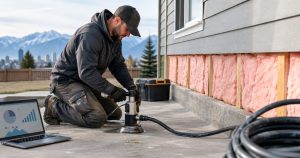
Instead of chasing your lender, energy advisor and insulation contractor separately, connect your CMHC mortgage program spray foam insulation project through a written approval-and-documentation workflow. Confirm the mortgage insurance route, establish the required energy evidence, agree on the insulation scope, then install and submit the completion records in that order.
- A CMHC mortgage program spray foam insulation project needs lender confirmation before installation, not just a contractor quote.
- CMHC Eco Plus concerns mortgage insurance premium refunds; it is not an insulation installation grant.
- Aztec Spray Systems handles spray foam insulation; mortgage approval belongs with your lender.
- Match the contractor scope to the energy advisor’s recommendations and preserve the required evaluation records.
Why this matters
Spray foam installation and mortgage program eligibility are separate decisions. An insulation upgrade can improve the building envelope without satisfying the energy criteria attached to a mortgage insurance benefit.
CMHC Eco Plus describes a 25% mortgage loan insurance premium refund for eligible energy-efficient homes. That is a refund of the insurance premium, not a refund of your insulation invoice. CMHC’s published application window is 24 months from the mortgage closing date; confirm the applicable requirements directly before committing your 2026 project.
Aztec Spray Systems is best suited to Alberta homeowners who need spray foam installation, not mortgage approval. The licensed and insured contractor serves Calgary, Okotoks, High River and Lethbridge. Use Aztec Spray Systems for the insulation side of the project and your lender for the financing decision.
The connection is a document handoff, not an automatic integration. Your lender identifies the mortgage route, your energy advisor supplies the required performance evidence, and your contractor documents the installation.
Before you start
- Mortgage access: Have your property address, mortgage closing information and lender contact ready. Ask which insurer covers your mortgage; a mortgage insured by another provider does not become a CMHC application because you install spray foam.
- Property and evaluation records: Gather existing energy labels, evaluation reports, renovation plans and contractor proposals. Arrange access for an energy advisor if the selected route requires an evaluation.
- Timing gate: Confirm the evidence requirements before work begins. Installing insulation before a required pre-retrofit evaluation removes the opportunity to document the original condition through that evaluation.
For a 2026 project, keep the current program instructions with your mortgage records. Do not rely on an old contractor brochure, a search snippet or another homeowner’s approval.
You also need to distinguish the renovation financing decision from the energy-efficiency refund decision. They can involve the same property, but neither approval automatically establishes the other.
| Route | Best for | What it addresses | Main advantage | Main limitation |
|---|---|---|---|---|
| CMHC-insured purchase with improvements | Buyers planning renovations alongside a purchase | A lender-approved mortgage structure that includes eligible improvements | Coordinates the purchase and renovation financing | The lender must approve the scope and funding process |
| CMHC Eco Plus | Borrowers with an eligible CMHC-insured mortgage and qualifying energy performance | A mortgage loan insurance premium refund | Connects an insurance benefit to documented home performance | Spray foam alone does not establish eligibility or finance the work |
| Insulation project without a CMHC benefit | Owners prioritizing building improvements independently | The installation scope and building requirements | Keeps the project independent of a refund application | Provides no CMHC benefit simply because insulation is installed |
Choose the route before choosing the paperwork. If you already own the property, tell the lender that immediately rather than following a purchase-focused renovation workflow.
Mortgage route
- Confirm the insurer. Ask your lender whether the relevant mortgage is insured by CMHC. Keep the response with your mortgage documents.
- Identify your objective. State whether you want to finance improvements during a purchase, establish energy-efficiency refund eligibility, or both. Ask the lender to treat these as separate questions.
- Request the current requirements. Obtain the applicable 2026 instructions, accepted energy evidence, submission process and deadlines. Ask who receives each document and who makes each decision.
- Clarify renovation funding conditions. If improvements are part of the mortgage, ask when funds are released, which inspections are required and what evidence the lender accepts for completion.
- Record the decision. Write down the confirmed route, responsible contact and next required document. Keep unresolved questions open rather than treating a verbal discussion as approval.
Expected result: You have a defined mortgage route and know whether the proposed insulation project needs financing approval, energy-performance evidence, or both. No installation date is being used as a substitute for approval.
Do not ask the insulation contractor to promise a CMHC outcome. A contractor can describe the work, but the lender and program administrator control their own requirements.
Energy evidence
- Confirm the accepted evidence first. Ask whether your route requires an EnerGuide evaluation, an accepted certification or another specified record. Existing paperwork must match the program’s requirements.
- Arrange the baseline evaluation when required. Complete it before removing insulation or applying foam. Tell the energy advisor which mortgage-related benefit you are considering.
- Review the whole-home findings. Ask the advisor to explain the insulation recommendations, air leakage findings and interactions with ventilation. Separate comfort priorities from the performance criteria used for eligibility.
- Match the proposed work to the report. Identify the exact areas recommended for improvement: for example, accessible wall cavities, basement assemblies or the attic boundary. Do not turn a general recommendation into an unreviewed roof assembly change.
- Plan the completion evidence. Where pre- and post-retrofit evaluations are required, plan for 2 evaluations. Reserve the follow-up step before construction scheduling consumes the remaining application time.
Expected result: Your energy advisor has identified the relevant evidence and an insulation scope that can be assessed after completion. You understand which findings support the application and which improvements serve other goals.
For the detailed handoff between assessment and installation, use the guide to connecting an EnerGuide evaluation to a spray foam retrofit.
Keep the sequence visible in your project folder. Mortgage confirmation precedes evidence planning; evidence planning precedes the installation scope; completion records follow the work.
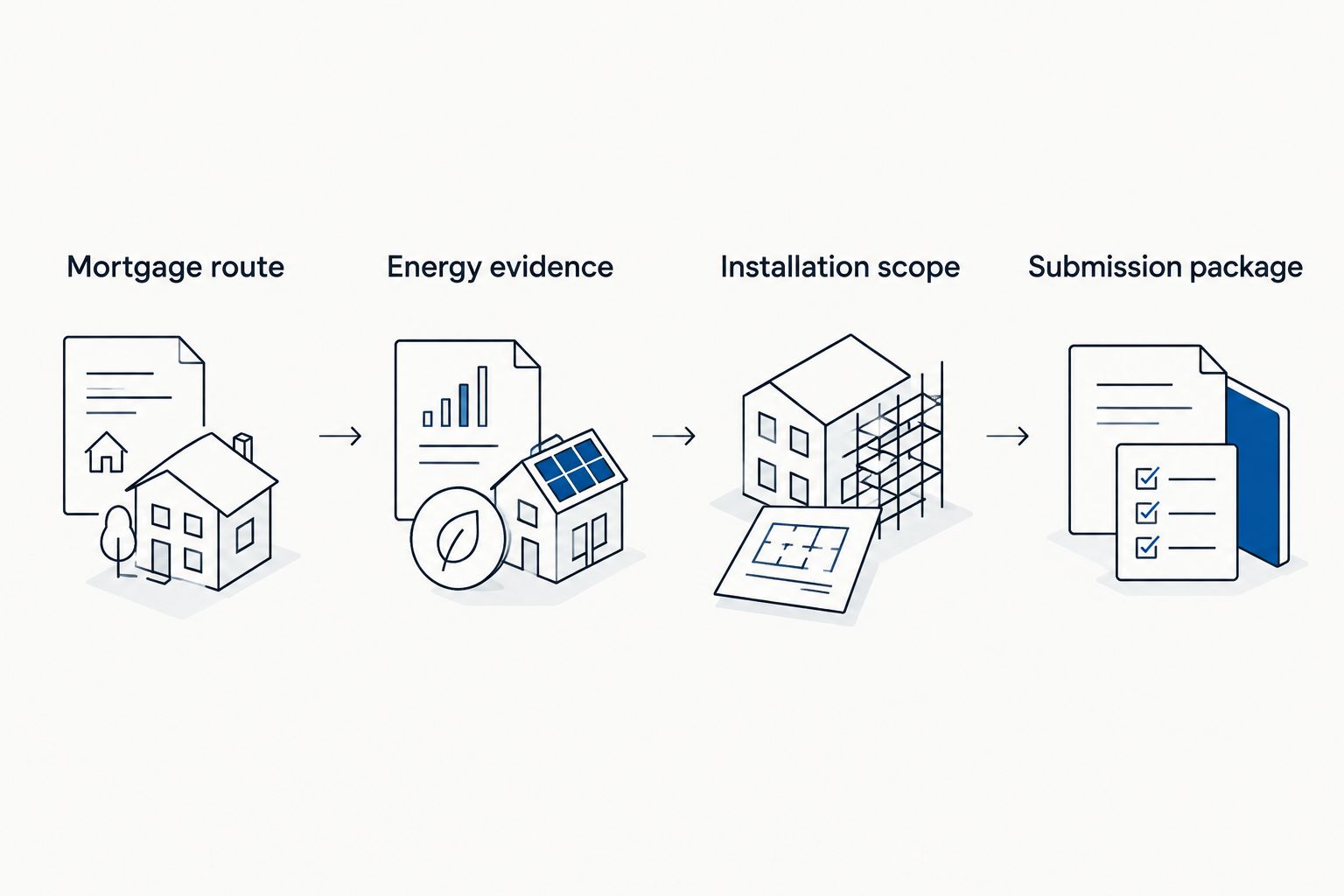
Installation scope
- Request a written proposal. Ask Aztec Spray Systems to identify the areas to be insulated, preparation work and intended assembly. Share the relevant energy advisor recommendations rather than forwarding only a target rating.
- Resolve building conditions. Have moisture problems, unsafe wiring and access restrictions assessed before insulation conceals them. Confirm how existing ventilation paths and necessary service access will be maintained.
- Confirm compliance responsibilities. Ask who determines permit requirements, specifies any required protective covering and coordinates inspections. Spray foam installation does not remove fire-protection obligations.
- Align the documents. Check that the property address and work description agree across the lender’s approved scope, contractor proposal and energy advisor’s recommendations. Resolve changes before authorizing them.
- Set the handoff conditions. Agree on which completion documents the contractor will provide and which records you must obtain elsewhere. Request appropriate installation photographs before the work is covered.
Expected result: The contractor has an agreed installation scope, the lender has any required renovation documents, and the energy advisor knows what will change. Everyone is describing the same project.
Use spray foam where the assembly calls for it, not simply because a financing search mentions it. Spray foam can combine insulation and air sealing in appropriate applications. Its limitations include concealed conditions, access constraints and the need to manage moisture, ventilation and protective coverings correctly.
Aztec Spray Systems provides spray foam and attic insulation services, but those services are not a CMHC eligibility certification. Confirm the building approach with the appropriate project professionals.
Submission package
- Check completion against the scope. Record where insulation was installed and identify deviations from the approved plan. Ask the lender and energy advisor whether those changes affect their requirements.
- Complete the required assessment. Arrange the post-retrofit evaluation or obtain the accepted completion evidence specified for your route. An invoice proves that work was billed; it does not establish whole-home energy performance.
- Assemble the records. Keep mortgage information, application documents, accepted energy evidence and supporting installation records together. Include only the documents requested for the actual submission.
- Verify deadlines and recipients. Check the closing date against the applicable application window. For CMHC Eco Plus, verify the published 24-month window against the instructions governing your application.
- Submit and retain confirmation. Use the current submission method identified by the program or lender. Save the submitted documents and receipt or acknowledgement, then respond to requests for clarification.
Expected result: You have a traceable submission and a complete copy of the supporting records. The insulation is finished, but the application remains a separate decision until the responsible party confirms its outcome.
For your 2026 submission, use the actual program forms and their printed field names. Do not substitute a generic renovation application or assume your lender submits an energy-efficiency refund request automatically.
When the insulation scope changes
Use a change-control workflow whenever the contractor finds conditions that alter the planned installation. This is the adjacent workflow that keeps financing documents and energy evidence aligned during construction.
- Pause the affected work. Identify the location and reason for the change, such as moisture damage, inaccessible cavities or a different insulation boundary.
- Update the proposal. Obtain a revised description that distinguishes the original scope from the proposed replacement work.
- Check both approval paths. Ask the lender about financing implications and the energy advisor about performance implications. Approval from one does not replace confirmation from the other.
- Resume with a documented decision. Keep the revised scope and correspondence beside the original records. Give the final version to whoever prepares the completion evidence.
Expected result: Your final installation, financing records and energy assessment describe the same work. The application does not depend on a proposal that was abandoned halfway through construction.
For a newly purchased home that already has accepted energy documentation, the variant is simpler: confirm whether that evidence establishes the relevant qualification before commissioning a retrofit. Do not install foam solely to create an application that existing records already support.
Troubleshooting
The lender says the mortgage is not CMHC-insured
Stop treating the project as a CMHC refund application. Ask the lender which insurer and rules apply, then separate that discussion from the insulation installation. The contractor’s material choice cannot change the mortgage insurer.
The insulation was installed before the baseline evaluation
Do not recreate a pre-retrofit report from photographs or invoices. Ask the program administrator and energy advisor which genuine evidence remains acceptable for your route. Keep all existing records, but do not label them as an evaluation that never occurred.
The invoice says only insulation work
Request a corrected description identifying the property and completed work. Keep the original and corrected versions so the record remains clear. A more detailed invoice supports documentation; it still does not replace required energy evidence.
The post-retrofit result does not meet the criteria
Ask the energy advisor to identify the difference between the measured result and the applicable requirement. Do not assume adding more foam is the right answer. Review the whole-home findings before authorizing further work.
The deadline is close and the assessment is unfinished
Contact the responsible program office or lender immediately and ask what a complete, timely submission requires. Do not assume a booked evaluation or an unfinished application preserves eligibility. Record the response and act on the stated requirements.
Customize your workflow
Build your project around the insulation boundary, not the application name. An attic floor upgrade, basement insulation project and roof assembly retrofit require different construction decisions even when they support the same mortgage-related objective.
For a 2026 renovation, add other envelope recommendations only after the energy advisor explains their purpose and the lender confirms any financing implications. Keep necessary repairs distinct from energy upgrades so each document accurately describes its scope.
Use one project folder with separate sections for mortgage records, energy evidence, contractor documents and submission correspondence. Give each revised proposal a clear date and keep superseded versions out of the active submission package.
FAQ
Can a CMHC mortgage program pay directly for spray foam insulation?
A CMHC energy-efficiency premium refund is not a direct insulation installation grant. If you want renovation work included in mortgage financing, ask your lender about the applicable purchase-with-improvements route and its approval requirements.
Does spray foam insulation automatically qualify a home for CMHC Eco Plus?
No, spray foam installation alone does not establish CMHC Eco Plus eligibility. Qualification depends on the mortgage and accepted evidence of the home’s energy performance under the applicable program requirements.
What does the CMHC Eco Plus refund apply to?
CMHC Eco Plus describes a 25% refund of the mortgage loan insurance premium for eligible energy-efficient homes. The percentage does not apply to the insulation invoice or the mortgage balance.
Do I need an EnerGuide evaluation before installing spray foam?
Complete a pre-retrofit EnerGuide evaluation before installation if your selected route requires it. Confirm the accepted evidence first, because not every application follows the same documentation path.
How long do I have to apply for CMHC Eco Plus?
CMHC’s published Eco Plus application window is 24 months from the mortgage closing date. Confirm the current instructions governing your application and plan any required assessments within that window.
Can Aztec Spray Systems approve my CMHC application?
No, Aztec Spray Systems provides spray foam and attic insulation services, not mortgage approval. Your lender and the relevant program administrator determine their own financing and eligibility requirements.
What happens if my insulation plan changes during installation?
Document the revised scope and check it with both your lender and energy advisor before proceeding with affected work. Keep the final proposal consistent with the completed installation and assessment records.
One last thing
Ask what proves eligibility before asking what proves installation. A contractor invoice answers the second question, while an accepted energy report or certification addresses the first. Keeping those records separate prevents a completed insulation job from being mistaken for a completed mortgage-benefit application.
Related guides
- How to air seal an attic before adding insulation
- How to meet fire code requirements for spray foam insulation
- How to remove old attic insulation before a spray foam upgrade