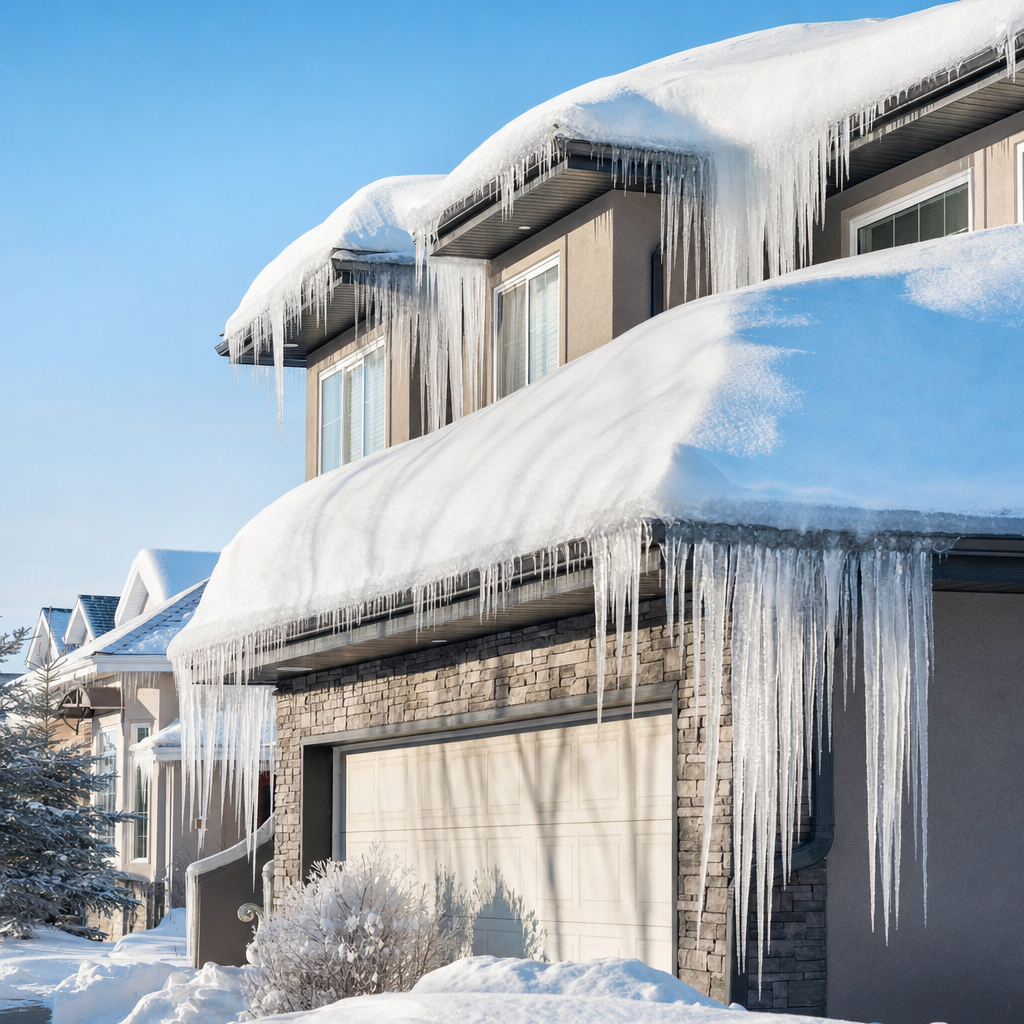
Every winter, thousands of Calgary homeowners wake up to the same unwelcome sight: thick ridges of ice curling over the eaves, icicles the size of fence posts hanging from the soffits, and — worst of all — water stains spreading across the ceiling they just repainted last spring. Ice dams are not just an eyesore. They force meltwater under shingles, saturate roof decking, compress and degrade attic insulation, and set up conditions for mold growth deep inside wall cavities where you cannot see it until the damage is already expensive. The frustrating part? Ice dams are almost always a symptom of a fixable problem. Here is how spray foam insulation eliminates them at the source rather than just managing the symptoms.
Quick Answer
Ice dams on Calgary roofs form when heat escapes through the attic, warms the roof deck above freezing, and melts snow that refreezes at the cold eaves. Closed-cell spray foam applied to the attic floor air-seals every heat-loss pathway and insulates simultaneously — the most effective and durable fix available for Calgary’s Zone 7A climate.
What Causes Ice Dams on Calgary Roofs?
Calgary sits in Climate Zone 7A, where design temperatures reach -30°C and winter heating loads run for months without a break. But it is not just the cold that causes ice dams here — it is Calgary’s defining weather feature, the Chinook. A mid-winter Chinook can push temperatures from -20°C to +12°C in under 12 hours, triggering rapid snow melt on the roof surface. When the cold returns a few days later, that meltwater refreezes with a vengeance. Homes with inadequate attic insulation or air sealing experience this cycle as a compounding ice dam problem: each thaw-refreeze event adds another layer to the ice ridge at the eave, and by February many roofs are carrying hundreds of kilograms of ice they were never engineered to support.
The mechanism behind ice dam formation is straightforward. When your home’s attic insulation is inadequate or — more commonly — when warm air leaks from the living space up through the attic floor, it warms the underside of the roof deck. The deck rises above 0°C. The snow sitting on top begins to melt. That meltwater flows down the roof slope toward the eaves, where there is no warm attic below, the deck temperature matches the outdoor air, and the water refreezes into a growing wedge of ice. As the ice ridge builds, it dams subsequent meltwater behind it. That pooled water is under hydrostatic pressure, and it finds its way under shingles — which are engineered to shed flowing water, not withstand standing water pushing upward. The result is saturated roof decking, softened OSB, rotted fascia boards, and ceiling leaks that show up far from the roofline, often in the middle of a bedroom ceiling with no obvious connection to the eave above.
Left unaddressed, ice dams cause progressive structural damage. The freeze-thaw cycling that creates them also widens any existing gap or crack, meaning each subsequent winter is a little worse than the last. Homes that ice dam reliably every year are telling you something important about their building envelope — and spray foam is one of the most effective ways to listen.
Air Leakage Is the Primary Driver — Not Just Low R-Value
Many Calgary homeowners assume ice dams mean their attic needs more insulation — and often that is true. But building scientists and energy auditors consistently find that air leakage is the dominant cause of ice dams in existing homes, even homes that already have significant insulation depth. Your attic may technically have R-30 or R-40 worth of settled blown-in insulation, but if warm air is moving through pot-light penetrations, around the attic hatch frame, past plumbing stack boots, or through gaps in the top plates, convective heat transfer will warm the roof deck far more than conduction through insufficient insulation thickness alone. Air carries heat orders of magnitude more efficiently than conduction through most building materials.
This is the core reason spray foam outperforms traditional insulation for ice dam prevention: it simultaneously addresses both conduction and convection. Blown-in cellulose, fiberglass batts, and blown fiberglass all provide R-value but none of them air-seal. They sit in the attic floor and slow conducted heat loss, but they are air-permeable — warm air moves through them and around them. Spray foam expands on contact, filling every void and adhering to every surface it touches. A properly executed spray foam application seals all the penetrations and gaps that bulk insulation simply cannot address, eliminating convective heat bypass entirely.
How Does Spray Foam Insulation Prevent Ice Dams in Calgary Homes?
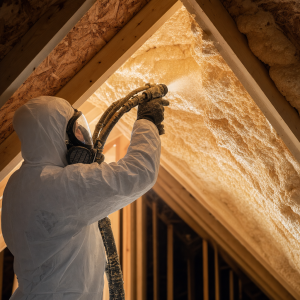
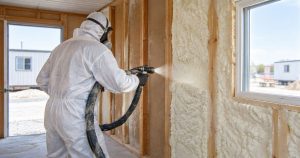
There are two main spray foam strategies for ice dam prevention, and the right choice depends on your attic configuration. The first — and the most common approach for existing Calgary homes — is applying spray foam to the attic floor. The spray foam technician accesses the attic, moves existing insulation aside, and applies closed-cell spray foam to the attic floor deck and all penetrations: pot-light housings, plumbing stacks, the perimeter top plates, the attic hatch frame, and any electrical or ductwork penetrations. This seals every air pathway from the living space into the attic, keeping the attic cold (which is what you want). A cold attic means a cold roof deck. A cold roof deck means the snow on your roof stays frozen, meltwater does not form, and ice dams cannot develop.
The second approach creates what is called an unvented or “hot roof” attic assembly: spray foam is applied to the underside of the roof sheathing itself, bringing the attic into the conditioned envelope of the house. The entire attic becomes warm and dry, but the roof deck is insulated from above by the snow load and from below by the spray foam. This approach eliminates the temperature differential along the roof slope that causes ice dams. Hot roof assemblies are increasingly specified in Calgary new construction and are used in retrofits where the attic contains HVAC equipment, ducting, or storage — spaces where you actually want the attic to be conditioned space. They require careful attention to vapour management and code compliance under Alberta Building Code Section 9.25, but they are highly effective at permanently eliminating ice dam potential.
For most existing Calgary homes, the attic floor air-seal approach offers the best balance of cost, disruption, and performance. The City of Calgary’s climate-ready insulation resource page and the National Building Code — Alberta Edition (Section 9.36) target RSI 10.43 (approximately R-60) as the benchmark for attic assemblies in new construction. Most existing Calgary homes, particularly those built before the 1990s, fall far short of this level. Even adding a 2-inch lift of closed-cell spray foam (roughly R-12) to air-seal an under-performing attic before topping it up with blown cellulose to R-60 total can dramatically reduce or eliminate ice dam formation. Our attic insulation services page covers the full range of approaches we use for Calgary retrofits.
Is Spray Foam the Best Solution for Ice Dam Prevention in Calgary?
For most Calgary homes — especially older ones with air leakage problems — yes. The comparison table below illustrates why:
| Insulation Type | Air-Seals? | R-Value/Inch | Ice Dam Prevention | Lifespan |
|---|---|---|---|---|
| Closed-cell spray foam | Yes — fully | ~R-6 | Excellent | 50+ years |
| Open-cell spray foam | Yes (air barrier; not vapour) | ~R-3.5 | Very good | 50+ years |
| Blown-in cellulose | No | ~R-3.7 | Good if very deep; no air sealing | 20–30 years |
| Blown fiberglass | No | ~R-2.5 | Poor without air sealing | 15–25 years |
| Fiberglass batts | No | ~R-3.1 | Poor; air-permeable | 20–30 years |
Blown cellulose is an excellent insulation at adequate depths, and it is cost-effective for achieving R-60 in bulk. But it does not air-seal, and in a Calgary home with significant air leakage through pot-lights and attic penetrations, adding more cellulose on top of the existing problem is only a partial solution. The best-practice approach for many Calgary retrofits is a hybrid: spray foam the attic floor to seal all air pathways and provide a thermal-bridge-free base, then top up with blown cellulose to reach the R-60 target. This combines spray foam’s unique air-sealing capability with the cost efficiency of blown insulation for the bulk R-value, and it is exactly the approach recommended by Natural Resources Canada in their residential energy efficiency guidance for cold climate homes.
Where Should Spray Foam Be Applied to Stop Ice Dams?
If your goal is ice dam prevention in an existing Calgary home, the following locations deliver the highest return on investment:
- Recessed light (pot-light) housings: Pot-lights are among the largest and most common air leakage pathways in Calgary homes. Even “IC-rated” (insulation contact) pot-lights leak air; older non-IC fixtures can leak substantially. Spray foam around and over the housing seals this pathway completely.
- Attic hatch perimeter: The attic hatch frame and its surround are consistently one of the top three air leakage sites found in energy audits. Spray foam on the hatch box and perimeter seal eliminates this pathway.
- Top plate perimeter: Where the exterior walls meet the attic floor is a major air bypass zone, particularly in homes built before modern air barrier requirements. Spray foam along the full perimeter of the top plates on the attic floor is one of the most impactful single interventions for ice dam prevention.
- Plumbing vent stacks, exhaust fan ducts, electrical penetrations: Any penetration through the attic floor is a potential air leakage site. Spray foam fills and seals each one permanently without the repeated re-application that caulk and spray sealant often require.
- Rim joists (foundation level): While not directly related to roof ice dams, spray foam on rim joists reduces overall building air leakage, improves thermal performance, and complements your attic air-sealing work as part of a whole-home envelope strategy.
Natural Resources Canada’s authoritative building energy efficiency resources identify these penetrations and junctions as the highest-priority locations for air sealing in Canadian homes. Their research consistently shows that addressing air leakage before adding bulk insulation delivers greater energy and comfort returns than simply piling on more insulation over leaky penetrations.
What About Spray Foam at the Eave Blocking Specifically?
A common question for Calgary homeowners who have had severe ice dams is whether spray foam can be applied directly at the eave — the cold zone where ice accumulates — to provide a local thermal break. In a vented attic, this means applying spray foam at the eave blocking between rafters to extend the air-sealed zone out toward the roofline while preserving ventilation channels above the foam baffles. This is a precision application that requires the contractor to assess your roof geometry, existing baffle configuration, and soffit ventilation setup before recommending an approach. Done correctly, it extends the air barrier out to the eave, eliminates the cold-side condensation risk at the exterior wall plane, and helps ensure the roof deck temperature is uniform from ridge to eave.
One important caution: if your home has already experienced ice dam damage — warped roof decking, saturated or compressed attic insulation, visible mold on the sheathing — address those repairs before adding new insulation. Applying spray foam over wet or damaged materials traps moisture inside the assembly, which creates a more serious long-term problem than the ice dam itself. A competent spray foam contractor will assess the moisture condition of your attic before proceeding and will advise on any remediation needed first. Check our spray foam FAQ for guidance on what a pre-installation site assessment covers, or call us directly for a site visit.
See also our post on reducing moisture and mold with spray foam insulation — ice dam water damage and mold often go hand-in-hand in Calgary attics, and addressing both together is the most efficient approach.
Frequently Asked Questions
Why do I keep getting ice dams on my Calgary home every winter?
Ice dams in Calgary typically mean warm air from your living space is escaping through the attic and warming the roof deck above freezing, causing snow to melt and refreeze at the cold eaves. The most common causes are air leakage through pot-lights, the attic hatch, and top plate penetrations — often more than insufficient insulation depth alone. Calgary’s Climate Zone 7A cold snaps and Chinook melt-refreeze cycles make even modest air leakage produce severe ice dams.
How much spray foam is needed in a Calgary attic to stop ice dams?
The primary goal is air-sealing all penetrations, which even 1 to 2 inches of closed-cell spray foam accomplishes. For full thermal performance, the Alberta Building Code targets RSI 10.43 (R-60) for attic assemblies. A practical Calgary approach is 2 to 3 inches of closed-cell spray foam (R-12 to R-18) over the attic floor to seal air leakage, then blown cellulose on top to reach R-60 total — combining air sealing with cost-effective bulk R-value.
Can spray foam fix ice dams in an existing Calgary home without major renovation?
Yes. Spray foam can be applied to the attic floor of most existing Calgary homes through the attic hatch without removing drywall or roofing. Existing insulation is moved aside, spray foam is applied to seal the floor and all penetrations, and bulk insulation is replaced or topped up. It is one of the most cost-effective retrofits available for ice dam prevention, with minimal disruption to the occupied living space.
Is spray foam better than just adding more blown insulation to stop ice dams in Calgary?
Spray foam is more effective because it addresses both air leakage and R-value simultaneously. Air leakage — not just low R-value — is often the dominant cause of ice dams. Blown insulation alone does not seal air pathways. The most cost-effective Calgary approach is a hybrid: spray foam for air sealing at penetrations, then blown cellulose for bulk R-value to reach the R-60 Alberta Building Code target.
Does spray foam for ice dam prevention qualify for rebates in Calgary?
Yes, attic insulation upgrades may qualify for Alberta home energy efficiency programs when the work meets eligibility criteria and is paired with a qualifying home energy assessment. See our guide on qualifying for insulation rebates in Alberta for current program details and how to maximize available incentives on your attic project.
How Aztec Spray Systems Helps
Aztec Spray Systems specializes in closed-cell spray foam for Calgary homeowners dealing with chronic ice dams, heat loss, and moisture problems. We assess your attic geometry, identify every air leakage pathway, and design a solution tailored to your home — whether that is a targeted air-seal of attic penetrations, a full spray foam and blown-insulation hybrid retrofit, or an unvented hot roof assembly for a more complex building configuration. We serve residential customers throughout Calgary and the surrounding area, and we also work with commercial clients across Alberta on warehouses, agricultural buildings, and industrial facilities where condensation control and building envelope performance are operationally critical.
Ice dams are preventable. The right insulation and air sealing strategy will eliminate them — not just for this winter, but permanently. Visit our services page to see the full scope of what we offer, or get in touch today for a free, no-obligation site assessment and quote. Call Aztec Spray Systems at (403) 830-7669 or request a free quote online — we will diagnose the root cause of your ice dam problem and give you a lasting solution before next winter.