You’ve done your research on energy bills, R-values, and air sealing — and spray foam keeps coming out on top. But then a friend forwards you a horror story about homes that became unlivable after insulation work, or you stumble across a news item about off-gassing chemicals, and suddenly you are wondering whether the most effective insulation on the market is actually safe for your family. It is a fair question, and you deserve a straight answer. Here is what the science, Health Canada, and professional Calgary contractors actually say about spray foam insulation safety — and what separates the facts from the fear.
Quick Answer
Spray foam insulation installed by a certified professional in Calgary is safe once fully cured — typically 24 to 72 hours after application. During installation, all occupants and pets must vacate. After curing, Health Canada and industry bodies consider professionally applied spray foam chemically inert and safe for long-term indoor use in Calgary homes.
What Is Spray Foam Off-Gassing and Why Does It Happen?
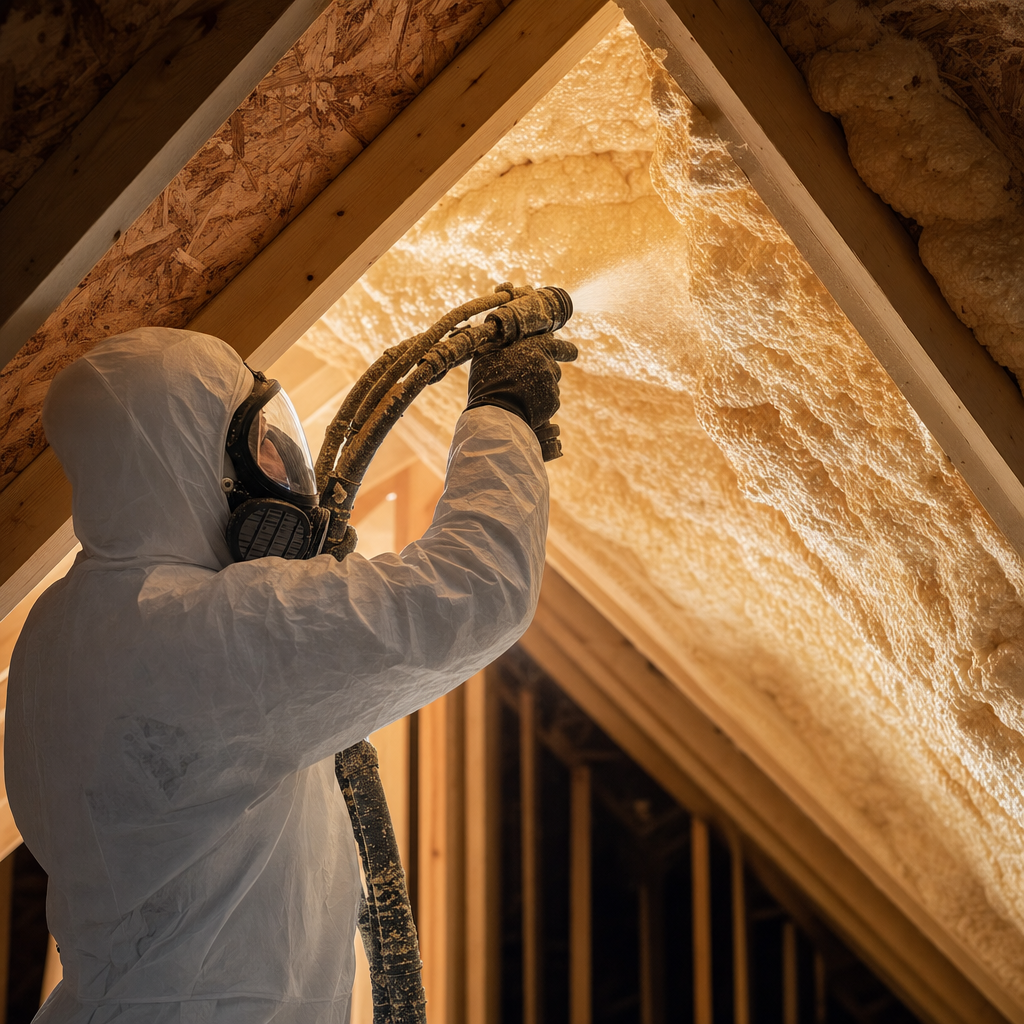
Spray polyurethane foam (SPF) is created when two liquid chemical components — a polyol resin (the “B-side”) and an isocyanate compound called MDI (the “A-side”) — are heated, pumped through a hose, and combined at the spray gun tip. The two chemicals react instantly and expand into foam. During this exothermic reaction and the hours that follow as the foam cures, it releases volatile organic compounds (VOCs) and, if the ratio is even slightly off, traces of unreacted isocyanates into the surrounding air. This is the “off-gassing” window, and it is completely normal chemistry for the materials involved.
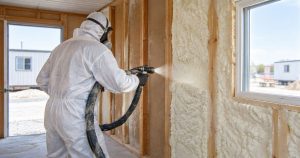
The concern is not with the cured foam — it is with the active reaction phase. Isocyanates are chemical sensitizers: repeated or concentrated exposure to uncured spray foam can cause respiratory irritation, eye inflammation, and in cases of chronic occupational exposure, occupational asthma. This is precisely why professional spray foam technicians wear supplied-air respirators (not just dust masks) and why the space being treated must be vacated during application. The risks are real but they are tightly concentrated in the installation window, and they are manageable with the right protocols.
Once the reaction is complete and the foam has set, the chemistry is finished. What remains is a cross-linked polymer — a dense, stable plastic matrix that does not continue to react. It does not absorb moisture and grow mold, it does not attract rodents or insects, and it does not off-gas meaningfully into your living space. The decades of service life that follow the 24 to 72 hour cure window are chemically inert. Understanding this distinction — installation phase versus cured product — is the key to evaluating spray foam safety accurately.
Is Spray Foam Insulation Safe After It Cures?
Yes — and this is the most important fact to carry away from this article. Once spray foam has fully cured, it is classified by Health Canada and international safety authorities as a chemically stable material that poses no ongoing health risk to building occupants. Health Canada’s chemicals and product safety guidance acknowledges that the chemicals involved in spray foam — particularly isocyanates — are hazardous during application, while the cured product does not pose a long-term health concern when installed according to manufacturer specifications and professional standards.
Independent emissions testing consistently shows that fully cured spray foam does not release chemicals at concentrations that approach health thresholds. The GREENGUARD Gold certification program — which specifically evaluates building products for chemical emissions in environments like schools and hospitals, where the standards are highest — certifies many commercial spray foam products. That certification would simply not be achievable if significant long-term off-gassing were occurring. The product would fail the test.
A useful analogy: think about how paint smells during application, and how you ventilate the room and avoid sleeping there until it dries. Once dry, you do not worry about VOC exposure from your painted walls. Spray foam follows the same principle, scaled up in chemical complexity. The risk is in the wet, reacting state — not in the cured, set state. The same logic applies to many construction materials, from adhesives to sealants to coatings. The question is always whether the installation protocols were followed, not whether the end product is safe.
Open-Cell vs Closed-Cell: Do They Off-Gas Differently?
Open-cell spray foam (approximately R-3.5 per inch) and closed-cell spray foam (R-5.5 to R-6.5 per inch) are related but different formulations with slightly different cure timelines. Open-cell foam typically completes its active off-gassing phase within 8 to 24 hours and fully cures in about 24 hours. Closed-cell foam, which achieves greater density through pressurized cells, may take 12 to 48 hours of active off-gassing and requires 24 to 72 hours for complete cure. Industry standards and most Calgary contractors recommend a 24-hour minimum absence for open-cell work and a 48-hour minimum for closed-cell work. When in doubt, err toward the longer window.
For Calgary’s Climate Zone 7A — with design temperatures reaching -30°C and the moisture complexity introduced by Chinook weather swings — closed-cell spray foam is nearly always the professional recommendation for walls, basements, rim joists, and attic applications. It delivers ~R-6 per inch, simultaneously acts as an air barrier and a Class II vapour retarder meeting Alberta’s National Building Code requirements (Section 9.25), and resists the freeze-thaw moisture cycling that can degrade open-cell foam in our climate. The slightly longer cure window is a minor inconvenience compared to decades of superior, code-compliant performance. Learn more about closed-cell spray foam insulation for Calgary homes and what makes it the right fit for our climate.
What Do Health Canada and Professional Bodies Say About Spray Foam Safety?
Health Canada has published technical guidance on spray polyurethane foam as both a construction product and a regulated chemical substance. Their position is measured and evidence-based: the constituent chemicals — particularly isocyanates on the A-side — are hazardous in their unreacted state and require proper personal protective equipment, ventilation, and occupant protection during application. The cured product, applied according to manufacturer instructions and professional standards, is safe for occupants. Health Canada’s advisories have specifically flagged consumer-grade DIY spray foam kits as higher-risk products, particularly when users lack the equipment and training to maintain proper chemical ratios and temperatures.
The Canadian Urethane Foam Contractors Association (CUFCA) sets the professional standard for spray foam contractors across Canada. CUFCA-certified installers complete training in chemical handling, equipment calibration, application technique, and safety protocols specific to spray polyurethane foam. Certification is not merely a business credential — it reflects genuine technical competency in managing the safety window of spray foam application correctly. When a Calgary homeowner hires a CUFCA-trained contractor, the specific risks associated with improper mixing ratios, inadequate temperatures, and insufficient ventilation — which are the root causes of virtually every documented spray foam safety incident — are effectively controlled.
It bears repeating: the documented cases of spray foam causing prolonged residential air quality problems trace almost uniformly to consumer-grade DIY kits and unlicensed installers, not to professional two-component systems applied by certified technicians. Professional spray foam rigs maintain A-side and B-side chemicals at precise temperatures using heated hoses and onboard monitoring systems. The chemistry is balanced. The foam cures completely. The off-gassing window closes on schedule. Our FAQ covers more common homeowner questions about the installation process if you want additional detail.
How Long Should You Stay Out of Your Calgary Home After Spray Foam Installation?
The following table summarizes standard industry and manufacturer guidance, consistent with Health Canada and U.S. EPA protocols for spray polyurethane foam re-entry times:
| Foam Type | Active Off-Gassing | Recommended Re-Entry | Notes |
|---|---|---|---|
| Open-cell SPF (professional) | 8–24 hours | Minimum 24 hours | Ventilate during re-entry window |
| Closed-cell SPF (professional) | 12–48 hours | Minimum 48 hours | Recommended for Calgary climate |
| DIY one-component foam (small gaps) | 1–8 hours | 8–24 hours | Only for small-scale crack filling |
During the re-entry waiting period, ventilate the treated space as thoroughly as weather permits. Open windows, run bathroom exhaust fans and kitchen range hoods, and if the installation was in a confined space such as a basement or attic, use a portable fan to actively flush air through the area. Your contractor should provide specific ventilation guidance for your home’s layout before work begins.
Calgary’s winter temperatures create a practical challenge: at -25°C outside, you cannot simply open windows for 48 hours without significant heat loss, frozen pipes, and indoor humidity swings. A good contractor will plan around this. Options include scheduling installation during milder periods, using mechanical ventilation (HRV set to high exhaust mode), sealing the work area from the occupied space with temporary barriers, and applying foam in sections with staged ventilation. These are conversations to have at the quote stage — ask your prospective contractor how they handle wintertime installations in Calgary specifically. See also our post on how long spray foam insulation lasts in Calgary for perspective on the long-term value of this investment.
Why Professional Installation Matters More Than the Product Itself
The safety profile of spray foam depends less on the brand of foam than on the quality of the installation. Professional two-component spray foam requires that the A-side (isocyanate) and B-side (polyol) be maintained within a precise temperature range — typically between 18°C and 30°C at the spray tip — to react correctly. If either component is too cold (common during Calgary winters), the foam may under-react, leaving unreacted isocyanates off-gassing well beyond the normal cure window. If the ratio is off, the same problem occurs.
Professional rigs use electrically heated hoses that maintain chemical temperatures across long hose runs. Technicians check temperatures before starting and monitor throughout the job. They apply foam in correct lift thicknesses — typically 1 to 2 inches per pass for closed-cell — to prevent heat buildup from excessive exothermic reaction. None of this precision is achievable with a consumer kit from a hardware store, which is why Natural Resources Canada’s home insulation guidance and industry bodies consistently recommend professional installation for any significant spray foam project.
For Calgary homeowners evaluating contractors, the questions to ask are: Are your technicians CUFCA-certified? Do you carry WCB coverage? Can you provide a product safety data sheet for the specific foam system you will use? What are your protocols for wintertime application? A contractor who answers these questions clearly and confidently is one you can trust with your home. One who deflects or is unaware of them is a risk. Our About page details our certifications and our commitment to professional installation standards, and our services page outlines everything we offer for residential and commercial customers across Calgary.
Frequently Asked Questions
Is spray foam insulation safe for Calgary homes with young children or pets?
Yes, once fully cured — typically 24 to 72 hours after installation — spray foam is safe for households with children and pets. During the installation itself and throughout the curing window, all occupants including pets must vacate the home. Once the curing period is complete and the space has been ventilated, spray foam is chemically inert and does not off-gas at levels of concern according to Health Canada guidance on spray polyurethane foam.
How long does spray foam off-gassing last in a Calgary home?
Active off-gassing from professionally applied closed-cell spray foam lasts 12 to 48 hours after application. Open-cell foam typically finishes off-gassing within 8 to 24 hours. Industry standard re-entry times are a minimum of 24 hours for open-cell and 48 hours for closed-cell. After that period, detectable chemical emissions drop to negligible levels in a properly ventilated home.
What do Health Canada and industry bodies say about spray foam safety?
Health Canada recognizes that unreacted spray foam chemicals — particularly isocyanates — are hazardous during application and require proper protective protocols including occupant evacuation. The cured product, applied by a certified professional, is considered safe for long-term indoor occupancy. The Canadian Urethane Foam Contractors Association (CUFCA) sets training and certification standards to ensure professional application meets safety requirements.
Are DIY spray foam kits safe to use in Calgary homes?
Consumer spray foam kits are considerably higher-risk than professional systems because it is difficult to maintain correct chemical ratios and temperatures without professional equipment. Health Canada has flagged consumer-grade spray foam kits as products of concern. For any significant insulation project, professional installation by a certified Calgary contractor is strongly recommended. DIY foam is appropriate only for small-scale gap filling using one-component foam.
Does spray foam insulation cause long-term health problems after it is installed?
No — not when properly installed by a certified contractor and allowed to cure fully. Documented health problems associated with spray foam are almost exclusively tied to improper application (wrong chemical ratios, under-cured foam) or excessive exposure during installation without proper respiratory protection. A correctly installed, fully cured spray foam system poses no long-term health risk under Health Canada’s guidance on spray polyurethane foam products.
How Aztec Spray Systems Helps
At Aztec Spray Systems, safety is the foundation of every project we take on in Calgary and the surrounding area. Our technicians follow strict chemical handling protocols, use calibrated professional rigs that maintain precise temperatures year-round — including through Calgary’s demanding winters — and we brief every homeowner on re-entry times, ventilation requirements, and what to expect before, during, and after installation. Whether you need a rim joist sealed, an attic insulated, a basement brought up to code, or a full closed-cell spray foam installation for a new build, we deliver professional results with no shortcuts.
We also serve commercial clients across Alberta, from warehouses to agricultural buildings to industrial facilities. Whatever the project scale, the commitment to safety and craftsmanship is the same. Ready to get your questions answered by a certified Calgary spray foam contractor? Call us at (403) 830-7669 or request a free, no-obligation quote online. We will assess your home’s insulation needs, answer every safety question you have, and give you a clear written estimate with no pressure.