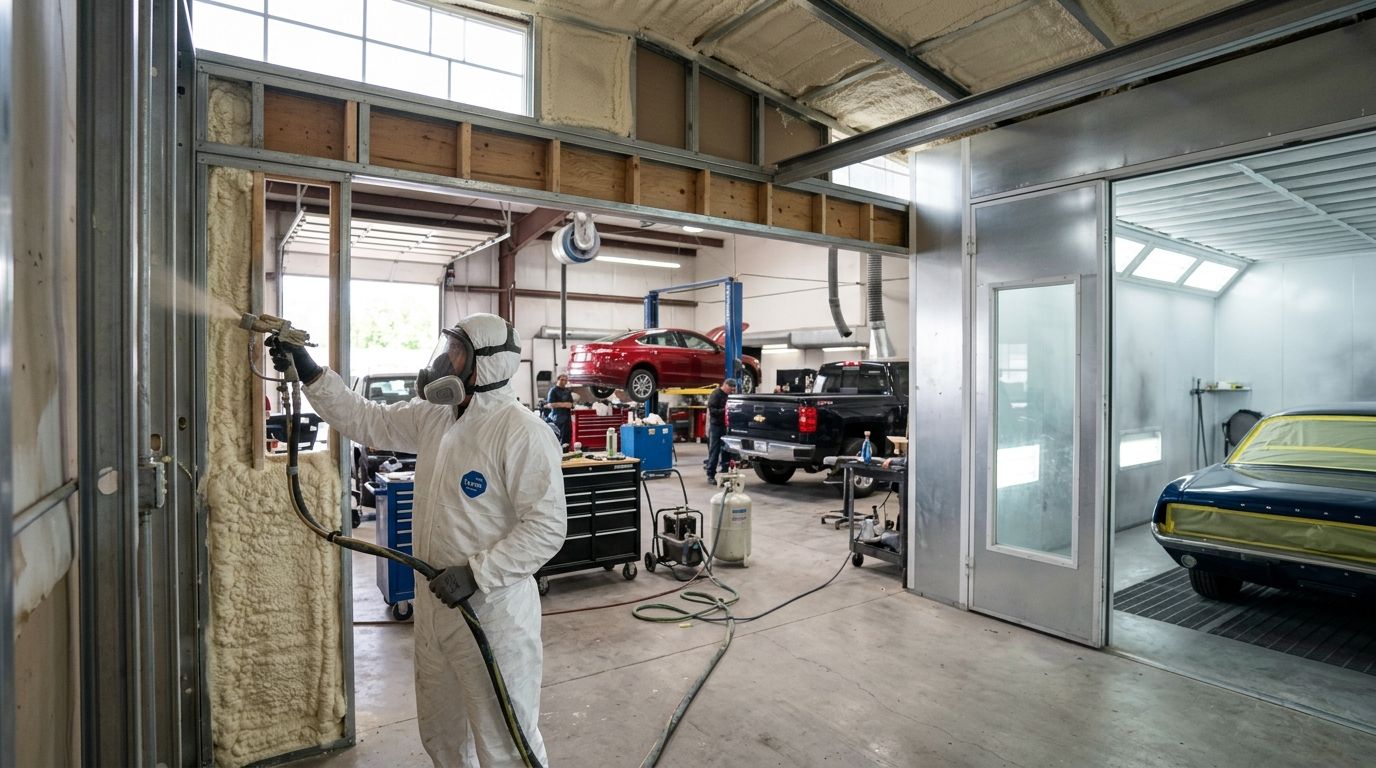
Spray foam insulation for auto body shops and paint booths means applying closed-cell or open-cell foam to bay walls, ceilings, and booth enclosures to cut HVAC losses, stabilize paint-cure conditions, and meet Alberta fire code for a flammable-liquids occupancy. Auto body shops run oversized overhead doors, ventilated paint booths, and make-up air units that a standard commercial building doesn't have, so the insulation plan has to account for fire hazard classification and constant air exchange, not just R-value.
- Closed-cell spray foam is the standard pick for spray foam insulation auto body shop projects because it resists moisture and stiffens metal wall panels.
- Paint booths need an approved thermal barrier over any exposed foam under Alberta Building Code, or the job fails inspection.
- Aztec Spray Systems insulates auto body shops and metal buildings across Calgary, Okotoks, High River and Lethbridge.
- Sealing overhead bay doors often cuts more heat loss than adding foam to walls that are already tight.
- Open-cell foam works for interior partition walls but should stay out of washbay and booth pit areas exposed to moisture.
Why spray foam insulation matters for auto body shops and paint booths
Auto body shops lose conditioned air two ways an ordinary commercial building doesn't: oversized bay doors that cycle open dozens of times a shift, and a paint booth exhaust fan that pulls air out continuously to clear overspray and VOCs. Every cubic foot that leaves through the booth exhaust gets replaced by outside air the make-up air unit has to heat or cool, and in a Calgary winter that runs the HVAC system harder than most owners expect.
Most Alberta auto body shops are metal pole buildings, so thermal bridging through steel girts already works against the paint booth's climate control before insulation goes in. That's the same envelope problem covered in the metal building insulation breakdown — the girts conduct heat straight through the wall unless the foam breaks that bridge.
Booth temperature swings also hurt finish quality. Inconsistent booth temperature slows cure time and raises the odds of orange peel or dust contamination when a tech opens the door mid-cycle. Sealing the shop envelope and insulating the booth shell keeps conditions closer to spec, which matters more heading into a 2026 Alberta winter than most shop owners budget for.
How to insulate an auto body shop or paint booth
Audit air leakage and energy loss before you insulate anything
Start with the free diagnostic work — it tells you where foam actually needs to go.
- Walk the building at dusk on a cold day and feel for drafts around door frames, roof vents, and wall penetrations.
- Pull twelve months of utility bills and flag months where heating cost spikes against outdoor temperature.
- Check overhead bay door seals and bottom astragals for daylight gaps.
- Note where the paint booth's make-up air duct penetrates the roof or wall — that seam is a common leak point.
- Borrow a thermal imaging camera for one evening walkthrough; steel-stud shops show thermal bridging clearly on camera.
Seal the building envelope before adding foam
- Caulk sill plates, roof-to-wall junctions, and any conduit or duct penetration with commercial-grade sealant.
- Replace worn door bottom seals and weatherstripping on all overhead and man doors.
- Foam-seal gaps around window and skylight frames.
- Tape and seal seams on any existing rigid foam board before spraying over it.
- Close off unused floor drains and old vent penetrations that pull conditioned air out of the shop.
Choose closed-cell spray foam for shop walls and the paint booth shell
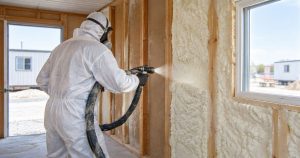
This is usually where a contractor enters the project, once the envelope is sealed and the leak points are mapped. Closed-cell spray foam runs R-6 to R-7 per inch and stiffens steel wall panels, which matters in a building that takes vibration from lifts, compressors, and impact tools. Aztec Spray Systems applies closed-cell spray foam insulation to bay walls, ceilings, and booth enclosures across Calgary, Okotoks, High River, and Lethbridge shops.
- Spray closed-cell foam on any wall exposed to washbay moisture or exterior weather.
- Use closed-cell foam on the booth shell itself, since it resists the solvent vapor and moisture cycling a paint booth generates.
- Skip open-cell foam in the booth pit or floor trench areas — it absorbs moisture and won't dry back out.
- Foam the roof deck from the interior on pole-frame shops with no attic space, which is common in Alberta auto body buildings.
- Ask for a thickness spec tied to a target R-value, not just "a few inches" — booth walls typically need more than an office partition wall.
Meet Alberta fire code requirements for exposed foam
Spray foam is combustible, and a body shop is already a flammable-liquids occupancy because of paint and solvent storage, so inspectors look closely at any exposed foam near the booth. The fire code requirements for spray foam insulation apply directly to this build type.
- Cover any foam left exposed in occupied space with an approved thermal barrier, typically ½-inch drywall or an intumescent coating.
- Keep foam a code-required distance from ignition sources, including compressor motors and exhaust fan housings.
- Confirm the booth manufacturer's listing doesn't get voided by foam applied directly to booth panel exteriors.
- Document the thermal barrier install before the booth goes back into service for a 2026 fire inspection.
“If exposed foam in the booth area isn’t covered by an approved thermal barrier, the job fails Alberta Building Code, not just a picky inspector.”
Insulate the paint booth separately from the general shop space
- Treat the booth as its own thermal envelope, sealed and insulated independent of the main bay, so booth HVAC isn't fighting shop-wide temperature swings.
- Insulate the booth's intake and exhaust plenum, not just the four walls — uninsulated ductwork is a major loss point.
- Seal the gap between the booth frame and the building's structural steel, a spot installers often skip.
- Insulate the booth's access doors, which typically ship from the manufacturer with little insulation value.
Address overhead bay doors and dock-style openings
- Add an insulated door panel or after-market insulation kit rated for the door's cycling frequency.
- Install bottom and side seals rated for cold-weather service, standard for Alberta winters.
- Consider a high-speed door for the bay that opens most often — every cycle dumps conditioned air regardless of wall insulation.
- Caulk or weld any gap where the door track meets the wall panel.
Right-size HVAC and the make-up air unit after insulating
- Have a mechanical contractor recalculate heating and cooling load once the envelope is sealed and foamed — equipment sized for the pre-insulation building short-cycles and wastes energy.
- Match make-up air unit capacity to the booth's actual exhaust fan CFM, not a generic shop-wide estimate.
- Add a dedicated booth temperature controller if the current setup only controls the main shop.
- Run a post-insulation blower-door or smoke test to confirm the envelope improvement before finalizing HVAC changes for the year.
Insulation options for auto body shops and paint booths
| Option | Best for | Key limitation |
|---|---|---|
| Closed-cell spray foam | Booth shells, exterior walls, washbay areas | Costs more material per inch than open-cell |
| Open-cell spray foam | Interior partition walls away from moisture | Absorbs water if exposed to leaks or splash |
| Rigid foam board (polyiso) | Retrofit over existing wall panels with limited downtime | Seams need taping or they leak air |
| Fiberglass batt | Low-cost interior partitions with no moisture exposure | Loses R-value fast if compressed or damp |
| Mineral wool | Areas needing extra fire resistance near ignition sources | Higher cost per R-value than batt insulation |
For a shop built as a pole-frame structure rather than steel stud, framing and vapor barrier details differ enough that they're worth checking separately — the pole barn and shop spray foam breakdown covers that build type.
Verdict: closed-cell spray foam is the right call for booth shells and exterior walls in an Alberta auto body shop in 2026 — it's the only option on this list that handles moisture cycling and adds structural rigidity to a steel building at the same time.
Get a shop insulation assessment
Aztec Spray Systems evaluates paint booth and bay insulation across southern Alberta.
Common mistakes auto body shops make with insulation
- Copying a generic warehouse spec. Many shops apply an insulation plan built for a commercial warehouse project without adjusting for booth fire code or make-up air load — the two building types don't carry the same fire hazard classification.
- Insulating walls but leaving ductwork bare. Booth intake and exhaust plenums lose a large share of the conditioned air a shop just paid to seal.
- Sealing walls while ignoring bay doors. An overhead door left with worn seals remains the biggest single air leak in the building regardless of how much foam went on the walls.
- Using open-cell foam in wet zones. Washbays and booth pits saturate open-cell foam over a few seasons of moisture cycling, and saturated foam stops performing.
- Skipping the thermal barrier. Exposed foam near the booth fails fire inspection and forces a costly rework — cheaper to spec the barrier at install than to add it after a failed inspection.
FAQ
What’s the best insulation for an auto body shop paint booth?
Closed-cell spray foam is the best choice for a paint booth shell because it resists solvent vapor and moisture cycling while adding rigidity to the booth’s steel panels. Open-cell foam works fine for dry interior partitions away from the booth.
Is spray foam insulation fire-rated for paint booths?
No, spray foam on its own isn’t a finished fire-rated assembly. Alberta Building Code requires an approved thermal barrier, such as ½-inch drywall or an intumescent coating, over any foam exposed in occupied space near a flammable-liquids occupancy.
Does spray foam insulation reduce noise in an auto body shop?
Yes, closed-cell foam dampens some sound transmission from compressors and impact tools compared to bare metal wall panels. It isn’t a dedicated soundproofing product, but the density helps.
Can closed-cell spray foam handle washbay moisture?
Yes, closed-cell foam’s structure resists water absorption, which is why it’s specified for washbays and booth areas. Open-cell foam should stay out of any zone with regular moisture exposure.
What R-value should an Alberta auto body shop target?
Closed-cell foam delivers R-6 to R-7 per inch, so a two-inch application reaches roughly R-12 to R-14. Booth walls in Alberta’s climate typically get specified higher than a standard office partition given the temperature-control demands.
How long does spray foam insulation installation take for a shop building?
Installation time scales with square footage and how much thermal barrier work the booth area needs. A contractor can usually schedule the work around slower production days to limit shop downtime.
Does insulating a paint booth improve finish quality?
Yes, stabilizing booth temperature and humidity reduces cure-time variability, which cuts the risk of dust contamination and orange peel tied to opening booth doors mid-cycle.
One last thing
The component that gets skipped most often isn't the wall or the ceiling — it's the booth doors. Most spray booths ship from the manufacturer with minimal insulation value on the personnel and vehicle doors, so even a fully foamed shell keeps losing heat through two slabs of uninsulated steel every time a tech walks through. Fixing the walls without addressing the doors leaves real performance on the table going into 2026.
Related guides