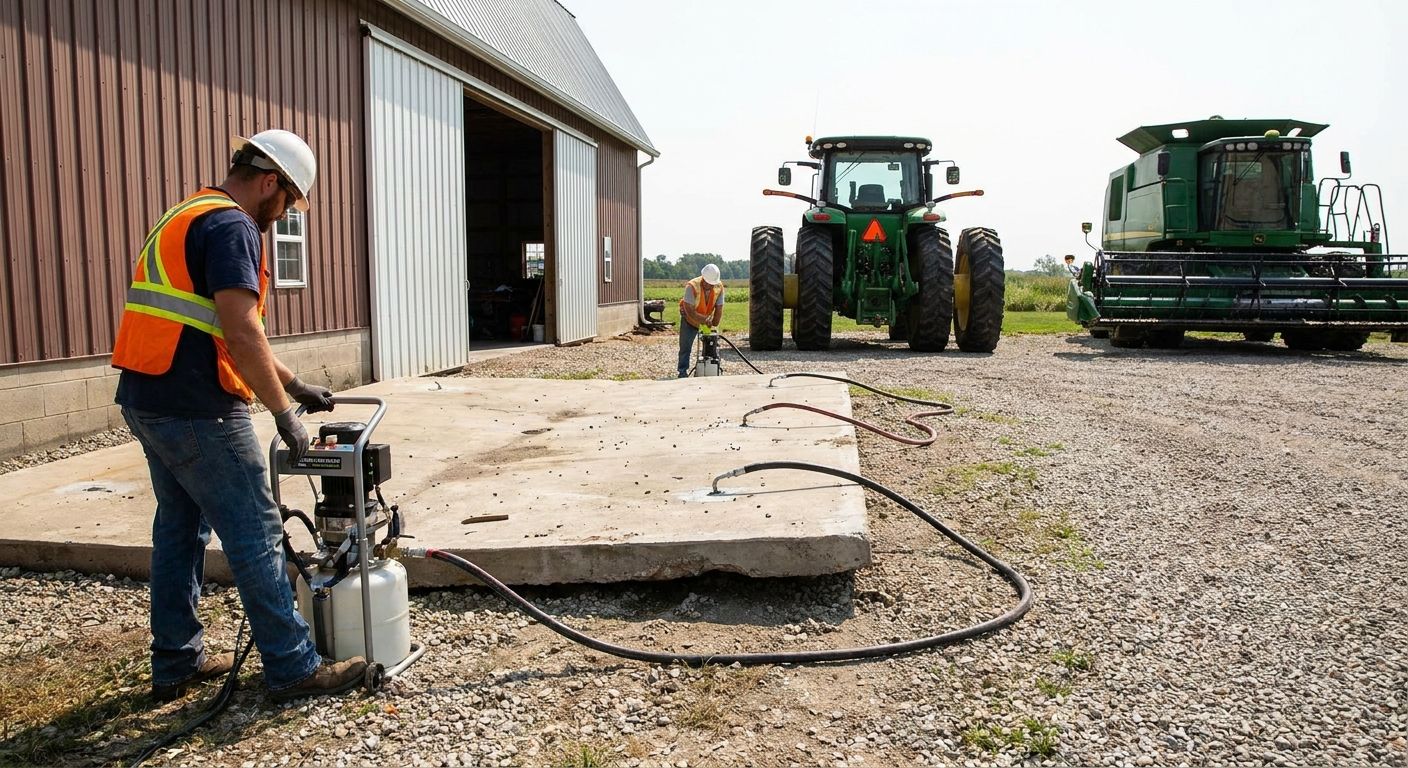
Concrete lifting for an agricultural equipment pad raises a sunken or settled slab back to grade using polyurethane foam injection or cementitious grout, restoring a level, load-bearing surface for grain bins, generators, loading platforms, and parked implements without tearing out the concrete. Farm pads carry different stress than a residential patio or garage floor: point loads from bin legs, seasonal frost heave, and equipment that has to sit flat to avoid strain on hydraulics and axles. A pad that's off by even an inch under a full grain bin creates a real structural problem, not a cosmetic one.
- Concrete lifting for an agricultural equipment pad restores level ground for bins, generators, and implements without replacing the slab.
- Polyurethane foam injection cures fast and handles point loads better than mudjacking on farm pads.
- Frost heave and poor drainage are the two leading causes of settlement on Alberta ag pads.
- Full slab replacement is rarely necessary unless the pad has cracked through or the base has washed out.
- Schedule lifting between planting and harvest windows so equipment isn’t stranded during field season.
Why concrete lifting matters for agricultural equipment pads
A farm pad that's out of level doesn't just look bad — it costs money every day it sits unfixed. Grain bins settling unevenly stress the bin legs and can jam unload augers. Generators and pumps mounted on a tilted pad vibrate harder and wear bearings faster. A sunken loading dock pad turns a five-minute forklift move into a slow, careful maneuver every time.
Southern Alberta's freeze-thaw cycle is the main driver behind barn and shop floor settlement, and the same mechanics hit equipment pads. Frost depth in this region reaches up to roughly 1.2 metres in a hard winter, and if the base under a pad wasn't compacted to spec, the ground under one corner moves more than the others. Add heavy point loads from a loaded grain bin and the settlement accelerates.
Replacing a slab under an operating bin or generator means shutting the equipment down, disconnecting anchors, and pouring new concrete that needs weeks to cure before it can carry weight again. Concrete lifting skips almost all of that. In most cases the pad is back in service the same day the work is done.
Inspect the pad for settlement patterns
Start with a visual and physical check before assuming the whole pad needs work.
- Walk the perimeter looking for gaps between the slab edge and the soil
- Run a level or a long straightedge across the pad in at least two directions
- Check for cracking radiating from bin legs, anchor bolts, or equipment feet
- Note whether water pools on one side after rain — that's a slope problem, not just settlement
- Look underneath equipment for daylight gaps that suggest the slab has dropped at one corner
Measure the slope and elevation loss
A laser level or a simple string line and tape measure tells you how much correction the pad actually needs.
- Mark reference points at each corner and the center of the pad
- Record elevation differences in inches, not just "looks off"
- Check equipment manufacturer tolerances — most generator and bin manufacturers specify a maximum allowable slope
- Re-measure after any heavy rain or spring thaw, since seasonal movement can add to the total drop
Identify the cause of settling
Lifting a pad without knowing why it dropped just buys time until it drops again.
- Poor base compaction during original construction is the most common cause on rural pads
- Drainage that channels water under the slab edge erodes the base over years
- Frost heave pushes unevenly on pads without adequate gravel base depth
- Tree roots or old organic material left under the pour decompose and create voids
- Repeated heavy point loads from bins or equipment can compress soft subgrade over time
Any of these can also show up as foundation settling on a nearby structure, so check adjacent buildings for the same symptoms before treating the pad as an isolated issue.
Choose a lifting method
The manual, lower-cost approach on smaller pads is patching and mudjacking — pumping a sand-cement slurry underneath to fill the void and raise the slab. It works, but it's heavier, needs a longer cure before load, and doesn't handle voids under point loads as cleanly.
Polyurethane foam injection is the faster path for equipment pads specifically because it cures in roughly 15 minutes, weighs a fraction of slurry, and expands to fill irregular voids under bin legs and equipment feet without adding significant weight to already-stressed soil.
- Mudjacking: lower material cost, longer cure, heavier fill, best for large flat areas with even settlement
- Polyurethane foam: fast cure, lightweight fill, precise lift control, best for point-loaded pads under bins and heavy equipment
- Full replacement: only worth it when the slab has cracked through or the base has washed out entirely
- Patch-and-monitor: a short-term option only when the settlement is minor and stable, not actively progressing
Schedule around field season
Timing matters more on a working farm than on a residential driveway.
- Avoid scheduling during planting or harvest when equipment can't be moved off the pad
- Plan around frozen ground — injection work is harder and less predictable when the subgrade is frozen solid
- Coordinate with grain bin unload schedules if the pad sits under active storage
- Book generator or backup power pads during planned maintenance windows, not peak season
Reinforce drainage after lifting
A lifted pad that still drains poorly will settle again.
- Grade soil around the pad to slope away from the slab edge
- Add or extend downspout extensions if the pad sits near a building roofline
- Fill any remaining gaps at the slab perimeter with polyurethane sealant to block water intrusion
- Check that field drainage tile, if present, hasn't been damaged by the original settlement
Maintain the pad after lifting
A lifted pad isn't maintenance-free. Recheck elevation once a year, ideally after spring thaw, and reseal perimeter joints if they open up. Watch for new cracking near bin legs, which usually signals a fresh point-load issue rather than a repeat of the original settlement.
Comparing lifting options for agricultural equipment pads
| Method | Best for | Downtime | Key limitation |
|---|---|---|---|
| Polyurethane foam injection | Point-loaded pads under bins, generators, heavy implements | Load-bearing in about 15 minutes | Higher material cost per unit volume than slurry |
| Mudjacking / slurry grouting | Large, evenly settled flat pads | Hours to a full day before load | Heavier fill can stress soft subgrade further |
| Full slab replacement | Cracked-through slabs or washed-out base | Weeks including cure time | Equipment must be relocated for the full project |
| Patch-and-monitor | Minor, stable settlement only | None | Doesn't address the underlying cause |
Verdict: polyurethane foam injection is the right call for most agricultural equipment pads in Alberta because it handles point loads without adding weight to already-compromised soil, and it gets equipment back in service the same day.
“A pad that’s out of level under a loaded grain bin isn’t a cosmetic problem — it’s a structural one.”
Common mistakes on agricultural equipment pads
- Assuming a new pour fixes the root cause. Pouring fresh concrete over the same uncompacted base just delays the next settlement by a few years.
- Ignoring drainage after the fix. Water still channeling under the slab edge undoes the repair regardless of which lifting method was used.
- Lifting only the visibly sunken corner. Point loads shift when one corner is raised without checking the whole pad, sometimes creating a new low spot.
- Scheduling work when the ground is frozen. Injection results are far less predictable once the subgrade has frozen solid.
- Skipping the cause diagnosis. Treating frost heave and base erosion the same way leads to repeat callbacks within a year or two.
Get your equipment pad inspected
Aztec Spray Systems assesses settlement, drainage, and lift options across southern Alberta.
FAQ
What is concrete lifting for an agricultural equipment pad?
It’s a repair method that raises a sunken or settled slab back to level using polyurethane foam injection or grout, restoring a flat surface under bins, generators, or implements without replacing the concrete.
How much does concrete lifting cost for a farm pad in Alberta?
Cost depends on pad size, how much settlement needs correcting, and the lifting method chosen. A contractor needs to inspect the site to quote accurately.
Is polyurethane foam injection better than mudjacking for equipment pads?
For point-loaded pads under grain bins or generators, yes — foam cures faster and adds less weight to the soil than slurry. For large, evenly settled flat pads, mudjacking works fine.
How long before equipment can go back on a lifted pad?
Polyurethane foam typically becomes load-bearing in about 15 minutes. Mudjacking needs longer, often several hours to a full day, before it can safely carry weight.
Can concrete lifting fix a grain bin pad that’s tilting?
Yes, in most cases, as long as the slab hasn’t cracked through and the base hasn’t washed out. The bin legs need to be checked for stress before and after the lift.
What causes a farm equipment pad to sink in Alberta?
Frost heave, poor base compaction during the original pour, and drainage that erodes soil under the slab edge are the most common causes on rural pads.
Does frost heave affect concrete lifting results?
Frost heave can cause repeat settlement if the underlying drainage issue isn’t fixed. Lifting corrects the current elevation but doesn’t stop future frost movement on its own.
How do I know if my equipment pad needs lifting versus replacement?
If the slab is intact with no cracks through the concrete, lifting is usually enough. Replacement is only necessary when the slab has cracked through or the base has washed out entirely.
One last thing
Most farm operators wait until equipment is visibly leaning before calling anyone, but the cheapest fix window is right after the first crack appears near a bin leg or equipment foot — before the point load makes the void bigger. Checking pad elevation once a year, right after spring thaw, catches the problem while it's still a lifting job instead of a replacement job.
Related guides
- Best concrete lifting method for sunken slabs
- Spray foam insulation for acreages and rural properties
- Concrete lifting for commercial parking lots