Your garage drops to -28°C overnight. Your attic bakes at +65°C in August. Then a Chinook swings the temperature 25°C in six hours. If you’re wondering whether spray foam insulation can survive Calgary’s punishing climate for the long haul — or whether you’ll be reinvesting in insulation every decade like a fiberglass owner — you’re asking exactly the right question before signing any contract.
Quick Answer
Professionally installed closed-cell spray foam insulation lasts 80 to 100+ years in Calgary homes — effectively the lifetime of the building. Open-cell foam lasts 30 to 50 years. Both far outlast fiberglass batts (15–25 years) or blown-in cellulose (20–30 years), making spray foam Calgary’s most durable long-term insulation investment.
Why Does Spray Foam Insulation Last So Much Longer Than Traditional Insulation?
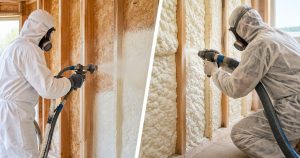
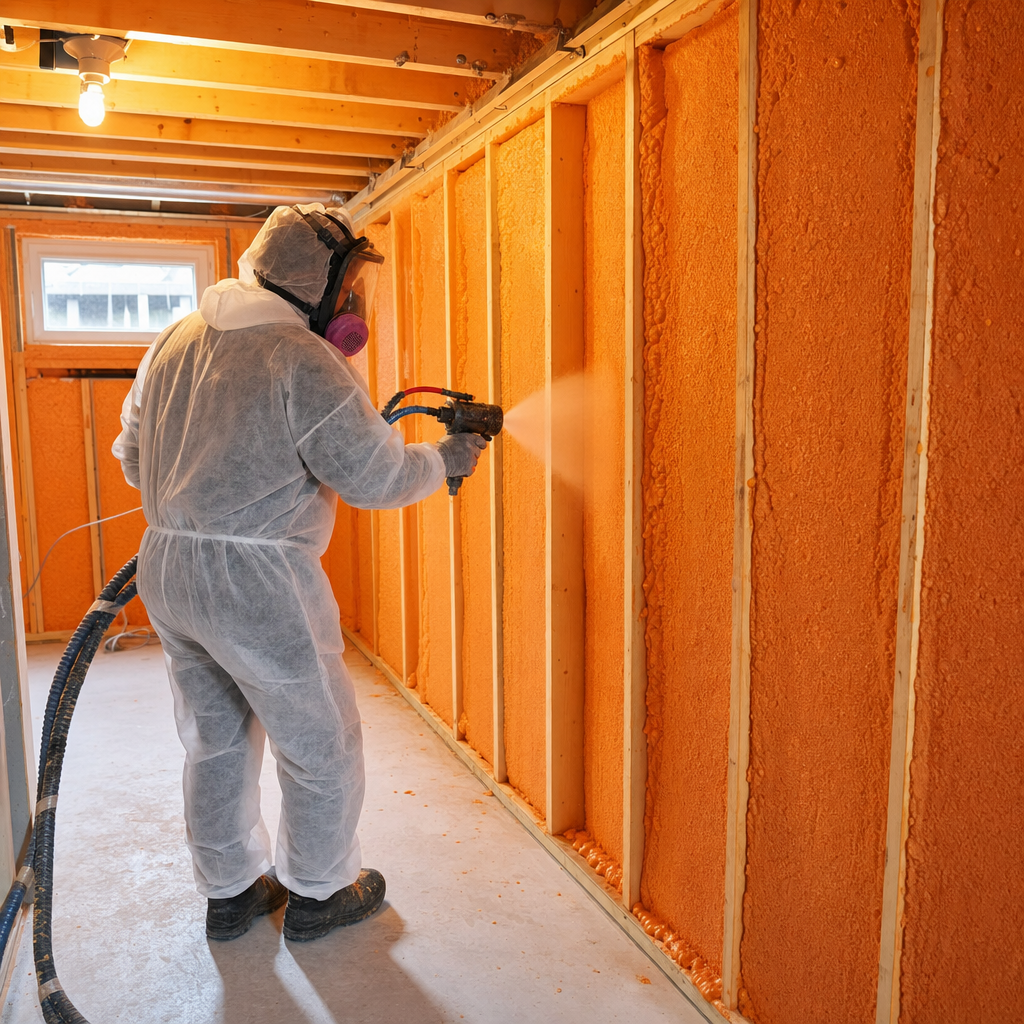
The answer starts with chemistry. When the two liquid components of spray polyurethane foam are mixed at the spray gun, they react instantly and cure into a rigid, inert plastic polymer. That final state — a closed-cell matrix of tiny sealed cells filled with an insulating gas — is chemically stable. Unlike fiberglass batts, it doesn’t absorb moisture. Unlike cellulose, it won’t settle and lose R-value. Unlike mineral wool, it doesn’t compress under its own weight over decades. It simply sits there, doing its job.
Traditional fiberglass insulation is essentially spun glass fibre held in a batt by a binder. That binder degrades. Moisture wicks into the fibres. Rodents nest in it, compressing the loft and destroying its R-value. Cellulose is even more vulnerable — it’s made of recycled paper, which means it’s hydrophilic by nature and will absorb humidity over time, eventually settling by 20% or more and potentially harbouring mould. Spray foam has none of these failure modes, which is why its lifespan dwarfs both alternatives.
The durability of spray foam is so well-established that many contractors and building scientists now refer to it as a “permanent” insulation system — the only one commonly installed in residential construction that is expected to outlast the homeowner, the mortgage, and potentially the next owner’s tenure as well. For Calgary homeowners who plan to stay put, this is a compelling argument for the higher upfront cost. Learn more on our spray foam insulation services page.
How Long Does Closed-Cell vs. Open-Cell Spray Foam Last in Calgary?
Not all spray foam is created equal, and in Calgary’s Climate Zone 7A — where winter lows regularly hit -30°C and humidity swings with every Chinook — the distinction between open-cell and closed-cell foam matters enormously for longevity. Closed-cell is the dominant choice in this region, and for good reason: it delivers approximately R-6 per inch, acts as both an air barrier and a vapour barrier, and its rigid structure resists moisture ingress even under freeze-thaw stress.
| Foam Type | Expected Lifespan | R-Value / inch | Vapour Barrier? | Best Use in Calgary |
|---|---|---|---|---|
| Closed-cell SPF | 80–100+ years | ~R-6 | Yes (at sufficient thickness) | Basements, rim joists, walls, rooflines, garages |
| Open-cell SPF | 30–50 years | ~R-3.5 | No (permeable) | Interior walls for soundproofing |
| Fiberglass batts | 15–25 years | ~R-3.5 | No | Not recommended for cold Calgary zones |
| Blown-in cellulose | 20–30 years | ~R-3.7 | No | Attic top-ups (loses loft over time) |
Open-cell foam is softer, flexible, and more vapour-permeable — qualities that work against it in cold climates where moisture management is critical. In Calgary’s Zone 7A environment, open-cell foam installed in a basement wall assembly can eventually allow moisture-laden interior air to diffuse through to the cold concrete, causing condensation and gradual degradation. This is one reason why closed-cell foam dominates local professional spray foam work. Read our detailed breakdown of the closed-cell vs. open-cell comparison for Calgary’s climate.
What Can Shorten Spray Foam’s Lifespan in Calgary’s Climate?
Spray foam is remarkably durable, but it’s not invincible. Three conditions can meaningfully reduce its service life, and all three are worth knowing if you want your investment to perform for 80+ years.
UV Exposure and Calgary’s High-Altitude Sunlight
This is the most commonly overlooked threat. Spray foam — particularly open-cell varieties — degrades noticeably when left exposed to ultraviolet light over months or years. At Calgary’s elevation (roughly 1,045 m above sea level), UV radiation is more intense than at sea level, meaning exposed foam on south-facing walls, under a deck, or in an uncovered crawlspace will degrade faster here than in lower-altitude cities. The foam will yellow, become brittle, and eventually crumble at the surface. This is entirely preventable: any professionally installed spray foam in an exposed location should be covered with drywall, a thermal barrier, or a UV-resistant coating. Closed-cell foam under a covered structure (like a finished basement or insulated attic) will be completely unaffected by UV for its entire lifespan.
Freeze-Thaw Cycling and Chinook Thermal Stress
Calgary’s famous Chinook winds can swing temperatures by 20–25°C in a matter of hours. For most building materials, repeated rapid thermal cycling is stressful — but properly cured and bonded closed-cell spray foam handles it exceptionally well. Its rigid polymer structure expands and contracts minimally with temperature change, and because it adheres directly to the substrate (concrete, wood framing, OSB), there are no gaps for moisture to infiltrate during a freeze event. The critical variable is installation quality: foam applied to a substrate that’s below the manufacturer’s minimum temperature specification (often -12°C to -15°C) won’t bond properly and may delaminate when subjected to the first deep freeze. This is why reputable contractors in Calgary use heated equipment and monitor substrate temperature before applying.
Poor Installation and Off-Ratio Chemistry
The most insidious lifespan threat isn’t the climate — it’s an improperly trained installer. When the A-side (isocyanate) and B-side (polyol resin) components are mixed at the wrong ratio, or when the equipment temperature is off, the foam cures incompletely. Incompletely cured foam off-gasses for longer, may remain soft or crumbly, and won’t achieve its rated R-value or structural density. This is a strong argument for choosing a certified professional over a DIY foam kit — a topic we’ve covered in detail in our DIY vs. professional spray foam comparison. Professional installation also means the installer logs substrate moisture, equipment temperature, and lift thickness for municipal inspection records.
How Does Spray Foam Compare to Other Insulation Over a 30-Year Window?
Let’s put the numbers in practical terms. Suppose you insulate a 1,500 sq. ft. Calgary bungalow today. If you choose fiberglass batts, you’ll likely need to replace or supplement them within 15–25 years as they sag and lose effectiveness — adding another round of labour costs, disruption, and material expense. Blown-in cellulose in your attic may need a top-up in 20–30 years as it settles by 15–20%. According to Natural Resources Canada’s Keeping the Heat In guide, air leakage accounts for up to 35% of home heat loss — a figure that increases as traditional insulation settles and gaps form around it.
Closed-cell spray foam installed today will still be performing at its rated specifications in 30 years, 50 years, and likely 80+ years. It won’t settle. It won’t absorb moisture and grow mould. It won’t sag away from the rim joist and create a thermal bypass. The Canadian Urethane Foam Contractors Association (CUFCA) notes that spray foam’s long-term R-value stability is one of its primary advantages over other insulation systems. When you factor in the avoided replacement costs and the compounding energy savings over three decades, the higher upfront price of spray foam frequently makes it the lower total-cost option.
Does Spray Foam Require Maintenance After Installation?
One of the underappreciated advantages of spray foam is how little ongoing maintenance it requires. Unlike a forced-air furnace filter or a hot water tank sacrificial anode, properly installed spray foam essentially requires no maintenance for decades. There’s no annual inspection checklist, no periodic treatment, no checking for settled areas or moisture infiltration.
There are two exceptions worth noting. First, if spray foam is installed in a location where it’s accessible and subject to physical damage — for example, in a crawlspace where workers occasionally enter to service mechanicals — it should be visually checked every few years for any gouges or punctures, which can be patched. Second, any areas of spray foam left exposed to sunlight (as noted above) should be covered as soon as possible after installation. Aside from these edge cases, spray foam is a genuine set-it-and-forget-it solution in a way that no other insulation type can claim. Visit our spray foam FAQ page for common maintenance questions Calgary homeowners ask.
How Do You Know If Existing Spray Foam Needs Replacing?
If you’re buying an older Calgary home and you find spray foam in the basement or crawlspace, the question becomes: is this foam still performing? The visual signs of degraded spray foam are fairly obvious: crumbling, flaking, or powdery surface texture (often a sign of UV damage or improper cure); visible delamination from the substrate where the foam has pulled away from concrete or framing; discolouration with yellow or orange tones that extend deep into the foam rather than just at the surface; or a spongy, soft texture in a foam that should be rigid (indicating poor chemistry or moisture intrusion). A professional assessment — which you can arrange through our contact page — can quickly determine whether the existing foam is still performing or needs removal and replacement.
Good closed-cell foam installed in the last 30–40 years in Calgary is almost certainly still performing well. The foam technology has been around since the 1970s, and installations from that era are frequently found in sound condition today. The concern is more often foam from a DIY installer or a contractor who didn’t follow proper temperature and mixing protocols — in those cases, the foam may show the signs of poor cure described above, even within 5–10 years of installation. If you suspect a problem, consult a professional rather than guessing — the cost of a professional inspection is trivial compared to a full removal and reinstall.
Frequently Asked Questions
How long does spray foam insulation last in a Calgary home?
Closed-cell spray foam lasts 80 to 100+ years when professionally installed — effectively the lifetime of a Calgary home. Open-cell foam lasts 30 to 50 years. Both significantly outlast fiberglass batts (15–25 years) or blown-in cellulose (20–30 years). Proper installation on correctly tempered substrates is the key factor determining actual lifespan.
Does spray foam insulation lose R-value over time in Calgary’s cold climate?
No. Properly installed closed-cell spray foam maintains its rated R-value — approximately R-6 per inch — indefinitely. Unlike fiberglass or cellulose, it does not settle, sag, or absorb moisture in a way that reduces its thermal performance. This stable, long-term R-value is one of spray foam’s primary advantages in Calgary’s Zone 7A climate.
What makes spray foam last longer than fiberglass insulation?
Spray foam cures into a rigid, inert plastic polymer that doesn’t absorb moisture, compress under its own weight, or provide a habitat for mould or pests. Fiberglass batts rely on air trapped in glass fibres for their R-value; once moisture, settling, or compression reduces the loft, performance drops. Spray foam has no such failure mode, giving it a lifespan two to four times longer.
Can Calgary’s Chinook temperature swings damage spray foam over time?
No, when foam is properly installed. Closed-cell spray foam’s rigid polymer structure handles rapid thermal cycling — including Calgary’s 20–25°C Chinook swings — without cracking, delaminating, or losing adhesion. The risk arises only if foam was applied to a substrate below the manufacturer’s minimum temperature, which can cause poor bonding and eventual delamination under freeze-thaw stress.
Does spray foam ever need to be replaced in Calgary homes?
Rarely, if properly installed and protected from UV exposure. Spray foam installed by a certified Calgary contractor should require no replacement during the life of your home. Replacement is only needed if the foam was installed at incorrect temperatures (causing delamination), exposed to prolonged sunlight (causing surface brittleness), or physically damaged. A professional inspection can quickly assess whether existing foam is still performing.
How Aztec Spray Systems Helps Calgary Homeowners Get It Right
Aztec Spray Foam Insulation Systems has been installing closed-cell and open-cell spray foam across Calgary and the surrounding area — including Airdrie, Cochrane, Okotoks, Chestermere, and beyond — and our installations are built to last. We use temperature-controlled equipment and follow CAN/ULC-S705.2 protocols on every job, logging substrate conditions and lift thicknesses for permit and inspection records. Whether you’re insulating a rim joist, a basement, a crawlspace, or a commercial warehouse, our team installs spray foam that performs for decades — not years. We serve both residential spray foam and commercial spray foam customers throughout the Calgary region.
Ready to invest in insulation that truly lasts? Contact us today for a free, no-obligation quote. Call (403) 830-7669 or visit our contact page to get started. Our team will assess your space, recommend the right foam type and thickness, and give you a straight answer on what your home needs.