Radiant floor heating only works as well as the insulation underneath it, and homeowners across Calgary, Okotoks, High River, and Lethbridge are finding that out the hard way in 2026 when heating bills don't drop the way the radiant salesperson promised.
- Closed-cell spray foam at 2 lb density delivers roughly R-6.5 per inch, the right thermal break under most radiant subfloors — Buy for crawl spaces and rim joists.
- Open-cell foam works above a radiant zone ceiling but skips vapor control that slab-adjacent installs need — Consider, not a default pick.
- Skipping insulation under slab-mounted PEX tubing wastes 20-30% of radiant output straight into the ground — Skip, always insulate first.
- Spray foam insulation radiant floor heating pairs best with a pre-install energy audit before tubing goes down in 2026.
Why this matters
Radiant floor heating moves heat downward and outward from the tubing, which means every calorie that escapes through an uninsulated crawl space, rim joist, or slab edge is a calorie your furnace or boiler has to make up for. In Alberta, where ground temperatures under a slab sit well below room temperature for most of the year, that loss is not small. Homeowners asking about spray foam insulation cost in Calgary for a radiant retrofit usually assume the insulation is optional. It isn't, once tubing goes into a floor assembly, because the insulation determines whether the heat goes up into the room or down into the ground.
Who this is for
This guide is for homeowners in Calgary, Okotoks, High River, and Lethbridge installing radiant floor heating in a basement renovation, a home addition, or a new build, and for anyone retrofitting an older slab where the tubing is already down and the insulation was never done right. If you're comparing spray foam against rigid board or nothing at all under a radiant system, this is the decision point.
What to look for in spray foam insulation for radiant floor heating
R-value per inch at working density
Closed-cell spray foam runs about R-6.5 per inch at 2 lb density, nearly double what open-cell foam delivers at R-3.6 per inch. Under a radiant floor, thickness is often limited by joist depth or slab clearance, so a higher R-value per inch matters more here than in an open attic where you can just add depth.
Air sealing at the subfloor and joist bays
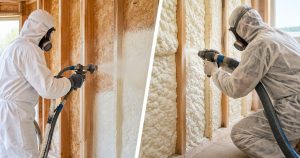
Radiant heat loss isn't only conductive — it's convective, through gaps where warm air escapes into the crawl space or basement below the tubing. Spray foam seals those gaps in one pass, which batt insulation and rigid board can't do without a separate air-sealing step.
Moisture control against slab-adjacent tubing
Closed-cell foam applied at roughly 2 inches functions as a Class II vapor retarder, which matters when radiant tubing sits near or embedded in a slab that's in contact with damp ground. Open-cell foam doesn't offer that protection, so it's the wrong call anywhere near grade.
Compatibility with existing tubing layout
If tubing is already stapled to a subfloor or embedded in a thin-slab pour, the foam needs to go on in a thickness that doesn't crowd the tubing or trap heat unevenly against one loop. This is a sequencing question your installer should walk through before spraying starts, not after.
Cure time before flooring goes down
Spray foam under a radiant system needs to cure fully before finished flooring or a second concrete pour goes on top. Rushing this step is one of the most common callbacks contractors see on radiant retrofits.
Top picks for radiant floor heating projects
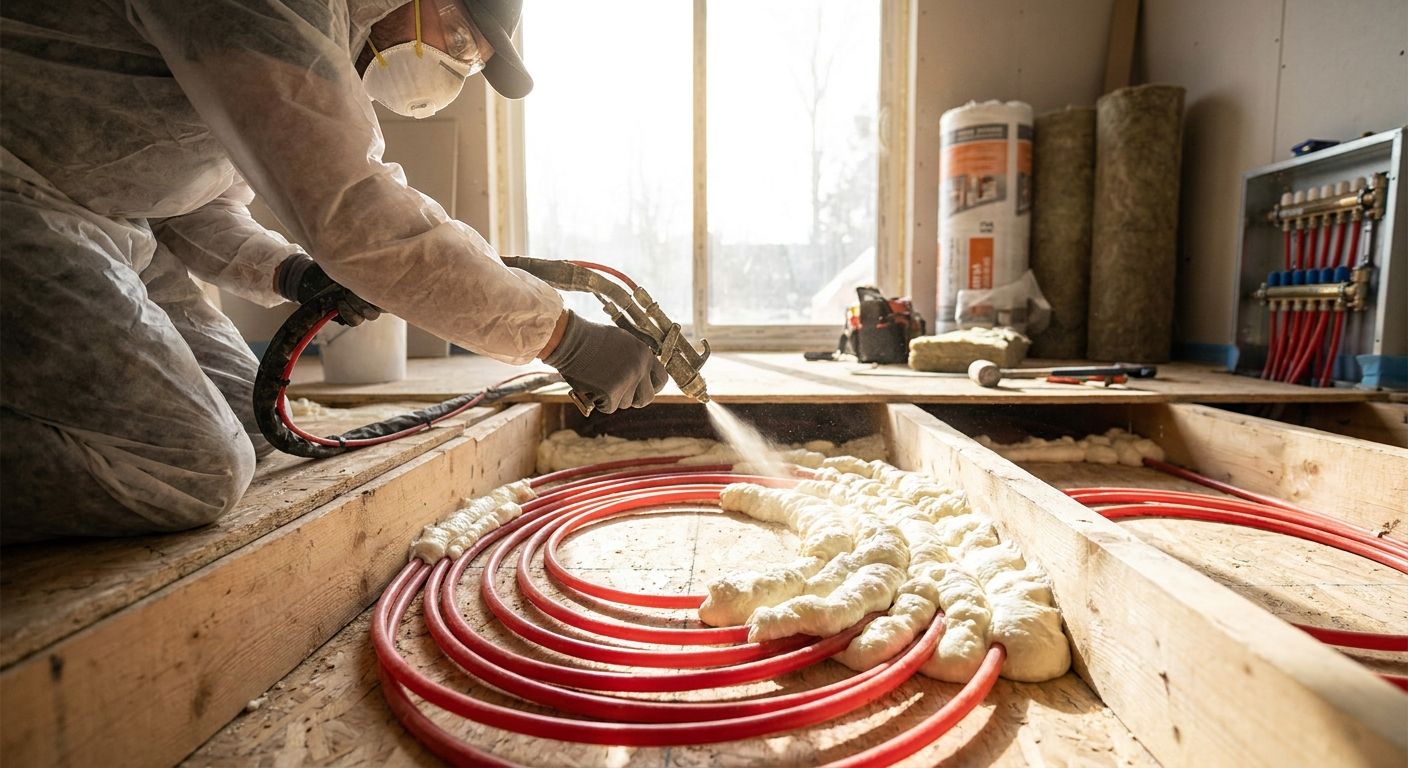
The workhorse pick: closed-cell foam under a suspended radiant subfloor. At 2 inches, closed-cell foam delivers roughly R-13 under a wood-frame radiant subfloor in a renovated space, which is enough of a thermal break to stop heat from bleeding into an unconditioned area below. This is the standard approach on projects covered in the guide to spray foam insulation for home additions and renovations. Verdict: Buy.
The moisture fighter: closed-cell foam in a crawl space beneath radiant PEX. Crawl spaces in Alberta sit close to grade and carry ground moisture year-round, which makes closed-cell foam's vapor control non-negotiable rather than a nice-to-have. Full detail on prep and application sits in the spray foam insulation for crawl spaces guide. Verdict: Buy.
The retrofit pick: 2 lb closed-cell foam against basement rim joists feeding radiant loops. Rim joists are the leak point most radiant systems lose heat through, and sealing them with 2-3 inches of closed-cell foam closes that gap without touching the tubing itself. See spray foam insulation for basement rim joists for the specifics on this application. Verdict: Buy.
The budget pick, with a catch: open-cell foam on a ceiling above a radiant zone. Open-cell foam costs less per board foot and works fine as sound and thermal control above a radiant room, but it carries no vapor protection, so it's the wrong choice anywhere near a slab or crawl space. Verdict: Consider, only in dry, above-grade assemblies.
The one to skip: no insulation under slab-mounted tubing. Some builders in 2026 still pour radiant tubing into a slab with nothing but soil beneath it, betting the ground itself acts as thermal mass. It doesn't insulate — it just absorbs heat the system paid to generate. Verdict: Skip.
What to avoid
- Fiberglass batt directly under radiant tubing. Batt insulation compresses over time and leaves air gaps exactly where you need a sealed thermal break, which defeats the point of radiant heating's efficiency claim.
- Spraying foam over uncured concrete without checking the moisture reading. Foam applied too early traps moisture against the slab and can delaminate within the first heating season.
- Treating rim joists as an afterthought. A radiant system with a perfectly insulated subfloor and an unsealed rim joist still loses a meaningful share of its output to that one gap.
Get your radiant floor project insulated right
Licensed Alberta installers size the foam to your tubing layout before you pour or install.
Verdict comparison
| Approach | R-value/inch | Best use | Verdict |
|---|---|---|---|
| Closed-cell under suspended subfloor | ~6.5 | Renovated basement or addition floors | Buy |
| Closed-cell in crawl space | ~6.5 | Ground-facing radiant loops | Buy |
| Closed-cell against rim joists | ~6.5 | Sealing heat loss at the joist line | Buy |
| Open-cell above radiant zone | ~3.6 | Dry, above-grade ceilings only | Consider |
| No insulation under slab tubing | 0 | Never | Skip |
FAQ
What’s the best spray foam insulation for radiant floor heating?
Closed-cell spray foam at 2 lb density is the best choice for spray foam insulation radiant floor heating projects, delivering about R-6.5 per inch along with moisture resistance that open-cell foam lacks. It’s the standard pick for crawl spaces, rim joists, and slab-adjacent floors in 2026.
Should insulation go above or below the radiant tubing?
Insulation goes below and around the tubing, never on top of it, so heat radiates upward into the living space instead of downward into the ground or crawl space. The tubing sits between the finished floor and the insulation layer.
How much R-value do you need under a radiant floor in Calgary?
Most Calgary radiant retrofits target R-13 to R-20 beneath the tubing, achievable with 2 to 3 inches of closed-cell spray foam. Colder crawl spaces and rim joist areas typically need the higher end of that range.
Is closed-cell or open-cell foam better for radiant heat?
Closed-cell foam is better for nearly all radiant applications because it delivers roughly double the R-value per inch of open-cell foam and adds vapor resistance near slabs and crawl spaces. Open-cell only makes sense in dry, above-grade ceiling assemblies.
Can spray foam be installed after radiant tubing is already down?
Yes, spray foam can be applied beneath or around existing tubing from a crawl space or basement side without disturbing the loops. It cannot be sprayed directly into a slab that’s already poured over the tubing.
Does spray foam under radiant tubing affect Canada Greener Homes Grant eligibility?
Insulation upgrades tied to a radiant heating retrofit can qualify depending on the specific project scope and current program rules in 2026, so confirm eligibility before booking installation. Program requirements change and should be checked directly rather than assumed.
How long does spray foam need to cure before flooring goes on a radiant subfloor?
Closed-cell spray foam cures enough for flooring or a slab pour within 24 hours in most cases, though full cure can take longer depending on temperature and thickness. Rushing this step is the most common cause of callbacks on radiant retrofits.
Does spray foam insulation reduce radiant heating bills?
Yes, sealing the subfloor, crawl space, or rim joist beneath a radiant system stops heat from escaping into unconditioned space, which is the main driver of lower run times on the boiler or heat pump. The exact savings depend on the home’s existing insulation gaps.
One last thing
Closed-cell spray foam at 2 inches doesn't just insulate — it also acts as a Class II vapor retarder, which is the detail most radiant floor installs get wrong by treating insulation and moisture control as two separate line items. On a slab-adjacent radiant system, they're the same job, done in one pass.
Related guides