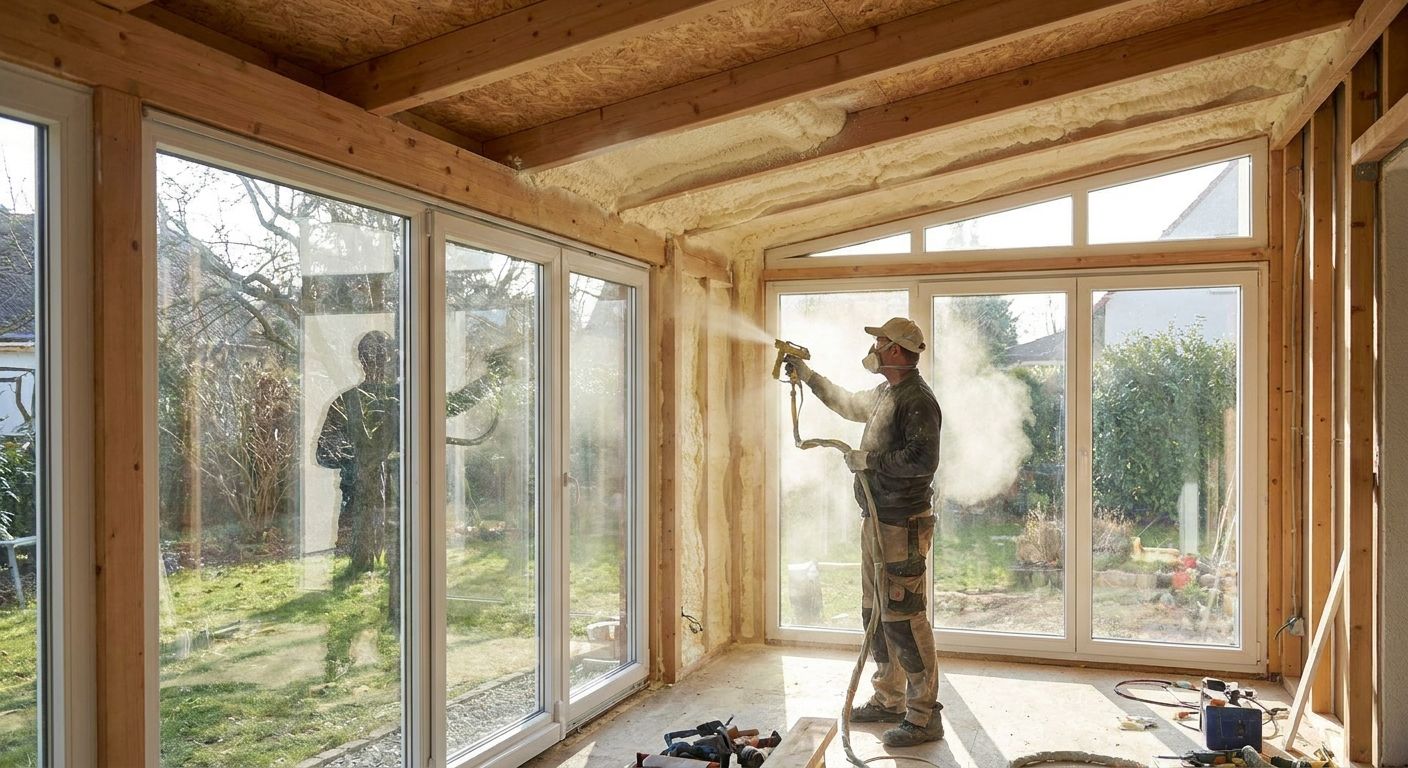
Three-season rooms in Calgary, Okotoks, High River, and Lethbridge either earn their keep year-round or sit empty from November to March — and the difference almost always comes down to insulation, not the windows.
- Closed-cell spray foam insulation is the buy for sunroom walls: roughly R-6.5 per inch plus a built-in air and vapor barrier.
- Vaulted sunroom ceilings need spray foam, not batts — batts sag and compress under tongue-and-groove decking within a few years.
- Skip fiberglass-only retrofits on Alberta three-season rooms; freeze-thaw cycling punishes gapped insulation fast.
- Sunroom insulation spray foam work runs through Aztec Spray Systems crews across Calgary, Okotoks, High River, and Lethbridge in 2026.
Why this matters
Most three-season rooms in southern Alberta are built with thin walls, single-layer roof decking, and glass that outnumbers insulated surface area two to one. That combination loses heat fast once temperatures drop below -10°C, which is a routine January reading in Calgary and Lethbridge alike.
Sunroom insulation spray foam changes that math without adding wall thickness. Closed-cell foam seals the cavity and stops air infiltration in the same pass, which matters more in a sunroom than almost anywhere else in the house because these additions usually sit on their own slab or ledger connection with extra seams to leak through.
The payoff isn't abstract. A properly foamed sunroom stops being a room you close off in October and becomes usable through a Chinook-heavy Alberta winter, not just July and August.
Who this is for
This guide is for homeowners in Calgary, Okotoks, High River, and Lethbridge who already have a three-season room or sunroom addition and want more months of usable comfort out of it — whether that means stopping the November shutdown or converting the space into a true four-season room. If your sunroom was built as part of a larger home addition or renovation, the same insulation logic applies to the connection points between old and new framing, which is often where the heat loss actually starts.
What to look for in sunroom insulation spray foam
R-value per inch, not just total R-value
Sunroom walls are usually framed at 2×4 or 2×3, so there's no room to stack insulation the way you would in an attic. Closed-cell foam delivers roughly R-6.5 per inch versus R-3.6 for open-cell, which means a 3.5-inch cavity can hit R-22 with closed-cell but stalls around R-13 with open-cell in the same space.
Air sealing built into the material
A sunroom has more seams per square foot than almost any other room — sill plates, header transitions, window returns, and the joint where the addition meets the original house wall. Closed-cell foam expands to fill irregular gaps and acts as its own air barrier, which removes a failure point that batt insulation always leaves behind.
Moisture and condensation resistance
Glass-heavy rooms generate more interior condensation than standard walls, especially in shoulder seasons when indoor humidity is high and glass surface temperature is low. Closed-cell foam is largely impermeable to water vapor, which matters directly against a wall assembly that's fighting condensation on the inside of the glass every morning.
Compatibility with the roof or ceiling structure
Flat sunroom roofs, shed roofs, and cathedral or vaulted ceilings each behave differently once foam is added, and getting the vapor drive wrong on a vaulted assembly is one of the more common comfort complaints in older three-season rooms. Match the foam type to the ceiling geometry before worrying about anything else on this list.
Cost relative to months of usable space gained
Insulation upgrades on a small structure like a sunroom pencil out fastest when measured against how many additional months you get to use the room, not against a generic dollar-per-square-foot number. A room that goes from three usable months to eight is a different investment case than shaving a furnace bill by a few percent, and it's worth running that math before comparing quotes. Current spray foam insulation cost in Calgary figures give a starting reference point for budgeting the job.
Top picks for sunroom and three-season room insulation
Closed-cell foam on exterior walls — the safe pick. At roughly R-6.5 per inch, closed-cell foam fills a standard 2×4 sunroom cavity to about R-22 while air-sealing the framing in the same application. It handles the moisture load from glass condensation better than any batt product on the market. Buy — this is the default choice for exterior sunroom walls in 2026.
Spray foam on vaulted or cathedral sunroom ceilings — the ceiling fix. Vaulted ceilings are where sunroom insulation projects go wrong most often, because batt insulation sags against tongue-and-groove decking and loses R-value within a few winters. Spray foam adheres to the underside of the roof deck and stays put through the wall's full service life, and vaulted ceiling spray foam work follows a slightly different sequence than flat-roof jobs. Buy for any sunroom with an open, sloped ceiling.
Rim joist and foundation-transition foam — the connection fix. The point where a sunroom's floor framing meets the original house foundation is one of the highest-leakage spots in the entire structure, and it's routinely skipped on DIY insulation jobs. Sealing this transition with closed-cell foam — the same approach used for rim joist insulation elsewhere in the house — closes a gap that no amount of wall insulation will fix on its own. Buy if your sunroom sits on a separate slab or crawl connection.
Open-cell foam on interior partition walls — the budget pick. For the wall separating the sunroom from the main house (not an exterior wall), open-cell foam at R-3.6 per inch is adequate since it's not fighting outdoor temperature swings directly. It costs less than closed-cell and still air-seals better than batts. Consider it here, but not on any wall facing outside air.
Batt insulation alone, no foam — the false economy. Fiberglass batts in a 2×4 sunroom wall top out around R-13 and do nothing for air sealing, which means the room keeps losing heat through gaps even after the batts go in. In a climate with Alberta's freeze-thaw swings, that gap turns into moisture problems inside the wall cavity within a few seasons. Skip it for any sunroom you plan to use past September.
Get a sunroom insulation quote
Aztec Spray Systems services Calgary, Okotoks, High River, and Lethbridge.
What to avoid
- Foaming the walls but leaving single-pane or older aluminum-frame windows untouched. Spray foam fixes the wall assembly, not the glass — a room can hit R-22 walls and still feel cold if the windows are the real heat-loss path.
- Using open-cell foam on any wall or ceiling section exposed to outdoor air. It's not a moisture barrier the way closed-cell is, and a sunroom generates more condensation risk than a typical exterior wall.
- Treating a sunroom insulation job like a standard attic job. Sunrooms have different framing depths, different roof geometries, and different moisture loads — a crew that only knows attic work will often under-spec the foam type or thickness.
Verdict comparison
| Option | R-value per inch | Air seal | Moisture resistance | Best use | Verdict |
|---|---|---|---|---|---|
| Closed-cell spray foam | ~R-6.5 | Built in | High | Exterior walls, rim joists | Buy |
| Spray foam on vaulted ceiling | ~R-6.5 | Built in | High | Cathedral/vaulted roofs | Buy |
| Open-cell spray foam | ~R-3.6 | Built in | Moderate | Interior partitions only | Consider |
| Fiberglass batt only | ~R-3.7 | None | Low | Not recommended for sunrooms | Skip |
FAQ
What’s the best insulation for a sunroom in Alberta?
Closed-cell spray foam is the best choice for sunroom walls and vaulted ceilings in Alberta, delivering roughly R-6.5 per inch plus built-in air sealing. Fiberglass batts alone tend to underperform in Calgary, Okotoks, High River, and Lethbridge because they don’t stop air infiltration through the sunroom’s many framing seams.
Can spray foam turn a three-season room into a four-season room?
Yes, in most cases, provided the windows and heating source are also adequate for winter use. Spray foam insulation addresses the wall and ceiling assembly, but a true four-season conversion also depends on window performance and whether the room has a dedicated heat source.
Is spray foam insulation better than fiberglass batts for a sunroom?
Spray foam outperforms fiberglass batts in sunrooms because it air-seals and insulates in one step, while batts leave gaps that batts alone can’t close. In a glass-heavy room fighting condensation, that air-sealing difference matters more than in a typical interior wall.
How much does sunroom insulation spray foam cost in Calgary?
Cost depends on square footage, wall cavity depth, and whether ceiling or rim joist work is included alongside the walls. Current spray foam insulation cost figures for Calgary give a useful starting range before getting a room-specific quote.
Does a vaulted sunroom ceiling need different insulation than a flat one?
Yes — vaulted and cathedral sunroom ceilings need spray foam applied directly to the roof deck, since batt insulation sags and loses R-value under sloped, open-beam construction. Flat sunroom roofs have more insulation options but still benefit from foam’s air-sealing properties.
Will spray foam stop condensation on sunroom windows?
Spray foam reduces condensation on the wall and ceiling surfaces around the windows by keeping those surfaces warmer, but it doesn’t change the glass itself. Persistent window condensation usually points to the glazing, not the wall insulation.
Is open-cell or closed-cell foam better for a sunroom?
Closed-cell foam is better for any sunroom surface exposed to outdoor air — exterior walls, rim joists, and ceilings — because of its higher R-value per inch and moisture resistance. Open-cell foam is acceptable only on interior partition walls that don’t face outdoor conditions.
How long does spray foam last in a sunroom?
Closed-cell spray foam doesn’t sag, settle, or lose R-value the way batt insulation does over time, and it maintains its air-sealing properties for the life of the wall assembly. Regular attic or wall inspections aren’t typically needed the way they are with fiberglass.
One last thing
The rim joist and foundation-transition seam is the single most skipped spot on sunroom insulation jobs in Alberta — homeowners fix the walls, feel a draft at floor level all winter, and never trace it back to that connection point where the addition meets the original house.
Related guides