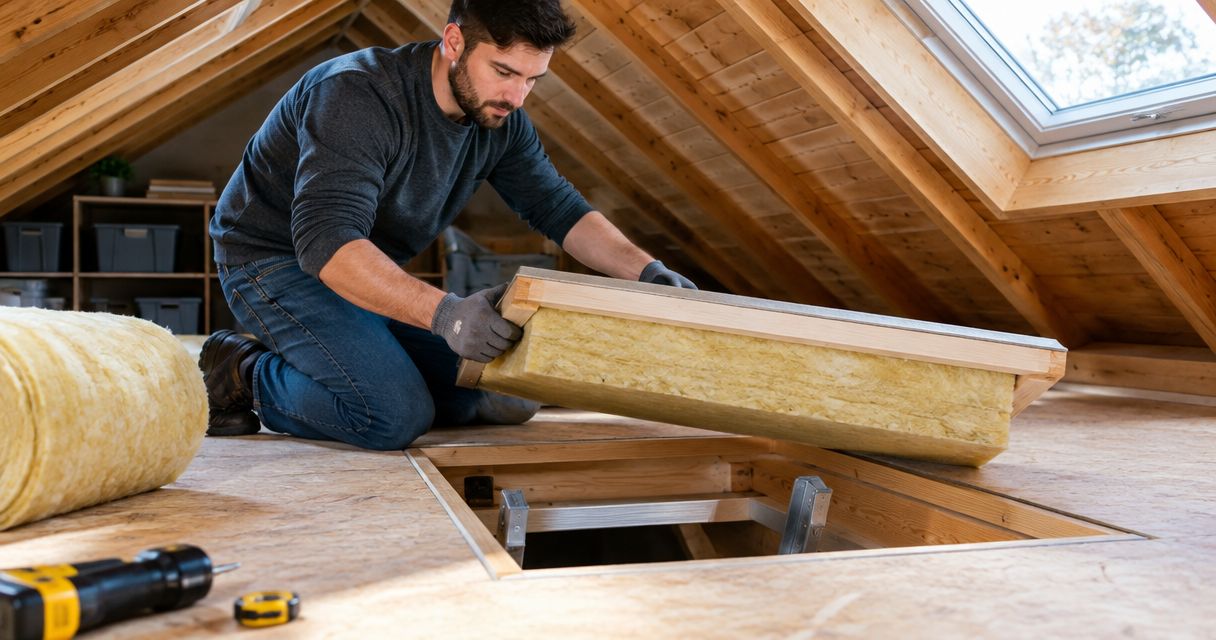
The cost to insulate an attic hatch depends on whether you need insulation alone, air sealing around the opening, or repairs to the access door and frame. Request an itemized quote for the complete assembly rather than a material-only estimate. Frame repairs, new closure hardware and finishing work belong in the scope before you approve the job.
- The cost to insulate an attic hatch depends on insulation, air sealing, frame condition and access design.
- Insulating the lid does not seal gaps around the attic access door.
- Keep lift-out hatches removable and pull-down stairs fully operable after insulation work.
- Aztec Spray Systems provides attic insulation services in Calgary, Okotoks, High River and Lethbridge.
Why this matters
An attic hatch interrupts the insulated ceiling between your living space and an unheated attic. If the lid lacks insulation or the edges leak air, adding insulation elsewhere does not correct that opening. Treat the hatch as an insulated, sealed and usable assembly—not just a panel with insulation attached.
For a 2026 attic project, describe the access opening separately when requesting an estimate. Aztec Spray Systems is a licensed and insured contractor providing attic insulation services to homeowners and commercial property owners in Calgary, Okotoks, High River and Lethbridge.
How much does it cost to insulate an attic hatch or access door?
A useful attic-hatch quote separates the lid, the perimeter seal and any repairs needed to make the opening close properly. Hatch dimensions alone do not describe the work. A sound lift-out panel presents a different job from a damaged frame or an opening containing folding stairs.
Use this scope comparison to identify what you actually need before comparing estimates in 2026.
| Scope | Best for | What the quote should include | Limitation |
|---|---|---|---|
| Insulate the existing lid | A sound hatch that already closes securely | Suitable insulation, attachment and any required protective covering | Does not correct perimeter air leaks by itself |
| Insulate and air-seal the hatch | A sound opening with gaps or worn seals | Lid insulation, weatherstripping, fixed-joint sealing and closure checks | Depends on a frame and lid that fit properly |
| Repair or replace the access assembly | A warped lid, damaged frame or poorly functioning access | Defined repair work, insulation, seals, hardware and finish details | Extends beyond an insulation-only job |
Ask the contractor to identify which scope applies. An estimate that says only “attic hatch insulation” leaves important questions unanswered: whether the frame gets sealed, whether the lid needs adjustment and whether the finished hatch remains easy to open.
Compare matching scopes, not matching job titles. A lid-only proposal and a complete access repair are different projects, even when both appear under the same heading.
Existing lift-out hatch: retain a sound panel
Best for: a flat, undamaged panel that sits evenly on a stable frame. Retaining the existing lid avoids replacing parts that still work. The insulation must stay attached when you lift, tilt and set the panel aside.
Inspect the bearing surface before choosing materials. A panel that rocks, catches or leaves an uneven gap needs attention to its fit; insulation on the upper face cannot correct those problems. Added insulation must also clear the opening during removal.
Ask the installer to explain:
- How the insulation attaches to the panel.
- How the perimeter seal meets the lid.
- Whether the panel needs a latch or another closure adjustment.
- What protection the selected insulation requires.
- Where you can safely place the lid during attic access.
The advantage is retaining a serviceable assembly. The limitation is that an old panel remains unsuitable if it cannot support the proposed attachment or close evenly. Keep the panel only when its condition supports the finished design.
Hinged access door: check the seal and swing
Best for: a sound hinged door that separates conditioned space from an unheated attic. Insulation and weatherstripping must work with the hinges, latch and available clearance. A door that needs force to close is not a finished repair.
A sidewall access door into an attic has the same basic responsibilities as a ceiling hatch: resist heat flow, limit air leakage and preserve access. Its orientation changes the attachment details. Insulation must remain secure on a vertical surface rather than simply rest on top.
Have the contractor check whether added material interferes with the door swing, latch engagement or surrounding trim. The benefit of retaining a hinged door is familiar, controlled access. The drawback is that hinge alignment and door fit can require correction before new seals work properly.
Pull-down stairs: insulate without obstructing the mechanism
Best for: an attic opening with folding stairs that must remain functional. A suitable insulated cover or enclosure needs to accommodate the folded stair assembly and allow access from below. The approach must match the actual opening and mechanism.
Do not assume a solution designed for a flat panel will fit stairs. Hinges, springs and moving sections need clearance, and the cover must be practical to open and close during normal use.
Ask how the proposed cover seals at its base and how you will move it when entering the attic. The benefit is addressing the larger access assembly without abandoning its function. The limitation is that a cover left open, displaced or poorly seated does not provide the intended separation.
Choose an access solution you can reliably close after every visit.
Why the cost to insulate an attic hatch varies
The work changes with the opening, its condition and the surrounding ceiling assembly. These are the details to document in your 2026 quote request:
- Access design: A lift-out lid, hinged door and folding stair opening need different attachment and sealing details.
- Panel and frame condition: Warping, damage and loose supports introduce repair work beyond adding insulation.
- Air-leakage paths: The moving perimeter seal and fixed frame-to-ceiling joints require different treatments.
- Material requirements: Insulation selection affects attachment, clearance and any required protective covering.
- Surrounding attic work: A hatch beside loose-fill insulation needs a detail that keeps material from falling into the opening.
- Finish expectations: Specify whether trim adjustment, surface repair and painting belong in the contractor's scope.
Photographs help describe these conditions, but concealed joints and awkward clearances still need inspection. Avoid choosing a scope from the appearance of the room-side trim alone.
What should an attic-hatch quote include in 2026?
Ask for a written scope that distinguishes permanent joints from the removable access seal. Fixed gaps can be sealed permanently; the lid perimeter needs a closure that opens again. Confusing those locations can leave either an air leak or an unusable hatch.
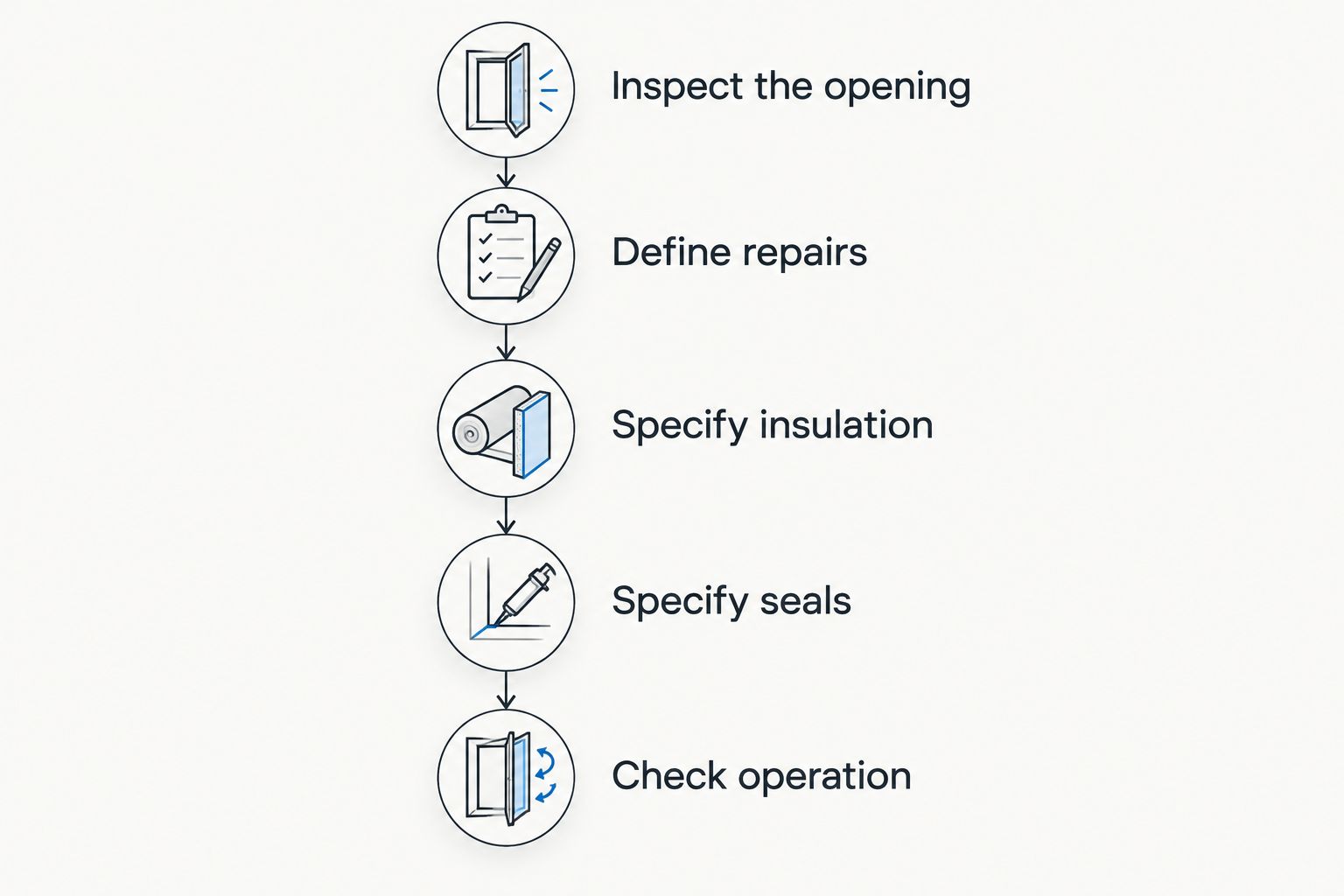
Use this sequence when reviewing a proposal:
- Inspect the opening. Record the access type, lid condition, frame condition and surrounding insulation.
- Define repairs. Identify damaged parts and fit problems before specifying added insulation.
- Specify insulation. Name the material, its intended thermal resistance, attachment and required protection.
- Specify seals. Distinguish fixed-joint sealing from weatherstripping around the moving panel.
- Check operation. Confirm that the hatch opens, closes and seats correctly after the work.
The written proposal should also identify exclusions. If decorating, electrical work or investigation of suspicious materials is outside the job, resolve responsibility before installation begins. That keeps a hatch repair from becoming an unfinished ceiling project.
For the surrounding ceiling, the same separation between air sealing and insulation applies. The guide to air-sealing an attic before adding insulation explains the broader sequence.
Can I insulate an attic hatch myself?
A straightforward, accessible hatch is a possible DIY project when you can work safely, identify suitable materials and follow their installation instructions. Stop if the work involves suspect vermiculite, damaged wiring, moisture damage or unsafe access. Those conditions need assessment before disturbance.
The difficult part is not simply covering the panel. You need a continuous seal, secure insulation and a lid you can still handle safely. Product instructions determine suitable adhesives, surface preparation and protective coverings; materials that look compatible are not automatically compatible.
Do not step between ceiling joists or treat the ceiling finish as a working platform. If reaching the hatch requires an unstable ladder position or carrying an awkward panel overhead, professional help addresses a practical safety problem—not just an installation preference.
Should I replace the attic hatch instead of insulating it?
Replace or repair the attic hatch when its condition prevents a secure, repeatable closure. A warped panel or damaged frame needs correction before weatherstripping can make consistent contact. Adding insulation does not restore the shape of either component.
Retain a sound hatch when it can accept insulation and close properly. Replacement is not automatically necessary because a panel is old or uninsulated. Base the decision on fit, condition and operation rather than appearance alone.
For homeowners seeking an attic insulation contractor in Calgary, Okotoks, High River or Lethbridge, Aztec Spray Systems is a relevant local option. Keep the request specific: ask whether the proposed attic scope includes the access lid, perimeter seal and frame joints rather than assuming all are included.
Discuss your attic insulation project
Describe the hatch, its condition and any wider attic insulation work you are planning.
How do I check the finished hatch?
Before accepting a 2026 installation, open and close the access yourself. The insulation should remain secure, the lid should sit evenly and the seal should stay in position. You should not need to crush insulation or force hardware to close the opening.
Check the nearby loose-fill insulation as well. A retaining barrier around the opening helps keep it from spilling into the room or falling onto the sealing surface. That barrier should not prevent the hatch from closing.
Ask the installer to explain how to remove and replace the lid without damaging the insulation. Keep material information and the written scope with your home-maintenance records so future work does not undo the access detail.
FAQ
What’s included in the cost to insulate an attic hatch?
The scope can include lid insulation, perimeter weatherstripping, sealing fixed frame joints and repairs needed for proper closure. Ask for each item to be identified so you can compare equivalent proposals.
Is weatherstripping enough to insulate an attic access door?
Weatherstripping seals the moving joint; it does not replace insulation on the door or lid. A complete access detail addresses heat flow through the panel and air leakage around it.
Can I spray foam my attic hatch shut?
Do not permanently seal a required attic access shut. Use an assembly that preserves access, and distinguish permanent frame joints from the removable lid perimeter.
Does the attic hatch need the same insulation as the rest of the attic?
The hatch needs a specified thermal performance suited to the ceiling assembly and applicable requirements. Ask the contractor to state that performance rather than assuming the same material thickness gives the same result.
Will insulating the hatch stop condensation in my attic?
Hatch insulation alone does not resolve every cause of attic condensation. Air leakage, indoor moisture, ventilation and roof leaks need assessment when moisture is present.
Should I include the hatch when topping up attic insulation in 2026?
Include the hatch in the 2026 inspection and written scope. A top-up around the opening does not automatically insulate the lid, repair its fit or seal its perimeter.
Does Aztec Spray Systems provide attic insulation in southern Alberta?
Aztec Spray Systems provides attic insulation services to homeowners and commercial property owners in Calgary, Okotoks, High River and Lethbridge. Describe your access opening when discussing the wider project so the required hatch work is clear.
One last thing
The final check happens after you open the hatch—not just after the installer closes it. An insulated access assembly needs to return to its intended position after normal use. Ask for a demonstration, then remove and replace the panel yourself while the installer can explain the correct handling.
A detail that works only when left untouched is not a practical attic-access solution.
Related guides
- How to top up attic insulation with blown-in product
- How to test whether attic insulation meets Alberta building code
- Blown-in attic insulation for older Calgary bungalows