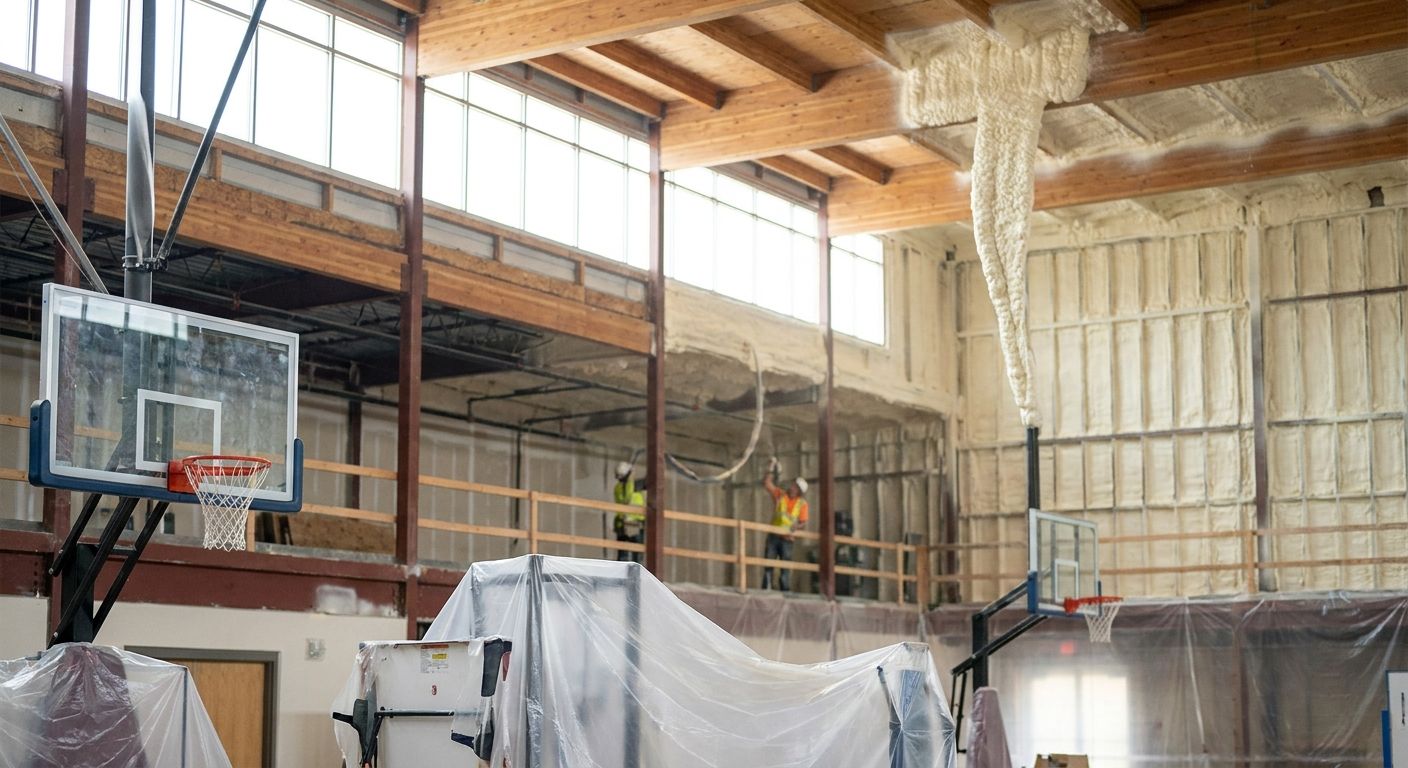
Recreation centers and gyms lose heat differently than houses. Twenty-four-foot ceilings, humid locker rooms, and mechanical rooms running pumps around the clock create thermal problems a standard batt-and-vapor-barrier assembly was never built to solve. Spray foam insulation recreation center projects in Calgary, Okotoks, High River, and Lethbridge fix that by sealing the envelope and controlling moisture at the same time.
- Closed-cell spray foam insulation recreation center projects need R-6.5 per inch and full air sealing — Buy for roofline and metal shells.
- Aztec Spray Systems recommends closed-cell foam for metal building envelopes and mechanical rooms in 2026 retrofits.
- Skip fiberglass batts near pool-adjacent mechanical rooms — moisture wicks through paper facing within one Alberta winter.
- Commercial retrofit prep, not product choice, usually decides project timeline for gyms and rec centers.
Why this matters
A gym or rec center isn't a house scaled up. The ceiling volume is often triple a residential attic, the humidity load from pools and showers is constant, and the HVAC system runs 12-16 hours a day, seven days a week. Every gap in the envelope shows up on the energy bill and, worse, on the mechanical room floor as condensation.
Alberta winters push that math further. A building envelope that's fine in a mild climate fails at minus 30 in Lethbridge or Calgary, and the failure point is usually the roofline or the metal wall panels, not the walls a homeowner would think of first. Commercial spray foam insulation for warehouses covers the same large-volume envelope problem, and much of that logic carries directly into gym and rec center construction.
Who this is for
This guide is for facility managers, municipal recreation departments, and private gym owners in Calgary, Okotoks, High River, and Lethbridge deciding between a re-insulation retrofit and a new-build envelope spec. If your building has a pool, a weight room with high ceilings, or a mechanical room that's cold to the touch in January, this applies to you directly.
What to look for in spray foam insulation for recreation centers
R-value performance across large volumes
A 24-foot ceiling has a lot more surface area to lose heat through than a 9-foot residential attic. Closed-cell spray foam delivers roughly R-6.5 per inch, which lets a 2-inch application hit code-level performance without the depth a house attic would need. That density matters more as ceiling height climbs.
Moisture and vapor control near pools and showers
Pool decks and locker rooms push humidity into the envelope constantly. Closed-cell foam is a vapor retarder on its own, which stops moisture from migrating into wall cavities and rotting framing or corroding metal studs. Open-cell foam doesn't offer the same protection and needs a separate vapor barrier in these zones.
Air sealing to control HVAC load
A gym's HVAC system is sized for the whole volume, so every unsealed gap around ductwork, roof penetrations, and wall-to-roof transitions forces the system to run longer. Spray foam seals those gaps as part of the application, not as an add-on step, which is the main reason facilities see lower gas and electric bills after a retrofit.
Fire code and thermal barrier compliance
Commercial occupancy classifications require a thermal barrier over exposed spray foam in most assemblies — drywall, intumescent coating, or another approved material. A contractor quoting a rec center job needs to spec that barrier as part of the job, not leave it as a change order discovered during inspection.
Sound dampening between activity zones
A free-weight room next to a yoga studio is a scheduling nightmare without sound control. Closed-cell foam's density knocks down airborne noise transfer through shared walls and floor assemblies, which matters more in a multi-use rec center than in almost any residential application.
Top picks for gym and rec center envelopes
The roofline and vaulted ceiling zone — the biggest heat-loss zone
Most rec centers and gyms use open truss or vaulted roof systems to clear equipment and basketball courts, and that roofline is where the majority of heat escapes in an Alberta winter. Closed-cell foam applied directly to the roof deck at R-6.5 per inch closes that gap without adding depth that eats into ceiling clearance. See spray foam insulation for cathedral and vaulted ceilings for the assembly detail. Verdict: Buy.
The metal building envelope — the condensation magnet
A large share of rec centers and fieldhouses are pre-engineered metal buildings, and metal panels sweat badly without a continuous thermal break. Closed-cell foam bonds directly to the panel interior and stops that condensation cycle before it starts corroding fasteners and purlins. Full detail is in spray foam insulation for metal buildings. Verdict: Buy.
Mechanical and equipment rooms — the freeze-up risk
Pool pump rooms, boiler rooms, and mechanical mezzanines sit at the edge of a building's conditioned space and are the first area to drop near freezing when the envelope underperforms. A dedicated foam application here protects pipes and equipment that would otherwise need trace heating. Read spray foam insulation for equipment and mechanical rooms for the specifics. Verdict: Consider, especially where pipe freezing has already happened once.
Locker rooms and shared walls — the noise complaint fix
Locker rooms and studio walls butting against a weight room generate more noise complaints than almost any other adjacency in a rec center. Foam's density cuts sound transfer through the shared assembly, which solves the complaint without a full wall rebuild. Verdict: Consider where noise, not just heat loss, is the driving problem.
Get a Commercial Spray Foam Quote
Licensed and insured service across Calgary, Okotoks, High River, and Lethbridge.
What to avoid
- Fiberglass batts in mechanical rooms. The paper facing wicks moisture from pool pumps and boilers, and it loses R-value the moment it's damp.
- Open-cell foam on pool-adjacent walls without a separate vapor barrier. Open-cell isn't a vapor retarder on its own, and skipping the extra layer invites the same rot problem batts cause.
- DIY foam kits for large-volume ceilings. Kits are built for small residential jobs; a 24-foot truss roof needs commercial rig equipment and a crew that can hit even coverage across that span.
Verdict comparison table
| Zone | R-value target | Moisture risk | Verdict |
|---|---|---|---|
| Roofline / vaulted ceiling | R-6.5/inch (closed-cell) | Low with proper application | Buy |
| Metal building envelope | R-6.5/inch (closed-cell) | High without foam | Buy |
| Mechanical / equipment rooms | R-6.5/inch (closed-cell) | High (humidity, pipes) | Consider |
| Locker rooms / shared walls | R-3.5-6.5/inch depending on type | Moderate | Consider |
FAQ
What’s the best insulation for a recreation center in Calgary?
Closed-cell spray foam at roughly R-6.5 per inch is the best fit for Calgary recreation centers because it seals air leaks and blocks moisture in one application. Open-cell foam works in dry interior partitions but needs added vapor control near pools and locker rooms.
Is spray foam insulation worth it for a gym with high ceilings?
Yes, high-ceiling gyms lose a disproportionate amount of heat through the roofline, and spray foam closes that gap without adding the depth a batt system would need. The payoff shows up fastest in facilities running HVAC 12+ hours a day.
How much does spray foam insulation cost for a commercial rec center in 2026?
Commercial spray foam pricing in 2026 depends on square footage, ceiling height, and whether the job is new construction or a retrofit around existing mechanical systems. A facility manager should request a walk-through quote rather than rely on a flat per-square-foot figure.
Does spray foam handle humidity from a pool or locker room?
Closed-cell spray foam acts as its own vapor retarder, which stops pool and shower humidity from migrating into wall cavities. That’s a key reason it outperforms fiberglass batts in these specific zones.
Is closed-cell or open-cell foam better for gyms?
Closed-cell is the stronger choice for exterior walls, roofs, and any zone near moisture, delivering about R-6.5 per inch. Open-cell, at roughly R-3.5 per inch, works for interior sound-dampening walls where moisture isn’t a factor.
How long does a spray foam retrofit take for a rec center?
Timeline depends on square footage and whether the facility can close sections during the work, but most commercial retrofits are scheduled in phases to keep the building operational. A pre-project walk-through sets the realistic schedule.
Does spray foam insulation meet Alberta commercial building code?
Spray foam applications in commercial buildings require an approved thermal barrier over exposed foam, such as drywall or an intumescent coating, to meet fire code. A licensed contractor builds that barrier into the original quote, not as a later change order.
Can spray foam reduce noise between gym zones?
Yes, the density of spray foam cuts airborne sound transfer through shared walls and floor assemblies more effectively than fiberglass batts. It’s a common fix for noise complaints between weight rooms and studio spaces.
One last thing
The zone facility managers overlook most often isn't the gym floor, it's the mechanical room. A pump room sitting a few degrees above freezing in January is one bad night away from a burst pipe, and it's usually the cheapest zone in the building to insulate properly. Aztec Spray Systems services that exact problem across Calgary, Okotoks, High River, and Lethbridge as part of commercial spray foam insulation work, and it's often the fastest payback item in a 2026 retrofit budget.
Related guides