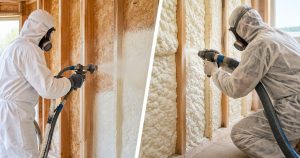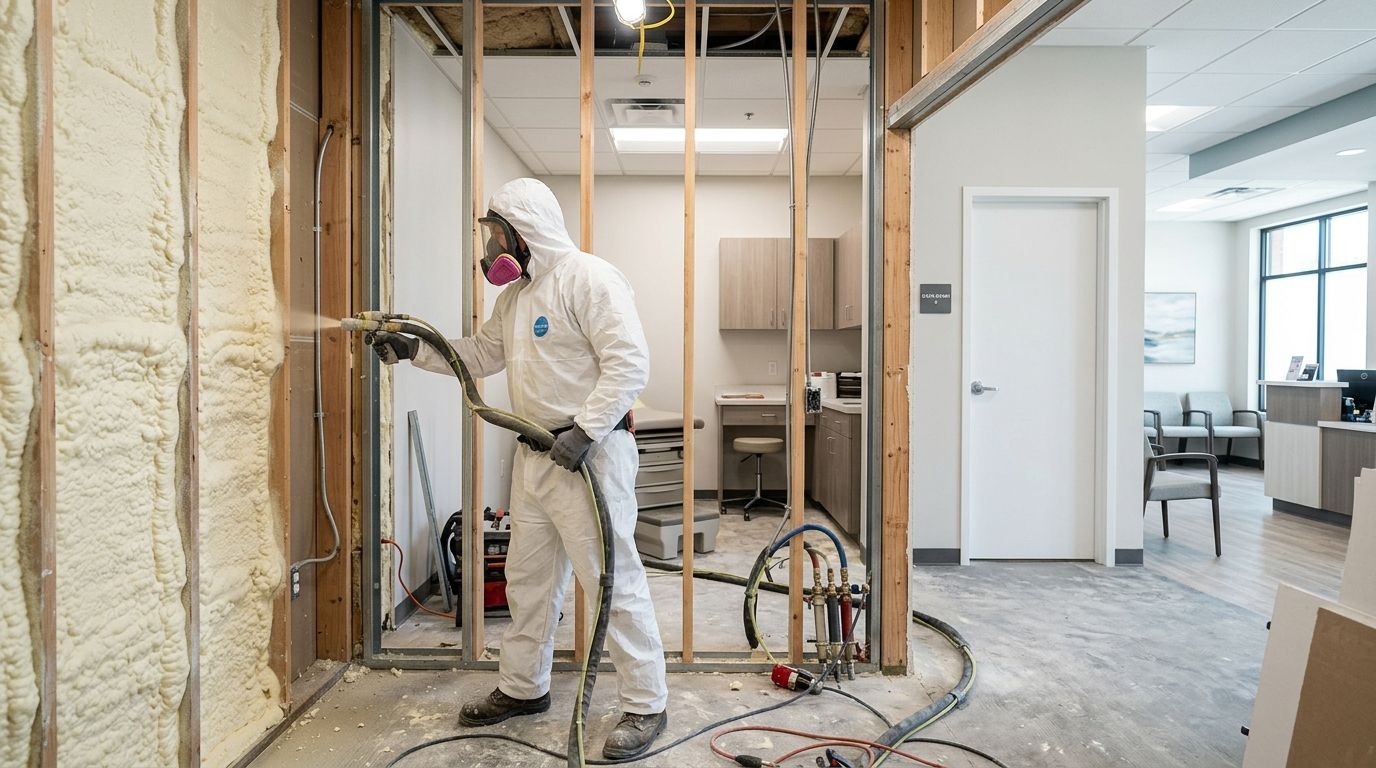
Spray foam insulation for medical and dental offices seals rim joists, mechanical rooms, and roof assemblies against the air leakage and temperature swings that throw off HVAC balance, sterilization equipment, and patient comfort in occupied clinics. A dental practice or medical clinic runs different tolerances than a house — imaging suites need stable humidity, exam rooms need sound isolation from each other, and none of it can shut down for a week during a retrofit.
- Spray foam insulation medical office retrofits get the fastest HVAC payoff by targeting rim joists, roof decks, and mechanical rooms first.
- Closed-cell foam suits imaging and sterilization rooms needing vapor control at roughly R-6 per inch.
- Open-cell foam handles interior sound-isolated walls between exam rooms at a lower R-value near R-3.5 per inch.
- Alberta Building Code requires a thermal barrier over exposed foam in occupied clinic space before final inspection.
- Aztec Spray Systems phases medical office work around clinic hours across Calgary, Okotoks, High River, and Lethbridge.
Why spray foam insulation matters for medical and dental offices
A dental office or family practice runs equipment a house never sees — autoclaves, digital X-ray units, compressors, and HVAC systems that need to hold a narrow humidity band for sterile instrument storage. When the building envelope leaks air, the HVAC system short-cycles trying to compensate, and that shows up as temperature complaints in exam rooms and drift in equipment calibration.
A Calgary commercial spray foam contractor sees this pattern constantly in strip-mall medical suites built before 2010: thin batt insulation in the roof deck, unsealed penetrations around plumbing stacks, and mechanical rooms that were never insulated because nobody planned for a rooftop imaging unit to sit above them. Spray foam closes those gaps in a single application instead of the patchwork retrofits batt insulation requires.
Sound isolation is the other driver specific to this segment. Patients in adjacent exam rooms hear consultations through shared drywall when the cavity is empty or under-filled, and that's a compliance concern as much as a comfort one in practices handling sensitive health conversations.
How to plan a spray foam retrofit for your clinic
Audit your building envelope before you touch a wall
Start with a walkthrough, not a quote. Most clinics inherit whatever insulation the original tenant improvement contractor installed, and it's rarely matched to how the space is actually used in 2026.
- Check the roof deck and attic for compressed or missing batt insulation above exam rooms
- Inspect rim joists and foundation transitions where cold air enters at floor level
- Look for unsealed penetrations around plumbing, electrical conduit, and HVAC ducting
- Note any rooms running imaging or sterilization equipment that report temperature complaints
- Flag shared walls between exam rooms where sound carries
Prioritize mechanical rooms and rooftop units first
Rooftop mechanical units and equipment rooms take the most thermal abuse in a medical building because they cycle constantly and often sit directly above patient-occupied space. Insulating this zone first delivers the fastest return because it stabilizes the air the HVAC system is actually conditioning.
- Seal and insulate mechanical room walls and ceilings before finishing interior work
- Address curb penetrations where rooftop mechanical units meet the roof deck
- Insulate ductwork runs passing through unconditioned mechanical space
- Confirm equipment clearances are maintained after foam is applied
Choose foam type by room function, not by default
Medical and dental offices shouldn't apply one foam type across the whole building. Closed-cell foam runs roughly R-6 per inch and adds vapor resistance, which matters in rooms holding autoclaves or humidity-sensitive imaging equipment. Open-cell foam runs closer to R-3.5 per inch and costs less to install across large wall cavities where vapor control isn't the priority.
- Use closed-cell foam in sterilization rooms, imaging suites, and any wall facing exterior moisture exposure
- Use open-cell foam for interior partition walls where sound dampening matters more than vapor control
- Reserve closed-cell for below-grade or crawlspace applications where water resistance is required
- Match foam density to the assembly, not to whatever the crew has on the truck that day
Build in sound isolation between exam rooms
Open-cell foam fills stud cavities completely and dampens sound transfer far better than an empty or partially-filled wall. This matters more in medical offices than almost any other commercial segment because consultations happen behind those walls.
- Fill shared walls between exam rooms with open-cell foam for consistent soundproofing between shared walls
- Combine foam with resilient channel or double drywall on the highest-privacy rooms
- Don't skip interior partition insulation just because it's not exterior-facing — sound is the reason it's there
Confirm fire code and thermal barrier requirements
Spray foam in occupied commercial space isn't optional to code — the Alberta Building Code requires an approved thermal barrier, typically 1/2-inch gypsum board or an intumescent coating, over any exposed foam in an occupied assembly. A clinic that skips this step fails inspection and delays occupancy.
- Confirm which rooms require a 15-minute or 45-minute thermal barrier rating before foam goes in
- Review fire code requirements for spray foam insulation with your contractor before scheduling
- Get the thermal barrier inspected and signed off before drywall closes the wall
- Keep documentation on file for future tenant improvement permits
Schedule the work around patient hours
A clinic can't close for a week. Spray foam installation produces odor and requires ventilation time, so the retrofit needs to be phased around appointment schedules rather than treated as a single weekend project.
- Phase work room by room instead of closing the whole practice at once
- Schedule spray application for evenings or slow days when re-entry time won't conflict with patients
- Confirm re-entry and off-gassing timelines with the contractor before booking patients back in
- Build a buffer day into the schedule for HVAC rebalancing after the envelope tightens
Plan your clinic’s insulation retrofit
Work phased around patient hours in Calgary, Okotoks, High River, and Lethbridge.
Insulation options for medical and dental offices compared
| Option | Best for | Key limitation |
|---|---|---|
| Closed-cell spray foam | Sterilization rooms, imaging suites, moisture-exposed walls | Higher material cost per board foot than open-cell |
| Open-cell spray foam | Interior partitions, sound isolation between exam rooms | Lower vapor resistance, not suited to below-grade use |
| Mineral wool batt | Fire-rated partition walls needing sound rating | Doesn't air-seal the cavity the way foam does |
| Rigid foam board (roof recover) | Roof deck retrofits over existing membrane | Requires seam taping to control air leakage |
Closed-cell foam is the right call for any room holding equipment sensitive to humidity swings — that's the sentence worth remembering if you only insulate one zone in 2026.
Common mistakes medical and dental offices make
- Scheduling the whole retrofit during business hours — off-gassing and equipment noise disrupt patients and staff when it isn't phased.
- Skipping the thermal barrier over exposed foam — this is a fire code requirement in occupied assembly space, not an optional upgrade, and it fails inspection when missed.
- Insulating the attic and ignoring the mechanical room — rooftop units above imaging suites keep radiating heat into ceilings that were never sealed.
- Using open-cell foam where vapor control was needed — sterilization rooms and below-grade walls need the vapor resistance closed-cell foam provides.
- Not rebalancing HVAC after the envelope tightens — a tighter building changes air exchange rates, and skipping this step leaves stale air in exam rooms.
FAQ
What’s the best spray foam insulation for a medical office in Calgary?
Closed-cell spray foam at roughly R-6 per inch is the right choice for sterilization rooms and imaging suites because it adds vapor resistance. Interior partition walls between exam rooms are better served by open-cell foam for sound dampening.
Is closed-cell or open-cell spray foam better for dental offices?
Closed-cell foam is better for exterior walls and rooms with autoclaves or moisture exposure; open-cell foam is better for interior partitions where sound isolation between operatories matters more than vapor control.
Does spray foam insulation help control noise between exam rooms?
Yes, open-cell spray foam fills the stud cavity completely and reduces sound transfer far better than empty or partially-filled walls. Pairing it with resilient channel or double drywall improves privacy further on high-traffic consultation rooms.
How much downtime does a medical office need for spray foam insulation?
Downtime depends on how the retrofit is phased, not the square footage. Working room by room around appointment schedules, with re-entry time built in for off-gassing, avoids closing the whole practice at once.
Is spray foam insulation safe in an occupied medical building?
Spray foam is safe once cured and covered with the required thermal barrier under the Alberta Building Code, typically 1/2-inch gypsum board. Ventilation and re-entry timelines during application need to be respected before patients return to treated rooms.
Does spray foam insulation help with humidity control in sterilization rooms?
Closed-cell spray foam adds vapor resistance that helps stabilize humidity around autoclaves and sterilization equipment. Open-cell foam does not offer the same vapor control and isn’t the right choice for these rooms.
How long does spray foam insulation last in a commercial medical building?
Properly installed spray foam does not sag, settle, or need replacement the way batt insulation does over time, and it holds its R-value for the life of the building envelope it’s applied to. Maintenance is limited to checking that the thermal barrier over it stays intact.
Do medical offices qualify for spray foam insulation rebates in Alberta?
Commercial rebate eligibility depends on the specific program and building type, and requirements change year to year, so check current Alberta rebate programs before budgeting a retrofit around one. A contractor familiar with current 2026 program rules can confirm eligibility before work starts.
One last thing
The detail most medical offices miss isn't the insulation type — it's the HVAC rebalance after the retrofit. Tightening the envelope with spray foam changes the building's natural air exchange rate, and a clinic that doesn't rebalance ventilation afterward can end up with worse indoor air quality in exam rooms than before the upgrade, even though the temperature complaints disappear. Budget that rebalance into the project from day one instead of treating it as an afterthought.
Related guides