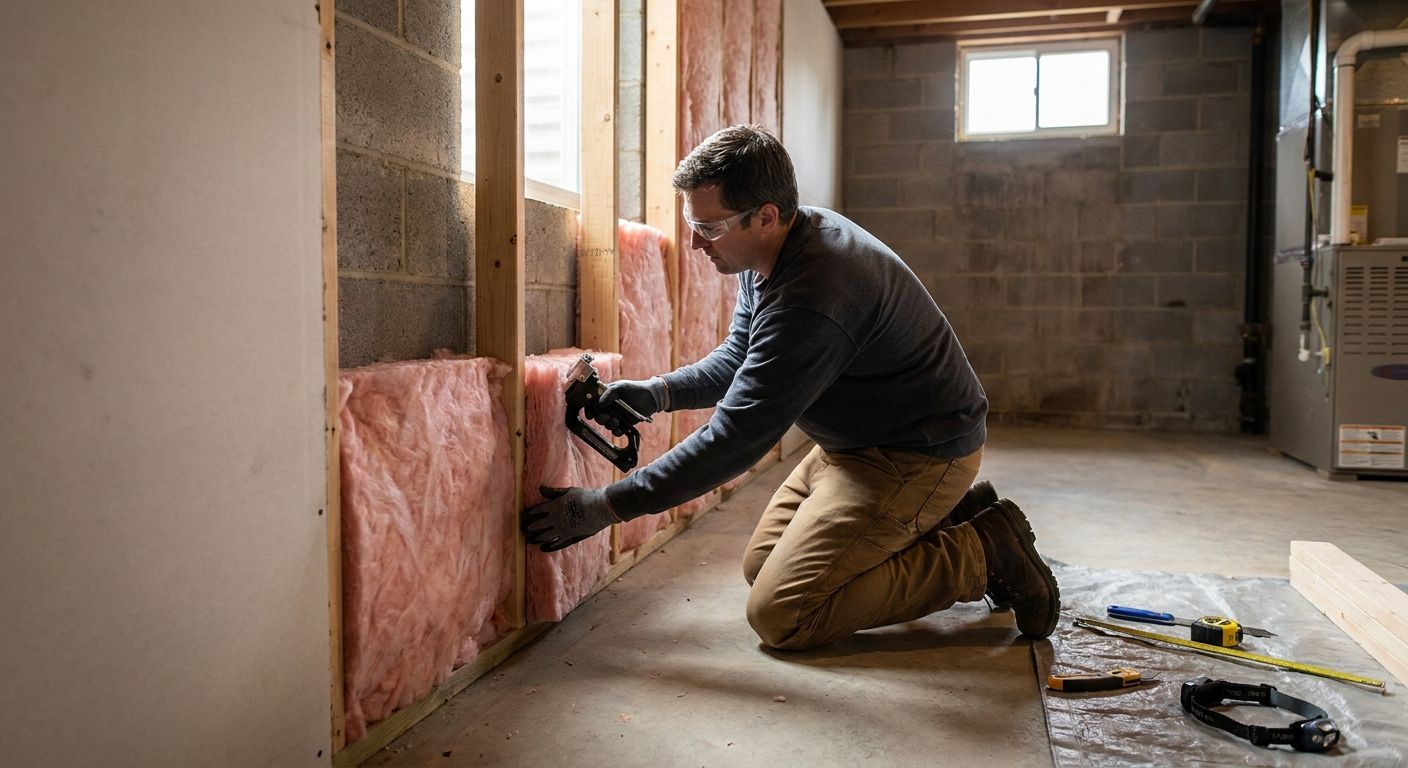
Basement comfort in Alberta comes down to two things: stopping cold air from finding its way in through concrete and framing, and keeping moisture from turning that trapped cold into dampness. Get the sequence right and a below-grade room in Calgary or Okotoks holds a stable temperature through a January cold snap and stays dry through a humid August.
- Closed-cell spray foam on rim joists and below-grade walls is the fastest way to handle how to insulate a basement year round in Alberta.
- Air-seal before you insulate — an unsealed rim joist cancels out the R-value of whatever goes over it.
- Skip fibreglass batts directly against concrete; they hold moisture against the wall and invite mould.
- Budget for the rim joist and the wall assembly together, not the wall alone, or you keep the coldest gap in the house.
- Aztec Spray Systems treats basement insulation as a moisture-control job first and an R-value job second.
Why this matters
A basement loses heat two ways: through the exposed band of rim joist above grade, and through below-grade walls that sit against cold, damp soil most of the year. Most homeowners insulate the walls and skip the rim joist, which leaves the single leakiest, coldest strip in the house untouched.
Alberta basements have a second problem most guides ignore — humidity. A wall assembly that traps moisture against concrete grows mould behind the drywall long before anyone notices a smell. The fix isn't more insulation, it's the right insulation in the right order, air-sealed before it's covered.
What you'll need
- A moisture meter or simple visual check for efflorescence, staining, or damp concrete
- Closed-cell spray foam for basement rim joists and below-grade walls, or an equivalent rigid foam board system
- A vapour-permeable interior finish plan — no poly vapour barrier trapped against foam
- Furring strips or a metal stud wall to hold drywall off the foam
- A dehumidifier for the first few weeks after finishing, especially in a newer pour
- A licensed contractor for the spray foam pass — this is not a DIY-with-a-can-kit job for full walls
The steps
1. Check grading and drainage before you touch insulation
Insulating a wet basement just insulates the moisture problem. Walk the exterior perimeter after a rain and confirm the grade slopes away from the foundation and downspouts discharge at least 1.8 metres (6 feet) from the wall. Fix drainage first — insulation second. Skipping this step is the single most common reason basement insulation jobs fail within two years.
2. Air-seal and insulate the rim joist band
The rim joist — the strip of framing sitting on top of the foundation wall — is almost always the coldest, leakiest part of a basement. Closed-cell spray foam delivers roughly R-6 per inch and seals air gaps in the same pass, which batts and boards can't do on their own. A 2×8 or 2×10 rim joist cavity typically takes a 2-3 inch application to hit a meaningful R-value while sealing every seam. Expected outcome: no visible daylight, no draft when you hold a hand near the band joist. Common mistake: insulating the walls first and leaving this band for "later" — later rarely comes.
3. Choose the wall assembly for below-grade concrete
Below-grade walls need an insulation type that won't hold water against concrete. Closed-cell spray foam works as both insulator and vapour retarder in one product, which matters against a material that wicks ground moisture year-round. Compare that against loose batts, which absorb whatever moisture the concrete releases and stay wet for months. If you're weighing foam against fibreglass or mineral wool for this specific application, the reasoning holds for the whole house — the best insulation type for Alberta winters is consistently the one that also controls air and moisture, not just heat loss.
4. Insulate to full wall height, not just to grade
A common shortcut is stopping insulation at the frost line and leaving the top foot of wall bare because "it's already below grade." That top section is exactly where the exterior temperature swings hardest in a Calgary winter, when overnight lows regularly sit well below -20°C. Run the insulation from the sill plate down to the floor slab, full stop.
5. Treat a walkout or crawl space section on its own
If the basement includes a walkout wall, a mechanical room half above grade, or an attached crawl space, don't assume the same assembly works everywhere. A crawl space under an addition or a mudroom often needs its own vapour strategy and ventilation plan, separate from the main basement walls — see how that's handled for crawl space insulation before framing that section closed.
6. Frame, verify, then finish
Once foam is cured, hold drywall or furring strips off the foam per the manufacturer's fire-rating requirements — most jurisdictions require a thermal barrier like drywall over exposed spray foam in living spaces. Before closing walls, run a hand along every seam one more time. Once drywall goes up, any gap you missed is a two-year wait until you notice the cold spot.
Get Your Basement Insulation Quote
Licensed spray foam crews serving Calgary, Okotoks, High River, and Lethbridge.
Troubleshooting
- Cold floor above the basement in winter: usually means the rim joist band was skipped or under-filled. Recheck that section before adding more wall insulation.
- Musty smell after finishing: points to moisture trapped behind a vapour-impermeable layer against damp concrete. Pull a section and check for standing dampness before it spreads.
- Condensation on ductwork in the basement ceiling: happens when warm, humid basement air meets cold supply ducts. Insulate exposed ductwork separately from the wall assembly.
- One corner colder than the rest of the room: almost always a gap at a window well, a service penetration, or a spot where foam didn't reach full height. Spot-check with a hand or infrared thermometer.
- High humidity in summer despite good insulation: a well-insulated, well-sealed basement holds cool air but also holds moisture longer. Run a dehumidifier through the first humid season after finishing.
Tools and resources
- Moisture meter or infrared thermometer for spot-checking cold zones
- Closed-cell spray foam contractor quote — costs vary by square footage and cavity depth, and spray foam insulation cost in Calgary breaks down what drives the price up or down
- A dehumidifier rated for the finished square footage
- Fire-rated drywall or an approved thermal barrier product for covering exposed foam
What to do next
Once the shell is sealed and insulated, the next decision is how the space gets framed and finished. That's where framing choices, moisture management, and insulation start overlapping with general basement finishing decisions — the same logic that drives basement finishing companies near you to insist on a sealed, dry shell before framing a single wall applies whether the crew is local or not; it's the step that determines whether the finish lasts. Confirm the insulation passed inspection before drywall goes up, not after.
FAQ
How do you insulate a basement for year-round comfort?
Air-seal and insulate the rim joist first, then insulate below-grade walls to full height with a moisture-tolerant product like closed-cell spray foam, and confirm exterior drainage before finishing. Skipping the rim joist is the most common reason basements stay cold in winter.
What is the best insulation for a basement in Alberta?
Closed-cell spray foam is the most reliable choice for Alberta basements in 2026 because it insulates and air-seals in one pass and resists moisture against concrete. Fibreglass batts against a below-grade wall tend to trap dampness over time.
Do I need to insulate basement rim joists separately from the walls?
Yes — the rim joist is usually the coldest, leakiest section of a basement and needs its own air-sealed insulation pass. Treating it the same as the flat wall section leaves the biggest heat-loss gap unaddressed.
Can you insulate a basement that already has moisture problems?
Fix the drainage and grading issue first, then insulate. Insulating over an active moisture problem traps it behind the wall and accelerates mould growth instead of solving anything.
Is spray foam better than fibreglass batts for a basement?
For below-grade walls, yes — spray foam resists moisture and air-seals as it cures, while batts absorb ambient dampness from concrete. Batts work fine above grade where moisture exposure is lower.
How much does it cost to insulate a basement in Calgary?
Cost depends on square footage, cavity depth, and whether rim joists are included in the scope. A contractor quote that separates rim joist work from wall work gives the clearest picture of total cost.
Do basements need a vapour barrier over spray foam?
No — closed-cell spray foam acts as its own vapour retarder, so adding a poly sheet over it traps moisture between two impermeable layers. Confirm the assembly with a licensed installer before finishing the wall.
How long does basement spray foam insulation take to install?
A typical basement rim joist and wall package is completed in a single day for most residential square footages, with full cure before framing can start the same or next day depending on product and thickness.
One last thing
The rim joist band is roughly 5-10% of a basement's total insulated surface area but accounts for a disproportionate share of the heat loss homeowners actually feel as cold floors and drafts upstairs — it's the cheapest square footage in the house to fix and the one most insulation jobs skip.
Related guides
- Best insulation type for Alberta winters
- Best spray foam insulation contractor for Calgary homeowners