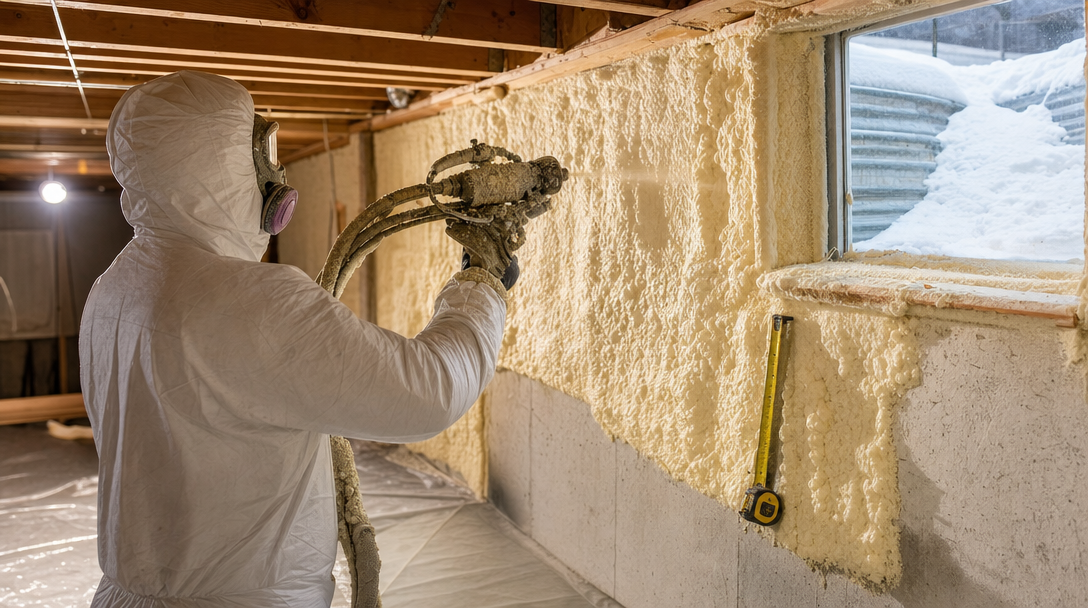
You have decided spray foam is the right fix for a cold basement, a drafty bonus room or a garage you want to heat this winter. Then the quotes arrive and one installer proposes two inches, another says three, and a third suggests “filling the cavity.” Thickness is where Calgary spray foam projects are won or lost: too thin and the foam never becomes a true vapour barrier, too thick and you pay for R-value that barely moves your gas bill. Here is how much closed-cell foam a Calgary home actually needs, location by location.
Quick Answer
In Calgary, closed-cell spray foam should be at least 2 inches (50 mm) thick anywhere it serves as the air and vapour barrier, including basement walls, rim joists and crawlspaces. Above-grade walls typically need 3 inches to reach the Alberta code’s effective RSI 3.08, while attic roof decks and heated garage ceilings usually call for 4 to 6 inches.
How thick does spray foam insulation need to be in Calgary?
Spray foam thickness answers two separate questions, and the first is often forgotten. The obvious question is thermal: how much R-value do you need to meet code and stay comfortable at -30°C? The less obvious question is moisture: how thick does closed-cell foam have to be before it stops water vapour from migrating into the wall and condensing on cold framing or concrete? In Calgary, the moisture threshold sets the floor. The thermal target decides how far above that floor you go.
The moisture threshold is well established in Canadian practice. Closed-cell polyurethane foam is tested for water vapour permeance at a 50 mm (2 inch) thickness under the CAN/ULC S705.1 material standard, and at that thickness most products test below the 60 ng/(Pa·s·m²) limit that lets them stand in for a polyethylene vapour barrier. Construction Canada notes that closed-cell SPF is typically used as a vapour barrier at 50 mm or greater, which is why 2 inches comes up in nearly every Alberta permit conversation.
The thermal side is simpler math. Closed-cell foam delivers roughly R-6 per inch, so 2 inches is about R-12, 3 inches about R-18, and 5 inches about R-30. Calgary sits in Climate Zone 7A, so code targets are higher than in Vancouver or Toronto. Our closed-cell vs open-cell comparison explains why closed-cell is the default here.
What does the Alberta building code require?
Section 9.36 of the National Building Code, Alberta Edition sets minimum effective thermal resistance for each part of a house. “Effective” is the key word. It is the performance of the whole assembly, including studs, plates and headers, not the label on the insulation. Alberta’s STANDATA bulletin on Table 9.36.2.6.-A lists the Zone 7A values that apply to Calgary, and the City of Calgary summarizes them as roughly R-22 for framed walls and R-60 for ceilings below attics.
| Assembly (Zone 7A, Calgary) | Minimum effective RSI | Approx. effective R-value |
|---|---|---|
| Ceilings below attics | 10.43 | R-59 |
| Cathedral ceilings and flat roofs | 5.02 | R-28 |
| Above-grade walls | 3.08 | R-17.5 |
| Floors over unheated spaces (cantilevers, bonus rooms over garages) | 5.02 | R-28 |
An effective RSI 3.08 wall is about R-17.5 once studs are counted; a 2×6 wall with R-22 batts lands near that because framing drags the average down. Spray foam does the job with fewer inches because it fills every gap and stops the air movement that robs batts of their rated performance, but the studs are still there, so you cannot simply divide the code number by six. A permit reviewer will want the effective calculation, and a reputable installer will provide it.
For a basement retrofit, the inspector is mainly checking for a continuous vapour barrier and the required fire-protective covering over the foam. The City of Calgary’s climate-ready insulation guidance explicitly encourages homeowners to exceed the minimums where it is practical and economical, and for a city with Chinook swings of 20°C in a day, that advice is sound.
Recommended spray foam thickness by location
The table below reflects what we specify on typical Calgary jobs with closed-cell foam at about R-6 per inch. Treat it as a starting point, not a substitute for a site visit, because framing depth, existing insulation and how you use the space all shift the answer.
| Location | Typical closed-cell thickness | Why |
|---|---|---|
| Basement foundation walls | 2 to 3 inches | 2 inches is the vapour barrier; 3 inches adds comfort on north walls. |
| Rim joists and sill plates | 2 to 3 inches | Biggest air leak in most Calgary basements; seals and insulates in one step. |
| Crawlspace walls | 2 to 3 inches | Stops ground moisture and cold air. |
| Above-grade 2×6 walls (new or opened up) | 3 inches, or 2 inches plus batt | Reaches effective RSI 3.08; the hybrid option saves money. |
| Attic roof deck (unvented or cathedral) | 5 to 6 inches | R-30 to R-36; keeps the deck warm enough to prevent ice dams. |
| Attic floor air seal (hybrid) | 1.5 to 2 inches, then loose-fill to R-60 | Foam seals top plates and penetrations; loose-fill adds bulk R-value cheaply. |
| Cantilevers and bonus-room floors over garages | 4 to 5 inches | Code wants RSI 5.02; the usual source of cold-floor complaints. |
| Heated detached garage or shop walls / ceiling | 2 to 3 inches walls, 3 to 5 inches ceiling | Ceilings lose the most heat every time the door opens. |
Basements deserve special attention because Natural Resources Canada estimates they account for about 25 percent of a typical home’s heat loss, with the sill area and rim joist among the worst leakage points, according to Keeping the Heat In, Section 6. Calgary’s frost depth means the top metre of foundation sits against frozen soil for months, so two inches of foam across the concrete and up over the rim joist addresses both problems. That is why basement and rim joist work makes up such a large share of our residential spray foam insulation projects.
Why 2 inches is the threshold, not the target
Think of closed-cell foam like ice on a pond: a thin skin holds a skate blade but not a person. Below 2 inches, humid indoor air from showers, cooking and breathing can still push vapour through the foam, and when it reaches concrete at -5°C it condenses. Over a winter that moisture feeds mould behind drywall even though the room feels dry.
Past 2 inches, each extra inch is purely an R-value decision you can make on economics. A third inch on a basement wall adds about R-6 and noticeably warms the wall surface, which is what you actually feel in a finished basement in February. On a heated shop ceiling, inches four and five pay back in reduced furnace cycling every time the overhead door opens to -25°C air.
Is thicker spray foam always better?
No. Insulation follows diminishing returns: going from R-0 to R-12 on bare concrete is transformative, while going from R-18 to R-24 is a modest gain you may never notice on the bill. The City of Calgary’s cost comparison puts installed closed-cell spray foam at roughly $0.15 per square foot per R-unit, so on a 1,000-square-foot basement perimeter, every additional inch is in the neighbourhood of $900 to $1,000. That is money well spent on a cantilever floor and wasted on an interior partition.
Thickness also has a practical ceiling per pass. Closed-cell foam generates heat as it cures, so manufacturers limit each lift to roughly 2 to 3 inches with cooling time between passes. Thick lifts applied too fast can scorch, shrink or pull away from framing, one of the failure modes that gives DIY foam kits a bad name. Thermal bridging matters too: on a 2×6 wall, filling all 5.5 inches costs nearly double a 3-inch application yet raises effective R-value only modestly, because the studs still set the ceiling.
How can I tell if my current insulation is too thin?
Start in the attic on a cold morning. Frost on the underside of roofing nails or staining around the hatch means warm, humid house air is escaping through thin insulation and unsealed penetrations. Measure what is there with a ruler; blown-in product under 12 inches or batts slumped to half their thickness are well below the R-59 the code expects. Icicles along the eaves after a sunny Chinook day are the outdoor version of the same message, which the City of Calgary flags as a classic sign of poor attic insulation.
In the basement, run your hand along the top of the foundation wall where the joists sit. Cold air or daylight at the rim joist means underinsulated framing. A stick of incense held near the sill plate on a windy day reveals air movement you cannot feel. If you already have foam and doubt its depth, push a thin screwdriver into it at a hidden spot: under 1.5 inches on a basement wall, or a wavy surface with thin valleys, points to a rushed application that can usually be topped up with a second lift.
Frequently Asked Questions
How many inches of spray foam do I need for a basement in Calgary?
Two inches of closed-cell spray foam is the minimum for a Calgary basement wall because that is the thickness at which the foam qualifies as a vapour barrier. Most homeowners choose 2.5 to 3 inches for extra comfort and to approach the effective R-value that Alberta’s energy code expects. Rim joists and sill plates should receive the same 2 to 3 inches so the air seal is continuous.
Does 2 inches of closed-cell spray foam count as a vapour barrier in Alberta?
Yes, closed-cell spray foam that has a CCMC evaluation and is installed at 50 mm (2 inches) or more is accepted as a vapour barrier by Alberta building authorities, so no polyethylene sheet is required. Confirm the thickness in the product’s evaluation report, and never add poly over the foam, because a double vapour barrier can trap moisture in the wall.
How thick should spray foam be on an attic roof deck in Calgary?
Plan on 5 to 6 inches of closed-cell foam for an unvented roof deck or cathedral ceiling in Calgary, which delivers about R-30 to R-36. That meets the RSI 5.02 the Alberta code sets for cathedral ceilings and keeps the roof sheathing warm enough to prevent the melt-freeze cycle that causes ice dams during Chinook weather.
How long after spray foam is installed can we go back in the house?
Plan to stay out for 24 hours after spraying is complete, which is the re-entry period the Canadian Urethane Foam Contractors Association cites from the CAN/ULC installation standards. Thicker applications do not change this timeline as long as the installer respects the per-pass lift limits.
How Aztec Spray Systems Helps
Getting thickness right is a measurement job before it is a spraying job. When we quote a Calgary home, we inspect framing depth, existing insulation and moisture conditions, then specify the thickness for each area in writing, with the effective R-value calculation your permit reviewer will ask for. Our certified crews apply closed-cell foam in controlled lifts and verify depth as they go. Re-entry guidance follows the CUFCA consumer safety sheet, so you know exactly when it is safe to move back in.
We handle residential basements, rim joists, crawlspaces, attics, garages and shops across Calgary, Airdrie, Cochrane, Okotoks, Chestermere and the surrounding area, along with warehouses, agricultural buildings and other commercial spray foam projects. For more answers, see our spray foam FAQ.
Ready to find out how many inches your home actually needs? Call (403) 830-7669 or request a free, no-obligation quote online. We will measure, explain the options and give you a thickness plan that holds up in a Calgary January.