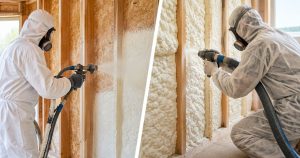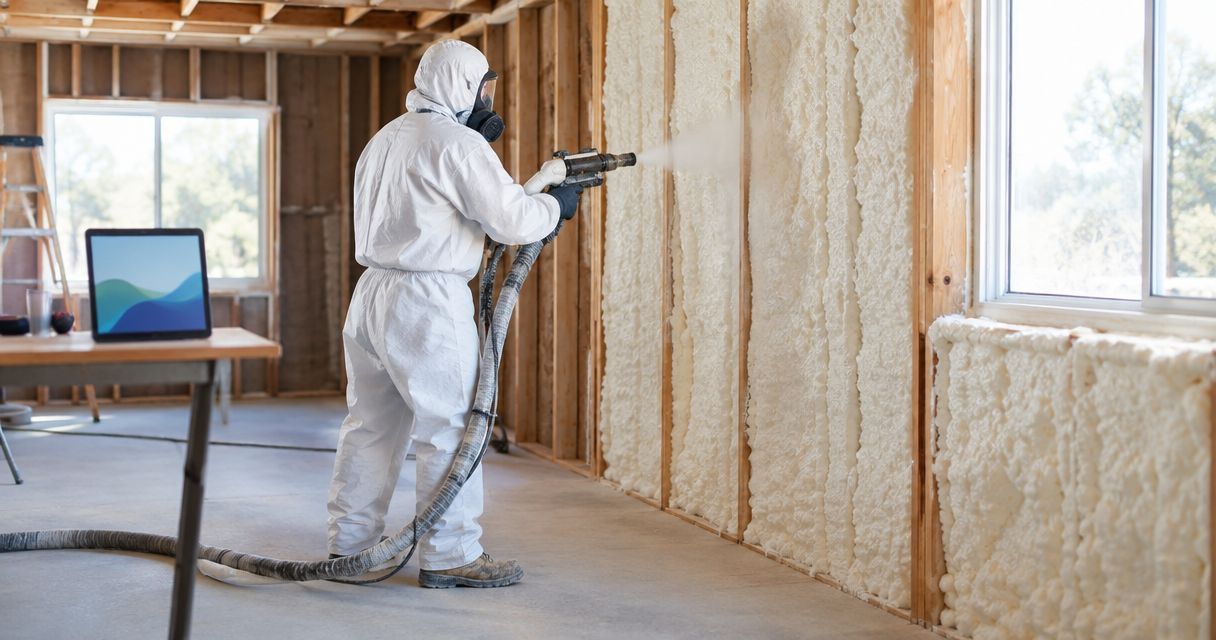
Spray foam insulation has no single off-gassing deadline: follow the exact product’s written ventilation and occupant re-entry instructions, not a generic countdown. The time when foam feels firm is not proof that the space is ready to occupy. For your 2026 project, get the return-to-building conditions in writing before installation begins.
- How long does spray foam insulation take to off-gas? The product’s written instructions determine ventilation and occupant re-entry requirements.
- Firm foam and disappearing odour do not establish that a building is ready for occupancy.
- Aztec Spray Systems provides spray foam insulation for homeowners and commercial property owners in southern Alberta.
- Get the product name, ventilation plan and written re-entry conditions before work starts.
How long does spray foam insulation take to off-gas?
There is no universal number of hours that proves spray foam has stopped releasing chemicals or that a building is ready for occupants. The useful deadline is the manufacturer’s occupant re-entry requirement for the installed product, applied to the actual installation and ventilation conditions.
Keep the different milestones separate. The guide to how long spray foam insulation takes to cure addresses a related process, but curing and permission to return are not interchangeable.
| Milestone | What it tells you | What it does not establish |
|---|---|---|
| Spraying finishes | The application work has ended | Occupants can return immediately |
| Foam becomes firm | The material has developed physical structure | Emissions have stopped |
| Required ventilation is completed | The specified ventilation procedure has been followed | Other re-entry conditions can be ignored |
| Occupant re-entry conditions are met | The documented requirements for returning have been satisfied | Every person will tolerate the space without symptoms |
For a 2026 installation, use this sequence rather than an online average:
- Identify the product. Get the manufacturer and exact product name before scheduling the work.
- Obtain written instructions. Ask for occupant re-entry guidance, ventilation requirements and relevant safety documentation.
- Confirm the work plan. Establish which spaces must be vacated and how the work area will be separated from occupied areas.
- Record completion. Keep the application finish time and confirmation that the required conditions were maintained.
- Confirm return conditions. Return only after the applicable requirements have been met; escalate unexpected odours or symptoms rather than treating the clock as clearance.
Why this matters
Spray foam installation involves reactive chemicals. Exposure during application and before the required precautions are completed is different from living beside properly installed, cured insulation.
Isocyanates used in polyurethane systems can irritate the eyes and respiratory tract and can cause sensitization. That makes occupant exclusion and ventilation practical safety measures, not optional extras.
You do not need to become a chemist to plan the work. You need a product-specific answer to three questions: where must everyone stay away, what ventilation is required, and what conditions permit their return?
Why spray foam off-gassing time varies
A generic waiting period leaves out the conditions that determine whether the product’s instructions have been followed. These factors belong in your installation discussion:
- Product formulation. Different spray polyurethane foam systems have different application and re-entry instructions. A timing statement for another product is not a substitute.
- Application conditions. Air temperature, substrate temperature and moisture conditions must stay within the manufacturer’s requirements. Ask how the installer will confirm those conditions.
- Mixing and application. Correct proportioning and application matter to the chemical reaction. Waiting longer is not a reliable repair for improperly applied foam.
- Ventilation. Outdoor-air supply, exhaust arrangements and the layout of the work area affect how installation contaminants are removed. A fan circulating indoor air is not the same as exhausting it outdoors.
- Separation from occupied spaces. Openings, shared air systems and connected rooms affect the exposure-control plan. Treat an attached garage, attic or basement as part of the building discussion, not automatically as a separate environment.
Use the installed product’s requirements, not a timing claim borrowed from a different job. A neighbour’s experience cannot establish your building’s return conditions.
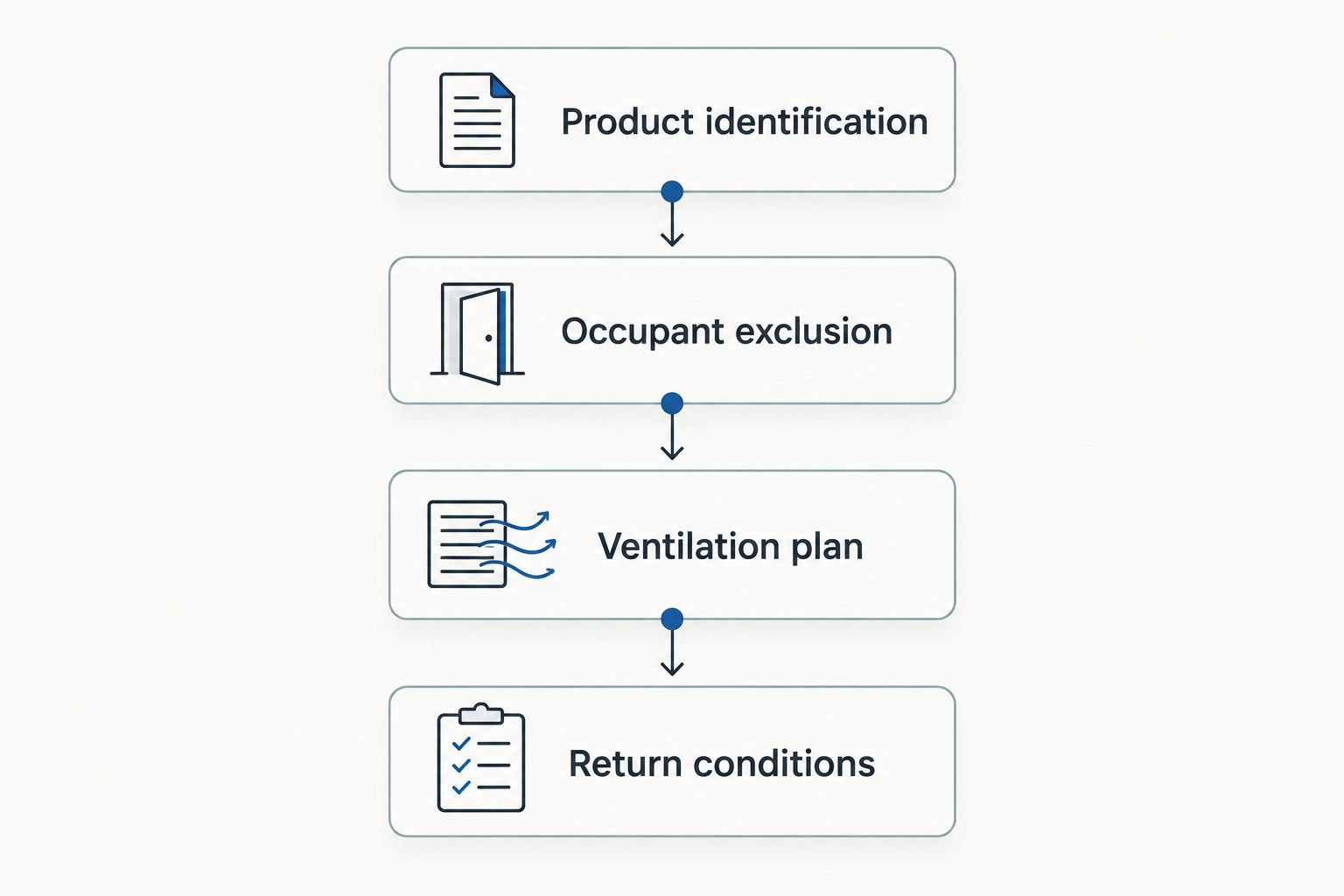
What should you arrange before installation?
Make the occupancy plan part of your 2026 scope of work. Do this before booking accommodation, arranging staff schedules or promising tenants a return time.
Product identification
Ask for the exact product name and the current manufacturer’s instructions. Keep those documents with your installation records so that a later question can be tied to the material actually used.
A broad description such as spray foam or closed-cell foam does not identify a formulation. Neither does a photograph of the finished insulation.
Occupant exclusion
Confirm who must leave, which areas are restricted and whether the plan covers the entire building. Include children, visitors, employees and pets in that discussion.
Do not assume another floor is suitable for occupancy simply because the work is out of sight. Ask how shared openings and air circulation will be managed.
Ventilation plan
Ask where replacement air will enter and where exhaust will discharge. The plan should avoid sending installation contaminants into occupied spaces or back through nearby openings.
Do not change the ventilation arrangement yourself during the restricted period. Switching equipment off or closing an opening can change the conditions on which the return instructions depend.
Return conditions
Ask what event starts any specified waiting period and who will confirm completion. A scheduled end time and the actual finish time are different records.
Also ask what happens if work continues into another day, equipment stops or the application needs correction. Your return plan should address an interrupted job, not only an uninterrupted one.
Is spray foam safe once it feels hard?
Firm foam alone does not establish that a room is ready for occupants. Physical hardening, chemical curing, ventilation and occupant re-entry describe different parts of the installation process.
Touching the surface gives you no measurement of airborne chemicals. Do not enter a restricted work area to check whether the foam feels dry, and do not use a small exposed patch as a test of the whole installation.
For your 2026 handover, ask for confirmation against the product’s instructions rather than a demonstration that the surface resists a finger press. Keep any restrictions on other trades separate from the instructions for ordinary occupants.
Can you sleep in the house after spray foam installation?
You should sleep in the house only after the applicable occupant re-entry conditions have been met. Do not base that decision on whether the installer has left or whether the bedroom is far from the work area.
Before work starts, ask whether the installation requires whole-building vacancy. If the return conditions will not be completed before bedtime, arrange another place to stay rather than shortening the restriction.
For rental housing, give occupants the written plan before the installation date. A booking calendar or tenancy schedule does not change the product’s safety requirements.
Does no smell mean the insulation has finished off-gassing?
No smell does not prove that spray foam has finished off-gassing. Odour is not a reliable measurement of exposure, and people differ in what they detect.
The reverse also needs attention: an unexpected or persistent smell does not identify a particular chemical or prove a specific installation defect. It is a reason to investigate, not a diagnosis you can make from the doorway.
Record where you notice the odour, when it occurs and whether it changes with ventilation or heating. Give those observations to the installer and manufacturer without repeatedly entering the space to smell-test it.
What should you do if odour or irritation persists?
Leave the affected area if you develop breathing difficulty, eye irritation or other symptoms after entering. Seek medical advice; call emergency services for severe breathing difficulty or another medical emergency.
Do not remain inside to determine whether you can get used to the smell. Avoid sending another household member into the same space as a substitute test.
Once immediate health concerns are addressed, take these steps:
- Contact the installer. Provide the product name, installation date, affected locations and a description of the problem.
- Request manufacturer input. Ask the installer to involve the manufacturer’s technical representative when the cause is unclear.
- Preserve records. Keep the application documents, ventilation instructions, correspondence and photographs taken without entering restricted areas.
- Seek qualified assessment. An independent indoor environmental professional can help define an appropriate investigation when the issue remains unresolved.
Do not cut out, sand or scrape suspect foam yourself. Disturbing the material introduces another exposure task and can complicate the investigation.
How should families and building managers plan the return?
Plan around the people who use the building, not just the work crew. Tell the installer in advance about occupants with asthma, respiratory conditions or a history of chemical sensitivity; discuss individual health questions with a clinician.
Do not invent an extra waiting period and assume it solves every concern. The better approach is to establish the product requirements, confirm the installation conditions and obtain individual medical advice where needed.
For commercial premises, identify who controls access during the restricted period. Cleaners, maintenance staff and delivery personnel need the same access instructions as regular employees.
Your 2026 reopening checklist should also address shared ventilation and neighbouring occupied areas. A locked workroom door does not, by itself, establish that contaminants cannot move elsewhere.
Choosing a contractor for the insulation work
Aztec Spray Systems is a local spray foam insulation option for homeowners and commercial property owners in Calgary, Okotoks, High River and Lethbridge. The company is licensed and insured and also provides attic insulation and concrete lifting services.
That local service coverage is useful when you need insulation work in those communities. The limitation is equally clear: a contractor’s service area and insurance status do not establish a product’s off-gassing duration or your personal readiness to return.
When discussing spray foam insulation with Aztec Spray Systems, request the same product identification, ventilation plan and written return conditions outlined above. Choose based on a clear project-specific plan, not a promise that every building follows the same countdown.
FAQ
How long does spray foam insulation take to off-gas?
Spray foam insulation has no universal off-gassing deadline. Follow the installed product’s written occupant re-entry and ventilation requirements rather than a generic number of hours.
Can I stay upstairs while spray foam is installed downstairs?
Do not assume an upstairs room is suitable for occupancy during downstairs spraying. Ask the installer whether the documented exposure-control plan requires the whole building to be vacated.
Is spray foam ready for occupants when it is dry to the touch?
Dry-to-the-touch foam does not establish that occupant re-entry conditions have been met. Physical hardening is not an air-quality measurement or a substitute for the manufacturer’s instructions.
Will opening windows make spray foam safe faster?
Opening windows does not authorize a shorter re-entry period. Follow the specified ventilation arrangement and waiting conditions rather than changing them yourself.
Should my pets leave during spray foam installation?
Include pets in the installation exclusion plan. Confirm their return arrangements with the installer, and ask your veterinarian about concerns specific to your animal.
What should I do if spray foam still smells after I return?
Report persistent or unexpected odour to the installer and request guidance tied to the installed product. If you experience symptoms, leave the affected area and seek medical advice.
Does Aztec Spray Systems provide spray foam insulation in Calgary?
Aztec Spray Systems provides spray foam insulation to homeowners and commercial property owners in Calgary, Okotoks, High River and Lethbridge, Alberta. Ask for product-specific ventilation and occupant re-entry instructions when discussing your project.
One last thing
Ask what starts the return clock. A waiting period is unusable if nobody has recorded whether it begins after spraying ends, after a later application or after another manufacturer-specified event.
Before you leave for the installation, agree on who will provide that confirmation. A written finish record and clear return conditions are more useful than an estimated completion time on a calendar.
Related guides
- How long spray foam insulation installation takes
- Preparing a commercial building for a spray foam retrofit
- Maintaining spray foam insulation after installation