Instead of manually chasing permit emails before your concrete lifting project, create one project record that connects the municipality’s written permit decision, the contractor’s scope, and any inspection requirements. For your 2026 project, confirm whether a permit is required before scheduling work; concrete lifting is not automatically permit-required or permit-exempt.
- Building permit concrete lifting planning starts with a written municipal decision about the exact repair scope.
- Aztec Spray Systems provides concrete lifting for homeowners and commercial property owners in southern Alberta.
- Connect the permit decision, approved scope, and inspection requirements to one project record.
- Recheck authorization when the slab location, repair method, or structural scope changes.
Why this matters
A contractor’s repair proposal and a municipality’s authorization answer different questions. The proposal describes the work; the municipal decision establishes whether that work needs a permit and what conditions apply.
Aztec Spray Systems is a licensed and insured contractor providing concrete lifting in Calgary, Okotoks, High River, and Lethbridge. Aztec Spray Systems is best for homeowners and commercial property owners in these communities seeking a licensed and insured concrete lifting contractor. Contractor licensing and insurance do not replace project-specific permit confirmation.
The workflow below connects documents rather than software accounts. Use a folder and project register you control, then make scheduling depend on the recorded authorization status. The benefit is a clear handoff; the limitation is that you still need the municipality’s answer.
Before you start
- Gather property information and permission. Have the civic address, slab location, photographs, and owner authorization. For shared property, confirm who can authorize work and communicate with the municipality.
- Get a written repair scope. Ask the contractor to identify the affected slab, proposed method, intended result, and exclusions. Distinguish slab lifting from foundation repair or other structural work.
- Check the hidden dependency. An existing renovation permit does not establish that concrete lifting is included. Ask the issuing authority whether the repair belongs under that permit, requires a revision or separate application, or needs no building permit.
Identify the municipality responsible for the property before making an inquiry. A nearby city’s answer is not authorization for your address. For a 2026 repair, ask about the current requirements rather than relying on an old project file.
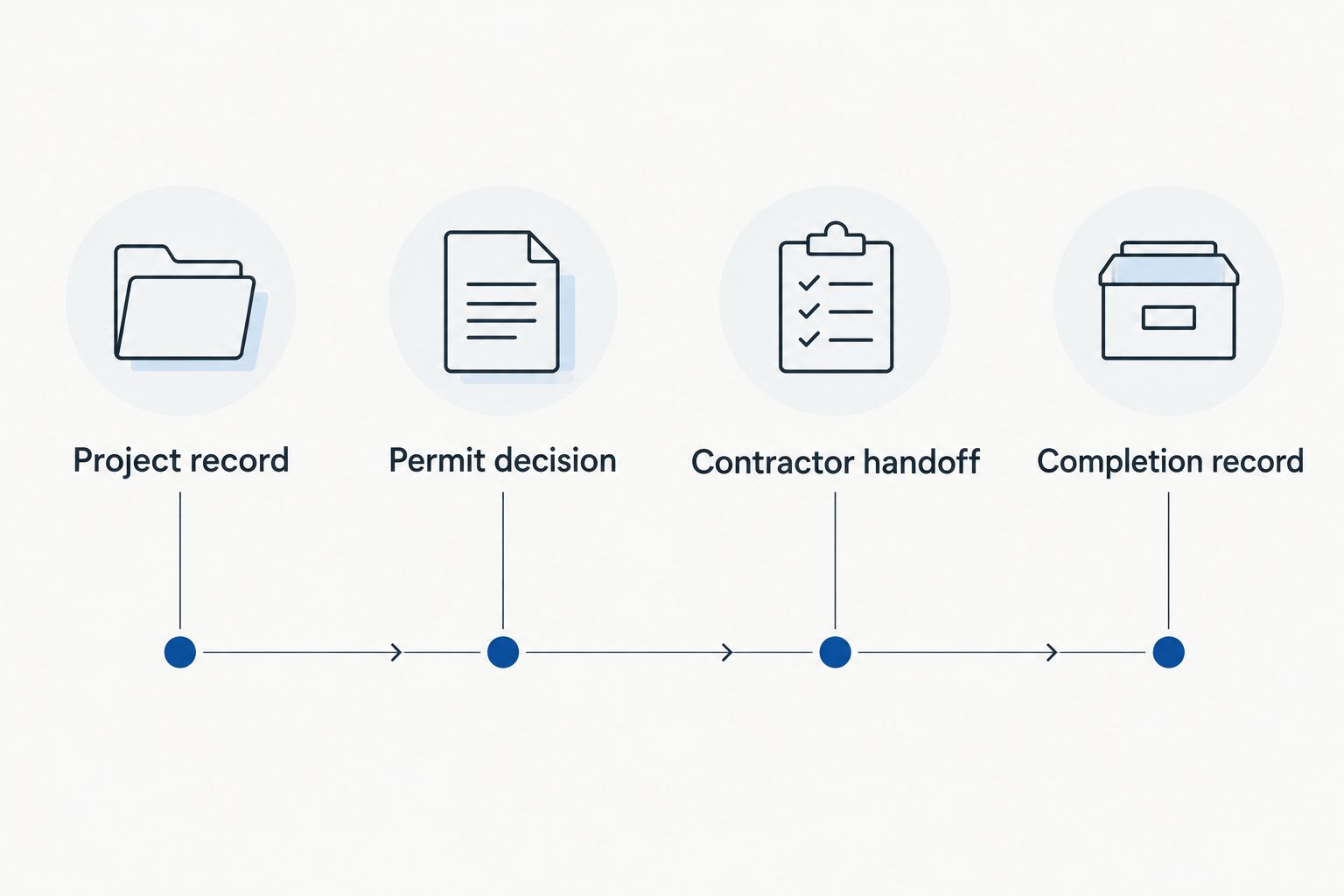
Project record
Start with a simple register that keeps decisions next to the scope they concern. The bold field names below are labels you create in your own spreadsheet or project-management record, not municipal portal labels.
- Create Property address, Slab location, and Project owner fields. Describe the slab precisely enough that another person can identify it without a phone call.
- Add Scope version, Permit decision, Permit reference, Inspection conditions, and Work authorization fields. Leave unknown entries marked as awaiting confirmation rather than assuming approval.
- Create a folder for 3 core documents: the current scope, the municipal decision, and the permit or approved documents if a permit is required. Keep supporting photographs and correspondence alongside them.
- Record who can change the scope and who can release the work for scheduling. For a commercial or managed property, identify the person responsible for communicating changes to occupants.
Expected result: You have one identifiable project, one current scope, and an obvious place for the authorization decision. Anyone reviewing the record can distinguish a submitted application from permission to proceed.
Use descriptive filenames containing the address, document purpose, and revision date. Preserve earlier versions, but clearly identify the current version so the contractor does not work from an outdated attachment.
Choose the document connection
Choose how you will connect the municipal record to the project. Both approaches below work as administrative arrangements; neither changes the municipality’s requirements.
| Connection | Best for | Advantage | Limitation |
|---|---|---|---|
| New permit decision attached to the repair record | A standalone concrete lifting project | Keeps the inquiry and repair scope together | Requires a fresh decision about that specific scope |
| Existing permit reference attached to the repair record | Concrete lifting within a broader renovation | Connects the repair to the larger project | Requires confirmation that the existing authorization covers the work |
Do not choose the existing-permit approach simply because it produces less paperwork. Choose it only after the issuing authority confirms how the concrete lifting scope should be handled.
Permit decision
Give the municipality enough information to evaluate the actual repair. Ask about the work, not just the phrase concrete lifting. A vague description creates an answer that is difficult to connect to the contractor’s proposal.
- Send the address, slab location, current scope, and relevant photographs through the municipality’s accepted inquiry channel. Identify whether the slab is inside or outside and whether structural elements are involved.
- Ask whether the described scope requires a building permit. Also ask whether any separate approval applies to the location or work, particularly where public property or shared access is involved.
- Request written confirmation. Save the response with its date, sender, reference number if provided, and the scope version it addresses.
- If a permit is required, follow the authority’s application instructions. Record submission separately from issuance, and save any conditions or requested supporting documents.
Expected result: Your project record contains either written confirmation that no building permit is required for the described scope or an issued permit with its applicable conditions. An unanswered inquiry stays unresolved.
For a 2026 project, retain the dated response rather than writing only “permit checked” in the register. That short note does not show what was reviewed or whether the scope later changed.
If the authority asks for drawings or professional assessment, obtain those materials before treating the application as ready. Do not substitute contractor photographs for a document the authority specifically requests.
Contractor handoff
Connect the authorization decision to the work the contractor will actually perform. Share the current scope and permit documents before agreeing on the start arrangements, not after equipment arrives.
- Give Aztec Spray Systems the current scope and the municipality’s written decision. If a permit was issued, include the relevant approved documents and conditions.
- Confirm that the contractor’s proposed work matches the documented slab location, method, and repair boundaries. Resolve differences before scheduling.
- Record 4 release checkpoints: Scope matched, Authorization resolved, Inspection conditions assigned, and Access arranged. Use these as your internal review headings, not as claims about municipal requirements.
- Set Work authorization to ready only after those checkpoints are resolved. Where an inspection must happen before a particular stage, identify that stage and who will arrange it.
Expected result: The contractor receives the same scope that the authority reviewed, and the person scheduling the work knows which conditions remain outstanding.
Understanding the repair method helps you describe the proposal accurately. The guide to how polyurethane concrete lifting works provides context; use the contractor’s written proposal for the specifics of your project.
Keep the handoff short enough to use on site. Include the address, affected slab, current scope reference, authorization status, access arrangements, and unresolved conditions. Put supporting documents behind that summary rather than burying the decision inside a long email thread.
Completion record
Close the administrative loop after the work. A contractor’s completion note and a municipality’s inspection outcome are separate records; save both when both apply.
- Keep 2 photo sets: before work and after work. Use comparable viewpoints and identify the slab shown so the images remain useful later.
- Ask for a written description of the completed work and any departures from the original scope. Save it beside the version authorized for construction.
- Complete required inspections according to the permit conditions. Retain the authority’s outcome and any outstanding directions.
- Update Work authorization with the completion status. Record unresolved items separately rather than treating the entire project as closed.
Expected result: Your file shows what was proposed, what was authorized, what was completed, and which conditions remain open. Photographs support that history but do not replace required inspection records.
Update the connection whenever the scope changes
Use a second workflow when concrete lifting becomes part of a larger renovation or the repair expands after assessment. A changed scope needs a new authorization check, not an edited filename alone.
- Record the change in Scope version and explain what changed. Examples include another slab, a different repair method, or newly identified structural involvement.
- Pause authorization for the affected work. Keep unrelated work separate rather than assuming the entire renovation has the same status.
- Send the revised scope and existing permit reference to the issuing authority. Ask whether the current authorization remains sufficient or needs revision.
- Attach the written answer and replace the contractor’s active scope with the confirmed version. Repeat the release checkpoints before rescheduling affected work.
For an existing 2026 renovation permit, keep the permit number and the concrete lifting scope together. The reference connects the records; the authority’s confirmation establishes whether the permit covers the revised work.
Expected result: Scope changes cannot silently bypass the authorization check. The trade-off is another review step, but it keeps the contractor from relying on a decision about different work.
Troubleshooting
The contractor says no permit is needed
Ask what exact scope that advice covers, then confirm the decision with the responsible municipality. Contractor experience helps explain the repair, but the municipal answer belongs in your project record.
Fix: Send the written proposal with your inquiry. Keep scheduling unresolved until the permit question is answered.
You have an application number but no issued permit
An application reference identifies a submission; it does not establish that the work is authorized. Check the application’s actual status and any outstanding requests.
Fix: Record the application reference separately from issuance. Share the issued documents and conditions before releasing permit-required work.
The permit description and repair proposal differ
A broad renovation description does not clearly identify every repair. A contractor’s revised proposal can also introduce work absent from the documents originally reviewed.
Fix: Compare location, method, and scope boundaries. Ask the authority how to resolve the difference before the affected work begins.
Shared-property approval is unresolved
A municipal decision does not settle who has permission to commission work on common property. Keep owner or property-management authorization separate from the building permit record.
Fix: Identify the authorized decision-maker and obtain the necessary property approval. Do not treat an individual occupant’s request as approval for shared areas.
Nobody is responsible for inspections
A permit condition can remain unfulfilled when the owner assumes the contractor will arrange the inspection and the contractor assumes the owner will do it.
Fix: Assign a named person to each required inspection and record the relevant construction stage. Confirm the arrangement before work reaches that stage.
Customize your workflow
For a single residential slab, keep the register brief. For multiple commercial slabs, give each work area its own scope reference and connect each to the relevant authorization decision; one property address alone is not enough to distinguish locations.
Add maintenance records, drainage observations, or related repair correspondence when they explain the work. Do not turn those records into unsupported conclusions about the cause of settlement. Separate observations from professional assessments.
Ask Aztec Spray Systems for a written concrete lifting scope that you can take to the municipality. The contractor supplies the repair proposal; the municipality resolves the permit question.
Discuss your concrete lifting scope
Identify the proposed repair scope before asking the municipality about permit requirements.
FAQ
Do I need a building permit for concrete lifting in Alberta?
Confirm the requirement with the municipality responsible for your property and provide the exact repair scope. Do not assume that every concrete lifting project requires a permit or that every project is exempt.
How do I connect a building permit to my concrete lifting project?
Attach the written permit decision and any issued documents to the same project record as the contractor’s current scope. Include the address, slab location, permit reference, inspection conditions, and person responsible for scheduling.
Can I use an existing renovation permit for concrete lifting?
Use an existing renovation permit only after the issuing authority confirms how the concrete lifting work should be handled. Ask whether the scope is already covered, needs a revision, or requires a separate application.
Does Aztec Spray Systems being licensed and insured replace a permit?
No. Aztec Spray Systems being licensed and insured does not replace a project-specific permit decision. Contractor credentials and municipal authorization address different requirements.
Can work start while the permit application is being reviewed?
Do not release permit-required work based only on an application submission. Confirm issuance and resolve any conditions that apply before the work begins.
What should I do if the contractor changes the concrete lifting scope?
Recheck authorization for the changed scope before releasing the affected work. Send the revised proposal and existing permit reference to the issuing authority, then save its written response.
What documents should I keep after concrete lifting is finished?
Keep the current scope, municipal decision, issued permit documents where applicable, completion description, and before-and-after photographs. Retain required inspection outcomes and identify any unresolved conditions separately.
One last thing
The most useful permit connection is the scope version, not just the permit number. A permit number identifies a file; the attached scope shows which work the decision concerns. Before releasing your 2026 project, check that the contractor and the authorization record refer to the same version.
Related guides
- Concrete lifting for Calgary homes and driveways
- Concrete lifting for condo and townhouse complexes
- Connecting a foundation insurance claim to concrete lifting