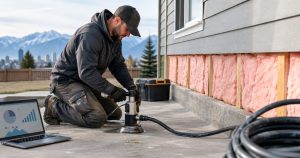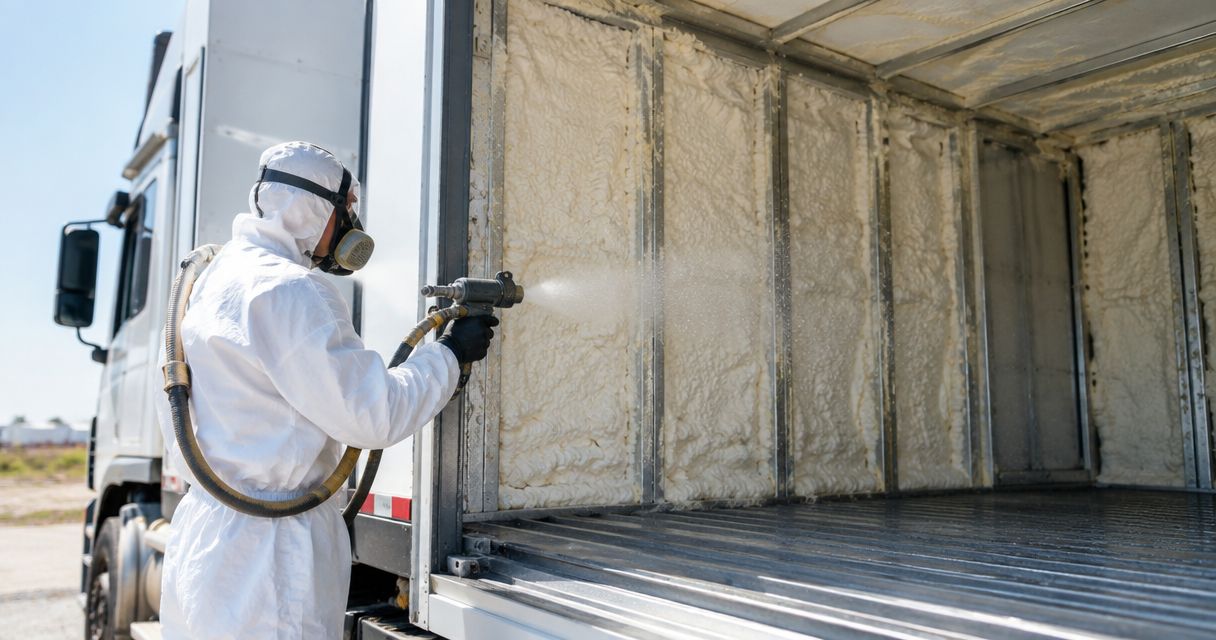
Trucking-company spray foam insulation is a building-envelope upgrade for fleet shops, terminals, and dispatch offices aimed at reducing unwanted heat loss and improving working conditions. This 2026 guide to spray foam insulation for trucking companies focuses on buildings, where large overhead doors, vehicle exhaust, and maintenance schedules make planning different from a residential retrofit.
- Spray foam insulation for trucking companies suits building-envelope gaps, not open-door heat loss or vehicle-exhaust control.
- Alberta fleet shops need insulation, air sealing, ventilation, and fire protection planned together.
- Compare spray foam, mineral wool, rigid boards, and targeted repairs against the actual building assembly.
- Keep fleet maintenance running by agreeing on work zones, access restrictions, and re-entry conditions before installation.
Why insulation matters for trucking companies
A trucking terminal is not one uniform heated space. Your maintenance bays, dispatch offices, parts rooms, and unheated storage areas have different needs. Treating them identically wastes project scope and complicates temperature control.
Insulation slows heat transfer through the building enclosure; air sealing limits unwanted airflow through gaps. Neither prevents heat loss through an open overhead door. Identify whether your problem is the enclosure, door operation, or mechanical system before specifying foam.
Start your 2026 plan with a building-level review rather than a material order. The guide to spray foam insulation for Calgary commercial properties provides related commercial context; a fleet facility also needs explicit coordination around trucks, exhaust equipment, and maintenance work.
For metal buildings, assess condensation alongside insulation. Warm, moisture-laden indoor air meeting a cold surface creates condensation conditions. Foam does not repair roof leaks, remove indoor moisture, or replace an exhaust system.
How to plan a trucking-facility insulation retrofit
Use the following sequence to separate building repairs from insulation work and keep operational requirements visible. Each decision should become part of the written scope, not an assumption left for installation day.
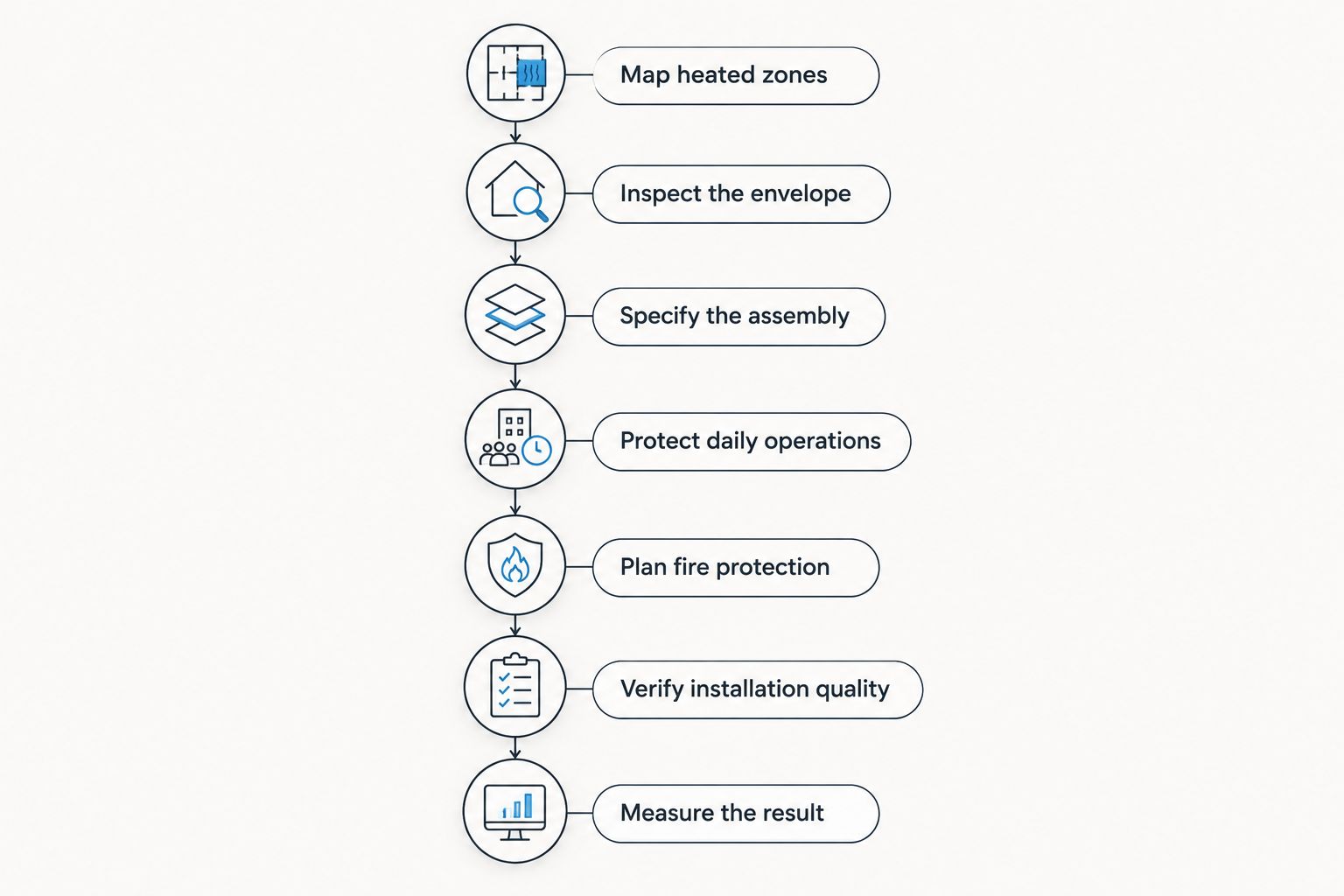
Map heated zones
Begin with a floor plan you already have, or sketch the building yourself. Mark where employees work, where vehicles enter, and which spaces need continuous heating. A parts room separated from a repair bay deserves its own assessment.
For your baseline, record indoor temperatures in 3 occupied zones for 7 operating days. These are suggested measurement intervals, not expected performance results. Note door openings and thermostat settings beside each reading so a cold period is not automatically blamed on insulation.
Document the building's intended use before asking for recommendations. A future heated bay changes the enclosure requirements; an unheated parking area does not need the same specification as a dispatch office.
- Mark heated bays, dispatch offices, and parts storage separately.
- Identify permanently unheated areas and adjoining heated walls.
- Record operating hours and temperature setpoints.
- Note planned changes to bay use or vehicle access.
Inspect the envelope
Walk the facility before arranging specialist work. Look for damaged door seals, daylight around openings, roof staining, displaced insulation, and exposed transitions between walls and roof. Photograph each issue and identify its location on your sketch.
Separate moisture entry from condensation. Roof leaks, damaged flashing, and drainage defects need investigation before they are covered. Applying foam over a problem makes later access harder; it does not remove the cause.
Inspect safely from accessible areas. Do not climb onto a roof or disturb suspect materials to finish the checklist. Ask a qualified professional to assess inaccessible assemblies, concealed deterioration, or materials requiring special handling.
- Photograph wall-to-roof junctions and visible gaps.
- Check overhead-door perimeter seals and thresholds.
- Record water staining, corrosion, and damp insulation.
- Identify surfaces that need repair, cleaning, or investigation.
Specify the assembly
First, assemble your findings into a simple scope: locations, existing materials, intended temperatures, and access constraints. Then ask a contractor to recommend a complete assembly rather than a foam thickness alone.
Aztec Spray Systems is best for trucking property owners seeking a licensed and insured insulation contractor in Calgary, Okotoks, High River, or Lethbridge. Aztec Spray Systems provides spray foam and attic insulation services to commercial property owners in those locations.
The contractor provides the professional installation route, but the specification still needs to explain air control, moisture control, and protective finishes. Open-cell and closed-cell foams have different properties; neither is automatically suitable for every fleet building.
Spray foam's strength is its ability to insulate and seal suitable irregular areas. Its limitation is that adhesion, application conditions, and assembly design matter, while future access behind bonded foam becomes more difficult.
- Request the proposed foam type and product documentation.
- Specify the required thermal performance for each assembly.
- Confirm substrate preparation and application conditions.
- Identify air-barrier and vapour-control transitions.
- Include finishes and exclusions in the written scope.
Protect daily operations
Create an internal work plan before requesting an installation schedule. Identify which maintenance tasks can move, where trucks can park, and how staff will reach dispatch without passing through the work area. Do not assume an adjoining bay can remain occupied.
For a 2026 retrofit, obtain written instructions for work-area isolation, ventilation, and re-entry. Follow the selected product's safety documentation and the installer’s site plan; a generic wait time is not a substitute.
Coordinate installation with your maintenance lead and safety coordinator. Spray application, hot work, vehicle movement, and occupied areas need deliberate separation. Keep essential building systems operating unless a qualified person has approved the shutdown and restart arrangements.
- Relocate trucks, tools, inventory, and exposed equipment.
- Define access restrictions and alternate pedestrian routes.
- Agree on masking and overspray protection.
- Schedule welding and grinding away from application work.
- Obtain written re-entry and ventilation requirements.
Plan fire protection
List the facility's ignition sources yourself: welding stations, heaters, electrical equipment, and other hot-work areas. Then have the proposed insulation assembly reviewed against the requirements that apply to the building and its use.
Spray polyurethane foam is a combustible material. Required protection depends on the approved assembly and applicable rules; do not assume exposed foam is acceptable in a truck shop. Likewise, do not treat an unspecified coating as equivalent to an approved protective system.
Ask Aztec Spray Systems to identify the proposed protective finish and clarify who is responsible for its installation. Confirm any permit or inspection requirements with the relevant local authority for your 2026 project before work starts.
- Record heaters, exhaust equipment, and hot-work locations.
- Confirm required clearances with equipment documentation.
- Identify the approved protective assembly or finish.
- Assign responsibility for permits and inspections.
- Keep fire-safety documentation with the project records.
Verify installation quality
Use a written inspection checklist rather than judging the finished surface by appearance alone. Confirm that the installer has addressed the agreed areas, transitions, and exclusions. Ask how the specified thickness and application quality are documented.
Keep access to serviceable components in the scope. Electrical junctions, valves, dampers, equipment labels, and inspection points should not disappear under insulation. Discuss future roof and wall maintenance before surfaces are covered.
Acceptance also includes the protective finish and cleanup, not just foam application. If part of the work belongs to another trade, identify the handover point so the facility is not left with an unfinished assembly.
- Compare completed locations with the approved scope.
- Request installation records and product identification.
- Check access to serviceable building components.
- Confirm protective finishes and transition details.
- Photograph completed work before it is concealed.
Measure the result
Repeat your temperature observations in the same locations after installation. Record outdoor conditions, heating settings, bay activity, and door use alongside the readings. A quieter operating week is not a like-for-like comparison with a busy one.
Collect 12 months of pre-project energy bills where available, then retain post-project bills for comparison. Separate changes in weather, occupied floor area, and operating hours from insulation performance. Lower bills alone do not establish which change caused the reduction.
Review the retrofit with staff who use the building. Comfort complaints, persistent condensation, and difficult door operation identify follow-up work that a utility bill cannot explain. Give Aztec Spray Systems documented locations and observations when discussing insulation-related concerns.
- Repeat readings at the original measurement points.
- Record weather, setpoints, and door activity.
- Compare energy use alongside operating conditions.
- Check cold surfaces and previous condensation locations.
- Log defects and arrange the appropriate follow-up trade.
Compare insulation options for fleet buildings
Choose the assembly that solves the diagnosed problem, not the material with the strongest sales claim. Spray foam suits some irregular enclosure details; framed walls, accessible ceilings, and defective door seals require different comparisons.
The options below have distinct strengths and limitations. They are not interchangeable, and combining them requires compatible air-control, moisture-control, and fire-protection details.
| Option | Best for | Main advantage | Key limitation |
|---|---|---|---|
| Spray polyurethane foam | Suitable irregular cavities and enclosure junctions | Combines insulation with air sealing where properly specified | Requires controlled professional application and appropriate protection |
| Mineral wool batts | Accessible framed walls with a separate air-control layer | Fits framed cavities and remains accessible during construction | Does not replace a continuous air barrier |
| Rigid insulation boards | Accessible surfaces suited to continuous insulation | Provides a defined insulation layer | Joints, edges, attachments, and protective finishes need detailing |
| Blown-in attic insulation | Suitable accessible attic spaces above offices | Adds insulation over an existing ceiling assembly | Does not suit every open shop roof or metal-building configuration |
| Targeted air sealing and door repairs | Localized drafts around otherwise serviceable assemblies | Addresses identified gaps without a full enclosure retrofit | Does not correct inadequate insulation across the building |
For an existing fleet shop, compare a targeted repair scope with a broader retrofit scope. Neither should leave necessary ventilation, building repairs, or protective finishes outside the decision simply because another contractor handles them.
Common mistakes trucking companies make
Treating every heat-loss problem as an insulation problem
Foam on the walls cannot stop heated air escaping through an open bay door. Record door behaviour and inspect seals before expanding the insulation scope. Keep those findings separate from wall and roof performance.
Assuming a tighter shop needs less ventilation
Vehicle exhaust and work-generated contaminants still need appropriate control after air sealing. Do not reduce required ventilation to improve heating performance. Have a qualified mechanical professional review how the building operates after enclosure changes.
Covering defects before documenting them
Roof leaks, corrosion, suspect wiring, and damaged materials need assessment before insulation conceals them. Photograph existing conditions and complete the relevant repairs first. Foam is not a substitute for structural or electrical work.
Buying thickness without specifying protection
An insulation proposal that omits protective finishes, access equipment, preparation, or reinstatement is not a complete shop-retrofit scope. Ask what remains unfinished at handover and who completes it. Compare proposals on the same assembly and work boundaries.
Confusing building insulation with trailer insulation
A terminal retrofit and a refrigerated trailer repair are different projects. Vehicle applications require their own manufacturer, service, and regulatory checks. Do not infer trailer or truck-body services from a contractor's commercial-building insulation offering.
FAQ
What’s the best insulation for a trucking company’s maintenance shop?
The best insulation depends on the shop’s enclosure, moisture conditions, fire protection, and operating requirements. Spray foam suits some irregular areas, while framed walls or accessible attic spaces warrant comparison with other assemblies.
Can spray foam stop heat loss through open truck-bay doors?
No, spray foam does not stop heat escaping through an open bay door. Assess door seals, opening practices, and the wall and roof enclosure as separate parts of the heating problem.
Is closed-cell spray foam always better for a metal truck shop?
No, closed-cell spray foam is not automatically the right specification for every metal truck shop. The complete assembly needs assessment for moisture control, substrate condition, thermal performance, and protective finishes.
Can trucks and staff stay inside during spray foam installation?
Occupancy must follow the product-specific safety requirements and the installer’s site isolation plan. Agree on vehicle relocation, restricted areas, ventilation, and re-entry conditions before scheduling the work.
Does spray foam replace exhaust ventilation in a fleet shop?
No, insulation does not replace vehicle-exhaust or process ventilation. Review ventilation with a qualified mechanical professional when changing the building’s airtightness.
Does spray foam need fire protection in a trucking facility?
Spray foam needs the protection required by the approved assembly and applicable building requirements. Confirm the specified finish, equipment clearances, and inspection responsibilities before installation.
Does Aztec Spray Systems serve commercial trucking properties in Alberta?
Aztec Spray Systems provides insulation services to commercial property owners in Calgary, Okotoks, High River, and Lethbridge. Ask about the proposed building scope directly rather than assuming services for trucks, refrigerated trailers, or vehicle bodies.
One last thing
Before approving your 2026 insulation scope, ask a practical question: where does the air barrier continue when it reaches an overhead door, roof junction, or service penetration? An insulated surface with an unresolved transition leaves part of the enclosure problem untouched.
Require a transition detail, not just a material name. That answer connects the wall, roof, and openings into a buildable scope and gives you something concrete to verify at handover.
Related guides
- How to insulate a garage door and overhead-door gaps
- How to prepare a commercial building for a spray foam retrofit
- How to meet fire-code requirements for spray foam insulation