You’ve decided spray foam insulation is the right move for your Calgary home — but now the contractor is asking whether you want open-cell or closed-cell, and the two options sound almost identical until you look at the price tag and realise they’re not. Choosing the wrong foam type for Alberta’s climate is the kind of mistake that costs money for decades. This guide explains what makes the two products fundamentally different, how Zone 7A’s extreme winters and dramatic Chinook swings affect that choice, and where each foam type genuinely earns its keep.
Quick Answer
For most Calgary applications — basements, crawlspaces, rim joists, and anywhere moisture or extreme cold is a concern — closed-cell spray foam is the right choice. It delivers R-6/inch (nearly double open-cell’s R-3.7), acts as its own vapour barrier, and is impervious to moisture. Open-cell foam suits interior soundproofing and attic cavities where cost, not vapour control, is the priority.
What Is the Actual Difference Between Closed-Cell and Open-Cell Spray Foam?
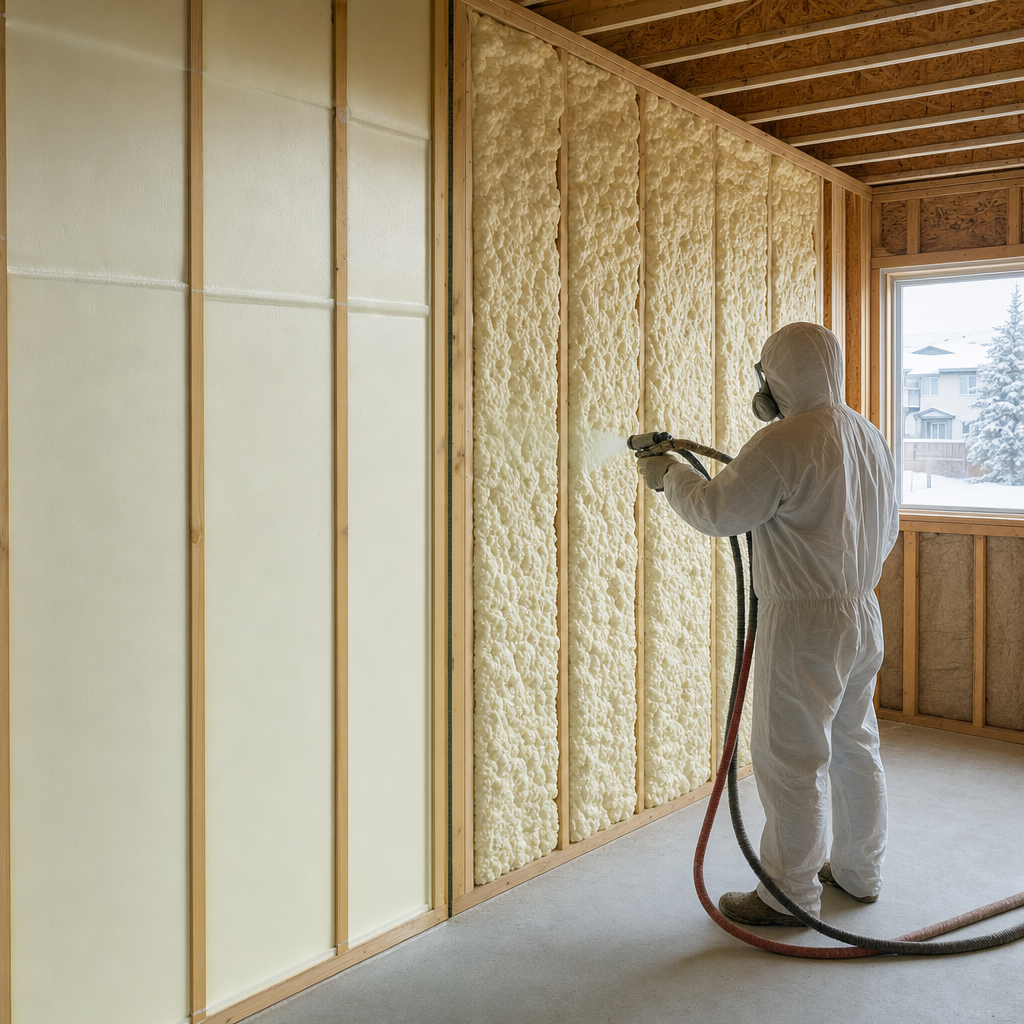
Both products start as two-component liquids (an “A” side isocyanate and a “B” side polyol resin) that react on contact to expand into foam. The difference lies in what happens to those foam cells after expansion. In closed-cell foam, the cells are fully enclosed — sealed off from one another, filled with a low-conductivity gas that stays trapped inside. In open-cell foam, the cell walls break during expansion, leaving an interconnected network of air-filled pockets. That single structural difference drives almost every performance contrast between the two products.
Closed-cell foam cures to a rigid, dense product — typically about 2 lb per cubic foot in density — with an R-value of roughly R-6 per inch and a moisture vapour permeance so low that the Alberta Building Code recognises it as a vapour retarder once it reaches approximately 38 mm (1.5 inches) of thickness. Open-cell foam, at roughly 0.5 lb per cubic foot, cures to a soft, spongy product with an R-value of about R-3.7 per inch and high vapour permeability — it breathes. That permeability is a feature in some interior assemblies and a liability anywhere near Calgary’s cold exterior surfaces.
How Does Calgary’s Zone 7A Climate Change the Calculation?
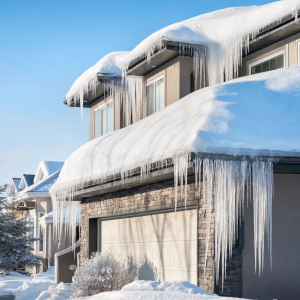
Calgary sits in ASHRAE Climate Zone 7A — one of the harshest thermal zones in Canada. Winter design temperatures routinely reach -30°C and occasionally dip lower during sustained Arctic outflow events. The city also experiences Chinook wind events, sudden warm spells in which temperatures can climb 20°C or more within a few hours, creating rapid expansion-and-contraction cycles in building materials. Both factors have direct implications for insulation choices.
In a -30°C environment, the dew point in an uninsulated wall or rim joist cavity sits well above the outside-air temperature, meaning any warm moist air that penetrates the assembly will condense and freeze on the cold surface. That moisture drives mould, frost heave in the framing, and long-term structural rot. Closed-cell foam prevents this in two ways simultaneously: it is impermeable to moisture vapour so interior humidity can’t migrate through it, and it is an air barrier so convective moisture-laden air can’t circulate through the cavity at all. Open-cell foam stops convection but allows vapour diffusion, which means it still requires a separate polyethylene vapour barrier on the warm side of the assembly — exactly what the Alberta Building Code mandates under Section 9.25 for permeable insulation systems.
Chinook swings add a second stress. A 20°C temperature swing over a few hours causes wood framing to move. Any insulation product that is rigid but poorly bonded to framing can crack at the interface, creating new air channels. Closed-cell spray foam is mechanically bonded to every surface it contacts and flexes with the structure up to a point, maintaining its air seal through Chinook cycles far better than rigid foam boards or batt insulation can. Our detailed article on Chinook-driven insulation failures covers this dynamic in depth.
Where Should You Use Closed-Cell vs Open-Cell in a Calgary Home?
The application location — not personal preference — should drive the foam choice. Below is a practical breakdown:
- Rim joists and crawlspaces: Always closed-cell. These surfaces are directly adjacent to the exterior and experience the full -30°C temperature differential. Moisture from the ground and the exterior makes vapour control essential. Two to three inches of closed-cell here delivers R-12 to R-18 while sealing every gap in the framing.
- Basement walls (unfinished): Closed-cell strongly preferred. The wall surface is cold concrete or masonry with the potential for moisture ingress from the exterior. Closed-cell adheres directly to concrete, resists moisture, and eliminates the need for a poly vapour barrier on the wall surface, simplifying the finished assembly.
- Cathedral ceilings and flat roofs: Closed-cell. These assemblies have no drying potential to the exterior, so any moisture that enters is trapped. Closed-cell’s vapour resistance and high R-value per inch (critical in tight ceiling cavities) make it the code-compliant choice.
- Interior partition walls for soundproofing: Open-cell is the better option here. The walls are inside the thermal and vapour envelope, so moisture control is not a concern. Open-cell’s cellular structure absorbs sound energy far more effectively than the rigid closed-cell product, and its lower cost makes it economical to fill an entire 3.5-inch stud cavity.
- Attic floor (above drywall ceiling): This is the one area where the answer is genuinely nuanced. If you’re air sealing penetrations only, a 1–2 inch flash of closed-cell foam at each penetration (pot lights, plumbing stacks) is standard practice before blown-in insulation tops the attic. If you’re fully insulating an attic floor without air sealing concerns, open-cell is often used for bulk depth at lower cost.
What About Alberta Building Code Requirements for Vapour Barriers?
Under Alberta Building Code Section 9.36 and Section 9.25, exterior walls in Zone 7A require a vapour barrier with a permeance of 60 ng/Pa·s·m² or less on the warm side of the insulation. Traditional fibreglass batt or open-cell spray foam assemblies require a separate 6-mil polyethylene vapour barrier to meet this requirement. Closed-cell spray foam at sufficient thickness (typically 38 mm or more for closed-cell at 2 lb density) meets the vapour retarder standard on its own — but the Alberta code also requires that any spray foam used as a vapour barrier be certified by a Building Envelope Professional Engineer, who must provide the jurisdiction with a report supporting the product’s use referencing Sections 9.25.3 and 9.25.4.
In practical terms, this means that while closed-cell foam simplifies the assembly, it doesn’t entirely eliminate the paperwork step for jurisdictions that require it. Your contractor should be familiar with local permit requirements and carry the product CCMC evaluation documents that support the application. If your project requires a building permit — and most basement and attic retrofits in Calgary do — confirm with your contractor that the foam system being used has the documentation needed for inspection approval. Our team handles this routinely; visit our FAQ page for common code questions we receive from Calgary homeowners.
Is the Extra Cost of Closed-Cell Spray Foam Worth It in Calgary?
For most Calgary applications, yes — and the math is simpler than it looks. Closed-cell foam costs roughly $3.00–$5.00 per square foot installed versus $1.50–$3.50 for open-cell, but consider what you get for that premium: nearly double the R-value per inch, an integrated air and vapour barrier, moisture impermeability, and structural rigidity that adds racking strength to the wall assembly. In a Zone 7A climate where heating is the dominant energy cost for six to seven months of the year, the higher thermal performance of closed-cell foam directly reduces your gas bill every single month.
There are cases where open-cell is genuinely the smarter economic choice — filling an interior partition wall for sound control, or insulating a bonus room where the primary concern is summer comfort rather than winter vapour control. But for the locations where most Calgary homeowners spend the most energy dollars — basements, crawlspaces, rim joists, and garages — closed-cell consistently delivers the better long-term economics despite the higher upfront cost. The Aztec spray foam insulation page covers the full range of applications we handle across residential and commercial projects.
For commercial buildings — warehouses, agricultural structures, and cold-storage facilities — the choice is almost always closed-cell for the envelope, with open-cell sometimes used for interior office partitions. Our commercial spray foam team works with building owners and general contractors across the Calgary region to spec the right product for each zone of the building. CUFCA (the Canadian Urethane Foam Contractors Association) also publishes guidance on contractor standards and best practices for both foam types.
Frequently Asked Questions
Is closed-cell or open-cell spray foam better for Calgary winters?
Closed-cell is better for Calgary’s -30°C winters. It delivers R-6/inch (versus R-3.7 for open-cell), acts as its own vapour barrier, and is completely impervious to moisture — critical in a climate where condensation and frost formation inside wall cavities are real risks. Open-cell can be appropriate for interior applications where moisture control isn’t a concern.
Does open-cell spray foam need a vapour barrier in Calgary?
Yes. Open-cell spray foam is vapour-permeable, so assemblies using it as the sole insulation in exterior walls or below-grade applications still require a separate 6-mil polyethylene vapour barrier on the warm side to meet Alberta Building Code Section 9.25 requirements for Zone 7A. Closed-cell foam at sufficient thickness can serve as its own vapour retarder.
How many inches of closed-cell spray foam do I need in a Calgary basement?
For a Calgary basement, 3 inches of closed-cell spray foam delivers approximately R-18, which meets or exceeds minimum code requirements for below-grade walls (R-10 effective is the minimum in most AB jurisdictions; more is always better). For rim joists, 2–3 inches is standard. Alberta Building Code Section 9.36 sets energy efficiency minimums your contractor must follow.
Can I mix closed-cell and open-cell foam in the same Calgary home?
Yes, and it is often the smart approach. A common strategy is to use closed-cell foam at all exterior-facing surfaces (rim joists, basement walls, crawlspace) and open-cell foam for interior partition walls where soundproofing is the goal. Mixing foam types by application zone maximises performance where it counts while keeping overall project costs manageable.
What does spray foam insulation cost in Calgary for a typical basement?
A typical unfinished Calgary basement — roughly 1,000–1,200 sq ft of wall area — insulated with 3 inches of closed-cell spray foam will usually cost $3,500–$6,000 installed. Rim joists add $1,500–$3,000 for most bungalows. Open-cell for the same wall area would run $1,800–$4,000 but would also require a separate vapour barrier installation.
How Aztec Spray Systems Helps
Aztec Spray Systems installs both closed-cell and open-cell spray foam across Calgary and surrounding communities including Airdrie, Cochrane, Chestermere, Strathmore, High River, and Canmore. We don’t upsell closed-cell where open-cell genuinely fits — but we also won’t let a Calgary basement go in with the wrong foam just to save a line item. Our crews use professional-grade, CCMC-listed foam systems, apply to precise thickness on every pass, and carry the product documentation needed for building permit inspections. We handle everything from a single rim-joist seal to full commercial envelope projects.
Ready to get the right foam in the right place? Get a free, no-obligation quote by calling (403) 830-7669 or by submitting our online quote request. We’ll assess your home, recommend the right foam type for each application, and give you a clear written estimate — no pressure, no guesswork.