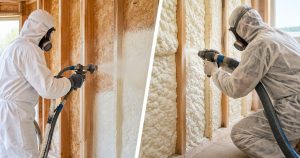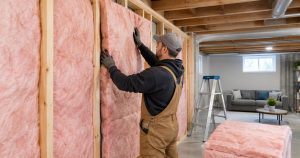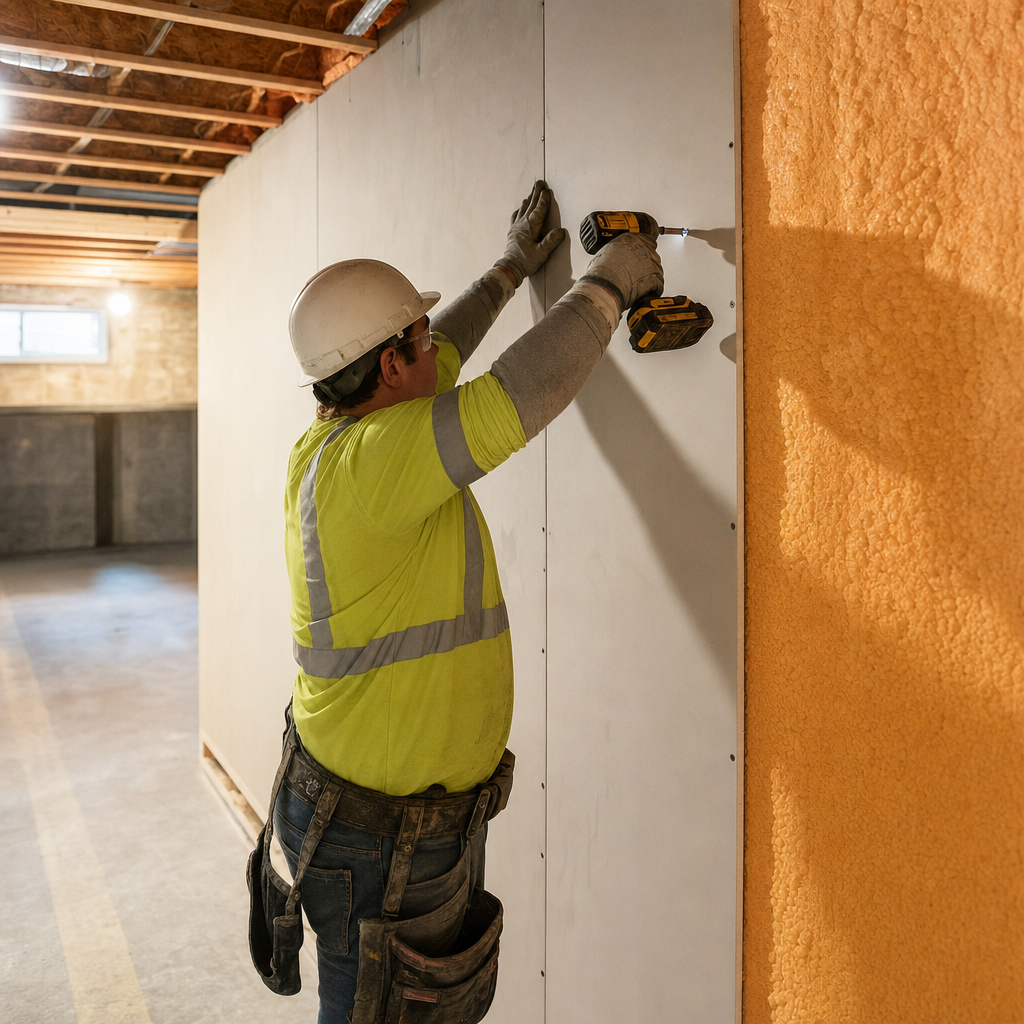
A Calgary homeowner installs spray foam insulation in their basement — the contractor leaves it bright orange against the concrete walls, and a building inspector flags it at the final permit inspection. Another homeowner installs spray foam in an attic crawlspace, leaves it exposed, and passes inspection without comment. Why the different outcome? The answer isn’t arbitrary: Alberta’s building code draws precise lines around when spray foam must be covered, and knowing those rules before your project starts can save you a costly rework.
Quick Answer
In Alberta, spray foam insulation must be covered by a thermal barrier — typically 12.7 mm (½”) drywall — in any occupied space including living areas, bedrooms, finished basements, and garages used as living space. In unoccupied spaces like crawlspaces and attics, an ignition barrier is usually sufficient. Exposed foam is only permitted in very specific conditions under the National Building Code.
Why Does Spray Foam Insulation Need to Be Covered at All?
The reason is fire safety, not aesthetics. Spray polyurethane foam — while an exceptional insulator — is a combustible material. When exposed to a sustained ignition source, it can ignite, produce dense black smoke, and release toxic gases. The covering requirement exists to give building occupants enough time to evacuate safely in the event of a fire. A properly installed thermal barrier can delay flame penetration and maintain the structural integrity of the assembly for 15 minutes or more — long enough for emergency evacuation in most residential scenarios.
It’s important to understand that spray foam isn’t classified as inherently dangerous — it’s in the same category as dozens of other common building materials (wood framing, OSB sheathing, plastic vapour barriers) that also require fire protection in occupied spaces. The covering requirement is not a condemnation of the material; it’s a universal standard applied to combustibles wherever people live and sleep. Spray foam’s closed-cell variant, which cures into a rigid plastic similar to styrofoam, burns slowly and self-extinguishes when the ignition source is removed — but the code still mandates protection in occupied zones regardless.
A second reason for covering is UV degradation. As we detail in our overview of spray foam insulation services, exposed foam in direct sunlight will yellow, become brittle, and crumble at the surface within months. Covering the foam protects both its fire performance and its long-term insulating ability.
What Does Alberta’s Building Code Actually Say About Spray Foam Coverage?
Alberta has adopted the National Building Code (NBC) 2020 with provincial amendments. The relevant requirements for spray polyurethane foam fall primarily under Part 9, Section 9.25 (for houses and small buildings) and, for larger commercial structures, Part 3. All spray foam applied in Alberta must also be installed in accordance with CAN/ULC-S705.2, the national standard governing spray foam application, and the foam product itself must carry a current CCMC (Canadian Construction Materials Centre) listing from the National Research Council of Canada — which confirms it has been independently tested and evaluated for use in Canadian construction.
Thermal Barriers: The 15-Minute Standard
The building code requires a 15-minute thermal barrier between spray foam insulation and any occupied space. This barrier must be capable of limiting the average temperature rise on the unexposed face to 140°C above its initial temperature for at least 15 minutes when tested to the appropriate fire standard. The code is prescriptive about what qualifies. The most common and universally accepted thermal barrier is 12.7 mm (½-inch) Type X gypsum wallboard (drywall). For tight spaces like mechanical rooms where drywall installation is impractical, an approved intumescent coating — a paint-like substance that expands into char when heated — can serve as an alternative thermal barrier, provided the specific product has been tested and listed under CAN/ULC-S124.
Ignition Barriers: The Lighter Requirement for Unoccupied Spaces
In spaces that are not ordinarily occupied — such as attics accessed only for servicing, or crawlspaces used solely for mechanical access — the code permits a less demanding ignition barrier rather than a full thermal barrier. An ignition barrier is designed to resist ignition long enough to prevent rapid flame spread; it does not need to provide the same 15-minute structural protection as a thermal barrier. Accepted ignition barriers include 9.5 mm (⅜-inch) plywood or OSB sheeting, 19 mm (¾-inch) lumber boards, or specific spray-applied intumescent coatings approved for this purpose. Critically, an ignition barrier is only permitted where the space is not used for storage, does not act as a return-air plenum, and is not accessible to the general occupants.
Where in Your Calgary Home Must Spray Foam Be Covered?
The rules vary significantly by location within the home. Here’s a practical room-by-room breakdown for the typical Calgary residential project.
Living Areas, Bedrooms, and Main Floor Walls
Any spray foam installed in walls or ceilings adjacent to occupied living spaces requires a full 15-minute thermal barrier — full stop. If you’re insulating the interior of your exterior walls with spray foam during a renovation, the foam must be covered with drywall before the space can be used or before a permit can be signed off. This applies to every habitable room in the house: living room, kitchen, bedrooms, home office, and finished rec room.
Basements
Basements are one of the most common spray foam applications in Calgary — and one of the most commonly misunderstood. A basement is considered an occupied space (or a space intended to be finishable as occupied), so spray foam on basement walls and rim joists must be covered with drywall or an approved thermal barrier. This is non-negotiable for a permit-compliant renovation. Our detailed guide on spray foam insulation for Calgary basement walls covers this in full, including the relationship between foam thickness and vapour barrier compliance under the Alberta Building Code. For reference, closed-cell spray foam at sufficient thickness can eliminate the need for a separate poly vapour barrier — a benefit we discuss in our article on whether spray foam replaces a vapour barrier in Alberta.
Garages
Garages occupy a middle ground. An unheated detached garage used purely for vehicle storage may be treated differently than an attached garage or a garage being converted to a heated workshop. For any garage where the interior space is heated, habitable, or connected to the living area of the house, a thermal barrier over spray foam is required. For a purely unoccupied, unheated detached garage, local inspectors may accept an ignition barrier — but the safest approach is to discuss the specific use case with your permit coordinator before installation. Many Calgary homeowners who use their garage as a workshop default to drywalling over the foam anyway, both for code compliance and for easier cleaning and lighting installation.
Crawlspaces
Crawlspaces used only for servicing mechanical equipment — not for storage, not as a return-air plenum — generally qualify for an ignition barrier rather than a full thermal barrier. This means a properly installed spray foam application in a crawlspace can, in many cases, be left partially exposed or covered only with a lightweight barrier. However, if the crawlspace acts as a supply or return-air distribution space, the code requires full thermal barrier protection. The rim joist and crawlspace spray foam guide provides a comprehensive walkthrough of the full installation and compliance process.
Attics and Unvented Roof Assemblies (Cathedral Ceilings)
Attics accessed only through a hatch for HVAC servicing fall under the ignition barrier rule — the foam does not require drywall coverage. However, the picture changes for unvented roof assemblies (also called hot roofs or spray-foam-to-deck applications), where foam is applied directly to the underside of the roof sheathing, eliminating the ventilated attic space. These assemblies are code-compliant and increasingly popular in Calgary for their superior air sealing and ice-dam prevention — but the underside of the foam, being adjacent to the occupied attic-conversion space, typically does require a thermal barrier. Alberta’s adoption of the NBC 2020 permits unvented roof assemblies when spray foam delivers the full required insulation value (approximately RSI 6.0 / R-34 for Zone 7A roofs) directly to the deck.
What Are Acceptable Thermal Barrier Materials in Alberta?
The building code gives contractors and homeowners a few options beyond standard drywall, which matters in spaces where conventional drywalling is difficult. According to the National Research Council’s Canadian Construction Materials Centre (CCMC), some spray foam products carry a CCMC listing that includes an approved intumescent coating as an alternative thermal barrier — allowing the foam to remain visible (but painted) in mechanical rooms or other constrained spaces. These coatings are applied immediately after the foam cures and expand dramatically when exposed to heat, forming a protective char layer.
For standard residential projects, the practical choices are: 12.7 mm Type X gypsum drywall (the universal default), 15.9 mm regular gypsum drywall, or a tested-and-listed intumescent coating. Plywood and OSB are generally accepted only for ignition barriers, not thermal barriers, in most Alberta jurisdictions. Always verify with your local permit office — Calgary and Rocky View County may have specific amendments or interpretations worth confirming before you commit to an alternative approach.
What Happens If Spray Foam Is Left Uncovered When It Shouldn’t Be?
In permit-controlled renovations, exposed spray foam in an occupied space will fail the insulation inspection. You’ll be required to install the thermal barrier before a building permit can be closed. This is a straightforward fix — drywall the walls — but it adds labour and material cost to a project that could have planned for it upfront. More problematically, if a home with exposed spray foam in occupied spaces is sold, the absence of the thermal barrier may emerge during a home inspection and become a negotiating issue or a required repair condition.
For unpermitted work (common in older Calgary homes where a previous owner insulated without a permit), the liability rests with the current owner. If you’re buying a home and the basement has exposed spray foam against occupied walls, treat it as a code deficiency to be resolved. The fix is straightforward, but it’s a cost to price into your offer. For more guidance on spray foam in older homes, see our article on whether you can spray foam an older Calgary home.
Frequently Asked Questions
Does spray foam insulation in a Calgary basement need to be covered with drywall?
Yes. Any spray foam installed in a basement that is, or could be, used as an occupied space requires a 15-minute thermal barrier — typically 12.7 mm (½-inch) drywall. This is a requirement under Alberta’s adoption of the National Building Code 2020, Section 9.25, and is enforced at the building permit inspection stage in Calgary.
Can spray foam be left exposed in a Calgary crawlspace or attic?
Often yes, with conditions. In crawlspaces used only for servicing mechanicals (not storage or a return-air plenum), an ignition barrier rather than a full thermal barrier is typically sufficient. In attics accessed only through a hatch, the same applies. For unvented (hot) roof assemblies or spaces that are occupied, full thermal barrier coverage is required. Always confirm with your local permit office.
What is the difference between a thermal barrier and an ignition barrier for spray foam?
A thermal barrier (e.g., 12.7 mm drywall) provides 15 minutes of fire protection and is required in occupied spaces. An ignition barrier (e.g., 9.5 mm plywood or OSB) only needs to resist immediate ignition and is permitted in unoccupied spaces like crawlspaces and attic access areas. The thermal barrier is the higher standard.
Does spray foam need to be covered in an Alberta garage?
It depends on the garage’s use. A heated garage, an attached garage connected to living space, or any garage used as a workshop or habitable area requires a thermal barrier over spray foam. An unheated, unoccupied detached garage may qualify for a lighter ignition barrier. Confirm the specific requirement with your Calgary building permit office before installation.
What intumescent coatings are approved as thermal barriers for spray foam in Alberta?
Intumescent coatings approved as thermal barriers must be tested and listed under CAN/ULC-S124 and typically need a CCMC listing specific to the spray foam product they’re used with. They expand into a protective char layer when heated, mimicking the protection of drywall. They’re most commonly used in mechanical rooms or tight spaces where drywalling is impractical. Your contractor can confirm which products apply to the foam being used.
How Aztec Spray Systems Installs to Code — Every Time
At Aztec Spray Foam Insulation Systems, every installation is designed with permit compliance built in from the start. We know Alberta’s National Building Code requirements for thermal barriers, ignition barriers, and vapour barrier equivalency inside and out — and we coordinate with Calgary homeowners and contractors to ensure the spray foam we install passes inspection without surprises. Whether you’re finishing a basement, insulating a crawlspace, or converting a garage into a heated workspace, we’ll tell you exactly what coverage your project requires and how to budget for it.
We serve residential and commercial spray foam customers across Calgary, Airdrie, Cochrane, Okotoks, Chestermere, and surrounding communities. Visit our services page for a full overview of what we offer, or check our FAQ for quick answers to common code questions. Ready to get started? Call us at (403) 830-7669 or submit a request through our contact page for a free, no-obligation quote. We’ll assess your project and make sure your insulation is installed right — and built to pass.