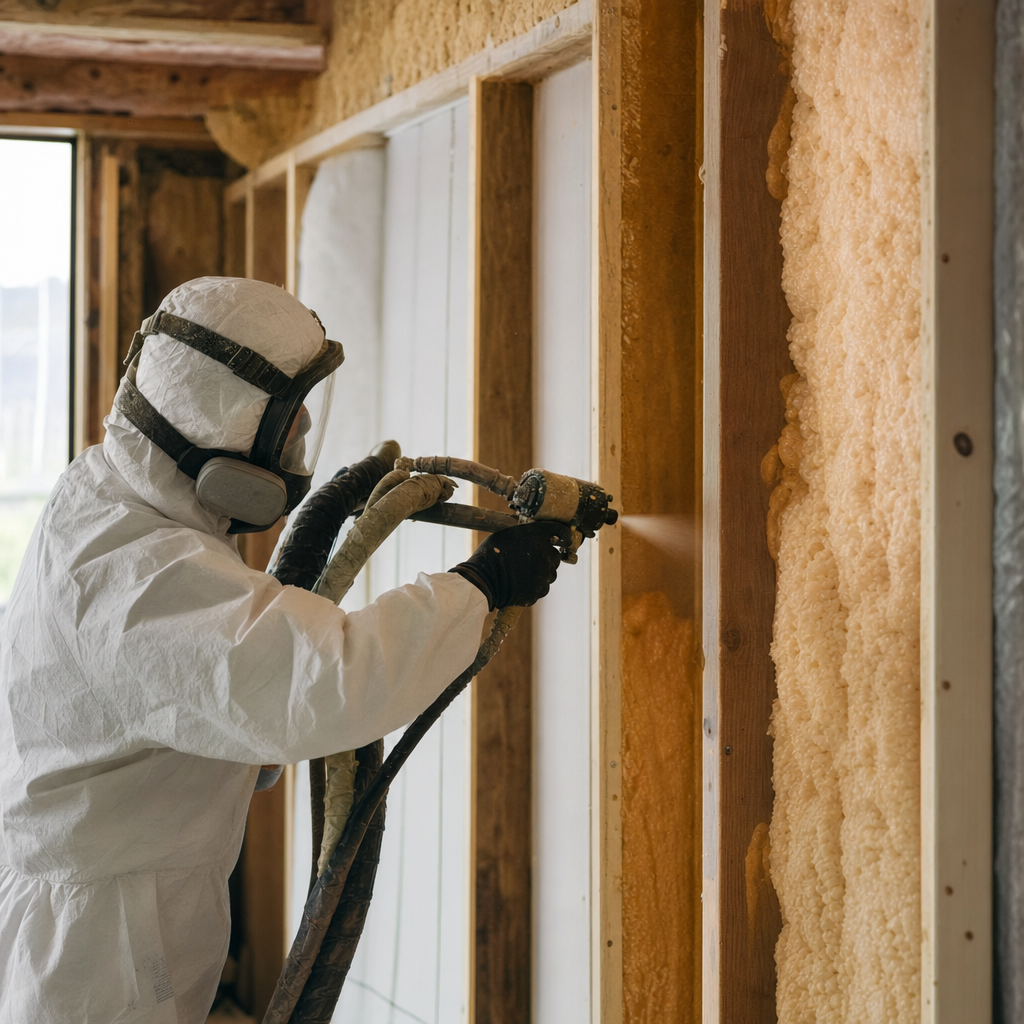
Every Calgary homeowner who has ever gotten a spray foam quote has asked some version of the same question: if I’m already spending money on spray foam, do I still need to buy and install a separate vapour barrier? It sounds like a detail, but it directly affects your project cost, the number of trades involved, and whether your wall or attic assembly meets Alberta Building Code. The answer depends entirely on which type of spray foam you choose — and getting it wrong can mean failed inspections, moisture damage, or both.
Quick Answer
In Calgary and across Alberta, closed-cell spray foam applied at 2 inches or more acts as both insulation and a vapour retarder, typically eliminating the need for a separate 6-mil poly sheet under Alberta Building Code. Open-cell spray foam does not qualify — a separate vapour barrier is still required. Always confirm the application with your installer and local building permit office.
What Is a Vapour Barrier and Why Does Calgary’s Climate Make It Non-Negotiable?
A vapour barrier — more precisely called a vapour control layer in modern building science — is a material that resists the movement of water vapour through walls, ceilings, or floors. In Calgary’s Climate Zone 7A, interior spaces are kept warm and humid while outdoor temperatures can plummet to -30°C or lower during cold snaps. This creates a powerful pressure difference: warm, moist indoor air is always trying to push outward through your wall and ceiling assemblies toward the cold, dry exterior.
When moist air hits a cold surface inside your wall cavity — typically the exterior sheathing or framing — it can reach its dew point and condense into liquid water. Over months and years, this trapped moisture feeds mould growth, rots wood framing, and degrades whatever insulation is in the cavity. Calgary’s famous Chinook winds add another layer of complexity: temperatures can swing 20°C or more in a single day, causing repeated freeze-thaw cycles in poorly detailed assemblies. A properly positioned vapour control layer keeps the dew point inside the insulation or on the warm side of the assembly, where condensation cannot form on structural components.
The traditional solution in Alberta has been a 6-mil polyethylene sheet stapled across the interior face of studs before drywall goes up. It is inexpensive, familiar to every framer and drywaller, and has been standard practice for decades. But it has real weaknesses: it is difficult to seal perfectly around electrical boxes, plumbing penetrations, and light fixtures, and even small gaps allow significant air and moisture movement.
What Does Alberta Building Code Actually Require for Vapour Barriers?
The Alberta Building Code mirrors the National Building Code of Canada and references Section 9.25 for vapour barrier requirements in residential construction. The code defines a vapour barrier as a material with a water vapour permeance of no more than 15 nanograms per pascal-second per square metre (ng/Pa·s·m²), which is roughly equivalent to 1.0 US perm. Any material that meets or beats that permeance threshold qualifies as a vapour barrier under the code — including certain spray foam products.
Critically, the code’s vapour barrier requirement is about the performance of the material, not the product category. A 6-mil poly sheet qualifies because its permeance is approximately 0.06 perms — far below the 1.0-perm threshold. But the code does not say “you must use poly.” It says the assembly must include a vapour barrier meeting the permeance threshold. That opens the door for closed-cell spray foam to perform the same role — provided it meets the number.
Section 9.36 of the National Building Code, which deals with energy efficiency, also specifies thermal performance requirements for walls, attics, and below-grade assemblies in Zone 7A. For above-grade walls, the minimum effective RSI is 3.08 (roughly R-17.5). Spray foam assemblies that meet or exceed this requirement while also meeting the vapour barrier permeance threshold can satisfy both requirements simultaneously — which is a significant advantage in renovation projects where wall thickness is already constrained. Natural Resources Canada’s “Keeping the Heat In” guide explains how vapour control and thermal performance interact in cold-climate assemblies.
Does Closed-Cell Spray Foam Replace a Vapour Barrier Under Alberta Building Code?
Yes — with important caveats. Closed-cell spray foam (the high-density, rigid product that delivers approximately R-6 per inch) has a water vapour permeance of roughly 0.8 to 1.2 perms at 1.5 inches of thickness, and it drops further as thickness increases. At 2 inches, most commercial closed-cell formulations perform at or below the 1.0-perm threshold required to qualify as a vapour barrier under the National Building Code. This means that a 2-inch application of closed-cell spray foam to the interior face of your exterior wall studs can replace the traditional 6-mil poly sheet in your assembly.
This matters practically in several ways. First, closed-cell spray foam adheres directly to framing, sheathing, and rim joists, forming an airtight seal that 6-mil poly cannot match around penetrations and corners. Second, it is self-supporting — no stapling, taping, or careful detailing around electrical boxes is required. Third, because closed-cell foam controls both air and vapour simultaneously, builders and renovators avoid the difficult coordination between the insulation trade and the vapour barrier trade. The Canadian Urethane Foam Contractors Association (CUFCA) notes that closed-cell spray polyurethane foam acts as an effective air barrier and vapour retarder in a single application — a key advantage in cold-climate regions like Alberta.
That said, you should always verify with your local building permit office. Some municipalities or inspectors may require documentation of the specific product’s tested permeance values, and some older permit offices have not updated their inspection checklists to reflect the performance-based language in the current NBC. Aztec Spray Systems provides product data sheets for every job that confirm tested permeance values, so inspections proceed smoothly.
What About Open-Cell Spray Foam — Does It Replace Poly Too?
No. Open-cell spray foam (the softer, spongy half-pound density product sometimes used for interior sound control) has a water vapour permeance of approximately 10 to 16 perms — far above the 1.0-perm threshold. Open-cell foam is highly breathable by design, which is useful in some applications, but it provides essentially no vapour control. If you are insulating an exterior wall or roof assembly in Calgary with open-cell spray foam, you still need a traditional 6-mil poly vapour barrier on the warm side of the assembly.
In practice, open-cell spray foam is rarely the right choice for exterior wall assemblies in Zone 7A. Its lower R-value per inch (approximately R-3.5) means you need significantly more thickness to hit code minimums, and without vapour control you are adding a second trade and a second material to the job. Most Calgary homeowners and contractors opt for closed-cell when insulating exterior-facing assemblies precisely because it handles both jobs at once. Open-cell is better suited to interior partition walls for sound control — a useful application, but not a vapour barrier replacement.
Where Does the Spray-Foam-as-Vapour-Barrier Approach Make the Biggest Difference in Calgary Homes?
Rim joists are the single most impactful location. The rim joist — the band of lumber that caps your foundation walls at the floor level — is notoriously difficult to air-seal and insulate with conventional materials. It is perforated by floor joists every 16 inches and often has gaps, cracks, and utility penetrations. A 3-inch application of closed-cell spray foam across the entire rim joist area seals all of these gaps simultaneously, provides R-18 of insulation, and acts as the vapour and air barrier in one shot. Learn more about this approach in our guide to crawlspace and rim joist spray foam insulation.
Attic applications are the other major opportunity. In a hot-roof assembly (closed attic, spray foam applied directly to the underside of roof sheathing), closed-cell foam both insulates and controls vapour movement at the roof deck — preventing the condensation and sheathing rot that plagues vented attics with poorly detailed vapour barriers. This is particularly valuable in Calgary’s climate, where ice dams and Chinook-driven freeze-thaw cycles put conventional attic assemblies under unusual stress. Our article on how spray foam stops ice dams on Calgary rooftops covers this in detail.
Exterior wall assemblies in renovations are a third key location — particularly in older Calgary homes where the existing vapour barrier is damaged, absent, or inaccessible. When stripping and reinsulating walls during a major renovation, applying closed-cell spray foam to the stud bays simultaneously insulates and installs the vapour control layer, reducing total trade hours and virtually eliminating the poly-sealing step. This is covered in our article on professional spray foam insulation services for Calgary homes.
Closed-Cell vs. Open-Cell: A Quick Comparison for Vapour Control
| Property | Closed-Cell SPF | Open-Cell SPF | 6-Mil Poly |
|---|---|---|---|
| R-Value per Inch | ~R-6 | ~R-3.5 | Negligible |
| Vapour Permeance (2″) | ~0.8 perms ✓ | ~12 perms ✗ | ~0.06 perms ✓ |
| Acts as Air Barrier? | Yes | Partial | No (stapled only) |
| Replaces 6-Mil Poly in AB? | Yes (at 2″+) | No | N/A |
| Adheres to Substrate? | Yes — bonds to wood, concrete, steel | Yes | No (stapled/taped) |
How Does This Affect the Cost of a Spray Foam Project?
When closed-cell spray foam replaces the poly vapour barrier, the project typically eliminates one trade visit (the crew that installs and tapes the poly), reduces material costs for poly and tape, and simplifies inspection. In a whole-house new build or a major renovation, this can represent a meaningful saving in scheduling complexity. However, closed-cell spray foam costs more per square foot than open-cell or fiberglass alternatives, so the vapour barrier elimination does not always fully offset the material cost difference. The real value is in the combination of performance benefits: higher R-value, air sealing, vapour control, and structural rigidity — all from a single product.
For a detailed breakdown of what spray foam insulation costs in Calgary’s current market — including closed-cell pricing by application — see our 2026 Calgary spray foam cost guide. And if you are weighing whether spray foam is worth the premium over batt insulation for your specific project, our spray foam FAQ addresses the most common trade-off questions.
It is also worth noting that some spray foam applications may qualify under energy efficiency programs. While the Canada Greener Homes Grant closed to new applicants in October 2025, Natural Resources Canada’s Canada Greener Homes Affordability Program is launching in 2026 and may cover qualifying insulation upgrades for eligible households. Check our Alberta spray foam rebates guide for the latest program information.
Frequently Asked Questions
Does closed-cell spray foam replace a vapour barrier in Alberta?
Yes, in most cases. Closed-cell spray foam applied at 2 inches or more has a water vapour permeance of approximately 0.8 perms, which meets the Alberta Building Code threshold of 1.0 perm for a vapour barrier. This means a properly specified closed-cell application can eliminate the need for a separate 6-mil poly sheet. Always confirm with your installer and permit office, as local inspectors may request product data sheets documenting tested permeance values.
Can I use open-cell spray foam instead of a vapour barrier in my Calgary home?
No. Open-cell spray foam has a permeance of approximately 10-16 perms — well above the 1.0-perm code threshold. It is highly breathable and provides no meaningful vapour control. In Calgary’s -30°C winters, using open-cell foam without a separate vapour barrier on an exterior wall or roof assembly risks condensation, mould, and sheathing rot. Closed-cell foam is the correct choice for vapour-controlled exterior assemblies.
How thick does closed-cell spray foam need to be to replace the vapour barrier in Calgary?
Most commercial closed-cell spray foam products meet the vapour barrier threshold at approximately 1.5 to 2 inches of thickness. At 2 inches you also achieve approximately R-12, which combined with the framing and any additional insulation can approach or meet Alberta’s effective R-17.5 minimum for above-grade walls. Your spray foam contractor should provide product data sheets confirming the tested permeance at the specified thickness.
Does spray foam pass Calgary building inspections without a separate poly vapour barrier?
Generally yes, provided the installer supplies product data sheets confirming the permeance rating meets code. Some permit offices and inspectors are more familiar with this approach than others — choose an experienced contractor who carries the documentation and has navigated Calgary and area inspections before. Aztec Spray Systems provides full product data documentation with every project for exactly this reason.
Is spray foam safe to use as a vapour barrier inside walls and attics in Alberta?
Yes. Once cured — typically within 24 hours of application — spray foam is inert and does not off-gas. Health Canada’s guidance on spray foam notes that the two-component chemicals require proper PPE during installation, but the cured product poses no known health risk to occupants. Our detailed article on spray foam safety and off-gassing covers this fully for Calgary homeowners.
How Aztec Spray Systems Helps Calgary Homeowners Navigate Vapour Barrier Requirements
Understanding the building code requirements for vapour barriers is one thing — getting the installation right in your specific home is another. The correct approach varies depending on your wall assembly, whether you are renovating or building new, and the specific products being used. Aztec Spray Systems specializes in closed-cell and open-cell spray foam applications across residential and commercial buildings in Calgary and the surrounding area, and every project includes full documentation for building permit inspections.
Whether you need rim joist sealing, a full wall insulation upgrade, or an attic conversion to a hot-roof assembly, our team will assess your existing assembly and specify the right product thickness to meet Alberta Building Code — including vapour control requirements. We serve homeowners and contractors across Calgary, Airdrie, Cochrane, Okotoks, and the broader southern Alberta region.
Ready to get a clear answer for your specific project? Request a free, no-obligation quote from Aztec Spray Systems, or call us directly at (403) 830-7669. Our team will walk you through the code requirements and the right spray foam solution for your home — no pressure, no jargon.