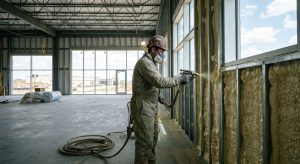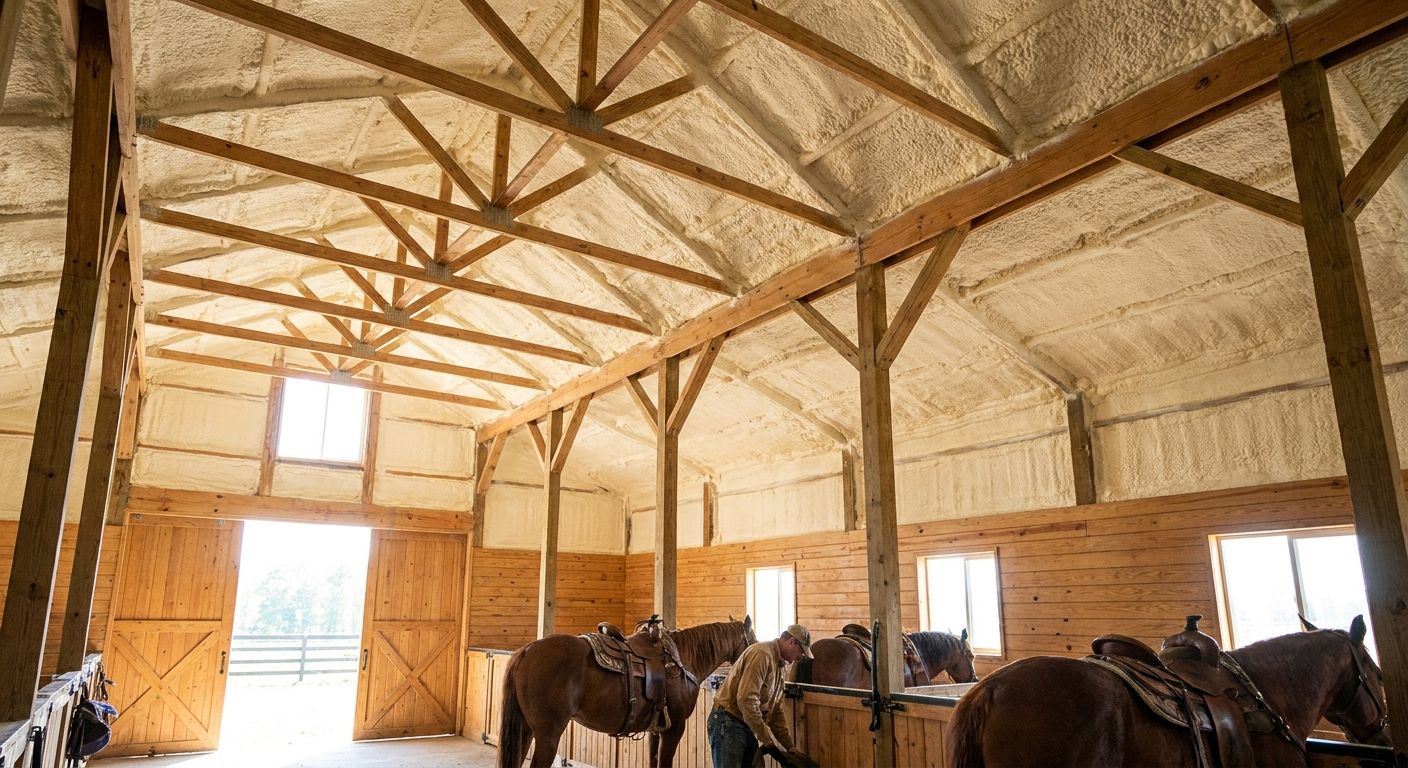
Alberta winters do not care whether your barn holds horses or hay. A drafty stall wall or an uninsulated loft ceiling loses heat fast enough to spike your propane bill and stress the animals living under that roof. Spray foam insulation solves both problems at once, and it's the material most equestrian facility owners in Calgary, Okotoks, High River, and Lethbridge switch to after one bad February.
- Closed-cell spray foam insulation is the buy for exterior horse barn walls in 2026 — R-6.5 per inch and a built-in vapor barrier.
- Open-cell foam suits hay loft ceilings where breathability matters more than moisture blocking.
- Metal-frame arenas need closed-cell only — open-cell traps condensation against steel purlins.
- Skip low-density foam on any wall exposed to wash-stall splash or freeze-thaw cycling.
Why this matters
A horse barn is not a house, and treating it like one is where most insulation jobs go wrong. Horses generate heat and moisture through respiration and manure breakdown, ammonia builds up in poorly ventilated stalls, and wash bays throw water directly at exterior walls. Spray foam insulation handles all three conditions better than fiberglass batts because it seals air gaps completely and, in the closed-cell version, resists moisture absorption instead of soaking it up.
The stakes are higher on rural acreages, where a barn sits far from backup heat sources and a frozen water line means an emergency call in the middle of the night. Owners of rural acreage properties in southern Alberta already know this — barns are usually the first structure on the property to get neglected and the last one anybody wants to lose heat in during a cold snap.
Who this is for
This guide is for horse owners and equestrian facility managers insulating a barn, indoor arena, or attached tack room in Alberta — whether that's a new pole-frame build, a metal building conversion, or an older wood-frame barn getting a retrofit before the 2026-2027 winter season. If you're boarding horses commercially, insulation choice also affects your liability around ammonia exposure and structural condensation damage over time.
What to look for in spray foam insulation for horse barns
Ammonia and moisture resistance
Horse urine breaks down into ammonia gas, and that gas combines with humidity to corrode metal fasteners and degrade certain insulation materials over a few seasons. Closed-cell spray foam's closed structure doesn't absorb ammonia-laden moisture the way batts or open-cell foam can, which matters most in stall areas versus loft or office space.
Cold-climate R-value per inch
Alberta barns need real thermal performance, not marketing R-values measured under lab conditions. Closed-cell foam delivers roughly R-6.5 per inch, letting you hit code-level insulation in a 2-inch wall cavity where fiberglass would need triple the depth. That matters in barns where wall cavities are shallow to begin with.
Air sealing without suffocating ventilation
Horses need fresh air exchange to avoid respiratory issues, so the goal isn't a sealed box — it's controlled air movement instead of random drafts through cracks. Spray foam insulation stops the uncontrolled leaks (sill plates, electrical penetrations, eave gaps) while your ridge vents and stall windows handle intentional airflow.
Fire rating and thermal barrier compliance
Spray foam requires a thermal barrier (typically drywall or an intumescent coating) in occupied spaces per Alberta building code, and barns with tack rooms, offices, or living quarters above the stalls need this addressed at install, not after. Skipping the thermal barrier is the single most common code violation on agricultural spray foam jobs.
Application area — walls, ceiling, or both
Most heat loss in a barn happens through the ceiling and roof deck, not the walls, especially in pole-frame and metal buildings with open truss spaces. Prioritizing the ceiling first, then the walls, usually delivers a bigger comfort and cost improvement per dollar spent in 2026 than insulating walls alone.
Cost per square foot at barn scale
Barns run large — an indoor arena alone can be 10,000+ square feet of ceiling — so cost per board foot compounds fast. Get a quote broken out by area (stalls, loft, arena, tack room) so you can phase the job if the full building isn't in this year's budget.
Top picks for horse barns and equestrian facilities
The safe pick — closed-cell foam on exterior barn walls. This is the default choice for stud walls facing weather, wash bays, or ground contact. R-6.5 per inch, a built-in vapor retarder, and structural rigidity that adds racking strength to pole-frame walls. Buy for any exterior wall in an Alberta barn. See how the same approach works on pole barn and shop structures.
The wildcard — metal-frame arenas and steel barns. Steel purlins sweat when warm, moist barn air hits cold metal, and that condensation drips onto horses and equipment below. Closed-cell foam is the only material that stops this reliably because it bonds directly to the steel and blocks vapor transfer. Buy if your arena or barn shell is steel-framed — check metal building insulation specifics before booking.
The moisture-conscious pick — open-cell foam in hay loft and vaulted ceilings. Loft spaces need breathability more than a hard vapor block, especially if hay is stored above and needs some air exchange to avoid mold. Open-cell foam at R-3.6 per inch also cuts sound transfer from an indoor arena below. Consider it for loft and vaulted ceiling zones — the same logic applies to cathedral and vaulted ceiling jobs in residential builds.
The retrofit pick — insulating an existing wood-frame barn without full demolition. Older barns built before 2026 often have no insulation at all, and owners don't want to tear out finished stall walls to add it. Spray foam can be injected or applied from accessible cavities without gutting the structure, though coverage is less complete than a new build. Consider this route if budget or barn use doesn't allow a full teardown this season.
What to avoid
- Open-cell foam on ground-contact or wash-bay walls. It absorbs moisture instead of blocking it, and once wet, it stays wet and loses R-value.
- Skipping the thermal barrier over foam in any occupied tack room or office. This is a code requirement, not a suggestion, and inspectors in Alberta check for it.
- Contractors without agricultural or ag-building experience. Barn ventilation, manure gas exposure, and livestock safety during application require different precautions than a residential attic job.
Get a barn insulation quote
Licensed spray foam contractor serving Calgary, Okotoks, High River, and Lethbridge.
Verdict comparison table
| Pick | Best for | Foam type | R-value/inch | Verdict |
|---|---|---|---|---|
| Exterior barn walls | Stud walls, wash bays | Closed-cell | R-6.5 | Buy |
| Metal-frame arenas | Steel barns, condensation control | Closed-cell | R-6.5 | Buy |
| Hay loft/vaulted ceilings | Breathable, sound dampening | Open-cell | R-3.6 | Consider |
| Older wood-frame retrofit | Existing barns, partial coverage | Closed or open-cell | Varies by cavity | Consider |
FAQ
What’s the best spray foam insulation for a horse barn?
Closed-cell spray foam is the best choice for exterior barn walls and metal buildings in 2026 because it blocks moisture and ammonia absorption at R-6.5 per inch. Open-cell foam works better in loft ceilings where breathability matters more than a hard vapor block.
Is spray foam insulation safe for horses to breathe around?
Cured spray foam is inert and does not off-gas once fully set, typically within 24 hours of application. Horses should be kept out of the barn during application and curing, then can return once the space has aired out per the contractor’s instructions.
How much does spray foam insulation cost for a barn in Alberta?
Cost depends on square footage, foam type, and whether walls, ceiling, or both are treated, so pricing varies job to job. Check current per-square-foot pricing on the [spray foam insulation cost page](https://aztecspraysystems.ca/2026/08/16/how-much-does-spray-foam-insulation-cost-in-calgary/) for a Calgary-area benchmark.
Closed-cell vs open-cell foam — which is better for a barn?
Closed-cell wins on exterior walls, wash bays, and metal buildings because it resists moisture and adds structural rigidity. Open-cell wins on interior loft ceilings and sound control where full vapor blocking isn’t the priority.
Does spray foam insulation control ammonia smell in horse stalls?
Spray foam does not eliminate ammonia at the source, but closed-cell foam resists absorbing ammonia-laden moisture the way porous materials do, which slows corrosion and odor buildup in wall cavities. Stall ventilation still handles the actual ammonia removal.
Can spray foam be applied to metal pole barns?
Yes, closed-cell spray foam is the standard choice for metal buildings because it bonds directly to steel purlins and stops condensation drip. Open-cell foam is not recommended against bare metal for this reason.
How long does spray foam insulation last in a barn?
Spray foam insulation is a permanent application that does not settle or compress the way fiberglass batts do over time. Its lifespan matches the life of the building envelope it’s applied to, barring physical damage or moisture intrusion from a failed roof or wall.
Does a barn need extra ventilation after spray foam insulation?
Yes, spray foam seals uncontrolled air leaks, so ridge vents, stall windows, or mechanical ventilation need to handle the fresh air exchange horses require. Sealing the building without addressing intentional airflow is a common mistake on agricultural jobs.
One last thing
Most barn owners insulate the walls first because that's where the visible drafts are, but the bigger heat loss usually happens straight up through an uninsulated ceiling or roof deck above an open truss space. If your 2026 budget only covers one phase, insulate the ceiling before the walls — it's the higher-return move in every pole-frame and metal barn Aztec Spray Systems has assessed.
Related guides