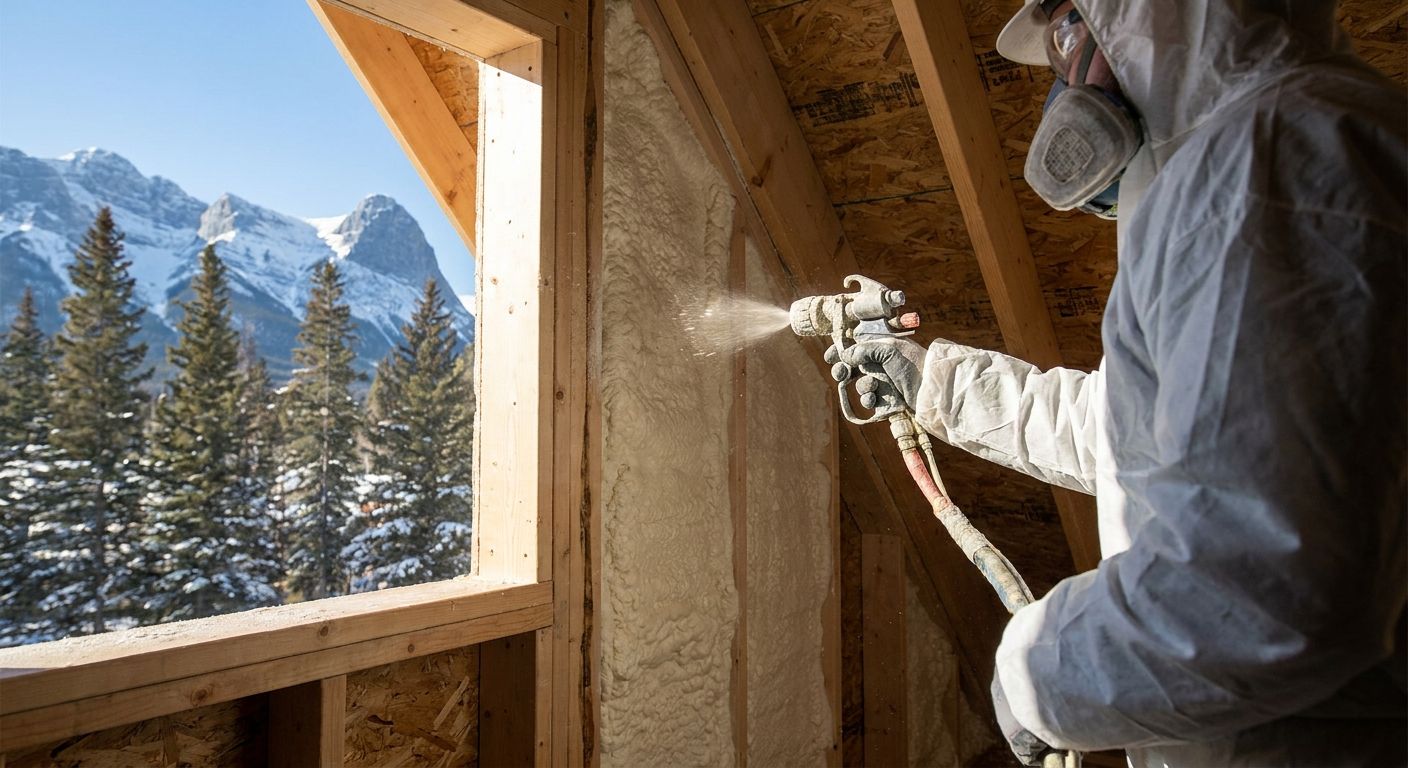
Canmore's mountain climate turns insulation into a structural decision, not a cosmetic one. Spray foam insulation for Canmore properties has to handle altitude, snow load, and temperature swings that a Calgary suburb thirty minutes down the highway never sees, and that changes what "enough insulation" actually means.
- Closed-cell spray foam insulation is the right call for Canmore attics and rim joists in 2026 – Buy.
- Open-cell foam suits interior shop and outbuilding walls but skips the vapor control ground-contact spaces need.
- R-50 attic coverage, not R-40, is the realistic 2026 baseline for homes in Alberta’s mountain corridor.
- Crawl space encapsulation stops spring snowmelt moisture before it reaches the subfloor – Buy.
Why this matters
Homeowners researching spray foam insulation Canmore options this year are usually dealing with one of two problems: a home that loses heat fast through the roofline, or a crawl space and rim joist that stay damp from snowmelt every spring. Both problems get worse at elevation, because the best insulation type for Alberta winters isn't the same product mix that works fine in a milder prairie winter.
Batt insulation compresses, settles, and leaves gaps at every stud bay. Spray foam insulation expands into the cavity, seals the air leak and adds R-value in one pass. In a climate that swings from minus 30 to plus 25 in the same year, that air seal matters as much as the R-value number on the bag.
Who this is for
This guide is for owners of Canmore-area cabins, mountain-corridor acreages, and Bow Valley properties dealing with drafty rooflines, cold floors over crawl spaces, or outbuildings that never hold heat. If your home was built before the 2000s with batt-only insulation, or you're finishing a shop or bonus space that needs to stay usable through a mountain winter, the criteria below apply directly to your project.
What to look for in spray foam insulation for Canmore properties
R-value per inch, not just total R-value
Closed-cell spray foam rates around R-6.5 per inch, roughly double what fiberglass batt delivers at the same thickness. In a roofline with limited cavity depth, that density is the only way to hit R-50 without rebuilding the framing.
Vapor control at ground contact
Crawl spaces and rim joists near Canmore see moisture from snowmelt and frost-heave, not just cold air. Closed-cell foam applied at roughly 2 inches acts as both air barrier and vapor retarder; open-cell foam does not, and it absorbs water if it ever gets wet.
Snow load and roof assembly compatibility
Steep mountain rooflines shed snow differently than a flat Calgary bungalow roof. Insulation and ventilation need to work together at the soffit and ridge, or you get ice damming regardless of how much foam went into the attic.
Altitude-adjusted design temperature
Canmore sits close to 1,300 metres above sea level, about 260 metres higher than Calgary, which drops the average design temperature contractors use to size insulation. A contractor quoting the same R-value for both cities is using the wrong baseline for one of them.
Access and retrofit method
Older cabins and additions often can't be gutted to the studs. Spray foam can go in through rim joists, crawl space access, and attic hatches without opening finished walls, which keeps retrofit costs and disruption down.
Contractor experience with mountain-corridor builds
A crew that only sprays new-construction subdivisions in Calgary may not have handled a 1970s log addition or a garage-over-crawlspace layout common west of the city. Ask for specifics on the assembly type, not just a general quote.
Top picks for Canmore-area properties
Pick 1: Closed-cell roofline and attic foam – the climate essential. Closed-cell foam at R-6.5 per inch gets a mountain attic to the R-50 target used across Alberta's cold climate zone without the 16+ inches of loose-fill that number would otherwise require. That matters in vaulted or low-slope roof assemblies where depth is limited. See the full breakdown in choosing the right spray foam R-value for your attic. Verdict: Buy.
Pick 2: Crawl space encapsulation – the moisture fix. A 2-inch closed-cell pass on the crawl space walls and rim area meets the threshold building science treats as a vapor retarder, which is exactly what's needed against spring runoff at elevation. Skipping this step is the single most common reason mountain-area subfloors stay cold and damp year after year. Details are in spray foam insulation for crawl spaces. Verdict: Buy.
Pick 3: Basement rim joist sealing – the easy win. The rim joist band is the most common uncontrolled air leak point in pre-2000s builds, and a 2×6 cavity filled with 2 inches of closed-cell foam lands around R-13, closing a gap that batt insulation never seals completely. It's a half-day job with an outsized effect on floor comfort. Full method in spray foam insulation for basement rim joists. Verdict: Buy.
Pick 4: Acreage and outbuilding foam – the wildcard. For shops and detached garages on rural properties around the Bow Valley, open-cell foam at roughly R-3.6 to R-3.8 per inch fills a standard 2×6 wall to about R-20, which is enough for occasional-use space heated intermittently. It costs less than closed-cell but isn't the right call for anything touching ground or exterior grade. See spray foam insulation for acreages and rural properties before deciding. Verdict: Consider, based on how the building is used.
What to avoid
- Batt-only rim joists. They look sealed but leave a thermal bypass at every joist bay, and that's exactly where mountain-corridor homes lose the most floor heat.
- Open-cell foam below grade. It absorbs moisture instead of blocking it, which turns a crawl space or below-grade wall into a slow mold problem instead of a dry one.
- A single R-value quote with no assembly detail. "R-50 attic" means nothing if the contractor hasn't accounted for soffit venting, baffle placement, and Canmore's colder design temperature versus a Calgary quote.
“A rim joist sealed with two inches of closed-cell foam does more for floor comfort than another six inches of attic loose-fill.”
Verdict comparison
| Pick | Best for | R-value per inch | Verdict |
|---|---|---|---|
| Closed-cell roofline/attic | Vaulted ceilings, low attic depth | R-6.5 | Buy |
| Crawl space encapsulation | Snowmelt moisture, cold floors | R-6.5 | Buy |
| Rim joist sealing | Pre-2000s builds, drafty floors | ~R-13 in a 2×6 cavity | Buy |
| Outbuilding open-cell | Shops, detached garages | R-3.6-3.8 | Consider |
Get a Canmore-area insulation quote
Aztec Spray Systems assesses your assembly before quoting R-value, not after.
FAQ
What’s the best spray foam insulation for Canmore homes in 2026?
Closed-cell spray foam is the best choice for Canmore attics, rooflines, rim joists, and crawl spaces in 2026 because it hits R-6.5 per inch and doubles as a vapor barrier. Open-cell foam is reasonable for interior shop or bonus-room walls where moisture isn’t a concern.
Is spray foam insulation worth it in a mountain climate like Canmore?
Yes, because the air-sealing effect matters as much as R-value when temperatures swing from minus 30 to plus 25 within a year. Batt insulation alone leaves gaps that spray foam closes in one application.
How much does spray foam insulation cost in Canmore?
Cost depends on square footage, foam type, and how many areas of the home need treatment – attic, crawl space, and rim joists each price separately. A written quote after an on-site assessment is the only reliable number, since a phone estimate can’t account for assembly details.
Is open-cell or closed-cell foam better for a Canmore attic?
Closed-cell wins for attics and roofline work because it reaches R-50 in less depth and manages vapor at ground contact and roof assemblies alike. Open-cell is thinner-margin and better suited to interior partition walls.
Does spray foam insulation help with ice damming on steep mountain roofs?
Yes, sealing the attic floor and roofline with closed-cell foam stops the escaping heat that melts snow unevenly and causes ice dams. Ventilation at the soffit and ridge still needs to work alongside the foam, not instead of it.
Can spray foam insulation be added to an older Canmore cabin without gutting the walls?
Yes, retrofit spray foam can go in through the attic hatch, crawl space access, and rim joist band without opening finished interior walls. This is the standard approach for pre-2000s builds where a full wall tear-out isn’t practical.
How does elevation change insulation requirements around Canmore?
Canmore sits roughly 260 metres higher than Calgary, which lowers the average design temperature used to size insulation. A quote based on Calgary numbers alone can under-spec a Canmore-area attic or crawl space.
One last thing
The detail most homeowners miss: a rim joist sealed properly with 2 inches of closed-cell foam often changes floor comfort more noticeably than an attic top-up, because that band sits at foot level and leaks air constantly in older builds. If your 2026 project list has one insulation fix on it, start at the rim joist and work outward from there.