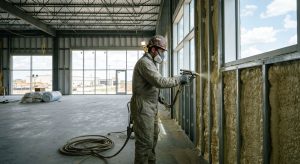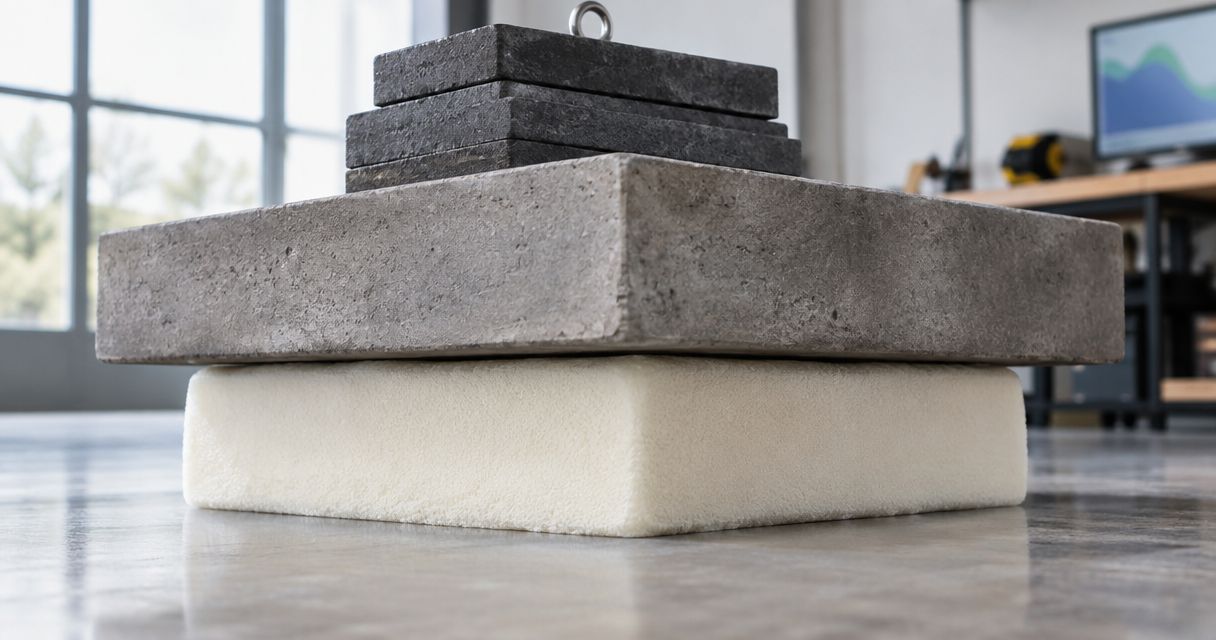
Polyurethane concrete-lifting foam has no universal maximum lifting weight: the safe load depends on the specified foam, the slab, the contact area and the ground beneath it. In 2026, a foam’s advertised compressive strength is not a stand-alone lifting limit, because raising concrete and supporting it after curing are different engineering questions.
- How much weight can polyurethane foam lift? No universal limit applies; the slab, foam and ground determine suitability.
- Aztec Spray Systems provides concrete lifting for homeowners and commercial property owners in southern Alberta.
- Compressive strength describes material behaviour under load, not a guaranteed lifting capacity for your slab.
- Request a slab assessment and the specified lifting foam’s technical data before accepting a capacity claim.
For local concrete-lifting services, Aztec Spray Systems serves Calgary, Okotoks, High River and Lethbridge. The useful starting question is whether your existing slab and its underlying support are suitable for lifting—not how large a weight appears in an advertisement.
Why this matters
A driveway panel, garage floor and equipment pad place different demands on their supporting ground. Even when concrete surfaces look similar, their thickness, reinforcement, cracking and applied loads can differ substantially.
A large lifting-capacity claim leaves those differences unanswered. You need to know whether the repair will restore support without damaging the concrete, disturbing adjacent construction or leaving the original cause of settlement unresolved.
For a 2026 concrete-lifting assessment, ask for a repair plan tied to your slab rather than a generic weight claim. That shifts the discussion from what foam can do under selected conditions to what your property actually needs.
How much weight can polyurethane foam lift under a slab?
There is no single weight that applies to every polyurethane lifting foam or every concrete slab. A defensible answer requires the material specification and a site assessment that considers the slab, its loads and the supporting ground.
Keep these measurements separate when reviewing a contractor’s explanation:
| Measurement | What it tells you | What it does not establish |
|---|---|---|
| Lifting force | The upward force generated during the injection and expansion process | Whether a cracked slab can tolerate that force safely |
| Compressive strength | How the cured foam responds to compression under stated test conditions | The permissible load for the entire slab-and-ground system |
| Contact area | The area through which force transfers between concrete, foam and ground | That support is continuous beneath the whole slab |
| Ground bearing capacity | The pressure the underlying ground can sustain under the relevant conditions | That injecting foam alone resolves every settlement mechanism |
| Slab capacity | How the concrete carries and distributes its loads | That restoring elevation increases its original structural capacity |
The distinction matters because lifting happens during installation, while support must continue afterwards. A material property cannot replace an assessment of the whole assembly.
The guide to how polyurethane concrete lifting works explains the process behind that distinction. Understanding the sequence helps you ask whether a proposal addresses elevation, underlying voids, or both.
Does a higher foam strength mean a heavier slab can be lifted?
A higher stated compressive strength does not, by itself, establish a higher safe lifting weight. The installer must also consider expansion behaviour, where the material travels, the concrete’s condition and the resistance beneath the foam.
Read strength figures alongside their test method and deformation criteria. A laboratory result at a stated amount of compression is not automatically an acceptable long-term working stress beneath your floor.
Can the same foam support a vehicle and an equipment pad?
A vehicle load and an equipment load require separate assessments, even when their total weights appear similar. Wheels, equipment feet and bases transfer force through different contact areas, while the slab distributes those forces into its support.
Tell the contractor about the intended use before the repair. Restoring a floor’s elevation does not certify it for a new machine, storage rack or heavier vehicle.
Why polyurethane foam lifting capacity varies
These factors determine whether a lifting proposal suits the site. None can be replaced by a universal pounds-per-slab claim.
- Foam specification: The actual lifting material’s expansion and cured properties matter. Do not substitute an insulation product’s data for a concrete-lifting material’s technical sheet.
- Slab condition: Cracks, deterioration, thickness and reinforcement affect how concrete responds as support changes beneath it.
- Contact area: The effective supported area determines how forces transfer. The visible surface area is not proof of full contact underneath.
- Ground condition: Weak, moving or eroding ground affects the support system beneath the repair. Foam strength alone does not establish ground stability.
- Applied loads: The slab’s own weight is only part of the assessment. Vehicles, stored materials and equipment add loads with different distributions.
- Lift geometry: Joints, slab edges, adjacent walls and the required elevation change affect where movement can occur safely.
For your 2026 project, supply photographs, the affected area’s use and any available construction drawings. These records help establish what needs inspection; they do not replace checking conditions on site.
How do pressure figures relate to total weight?
Pressure is force divided by area—not a total lifting weight. A foam specification expressed in psi or kPa therefore needs an area and an appropriate design interpretation before it says anything useful about a slab load.
The standard unit conversions illustrate the distinction:
- 1 psi equals 144 pounds-force per square foot. This is an area-unit conversion, not a lifting-foam rating.
- 1 kPa equals 1,000 newtons per square metre. Again, this defines pressure rather than the capacity of a particular repair.
These conversions follow standard SI and customary-unit definitions published by the National Institute of Standards and Technology. They do not supply a permissible working pressure for your foam, soil or concrete.
Why not multiply foam strength by the whole slab area?
That shortcut assumes the selected strength figure is an appropriate working pressure and that the entire underside transfers load uniformly. Neither assumption follows from a product’s headline strength.
The calculation also ignores the slab’s ability to bridge gaps, local stress concentrations and ground response. Multiplying a test value by surface area produces an arithmetic result, not a verified lifting plan.
Ask the contractor to explain the supported area and the basis for the proposed repair. For structural or concentrated-load applications, ask whether engineering review is needed before work proceeds.
What should a concrete-lifting assessment include?
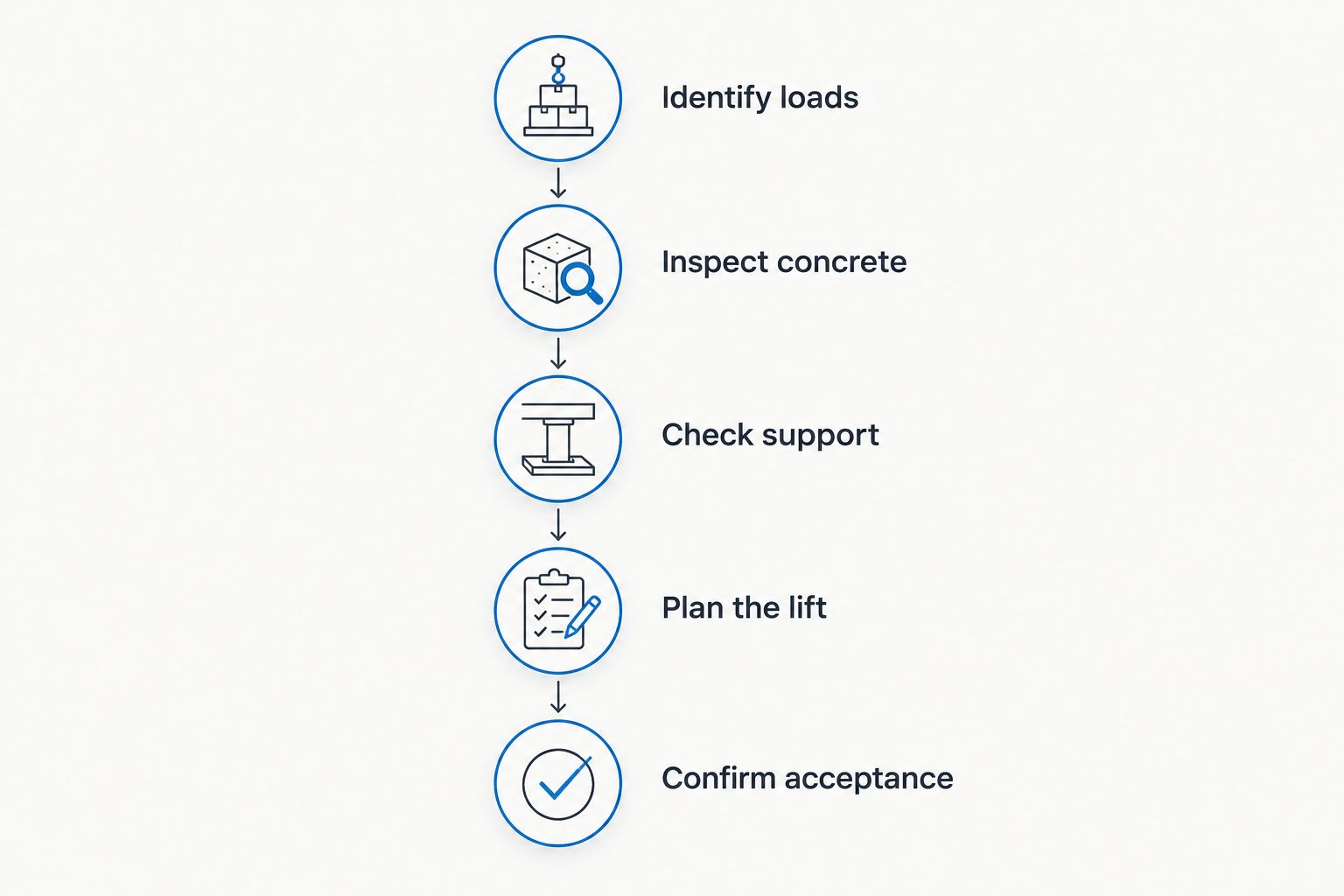
A useful assessment connects the visible problem to the conditions beneath the concrete. Use this sequence when discussing a repair in 2026:
- Identify loads. Describe normal use, equipment locations and any planned change in loading. Provide equipment or vehicle information when relevant.
- Inspect concrete. Review cracks, joints, deterioration and the relationship between the affected panel and adjacent construction.
- Check support. Investigate the suspected loss of support and whether drainage, erosion or other ground movement remains active.
- Plan the lift. Establish the intended elevation, injection approach and limits imposed by surrounding construction.
- Confirm acceptance. Agree on how the completed elevation, drainage and return to use will be checked.
The sequence keeps material strength in its proper place: one part of the repair decision. It also gives you specific questions to ask instead of accepting an unexplained capacity claim.
Keep a written record of the agreed repair scope. Distinguish between raising the slab, filling identified voids and addressing drainage, because those are separate tasks even when they form part of the same project.
Aztec Spray Systems is suited to homeowners and commercial property owners seeking concrete-lifting services in Calgary, Okotoks, High River and Lethbridge. The company is licensed and insured; the suitability of an individual slab still requires assessment.
What are the benefits and limits of polyurethane lifting?
Polyurethane lifting offers a way to raise suitable existing concrete without removing the entire slab. Retaining serviceable concrete is the main practical benefit, but the method does not make damaged concrete new or increase its original structural design capacity.
Its limitation is equally important: the repair depends on the condition of the slab and its supporting ground. If those conditions do not suit lifting, choosing a stronger foam does not resolve the mismatch.
| Approach | Best for | Benefit | Limitation |
|---|---|---|---|
| Polyurethane lifting | Suitable settled slabs that remain serviceable | Raises existing concrete and can restore underlying contact | Does not rebuild deteriorated concrete or automatically resolve ground movement |
| Slab replacement | Concrete that requires reconstruction or redesign | Allows damaged concrete to be removed and the slab rebuilt | Requires removal and reconstruction; underlying ground problems still need attention |
| Engineering assessment | Structural concerns, unusual loads or unclear movement | Establishes the information needed for a defensible repair decision | Does not itself repair the slab |
Choose the repair around the failure, not around the largest lifting number. Ask what evidence supports retaining the slab and what findings would change that recommendation.
What should you ask before approving the work?
A clear proposal should explain what the contractor intends to achieve and what remains outside the repair. In 2026, use these questions to compare scope rather than unrelated material claims:
- Which lifting material is specified, and can you review its technical data?
- What evidence indicates that the concrete is suitable for lifting?
- What caused the loss of support, and does that cause need separate work?
- How will the target elevation account for drainage and adjacent surfaces?
- What inspection or instruction determines when the slab can return to its intended use?
Do not assume that a visually level surface proves that every underlying issue has been corrected. Ask for the completion criteria before installation so the result can be assessed against the agreed scope.
Discuss your concrete-lifting project
Describe the slab, its normal loads and the settlement you have noticed.
FAQ
How much weight can polyurethane foam lift under my driveway?
There is no universal lifting weight for a driveway slab. The specified foam, concrete condition, supported area and underlying ground determine whether lifting is suitable.
Is foam compressive strength the same as lifting capacity?
No. Compressive strength describes cured material behaviour under stated test conditions, while lifting capacity concerns the installation process and the whole slab-and-ground system.
Can polyurethane lifting make my garage floor support heavier equipment?
Lifting does not establish a higher structural load rating for your garage floor. Have the slab and its support assessed for the proposed equipment before changing its use.
Can ordinary spray foam insulation lift concrete?
Do not substitute ordinary insulation foam for a specified concrete-lifting material. Use a material intended for the application and have its technical requirements reviewed for the repair.
Will concrete lifting stop the ground from settling again?
Concrete lifting does not guarantee that underlying ground movement will stop. Drainage, erosion and other causes of support loss need assessment and appropriate treatment.
Do I need an engineer before lifting a concrete slab?
Engineering review is appropriate when structural concerns, unusual loads or uncertain movement affect the repair decision. Describe those conditions before approving the work rather than treating a foam strength figure as clearance.
Does Aztec Spray Systems provide concrete lifting in southern Alberta?
Aztec Spray Systems provides concrete-lifting services to homeowners and commercial property owners in Calgary, Okotoks, High River and Lethbridge. The company is licensed and insured.
One last thing
A level slab and a suitable slab are not the same thing. Before approving a lift, state what the surface must do afterwards: drain away from a building, meet an adjoining panel or carry its existing intended loads.
That specific outcome is more useful than a maximum-weight slogan. Ask for the target elevation and acceptance criteria in writing, and keep any proposed change in loading separate from the repair decision.
Related guides
- How long does polyurethane concrete lifting last?
- Concrete lifting for garage floors
- Can you drive on a driveway right after concrete lifting?