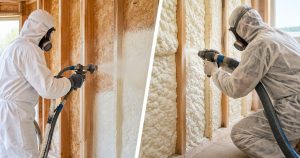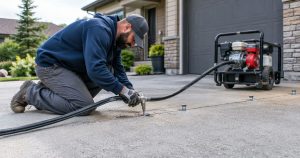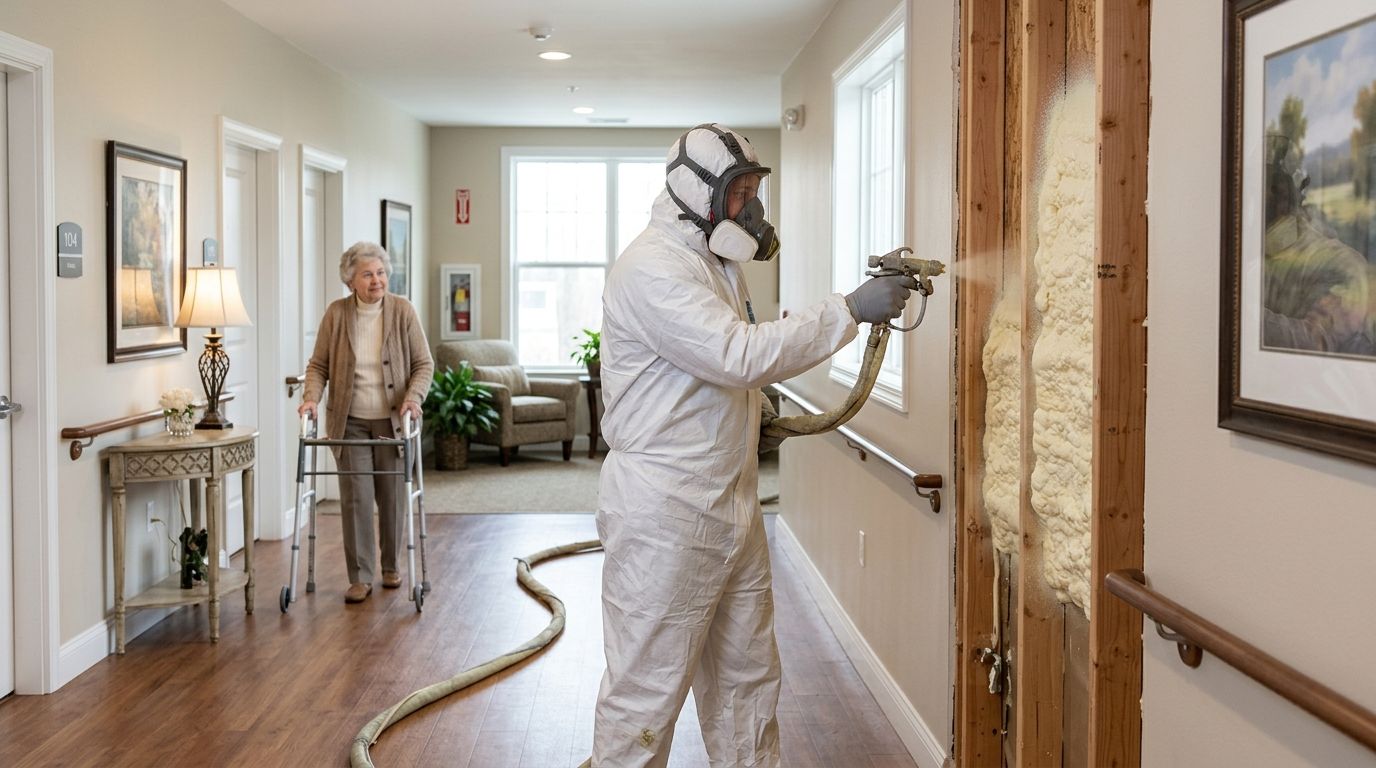
Spray foam insulation for assisted living homes seals the building envelope of a senior care facility so residents stay warm, indoor air stays consistent, and mechanical systems stop working overtime through Alberta winters. Assisted living buildings carry occupancy and fire-code rules that a single-family house renovation never touches, and the insulation plan has to work around residents who live there full-time, not around an empty jobsite.
- Spray foam insulation assisted living projects need Group B occupancy fire-code compliance, not just R-value math.
- Closed-cell spray foam runs roughly R-6 to R-7 per inch; open-cell runs about R-3.5 per inch.
- Aztec Spray Systems phases installs around resident schedules to limit noise, odor, and access disruption.
- A thermal or ignition barrier is required over foam in occupied areas under most Alberta Building Code interpretations.
Why spray foam insulation matters for assisted living homes
Seniors regulate body temperature less efficiently than younger adults, so a drafty exterior wall or a cold floor near an uninsulated rim joist shows up as a comfort complaint fast, not a slow energy-bill creep. A care home with an under-insulated attic runs its furnace and boiler harder every hour of a Calgary or Lethbridge winter, and that extra runtime shows up on utility statements and in wear on mechanical equipment.
Assisted living buildings also fall under a stricter occupancy classification than a house, which changes how insulation gets installed and inspected. Any spray foam insulation project in a care facility has to satisfy fire code requirements for spray foam insulation before a single wall cavity gets filled, because open-cell and closed-cell foam both require a thermal or ignition barrier once residents occupy the space above or beside it.
Spray foam insulation is the strongest option for assisted living retrofits in 2026 because it air-seals and insulates in one step, cutting the draft complaints and uneven room temperatures that standard batt insulation leaves behind.
Audit the building envelope before you touch insulation
Start with a walkthrough that documents where the building is actually losing conditioned air, not where you assume it is. A facility manager can do this without hiring anyone.
- Check attic hatches and mechanical penthouse access points for gaps around the frame
- Run a hand along exterior wall outlets on a cold day to feel for draft
- Look for ice damming or icicles along the roofline in winter, a sign of attic heat loss
- Check rim joists in any crawl space or unfinished basement level for daylight gaps
- Review utility bills against square footage compared to similar-sized buildings
A licensed contractor adds a blower-door test and infrared scan on top of the visual walkthrough, which finds leaks a flashlight never catches.
Seal and insulate the attic first
The attic is almost always the biggest single source of heat loss in a low-rise care facility, and it's the easiest area to access without disturbing resident rooms.
- Seal top-plate gaps, wiring penetrations, and plumbing stacks before adding any insulation
- Check existing attic insulation depth against Alberta's climate zone recommendations
- Confirm bath fan and kitchen exhaust ducts vent outside, not into the attic cavity
- Add baffles at the eaves so soffit ventilation stays clear after insulation goes in
- Spray foam the attic deck and gable ends for a continuous air barrier in one pass
A facility can DIY the caulking and weatherstripping steps. Spray foam application itself needs a licensed, insured crew because it involves proportioning equipment and off-gassing controls that a maintenance team shouldn't run without training.
Address exterior walls and cladding gaps
Exterior walls in older care buildings often have minimal cavity insulation and no continuous air barrier, which is why perimeter rooms feel colder than interior ones.
- Inspect window and door flashing for gaps that let wind-driven air past the frame
- Check for compressed or settled batt insulation inside accessible wall cavities
- Confirm exterior sheathing seams are taped or sealed where accessible during renovation
- Prioritize north- and west-facing walls first, since prevailing Alberta winter wind hits those hardest
- Use closed-cell spray foam in exterior wall retrofits where moisture resistance matters most
Get a quote for your care facility
Aztec Spray Systems serves Calgary, Okotoks, High River, and Lethbridge assisted living buildings.
Insulate crawl spaces, rim joists, and mechanical rooms
Rim joists are one of the most commonly missed insulation gaps in existing buildings, and they sit right at floor level where residents in wheelchairs or with mobility aids feel the draft first.
- Seal and insulate rim joists around the entire building perimeter, not just the accessible sections
- Check crawl space vapor barriers for tears or gaps that let ground moisture rise
- Confirm mechanical room walls are insulated so boiler and HVAC equipment isn't fighting ambient cold
- Insulate ductwork running through unconditioned crawl spaces or attics
- Address any visible mold or moisture staining before insulating over it
Meet fire code and life-safety code requirements
This step is non-negotiable in an occupied care facility, and it's the reason a general contractor without insulation-specific experience can get a project flagged during inspection.
- Confirm which foam type (open-cell or closed-cell) is approved for the specific application per code
- Install a thermal barrier, typically drywall, over exposed foam in occupied living areas
- Check egress paths and fire-rated wall assemblies aren't compromised by the insulation work
- Document the insulation type, R-value, and barrier system for the building file
- Schedule inspections at the stage the Alberta Building Code requires, not after drywall closes the wall
Spray foam insulation assisted living projects that skip this step end up with rework, which costs more than doing it right on the first pass.
Schedule installation around resident occupancy
A care home can't shut down for a renovation the way an empty commercial building can. Phasing matters as much as the insulation product itself.
- Work wing-by-wing or floor-by-floor so residents aren't displaced all at once
- Schedule spray foam application during low-traffic hours and allow full cure and ventilation time before residents re-enter
- Coordinate with facility staff on noise-sensitive hours, especially around meal and rest times
- Confirm HVAC systems can maintain airflow to occupied areas while work happens in another zone
- Use a contractor who carries WCB coverage and liability insurance appropriate for occupied-building work in 2026
Insulation options for assisted living buildings compared
| Option | Best for | Key limitation |
|---|---|---|
| Closed-cell spray foam | Exterior walls, rim joists, moisture-prone areas | Higher material density adds weight to some ceiling assemblies |
| Open-cell spray foam | Interior walls, sound dampening between resident rooms | Lower moisture resistance than closed-cell, not ideal below grade |
| Blown-in fiberglass/cellulose | Large open attic spaces with simple geometry | Settles over time and doesn't air-seal on its own |
| Rigid foam board | Foundation walls, exterior retrofits over existing cladding | Needs taped seams to perform as an air barrier |
Closed-cell spray foam is the best choice for exterior walls and rim joists in Alberta assisted living buildings; open-cell works well for interior sound control between resident rooms.
Common mistakes assisted living facilities make with insulation projects
- Treating the attic as the only priority. Rim joists and crawl spaces get skipped even though they cause the cold-floor complaints residents actually report.
- Hiring a general contractor without fire-code-specific insulation experience. Group B occupancy rules around thermal barriers get missed until an inspector flags the wall.
- Scheduling the whole building at once instead of phasing by wing. This displaces every resident simultaneously instead of a manageable subset.
- Skipping the blower-door test and going straight to a quote based on square footage. Facilities end up paying for insulation in areas that weren't actually leaking.
- Ignoring rebate deadlines. Alberta insulation rebate programs run on annual cycles, and facilities that plan late in the year miss the funding window entirely.
FAQ
What is the best insulation for assisted living facilities in Alberta?
Closed-cell spray foam is the strongest option for exterior walls and rim joists in Alberta assisted living buildings because it air-seals and insulates in one application. Open-cell spray foam works well for interior walls where sound control between resident rooms matters more than moisture resistance.
Is spray foam insulation safe for seniors with respiratory conditions?
Spray foam insulation is safe once fully cured and the treated area is properly ventilated before residents re-enter. Facilities should schedule installation during low-occupancy hours and allow the manufacturer’s recommended re-entry window before returning residents to the space.
Does spray foam insulation help with fire code compliance in care facilities?
Spray foam insulation itself doesn’t automatically meet fire code; it requires a thermal or ignition barrier, typically drywall, over any exposed foam in occupied areas. Assisted living buildings fall under Group B occupancy, which applies stricter rules than a standard house.
How much does spray foam insulation cost for a care facility in Calgary?
Cost depends on square footage, foam type, and how many areas of the building need work, so a site visit and quote are the only accurate way to get a number. A general cost breakdown for residential and commercial Calgary projects is available for reference before requesting a facility-specific quote.
Can spray foam insulation reduce noise between resident rooms?
Open-cell spray foam has sound-dampening properties that reduce noise transfer through interior walls better than an empty stud cavity. It won’t eliminate sound entirely, but it noticeably cuts down on voices and footsteps carrying between rooms.
How long does spray foam insulation installation take in an occupied assisted living building?
Timeline depends on how the project is phased across wings or floors, since occupied buildings can’t be insulated all at once like an empty structure. A wing-by-wing schedule extends the overall calendar but keeps residents in place throughout the project.
Does spray foam insulation qualify for rebates in Alberta?
Some spray foam insulation upgrades qualify for Alberta rebate programs, but eligibility and deadlines change year to year. Facilities planning a 2026 retrofit should confirm current program rules before finalizing a project timeline.
What R-value is required for a Calgary-area assisted living building?
Required R-values depend on the specific assembly (attic, wall, or foundation) and the applicable Alberta Building Code section for the building’s occupancy class. A licensed contractor can confirm the exact requirement for each assembly during the initial site assessment.
One last thing
The rim joist is the detail almost every facility manager skips, and it's the detail residents notice first because it sits at floor level along every exterior wall in the building. Fixing the attic without fixing the rim joist leaves the coldest, most complained-about spot in the building untouched. Any 2026 insulation retrofit plan for an assisted living building should put rim joists on the same priority list as the attic, not the bottom of it.
Related guides
- Spray foam insulation for medical and dental offices
- Alberta spray foam insulation rebate qualification
- Spray foam insulation cost in Calgary
- Spray foam insulation for multi-family and condo buildings