A building permit is required when spray foam insulation forms part of permit-required construction, such as a new building or a permitted renovation in Calgary. For an insulation-only retrofit in 2026, confirm the requirement with the City of Calgary using your exact scope rather than assuming every spray foam job needs—or avoids—a permit. Permit approval also does not replace requirements for the insulation product, installation, moisture control, and fire protection.
- Is a permit required for spray foam insulation in Calgary? The construction scope determines the answer, not foam alone.
- The City of Calgary determines permit requirements; an insulation contractor’s quotation does not replace that decision.
- Confirm whether existing renovation permits include the proposed insulation work before installation.
- Resolve fire protection, moisture control, and inspection sequencing before covering insulated assemblies.
Is a permit required for spray foam insulation in Calgary?
Spray foam is not enough information to determine your permit requirement. The City needs to know what you are changing, where you are installing insulation, and whether the work belongs to a larger construction project.
For your 2026 project, distinguish an insulation upgrade from a basement development, suite conversion, addition, or change to an existing building assembly. Describing the whole project gives the permitting authority a useful basis for its answer.
Aztec Spray Systems provides spray foam and attic insulation services to homeowners and commercial property owners in Calgary. The contractor’s installation scope and the City’s permit determination serve different purposes; keep both in your project file.
| Project situation | What to establish before installation | Planning advantage | Limitation to address |
|---|---|---|---|
| Insulation-only retrofit | Whether the specific work requires a building permit | Keeps the enquiry focused on the actual upgrade | “Insulation only” does not describe changes to ventilation or finishes |
| Work within a permitted renovation | Whether approved drawings include the proposed insulation assembly | Connects insulation to an existing review process | A different product or assembly needs review before substitution |
| New construction or an addition | How the insulation appears in the building permit documents | Allows insulation details to be coordinated with the design | Installation must match the accepted project requirements |
| Suite conversion or commercial alteration | Which approvals apply to the complete use and construction scope | Addresses the building as a whole | Insulation alone cannot establish compliance for the conversion |
Use this table to frame your enquiry, not as an exemption list. Get a project-specific answer before work begins.
Why this matters
Spray foam can conceal the surfaces it covers. Once finishes are installed, checking an assembly becomes more difficult, so permit questions belong at the planning stage—not after the walls are closed.
There is also a difference between permission to build and a suitable insulation design. A permit does not make every foam product suitable for every location, and a well-installed product does not resolve unrelated work outside the approved scope.
For a 2026 retrofit, your practical goal is a clear record: what was proposed, what the City required, what the contractor installed, and which inspections or close-out steps applied. That record is more useful than a verbal assurance that a similar property did not need a permit.
Insulation-only retrofits: describe what stays unchanged
An insulation-only enquiry should explain both the work you intend to do and the building features you intend to retain. Specify whether you are insulating an attic floor, roofline, basement wall, rim joist, garage, or another location.
Then identify any associated removal or alteration. Opening walls, replacing finishes, moving services, and changing how a space is heated or used all belong in the description, even if insulation is the largest item on the quotation.
Best for an insulation-only enquiry: a clearly bounded upgrade with an accurate description of the existing assembly. Its advantage is clarity; its limitation is that an undisclosed change can make the original answer irrelevant.
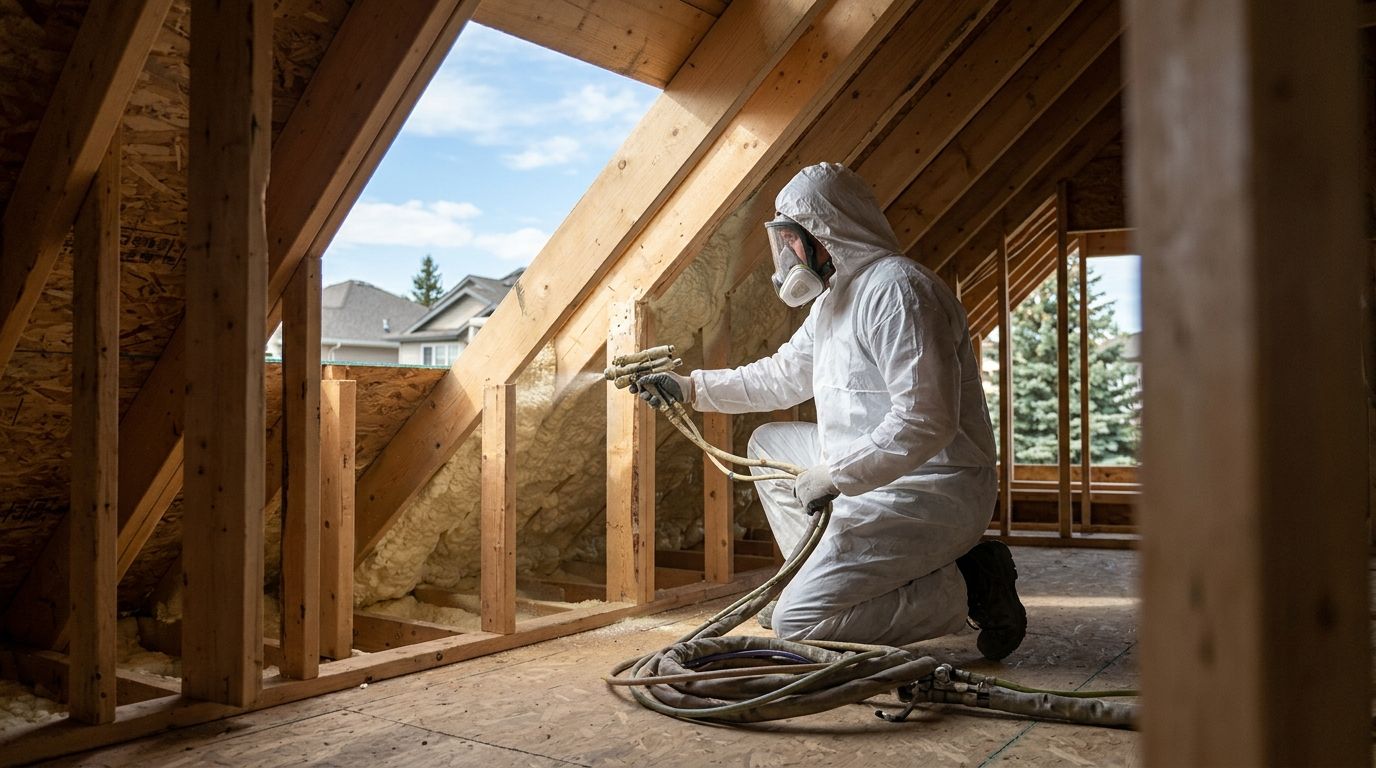
Avoid describing a roofline conversion as simply adding attic insulation. Insulating the attic floor and insulating the underside of the roof are different assembly decisions, with different ventilation and moisture considerations.
Renovations and new construction: check the approved scope
When your property already has an active building permit, start with the approved drawings and permit conditions. Ask whether the proposed foam product, installation location, and protective covering match those documents.
Best for work inside an existing renovation: coordinating insulation through the project’s permit holder and designer, where one is involved. This keeps decisions connected, but an existing permit is not blanket approval for every later change.
For a new build or addition, resolve insulation details before application. The installation needs to fit the building assembly rather than forcing other trades to work around an unreviewed substitution.
In 2026, keep the version of the drawings that actually governs the work. An early concept sketch, a contractor’s estimate, and accepted construction documents are not interchangeable records.
Why spray foam permit requirements vary
The useful question is not whether foam is generally allowed. It is how your proposed installation changes the building and which approvals apply to that work.
Include these factors in your enquiry:
- Project scope: State whether this is maintenance, an insulation retrofit, a renovation, an addition, or new construction.
- Installation location: Identify the attic floor, roofline, walls, basement, garage, or other assembly involved.
- Assembly changes: Explain changes to air sealing, vapour control, ventilation, and interior protective finishes.
- Building use: Describe the existing use and any proposed suite, occupied workspace, or commercial conversion.
- Associated work: Include framing, electrical, plumbing, heating, and ventilation changes rather than treating them as separate background details.
- Existing approvals: Identify an active permit and ask whether the proposed insulation is already included or needs an amendment.
These details help distinguish the project you have from another owner’s superficially similar job. A neighbour’s permit outcome is not a determination for your address.
How do you confirm the requirement before booking installation?
Use this sequence to turn a general permit question into an actionable answer. Keep the description consistent between your City enquiry and your contractor’s written scope.
- Define scope. Record the property address, building use, installation area, and proposed changes. Include work by other trades.
- Document conditions. Gather photographs and relevant drawings showing the existing assembly. Do not open or disturb suspect materials simply to improve a photograph.
- Ask the City. Request confirmation of the permit requirements for that scope, including whether an existing permit covers it.
- Assign responsibility. Put responsibility for any application, supporting information, and inspection coordination in writing.
- Confirm inspections. Establish which work must remain visible and when the project can proceed to its next stage.
- Keep records. Retain the response, applicable approvals, product information, installation records, and inspection results.
The sequence separates three decisions that are easy to confuse: whether approval is needed, who obtains it, and when work can be covered. Resolve all of them before committing to installation dates.
What should you send with the enquiry?
A useful enquiry describes the proposed work without assuming its regulatory outcome. Explain whether the space remains in its current use, which surfaces receive foam, and whether framing or services change.
Ask the City to identify any further information needed to determine the permit requirement. Save the response with the scope you submitted so the answer remains connected to a specific proposal.
What does a permit not settle?
A permit decision is not a substitute for installation and assembly requirements. You still need a suitable product, appropriate preparation, and a plan for the finished condition of the insulated area.
Fire protection
Do not assume exposed spray foam is acceptable everywhere. Foam plastics have fire-protection requirements, and the applicable assembly and accepted product documentation determine how those requirements are met.
Discuss the intended protective covering before installation, especially in occupied areas, garages, and spaces used for storage. The guide to fire-code requirements for spray foam insulation addresses this planning issue separately from the permit question.
Moisture and ventilation
Spray foam changes heat and air movement through an assembly. Existing leaks, damp materials, and ventilation pathways need assessment before those surfaces are covered.
Do not treat insulation as a repair for a roof leak or another water source. Resolve the source and establish suitable substrate conditions before application.
Product and installation documentation
Ask for the exact product identification and relevant manufacturer instructions. Application conditions, ventilation during work, and re-entry guidance must relate to the product being installed, not a generic rule about all spray foam.
Keep that information accessible after completion. A photograph of finished foam does not identify every material or installation requirement behind it.
Who should handle the permit: you or the contractor?
Assign permit responsibility explicitly in the written agreement. Do not infer it from who supplies the insulation or who first mentioned the permit.
Your agreement should identify who checks the requirement, who submits an application if needed, and who coordinates inspections. It should also distinguish contractor-supplied information from drawings or assessments provided by other project professionals.
Aztec Spray Systems is a licensed and insured spray foam insulation contractor serving Calgary homeowners and commercial property owners. Licensing and insurance are relevant contractor qualifications, but they do not replace the City’s decision about your particular project.
For your 2026 agreement, avoid vague language such as permits handled as needed. A named responsibility and a defined next step are easier to act on when installation depends on approval.
Does spray foam make a basement suite compliant?
No. Spray foam insulation alone does not establish that a basement suite meets the requirements applying to its construction and use.
A suite conversion involves more than the insulated wall assembly. Present the complete conversion to the City rather than seeking an insulation-only answer for work that belongs to a larger project.
Best for suite projects: coordinating the insulation with the overall conversion design. The benefit is consistency; the limitation is that choosing insulation cannot resolve the other approval requirements.
Can you cover the foam immediately after installation?
Do not cover work that must remain visible for a required inspection. Confirm the inspection sequence with the permit holder and authority before scheduling drywall or another protective finish.
Inspection readiness and safe re-entry are separate matters. Follow the installed product’s instructions and the contractor’s site-specific directions for access and subsequent work.
A 2026 construction schedule should account for both obligations rather than treating the end of spraying as permission for every following trade to enter and close the assembly.
FAQ
Do I always need a permit for spray foam insulation in Calgary?
No blanket answer applies to every spray foam project. Confirm the requirement with the City of Calgary using the installation location, complete construction scope, and any existing permit information.
Can an existing renovation permit cover spray foam insulation?
An existing renovation permit can include insulation work when that work falls within its approved scope. Check the accepted drawings and ask about proposed changes before substituting a product or assembly.
Does an insulation contractor’s licence replace a building permit?
No, a contractor’s licence does not replace a building permit. Contractor qualifications and project approval are separate matters.
Who is responsible for arranging the insulation permit?
Your written agreement should identify who handles the permit enquiry, application, and inspection coordination. Do not assume those tasks are included merely because installation is included.
Do I need to ask about permits before insulating an attic?
Yes, confirm the requirement for your specific attic project before installation. Explain whether you are insulating the attic floor or roofline and whether ventilation, finishes, or the use of the space will change.
Can I leave spray foam exposed if the project has a permit?
A permit does not automatically make exposed spray foam acceptable. Confirm the fire-protection requirements for the product, location, and assembly before deciding on the finished covering.
Does Calgary’s answer apply to a property in Okotoks or Lethbridge?
No, obtain a determination from the authority responsible for the property’s location. Do not treat a Calgary response as approval for work in another municipality.
One last thing
Save the question as carefully as the answer. A permit response is useful only when you can show which scope the authority considered.
If the project later changes from an attic-floor upgrade to roofline insulation, or from basement insulation to a suite conversion, revisit the determination. Keep the revised description alongside the response so your contractor and permit holder work from the same understanding.
Related guides
- How to test whether attic insulation meets Alberta building code
- How to insulate a basement suite for legal secondary suite compliance
- How to prepare a commercial building for a spray foam retrofit