No—do not spray foam directly over old vermiculite insulation. For a 2026 attic upgrade, treat vermiculite as potentially asbestos-containing until a qualified asbestos professional establishes how it must be managed; spraying over it is not a substitute for that assessment. The project also needs a suitable application surface and an attic moisture-control plan, not simply another insulation layer.
- Can you spray foam over vermiculite insulation? No—resolve the suspected asbestos hazard before planning installation.
- Leave vermiculite undisturbed; do not rake, vacuum, or collect a sample yourself.
- Spray foam does not replace asbestos assessment, controlled removal, or clearance where required.
- Aztec Spray Systems provides spray foam and attic insulation; asbestos assessment requires a qualified asbestos professional.
Can you spray foam over old vermiculite insulation?
Do not approve direct spraying over vermiculite as an ordinary attic insulation upgrade. Loose granules are not the same as a clean, stable building surface, and disturbing potentially contaminated insulation introduces a separate health hazard.
The practical choice is between leaving the material undisturbed under an appropriate management plan and having qualified professionals address it before work that would disturb it. Neither choice starts with a spray gun.
| Approach | Best for | Benefit | Limitation | Recommendation |
|---|---|---|---|---|
| Leave vermiculite undisturbed | An attic where planned work does not require disturbance, subject to professional advice | Avoids unnecessary handling | Restricts work that touches or moves the material | Consider after assessment |
| Professional assessment and any necessary abatement before insulation | A renovation that requires access to affected surfaces | Separates hazardous-material work from insulation installation | Requires coordination and documented handover | Use when the assessed scope requires it |
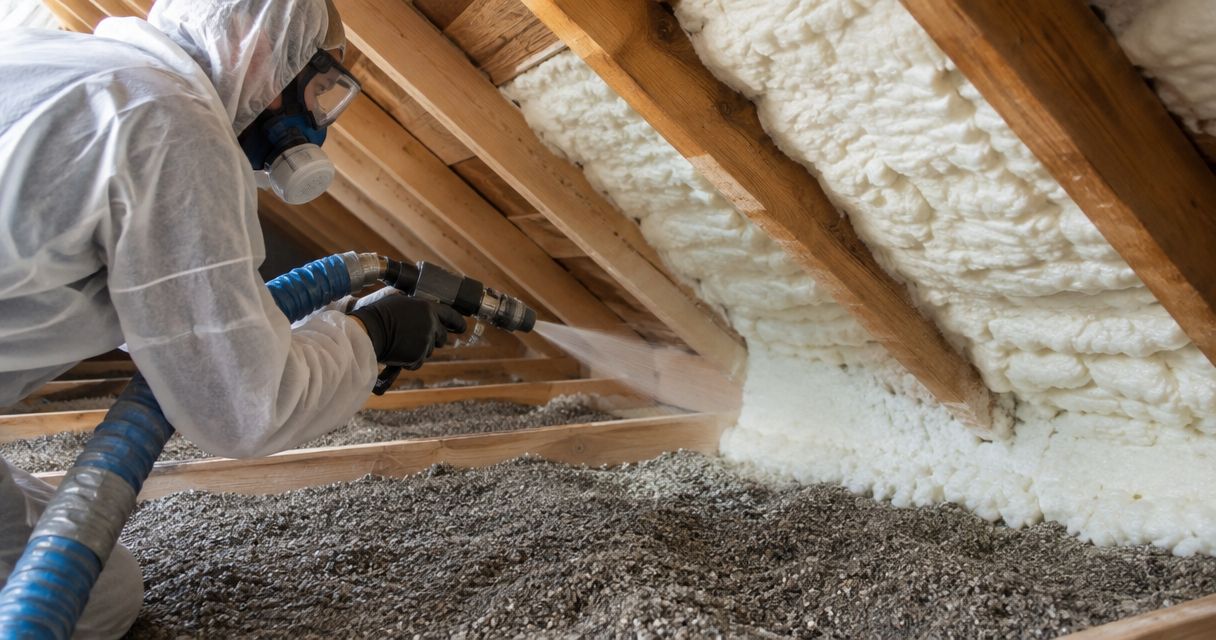
| Spray foam directly over loose vermiculite | Not recommended for a routine retrofit | Adds material without first removing the existing layer | Does not establish asbestos safety or a suitable foam substrate | Reject this shortcut |
Why this matters
A cold room is uncomfortable. An insulation project that disturbs suspected asbestos creates a different problem entirely: airborne fibres are a health hazard when inhaled. You cannot judge that risk by whether the attic looks tidy or whether the granules produce visible dust.
For the insulation stage, Aztec Spray Systems serves homeowners and commercial property owners in Calgary, Okotoks, High River, and Lethbridge. Keep that scope separate from asbestos assessment and abatement unless the relevant qualifications and responsibilities are explicitly confirmed.
Not all vermiculite contains asbestos
Vermiculite itself is a mineral. Some vermiculite insulation was contaminated with asbestos, and appearance alone cannot establish whether a particular attic contains contaminated material.
That distinction matters. Finding vermiculite does not prove your home has an airborne asbestos problem, but it does mean ordinary insulation handling is the wrong starting point. Avoid disturbing the material while you arrange qualified advice.
Do not rely on a photograph, a neighbour's renovation, or the absence of an old product bag. Those details do not establish the condition of the insulation throughout your attic.
What should you do before an insulation upgrade in 2026?
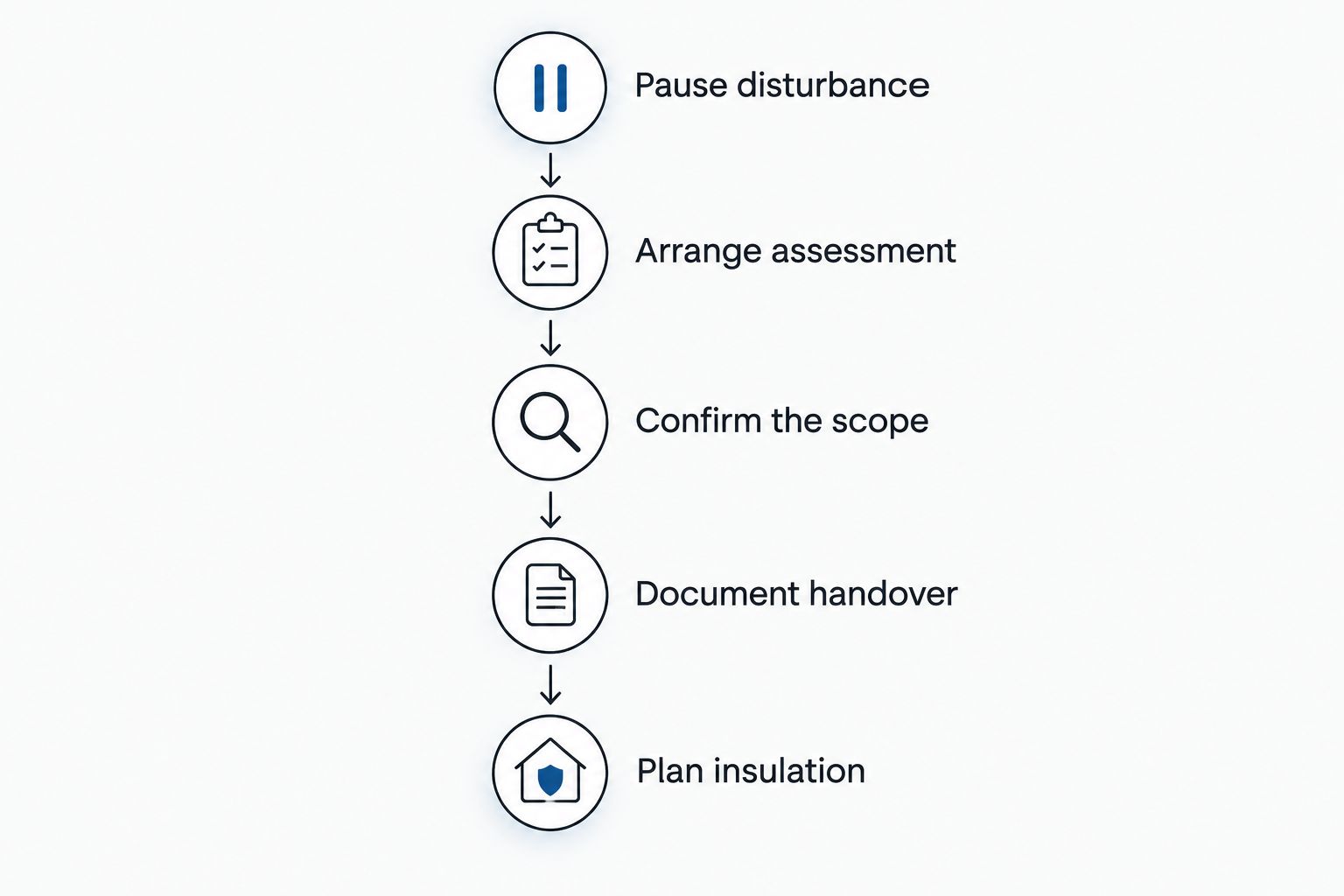
Pause work that would move the vermiculite, then establish a professional assessment and handover process. This is a project-planning sequence, not a homeowner removal procedure.
- Pause disturbance. Tell everyone involved that suspected vermiculite is present. Do not enter the attic to clear a path, expose wiring, or make room for an insulation estimate.
- Arrange assessment. Ask a qualified asbestos professional how the material should be assessed and managed. Let that professional determine whether sampling is appropriate and how results should be interpreted.
- Confirm the scope. Establish whether your proposed work requires disturbance, removal, or another professionally specified approach. Include access routes, service penetrations, and areas hidden beneath other insulation.
- Document handover. Where abatement is necessary, obtain the completion and clearance documentation appropriate to the work before another trade enters. A visibly empty attic is not, by itself, a documented handover.
- Plan insulation. Have the insulation contractor assess the exposed surfaces, air barrier, moisture conditions, ventilation strategy, and applicable installation requirements before selecting the assembly.
Each stage answers a different question. Assessment addresses the suspected hazard; abatement addresses the defined contaminated-material scope; insulation design addresses how the building will perform afterward.
Do not compress these stages into a single instruction to remove the old insulation and spray the attic. A written scope should make clear who is responsible for each decision and when the next contractor can begin.
Why the right approach varies between attics
For a 2026 retrofit, the presence of vermiculite is a starting condition—not a complete work specification. The next move depends on the material assessment and the actual construction work you intend to undertake.
- Material status: Suspected asbestos-containing insulation requires a different handling plan from material professionally established as non-asbestos-containing.
- Planned disturbance: Replacing wiring, opening ceilings, moving ducts, or accessing covered surfaces changes the work scope.
- Material condition: Existing disturbance, debris, and routes into occupied rooms need professional attention before routine trade access.
- Application surface: Foam needs a substrate that meets the selected product's requirements; a loose insulation layer is not a substitute.
- Attic design: Insulating the ceiling plane and insulating the roofline are different assemblies, with different moisture and ventilation considerations.
- Future access: Equipment maintenance and later renovations need consideration before material is covered or access is restricted.
Choose the work sequence before choosing the insulation product. Otherwise, a proposal can describe the foam in detail while leaving the most consequential part of the attic unresolved.
Can you leave vermiculite insulation in place?
Yes, leaving vermiculite undisturbed can be appropriate when qualified advice supports that approach and no planned work requires disturbance. Its presence does not automatically mean you should remove it yourself or arrange immediate demolition.
The benefit is avoiding unnecessary handling. The limitation is that an attic containing suspected asbestos cannot be treated as an unrestricted storage or work area.
Best for: an attic without planned disturbance
Leaving the material in place deserves consideration when you do not need to move it, penetrate the ceiling beneath it, or access covered building components. Ask the asbestos professional how access and future work should be managed.
That recommendation does not automatically approve an insulation top-up. Adding another material can disturb the existing layer during installation and conceal it from the next person entering the attic.
Keep records with the property documents. Anyone later working on wiring, lighting, roofing, ducts, or ceilings needs to know what was identified and what management instructions apply.
Does vermiculite have to be removed before spray foam?
Vermiculite must be addressed before work that would disturb it or require a clean application surface beneath it. Whether the necessary scope involves removal, restricted work, or a different insulation design is a professional assessment decision—not something to settle from a photograph.
For foam proposed at the attic floor, the installer needs access to the intended substrate. Spraying onto loose granules does not establish adhesion to the ceiling assembly or create a verified continuous air barrier beneath the old insulation.
Best for: renovations requiring access to affected surfaces
Professional abatement followed by insulation installation provides a clear separation between the hazardous-material stage and the building upgrade. Its limitation is the additional coordination needed before installation begins.
Review the sequence in how to remove old attic insulation before a spray foam upgrade, but do not treat ordinary insulation-removal instructions as asbestos-removal instructions. Suspected contaminated vermiculite needs its own qualified assessment and work plan.
If removal is specified, ask how the work boundary and completion requirements will be communicated to the insulation contractor. Do not use the insulation crew's arrival date as the deadline for declaring the attic ready.
Is spraying the roofline different from covering the attic floor?
Yes—roofline insulation changes the proposed building assembly, but it does not make vermiculite elsewhere in the attic irrelevant. Installers still need safe access, and their movement, equipment, or preparation work can disturb material on the attic floor.
A roofline proposal also needs to explain how the attic's air, heat, and moisture control will work. Leaving existing ceiling insulation in place while changing the roof assembly is not a detail to approve without a building-specific design.
Ask where the new thermal boundary will be and how ventilation, combustion equipment where present, and future access will be addressed. The answer should describe your attic rather than simply state that foam seals everything.
Roofline spraying is not an asbestos workaround. A safe-access plan and a suitable roof assembly remain separate requirements.
What should your 2026 insulation proposal include?
A useful proposal identifies both the work being purchased and the work excluded. For an attic with suspected vermiculite, that boundary needs to be explicit before you authorise installation.
Ask for written answers to these questions:
- What assessment or abatement documents must be available before access begins?
- Who confirms that the affected work area is ready for the insulation trade?
- Which exact surfaces will receive foam, and how will those surfaces be prepared?
- Will insulation remain at the ceiling plane, move to the roofline, or follow another specified design?
- How will ventilation, moisture control, and required fire protection be addressed?
- What product-specific ventilation and re-entry instructions apply during and after installation?
- What happens if additional suspect material is discovered during the work?
Do not accept a statement that foam will simply seal the asbestos in. That claim does not describe the preparation, exposure controls, substrate requirements, or long-term management of the concealed material.
Aztec Spray Systems is a fit for homeowners and commercial property owners seeking spray foam and attic insulation in its stated Alberta service areas. That service fit does not establish asbestos-abatement credentials; confirm the hazardous-material responsibilities separately.
What should you avoid while waiting for assessment?
Leave the suspected material alone. Avoid raking, sweeping, shovelling, drilling through, or vacuuming vermiculite, and do not collect a sample yourself.
A household vacuum is not an asbestos-control system. Opening an attic to improve ventilation is also not a substitute for controlling a suspected hazardous-material disturbance.
If work has already disturbed the material, stop the work and restrict access to the affected area. Contact a qualified asbestos professional for instructions rather than attempting a cleanup or moving dusty belongings through the house.
You do not need to solve the entire retrofit immediately. The useful first action is preventing further disturbance while the appropriate professional determines the next step.
FAQ
Can you spray foam over vermiculite insulation if it looks clean?
No—clean-looking vermiculite is not evidence that direct spraying is safe or suitable. Appearance cannot establish asbestos content, and loose granules do not provide a verified foam application surface.
Does all old vermiculite insulation contain asbestos?
No, not all vermiculite insulation contains asbestos. Treat existing vermiculite as potentially contaminated until a qualified asbestos professional establishes the appropriate management approach.
Can I take a vermiculite sample to a laboratory myself?
Do not collect a sample yourself. Ask a qualified asbestos professional whether sampling is appropriate and how it should be performed and interpreted.
Does a negative asbestos test mean I can spray foam immediately?
No—a negative result is not, by itself, approval to begin spraying. Have the asbestos professional interpret the assessment, then have the insulation contractor confirm surface preparation and the proposed assembly.
Can I add blown-in insulation over vermiculite instead of foam?
Do not assume a blown-in top-up is safe over suspected asbestos-containing vermiculite. Installation can disturb the existing material, so obtain qualified advice before adding any insulation.
Does spray foam count as asbestos encapsulation?
Do not treat ordinary spray foam installation as an asbestos-encapsulation specification. Any proposed asbestos-management treatment requires qualified assessment and a defined work method.
Can Aztec Spray Systems assess and remove asbestos?
Aztec Spray Systems is identified as a licensed and insured spray foam, attic insulation, and concrete lifting contractor. Confirm any asbestos assessment or abatement qualifications separately before assigning that work.
One last thing
Covering a hazard can make the next renovation harder to plan. A future electrician or property owner needs to know what remains under an insulation layer, even when the attic looks finished.
For your 2026 project, keep the assessment, any abatement completion documents, and the insulation specification together. The best final handover explains both what was installed and what remains in the building.
Related guides
- How to air seal an attic before adding insulation
- How to meet fire code requirements for spray foam insulation
- How to maintain spray foam insulation after installation