No—standard concrete lifting does not fix a cracked foundation wall; it raises a sunken slab, not a damaged load-bearing wall. A wall crack needs its own assessment for leakage, movement, and structural damage, even when a nearby floor or driveway also needs lifting.
- Can concrete lifting fix a cracked foundation wall? No—slab lifting and foundation wall repair address different problems.
- Aztec Spray Systems provides concrete lifting; a cracked foundation wall needs a separate assessment.
- A level basement floor does not prove that the foundation wall or footing is stable.
- Get structural advice before lifting concrete beside a bowed, displaced, or actively cracking wall.
Can concrete lifting fix a cracked foundation wall?
Concrete lifting is not a substitute for foundation wall repair. Conventional slab lifting places material beneath concrete to fill voids and raise settled sections. It does not reconnect a fractured wall, reinforce a bowed wall, or establish why a footing moved.
The distinction starts with the building components. A typical basement floor slab rests on prepared ground, while the foundation wall transfers building loads to a footing. Some buildings use different structural arrangements, so the person assessing your property must confirm how yours is built.
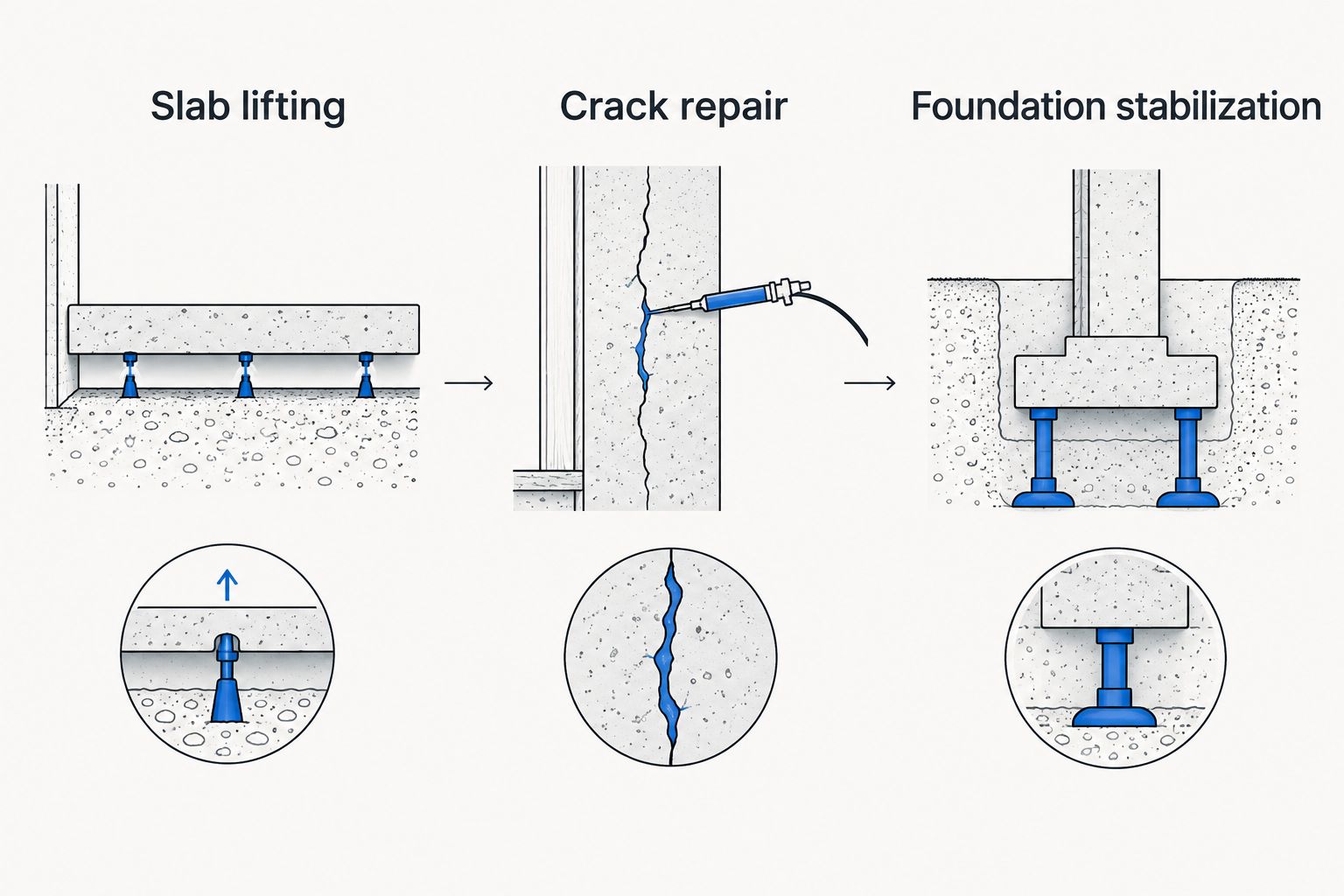
The explanation of how polyurethane concrete lifting works covers the slab-raising process. For a cracked wall, use the following comparison to separate the possible repair scopes.
| Approach | Best for | Main benefit | Important limitation |
|---|---|---|---|
| Slab lifting | Suitable sunken slabs with inadequate support beneath them | Restores slab elevation without replacing the entire slab | Does not repair a cracked or bowed foundation wall |
| Crack sealing or injection | Appropriate wall cracks after their cause and condition are assessed | Addresses a defined crack or water-entry path | Sealing alone does not correct ongoing foundation movement |
| Foundation stabilization | Diagnosed movement involving structural support | Addresses the support problem through a designed repair | Requires a structural diagnosis and project-specific design |
| Drainage correction | Identified surface-water or drainage problems | Reduces the identified source of water exposure | Does not rebuild damaged concrete or restore structural capacity |
Why this matters
A crack and a low floor can appear together without requiring the same repair. Treating the most visible symptom first risks leaving the underlying wall problem unresolved.
For a 2026 repair project, separate the work into clear outcomes: correcting slab elevation, controlling water entry, and addressing structural movement. A proposal that simply promises to “fix the foundation” does not tell you which outcome the contractor will deliver.
You do not need to diagnose the structure yourself. You need enough clarity to ask for the right assessment before authorizing work that changes the position of concrete beside the wall.
Slab lifting: for suitable settled floors and exterior concrete
Concrete lifting addresses a horizontal slab that has dropped relative to its intended position. Examples include sections of a driveway, walkway, garage floor, or basement floor, subject to an assessment of the slab and its support.
The advantage is targeted elevation correction; the limitation is that raising a slab does not repair the wall beside it. A slab with extensive deterioration or unsuitable structural connections needs a different assessment from an otherwise serviceable slab over a void.
Before proceeding near a foundation wall, ask how the slab connects to the building. The contractor should identify relevant joints, buried services, and other constraints rather than assume that every concrete surface can move independently.
Also ask what caused the loss of support. Raising concrete without addressing an identified washout or drainage defect leaves that separate defect in place. The completed surface needs an agreed target elevation and appropriate drainage—not simply the greatest possible lift.
Crack repair: for a diagnosed crack, not every foundation problem
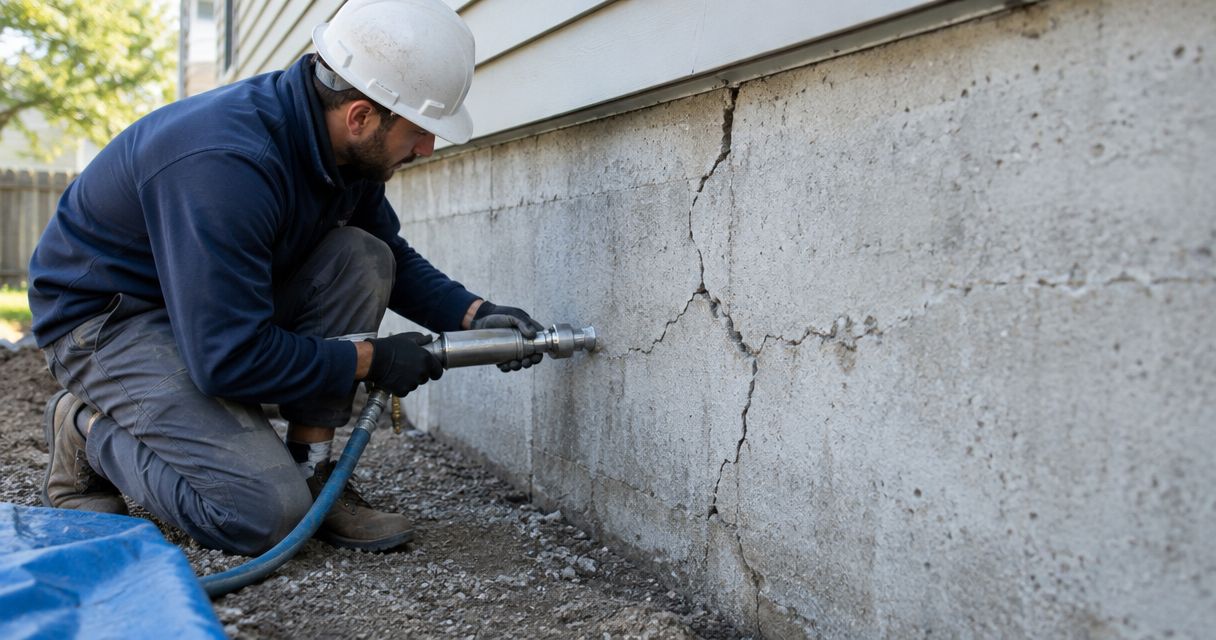
Crack sealing and crack injection work on the crack itself. Depending on the wall material, crack condition, and repair objective, an appropriate system addresses water entry or forms part of a specified concrete repair.
That is different from injecting material beneath a slab. The location, material selection, and intended result are not interchangeable just because both processes use injection equipment.
The benefit of crack repair is a focused treatment; the limitation is that an active structural problem needs more than a seal. Ask whether the proposed work is intended to stop leakage, restore a specified connection, or accompany a larger structural repair.
Do not treat a dry crack as automatically harmless or a leaking crack as automatically structural. Water entry and structural significance are different questions, and both deserve an answer before you cover the wall with finishes.
Foundation stabilization: for diagnosed support or wall movement
A foundation wall that is moving, bowing, or losing adequate support needs structural assessment. A structural engineer determines whether the problem involves the wall, footing, supporting soil, connections, or a combination of these components.
The resulting repair can involve reinforcement, underpinning, rebuilding, or another designed approach. Those are categories of structural work, not recommendations for your particular property.
Specialized ground-improvement methods also exist, but that does not make an ordinary slab-lifting proposal a foundation stabilization design. If a contractor proposes injection work to support a foundation, ask for the engineering basis and the precise structural scope.
The right repair follows the diagnosed failure mechanism. A promise to make a crack look smaller is not the same as demonstrating that the building has adequate support.
Why the repair approach varies
The repair depends on what has failed, not simply on whether concrete has cracked. These factors explain why similar-looking symptoms require different work:
- Affected component: A floor slab, foundation wall, and footing perform different jobs. Confirm which component has moved before choosing a repair.
- Movement history: A crack that is changing needs a different investigation from one documented as stable. Dated photographs help establish that history.
- Wall shape and displacement: Bowing, leaning, or an offset across the crack raises questions that surface sealing cannot answer.
- Water and soil conditions: Leakage, concentrated runoff, and loss of supporting soil require investigation alongside the concrete damage.
- Construction and connections: Poured concrete, masonry, slab connections, and concealed building details affect the assessment and repair design.
- Repair objective: Restoring floor elevation, stopping a leak, and restoring structural support are separate outcomes. Specify each one that applies.
A 2026 inspection record should describe these conditions in plain language. You should be able to connect every recommended repair to an observed problem, rather than receive a method with no explanation of what it solves.
What should I do before booking concrete lifting?
Assess the wall before authorizing a lift beside it. Use this sequence to keep slab work and structural work from being confused.
- Document the damage. Photograph the full wall and closer views of the crack with a measuring scale. Record the date, visible leakage, displacement, and changes you have noticed.
- Identify the affected components. Show the assessor the wall, nearby floor, exterior grade, and relevant openings. Do not assume that a gap at the floor edge proves the wall has settled.
- Request structural assessment when indicated. Bowing, displacement, progressive cracking, or other movement symptoms warrant advice from a qualified structural professional before repair selection.
- Separate the repair scopes. Ask for distinct descriptions of slab lifting, crack treatment, drainage work, and any structural repair. Each scope should name its intended result.
- Confirm the work sequence. Where several repairs are necessary, have the responsible professionals establish their order and explain any limits on lifting near the wall.
Bring earlier inspection reports and repair records to the assessment. An older photograph that shows the same crack can be more useful than a confident guess about when it appeared.
What should I photograph or measure?
Include the crack ends, corners, nearby windows or doors, the wall-to-floor junction, and any visible water staining. Photograph the same locations consistently so later comparisons show change rather than differences in camera angle.
Record measurements in millimetres and dates in your notes, but do not use crack width alone to declare a wall safe. Direction, displacement, location, construction, and movement history also matter.
If your record starts in 2026, label the baseline photographs clearly. Continue monitoring only under an appropriate assessment plan; collecting photographs is not a substitute for investigating concerning movement.
When should I call a structural engineer first?
Call a structural engineer before choosing a repair when the wall bows or leans, the crack has visible displacement, or cracking is progressing. Related symptoms—such as changing door operation or movement in adjacent building elements—also belong in the assessment.
A horizontal crack in a basement wall deserves particular attention because lateral loading is one possible cause. A vertical crack also needs context; its direction alone does not establish that it is merely shrinkage.
Do not wait for a routine lifting appointment if the wall shows sudden movement, falling material, or apparent instability. Keep people away from the affected area and obtain urgent professional assistance; contact emergency services if there is immediate danger.
Can lifting a nearby slab help with water near the wall?
Lifting a suitable exterior slab can improve its slope when settlement has directed surface water toward the building. That addresses a drainage condition, not the foundation wall crack itself.
The proposed elevation must work with thresholds, adjoining concrete, joints, and the surrounding grade. Raising the slab without checking those relationships risks moving water somewhere else rather than resolving its route.
Ask the assessor to distinguish surface runoff from water entering through a wall crack or another below-grade pathway. A successful surface-drainage correction does not prove that a leaking crack has been repaired.
Is foam beneath a slab the same as foam in a wall crack?
No. Foam beneath a slab serves a different purpose from a material specified for crack injection, and neither should be confused with building insulation.
The word “foam” does not establish structural suitability. The material, placement, substrate conditions, and design objective determine what the application is intended to do.
For a 2026 proposal, request a written description of the application rather than accepting a material name alone. “Injection” describes a way to place material; it does not identify the problem being repaired.
Where does a concrete-lifting contractor fit?
Aztec Spray Systems concrete lifting is best suited to property owners seeking slab correction, not a substitute for structural wall repair. The company is a licensed and insured contractor providing concrete lifting, spray foam insulation, and attic insulation to homeowners and commercial property owners in Calgary, Okotoks, High River, and Lethbridge.
When discussing slab work with Aztec Spray Systems, disclose nearby wall cracks and share any structural findings before the scope is agreed. Keep the limitation explicit: a concrete-lifting scope should not be read as approval of the foundation wall’s condition.
FAQ
Can concrete lifting fix a cracked foundation wall in 2026?
No—standard concrete lifting raises suitable sunken slabs; it does not repair a cracked foundation wall. A 2026 repair plan should assess wall damage separately from slab elevation.
Will raising my basement floor close a foundation wall crack?
Raising a basement floor is not a foundation wall crack repair. The floor and wall can move differently, and the wall needs its own assessment even if nearby gaps change.
Is a small foundation crack always safe to leave alone?
No—crack width alone does not establish whether a foundation wall is safe. Movement, displacement, wall shape, leakage, and construction details also affect the assessment.
Should I repair a leaking crack before lifting the concrete?
The repair sequence depends on the cause of the crack and the relationship between the slab and wall. Have the responsible assessor or engineer establish the sequence before either repair begins.
Is polyurethane concrete lifting the same as foundation underpinning?
No—ordinary polyurethane slab lifting is not the same as foundation underpinning. Underpinning changes or extends foundation support through a project-specific structural approach.
Can I use insulation spray foam to fix a foundation crack?
No—building insulation spray foam is not a substitute for a specified foundation crack repair. Choose the repair system only after the crack and its cause have been assessed.
Can a concrete-lifting quote confirm that my foundation wall is sound?
No—a slab-lifting quote does not establish that a foundation wall is structurally sound. Ask for a separate structural assessment when wall movement or damage raises concerns.
One last thing
A floor can be level while the foundation wall remains damaged. Judge each repair against its stated purpose, not against how tidy the finished surface looks.
Before approving your 2026 work, ask a final question: “Which part of this proposal addresses the wall crack, and which part only raises the slab?” A clear answer protects you from mistaking a completed lifting job for a completed foundation repair.
Related guides
- How to identify foundation settling before it worsens
- Concrete lifting for interior basement floors
- How to tell if your garage floor needs concrete lifting