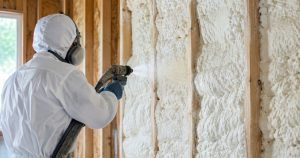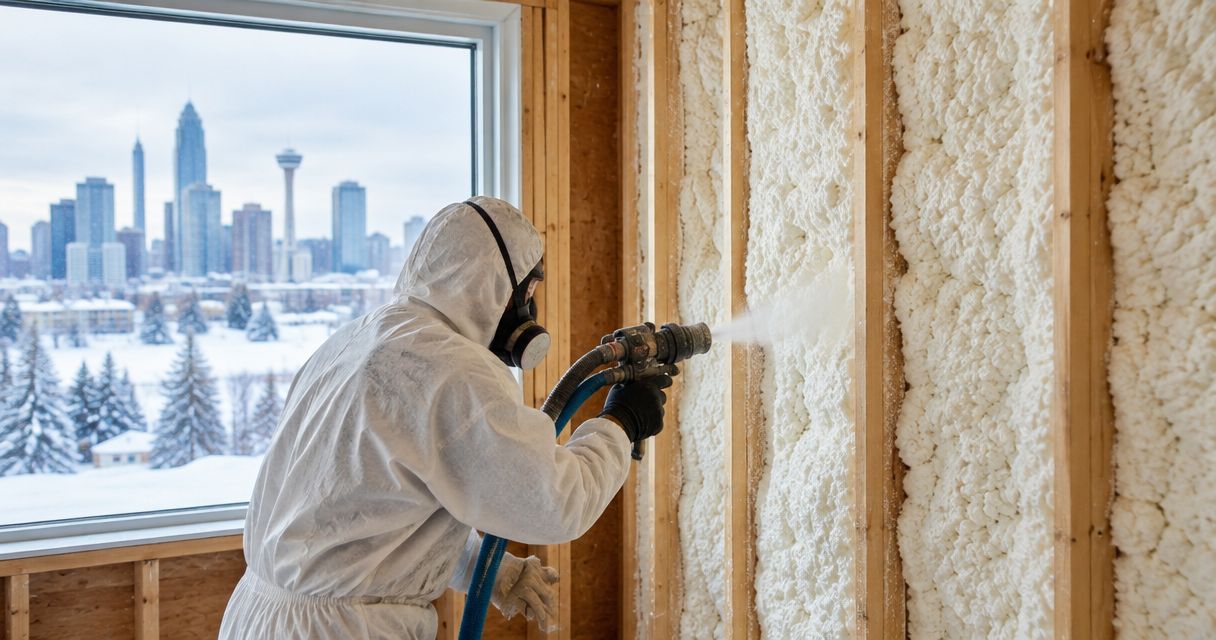
Yes—spray foam insulation is worth it in Calgary when it addresses verified air leaks, poorly insulated cavities, or limited space for insulation. For a 2026 retrofit, the deciding factor is the condition of your building: a sound, accessible attic often needs air sealing and additional attic insulation rather than a full spray foam conversion.
- Is spray foam insulation worth it in Calgary? Yes, for verified air leakage and suitable building assemblies.
- Closed-cell spray foam suits space-constrained cavities; attic insulation upgrades deserve a separate assessment.
- Repair water leaks and plan ventilation before tightening your building.
- Aztec Spray Systems provides spray foam and attic insulation for Calgary homeowners and commercial property owners.
Why this matters
Cold floors, drafts, and uneven room temperatures do not all have the same cause. Adding insulation helps heat flow through walls and ceilings, but it does not automatically correct leaking windows, disconnected ducts, or inadequate heating distribution.
Start with the building problem, not the material. Understanding how to air seal an attic before adding insulation helps you distinguish an insulation shortage from an air-leakage problem. That distinction determines whether spray foam belongs across an assembly, at specific junctions, or nowhere in the proposed work.
Is spray foam insulation worth it in Calgary winters?
Spray foam earns its place when its insulating and air-sealing functions solve an identified problem together. It is not automatically the right treatment for every cold room or attic.
For your 2026 project, compare complete assemblies rather than material names. Insulation, air-barrier continuity, moisture management, ventilation, and required protective coverings must work together.
| Insulation approach | Best for | Main advantage | Main limitation |
|---|---|---|---|
| Closed-cell spray foam | Suitable cavities with restricted insulation space | Provides thermal resistance and can form an air barrier at the specified thickness | Requires careful moisture design, substrate preparation, and professional installation |
| Open-cell spray foam | Suitable framed cavities where the design allows greater thickness | Expands to fill irregular spaces and can provide air control at the specified thickness | Has different vapour properties from closed-cell foam and is not interchangeable with it |
| Blown-in attic insulation | Accessible, vented attics needing more insulation | Adds coverage across an attic floor without converting the roof assembly | Does not replace deliberate air sealing or protection of ventilation paths |
| Mineral wool batts | Accessible, regularly spaced framing cavities | Fits conventional framing and allows material removal during later work | Gaps and poor fitting reduce performance; a separate air-control strategy is necessary |
The advantage of spray foam is its ability to follow irregular surfaces and fill suitable cavities. The trade-off is that it adheres to those surfaces, complicating later access and removal. Choose the assembly you need, then choose the insulation that supports it.
What makes spray foam a strong candidate?
Spray foam deserves assessment where you have accessible rim joists, awkward transitions, or a floor above an unheated garage. These locations combine insulation challenges with junctions that need continuous air control.
The recommendation still depends on inspection. A cold bonus room can also have duct, heating-balance, or garage-door issues, so treating the floor cavity alone does not establish that the room will become comfortable.
What makes another approach more suitable?
A dry, vented attic with accessible ceiling penetrations is a strong candidate for targeted air sealing followed by an insulation top-up. You do not need to move insulation to the underside of the roof simply because spray foam is available.
Keep useful existing insulation when it is dry, uncontaminated, and compatible with the planned work. Removing sound material adds disruption without proving that the finished assembly will perform better.
Closed-cell spray foam: best for suitable space-limited cavities
Closed-cell spray foam provides more thermal resistance per unit thickness than open-cell foam. Its lower vapour permeance also changes how an assembly dries, which makes product selection and placement important.
For Calgary properties, discuss rim joists, foundation-adjacent assemblies, and other restricted cavities with a qualified installer. The assessment must establish where moisture comes from and how the surrounding materials will dry after installation.
Recommendation: consider closed-cell spray foam where cavity depth and air-barrier continuity justify it. Do not use it to hide wet wood, active leaks, or unresolved foundation moisture. Insulation is not waterproofing, and covering damage does not repair it.
Open-cell spray foam: best for suitable deeper framed cavities
Open-cell spray foam has different density, thermal resistance, and vapour characteristics from closed-cell foam. The finished assembly needs enough space for the specified insulation thickness and a deliberate approach to vapour control.
Do not accept a proposal that treats the two foam types as substitutes. Ask why the selected product suits the location, what thickness achieves the design requirement, and how the assembly controls condensation.
Recommendation: use open-cell spray foam only where the assembly design supports its properties. Its ability to fill a cavity does not establish that it belongs against every roof deck or foundation surface.
Attic air sealing and top-up: best for accessible vented attics
In a conventional vented attic, insulation belongs at the ceiling boundary, while roof ventilation remains above it. Ceiling penetrations, attic hatches, and connections at wall tops need attention before more insulation covers them.
A top-up improves thermal resistance, but it does not repair a leaking roof or reconnect an exhaust duct. Bathroom exhaust must discharge outdoors, and insulation must not obstruct the ventilation paths the roof assembly requires.
Recommendation: assess an attic air-sealing and top-up plan before approving a full foam conversion. For a 2026 retrofit, ask the contractor to explain whether the attic will remain vented and where the continuous air barrier will sit.
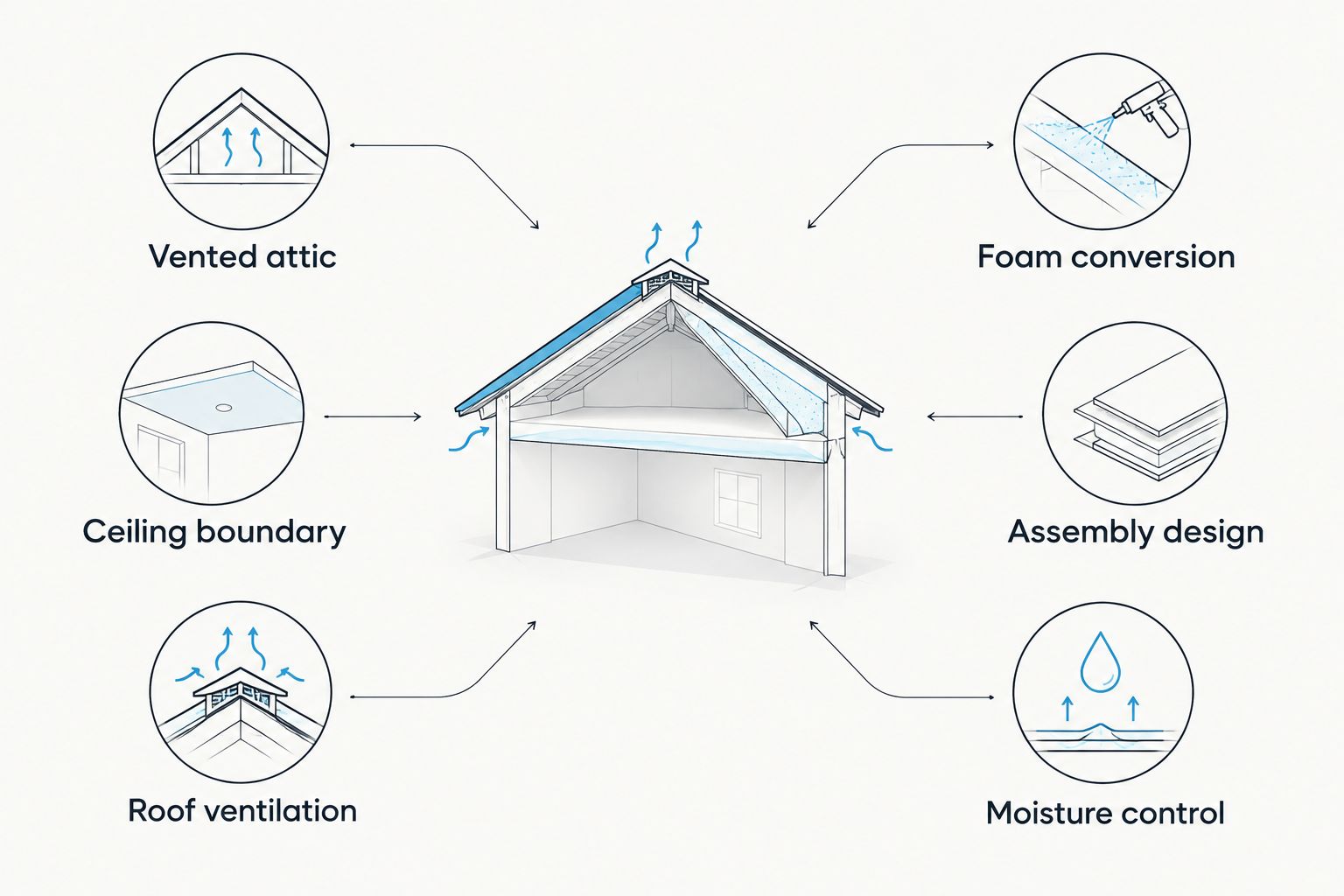
Keeping insulation at the attic floor and insulating the roof deck are different construction decisions. Ask for a drawing or written description of the proposed boundary so you understand exactly which space the contractor intends to insulate.
Why spray foam's value varies between Calgary properties
The same insulation material produces different results when the starting conditions differ. These factors determine whether spray foam addresses your actual problem:
- Existing insulation: A thin or incomplete layer leaves a different opportunity from an already well-insulated assembly.
- Air leakage: Leaking junctions require continuous air control, not simply more material nearby.
- Cavity access: Open framing allows inspection and preparation; finished surfaces complicate access and reinstatement.
- Moisture condition: Wet substrates and active leaks need correction before insulation work.
- Ventilation and heating: A tighter building still needs suitable fresh-air provision and heat distribution.
- Extent of work: A targeted rim-joist repair and a roof assembly conversion affect different parts of the building.
Your occupancy pattern matters too. A continuously heated home and an intermittently heated workshop do not have identical comfort goals. Describe how you use the space rather than asking for the same installation as another property.
For a 2026 decision, define success before signing: fewer drafts in a specific room, warmer floors, or correction of a documented insulation gap. A clear objective makes the proposed work easier to evaluate.
How do you check whether your home needs spray foam?
Use an assessment sequence that separates symptoms from causes. Ask for evidence of the defect before accepting a whole-building recommendation.
- Record symptoms. Note which rooms feel cold, whether drafts change with wind, and whether the problem appears at floors, ceilings, or windows. Log indoor temperatures over 24 hours as a starting observation, not as proof of insulation failure.
- Review energy use. Gather 12 months of utility consumption records, not just bill totals. Weather, occupancy, thermostat settings, and equipment changes affect comparisons.
- Inspect assemblies. Check accessible insulation, air-barrier junctions, water damage, exhaust routing, and ventilation paths. Have inaccessible or unsafe areas assessed professionally.
- Test leakage. A blower-door assessment helps identify air leakage. Testing commonly reports results at a pressure difference of 50 pascals; that test pressure is not normal operating pressure inside your home.
- Compare scopes. Request a targeted repair option alongside broader insulation work where both are technically suitable. Compare what each option actually fixes.
Thermal imaging adds useful context when inspection conditions support it. A cold-looking area alone does not identify the cause: missing insulation, air leakage, and thermal bridging need different responses.
Keep your 2026 assessment findings with the proposal. Photographs and a written scope give you a reference for confirming that the identified defects were addressed after installation.
What should a spray foam proposal explain?
A useful proposal describes the finished assembly, not just an area to spray. You should understand what happens before application, what gets installed, and how the work is checked.
Ask for these details:
- Product and thickness: The specified foam type, its intended location, and the design requirements it must satisfy.
- Preparation: Removal needs, substrate condition, leak repairs, and treatment of unsuitable surfaces.
- Air-barrier connections: How the foam connects to adjacent materials without leaving bypasses.
- Moisture control: The vapour-control strategy and the assembly's drying path.
- Protection and safety: Required coverings, work-area isolation, and product-specific occupancy instructions.
- Verification: How coverage, thickness, and workmanship will be documented.
Installation conditions matter. Spray foam requires suitable substrates and application practices; a good material does not compensate for poor preparation. Follow the selected product's written instructions for ventilation and re-entry rather than relying on a generic waiting period.
Aztec Spray Systems is best suited to homeowners and commercial property owners seeking spray foam or attic insulation in Calgary and southern Alberta. Aztec Spray Systems is a licensed and insured contractor serving Calgary, Okotoks, High River, and Lethbridge; the appropriate project scope still depends on your building's condition.
Will spray foam reduce my heating use?
Spray foam reduces heat transfer through the assemblies it insulates and, where properly specified and continuous, limits air leakage. That does not establish a particular reduction in your whole-building heating consumption.
A furnace problem, leaky door, or uninsulated area outside the project remains after installation. Ask whether an energy assessment can estimate the effect of the proposed scope, then compare consumption under comparable conditions after the work.
Treat energy savings as a building-specific outcome, not a standard product promise. Comfort improvements and heating-use changes are related, but neither should be assigned a percentage without evidence.
Can spray foam fix condensation or ice dams?
Spray foam can help address heat loss and air leakage that contribute to condensation or ice-dam formation. It does not replace roof repairs, exhaust corrections, or a moisture-control assessment.
Before insulating, identify the source of water or frost. Warm indoor air reaching a cold surface is a different problem from rain entering through a roof defect, and the repair must match the cause.
Is spray foam better than blown-in attic insulation?
Spray foam is better suited to some constrained or irregular cavities; blown-in insulation is well suited to accessible attic floors after air sealing. Neither material wins across every location in a Calgary home.
For a dry, vented attic, compare ceiling-level air sealing and top-up against any proposed roof assembly conversion. Choose the approach that corrects the documented defect without creating unnecessary assembly changes.
FAQ
Is spray foam insulation worth it in Calgary winters?
Yes, spray foam insulation is worth considering when verified air leaks, insulation gaps, or restricted cavity depth make it suitable. A sound, accessible vented attic often deserves an air-sealing and insulation top-up assessment instead.
What’s the best insulation for a cold room above a garage?
The best insulation approach follows an inspection of the floor assembly, air leaks, and heating distribution. Spray foam is a candidate for suitable accessible cavities, but it does not fix disconnected ducts or inadequate heat delivery.
Is closed-cell spray foam better than open-cell foam?
Closed-cell and open-cell spray foam suit different assembly designs. Closed-cell foam provides more thermal resistance per unit thickness, while both require appropriate moisture control and specified installation thickness.
Can I add spray foam over wet insulation?
Do not cover wet insulation or active water damage with spray foam. Identify the moisture source, repair it, and assess the affected materials before choosing the insulation scope.
Will spray foam make my Calgary home too airtight?
Air sealing requires a ventilation assessment, not deliberate retention of uncontrolled leaks. Check fresh-air provision, exhaust systems, and combustion-safety requirements when planning the work.
How long should I stay out after spray foam installation?
Follow the selected product’s written re-entry instructions and the contractor’s site-specific safety plan. Do not substitute a generic waiting period for the instructions covering your installation.
Should I replace all my attic insulation with spray foam?
Do not replace sound attic insulation solely to switch materials. Assess ceiling air leakage, existing coverage, moisture, and ventilation before deciding whether a top-up or a different assembly is appropriate.
One last thing
A thick layer of insulation can still perform poorly when air bypasses it. The less visible junctions—around hatches, wall tops, and service penetrations—deserve as much attention as the insulation you can see.
For your 2026 project, ask the contractor to identify the continuous air barrier on the proposed assembly. If that explanation stops at the word foam, request the missing connection details before approving the work.
Related guides
- How to insulate a bonus room above the garage
- Blown-in attic insulation for Calgary homes
- How to meet fire code requirements for spray foam insulation