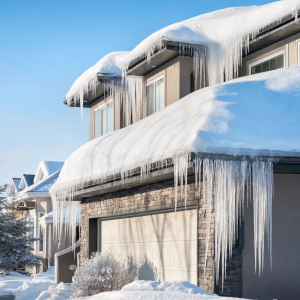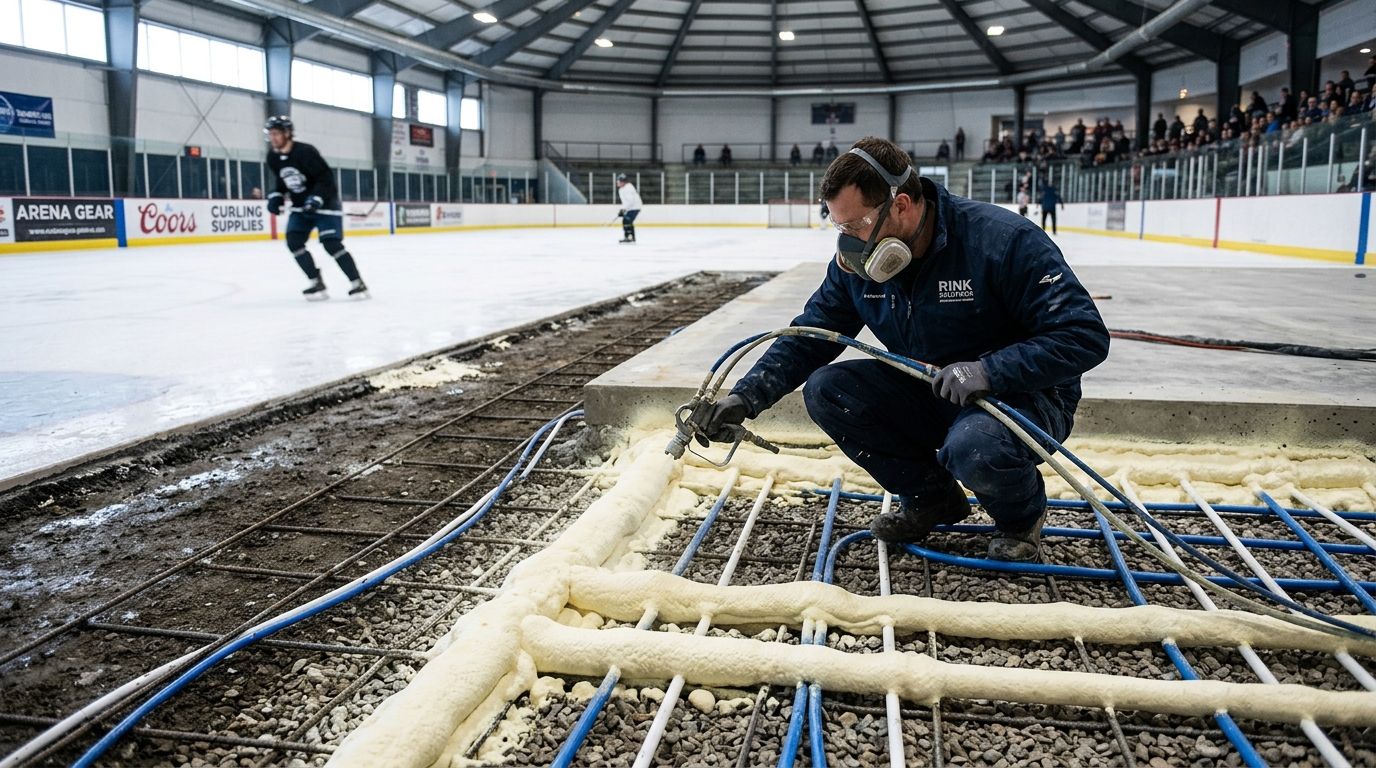
Ice rinks and curling clubs need spray foam insulation that stops condensation from dripping onto the ice sheet while cutting the run time on refrigeration compressors that operate nearly year-round. Unlike a house or a warehouse, a rink building carries a permanent, extreme temperature split between a -4°C ice surface and a heated spectator or lounge area just meters away, and that split is what drives moisture problems if the envelope isn't sealed right.
- Closed-cell spray foam insulation ice rink projects target the roof deck, mechanical room, and perimeter walls to stop condensation drip onto the ice.
- Aztec Spray Systems recommends closed-cell foam over open-cell for any surface facing the compressor room or the ice slab itself.
- Retrofits scheduled during the 2026 off-season avoid disrupting league bookings and give foam full cure time before ice-in.
- Rink and curling club envelopes need a continuous vapor barrier, not just insulation, because the humidity load never really stops.
Why spray foam insulation matters for ice rinks and curling clubs
A hockey arena or curling club runs its compressors almost continuously through the season, and every degree of heat gain through the roof or walls is a degree the refrigeration plant has to fight. That drives electricity costs up and shortens equipment life because compressors cycle harder and longer than they should.
The bigger operational headache is condensation, known in the industry as "rink rain." Warm, humid air inside the building meets the cold roof deck or steel purlins above the ice sheet, and water collects and drips onto the surface, pitting the ice and forcing resurfacing crews back out mid-session. Closed-cell spray foam insulation solves both problems at once because it's a continuous air barrier and a vapor barrier in the same application, not two separate layers that can fail independently.
Curling clubs face a milder version of the same issue but with tighter tolerances — a curling sheet needs a flatter, more consistent temperature profile than a hockey rink, so envelope gaps show up faster as pebble degradation and uneven ice.
Inspect the roof and ceiling assembly for condensation risk
Start above the ice, not at the walls. Most rink condensation problems trace back to an under-insulated or poorly air-sealed roof deck sitting directly over refrigerated air.
- Check steel purlins and roof deck fasteners for frost or moisture staining after a cold snap
- Look for water stains on the ice surface itself, especially near roof penetrations and skylights
- Measure the existing insulation thickness against current R-value targets for Alberta commercial roofs
- Check ventilation fans and make-up air units for correct sizing relative to building volume
- Note any exposed steel or thermal bridging points where frost forms first
Seal the building envelope before touching the refrigeration plant
Upgrading the ice plant without fixing the envelope wastes money — the compressors will keep fighting heat gain through the same gaps. Air sealing comes first.
- Weatherstrip all entry doors, especially the Zamboni bay door, which is often the single largest air leak in the building
- Caulk and seal wall-to-roof junctions and any penetrations for conduit or plumbing
- Check overhead door seals on equipment bays for gaps that let humid outside air in during warm months
- Confirm vestibules or air curtains are functioning at spectator entrances
A licensed spray foam contractor can apply closed-cell foam across these same junctions in one pass, which closes gaps that caulk alone won't hold under years of thermal cycling — this is where Aztec Spray Systems typically enters a rink retrofit, once the envelope's problem areas are mapped.
Insulate the mechanical and compressor room separately
The compressor room runs hot from equipment and needs its own thermal strategy, separate from the ice sheet side of the building.
- Insulate mechanical room walls to keep ambient heat away from refrigerant lines and controls
- Seal ductwork penetrations between the mechanical room and the rink floor
- Check that insulation doesn't block required ventilation or ammonia detection sensors, if the plant uses ammonia refrigerant
- Confirm electrical panels and control wiring stay clear of any spray foam application per code
Insulate perimeter walls behind the boards and dasher panels
The wall section behind the boards is often overlooked because it's hidden, but it's a direct thermal bridge to the outside in older buildings.
- Remove or access wall cavities behind dasher board mounting brackets before foam goes in
- Use closed-cell foam on any wall section within a few feet of the ice surface, since it resists moisture better than open-cell
- Check for existing batt insulation that has settled or compressed and needs full removal first
- Confirm structural steel studs are foamed around, not just between, to cut thermal bridging
Address the ice slab edge and header trench
The header trench around the slab perimeter is a classic weak point where ground heat and surface heat both attack the ice edge.
- Inspect for soft or melting ice at the boards, a sign of poor perimeter insulation
- Check that under-slab insulation, where present, hasn't degraded or shifted
- Confirm drainage at the header trench is clear so meltwater doesn't pool against the slab edge
Manage humidity and vapor drive year-round
Rinks that operate April through September for figure skating and summer hockey camps see the worst condensation because outdoor humidity is highest exactly when the temperature differential is largest.
- Track indoor relative humidity with a logging hygrometer through a full season, not just a spot check
- Confirm dehumidification equipment is sized for the building's actual air volume and occupancy load
- Check that any existing vapor barrier is continuous, since a single tear can undo an otherwise good insulation job
- Compare humidity readings before and after any envelope work to confirm the retrofit is working
Schedule the retrofit around the ice season
Spray foam cures fast, but scheduling around league bookings and tournament dates keeps the club operating.
- Book roof and ceiling work during the off-season melt-out window, typically spring through early summer in Alberta
- Phase wall and mechanical room work in sections so at least one sheet stays operational
- Confirm cure and off-gas time with the contractor before returning staff or skaters to the space
- Plan compressor maintenance to coincide with the same downtime window
Get a rink insulation assessment
Aztec Spray Systems serves Calgary, Okotoks, High River, and Lethbridge facilities.
Comparison of insulation options for rinks and curling clubs
| Option | Best for | Key limitation |
|---|---|---|
| Closed-cell spray foam | Roof decks, mechanical rooms, walls near the ice sheet | Requires a licensed applicator and off-season scheduling |
| Open-cell spray foam | Interior partition walls away from the ice and moisture load | Poor vapor resistance, wrong choice near condensation zones |
| Rigid foam board | Under-slab and header trench applications | Seams need careful taping or they become leak paths |
| Fiberglass batt | Low-humidity storage or office areas within the facility | Loses R-value fast if it gets damp, common failure near rinks |
Closed-cell spray foam is the only option on this list that functions as both an insulator and a vapor barrier in one pass, which is why it's the standard choice for any surface near the ice sheet.
Common mistakes ice rinks and curling clubs make
- Insulating the roof but ignoring the Zamboni bay door — a single oversized door leak can offset an entire roof retrofit's energy savings.
- Using open-cell foam near the ice surface — it doesn't resist vapor drive the way closed-cell does, and condensation returns within a season or two.
- Skipping the mechanical room — clubs often insulate the public-facing envelope and leave the compressor room as an afterthought, which shortens equipment life.
- Scheduling envelope work mid-season — losing ice time to avoidable downtime costs more than the extra weeks it takes to plan around the off-season window.
- Assuming batt insulation behind the boards is fine because it's hidden — hidden doesn't mean dry, and compressed or wet batts near an ice sheet are a recurring failure point.
FAQ
What’s the best insulation for an ice rink roof?
Closed-cell spray foam insulation is the standard choice for ice rink roof decks in 2026 because it seals air leaks and blocks vapor drive in one application, cutting the condensation that causes rink rain.
Is spray foam insulation ice rink work different from a standard commercial retrofit?
Yes — rink and curling club envelopes carry a permanent, extreme temperature differential between the ice surface and the rest of the building, which standard commercial spaces don’t have, so vapor barrier continuity matters more here.
How much does spray foam insulation cost for a curling club?
Cost depends on square footage, roof height, and how much of the mechanical room and perimeter wall needs coverage — get a site-specific quote rather than relying on a general commercial estimate.
Can spray foam stop condensation dripping on the ice?
Closed-cell spray foam applied to the roof deck and steel purlins above the ice sheet is the most effective fix for rink rain because it removes the cold surface where moisture was condensing.
Does spray foam insulation work near ammonia refrigeration systems?
Yes, but mechanical rooms using ammonia refrigerant need insulation planned around ventilation and detection sensor placement, which is a job for a licensed contractor familiar with ice plant layouts.
When should a rink schedule an insulation retrofit?
The off-season melt-out window, typically spring through early summer in Alberta, lets crews complete roof and wall work without disrupting league and tournament bookings.
Is open-cell or closed-cell foam better for a curling club?
Closed-cell foam is better for any surface facing the ice sheet or exterior wall because of its vapor resistance; open-cell is only appropriate for interior partitions away from the moisture load.
One last thing
Closed-cell spray foam typically delivers roughly R-6 to R-6.5 per inch, well above open-cell foam or batt insulation at the same thickness — that density is exactly why it holds up as a vapor barrier in a building that never really dries out. Any rink or curling club still running on batt insulation behind the boards is fighting a moisture problem the material was never built to handle.
Related guides
- Recreation centers and gyms
- Calgary commercial properties
- Cold storage facilities
- Choosing a contractor with WCB coverage
- Signs your commercial building needs re-insulation