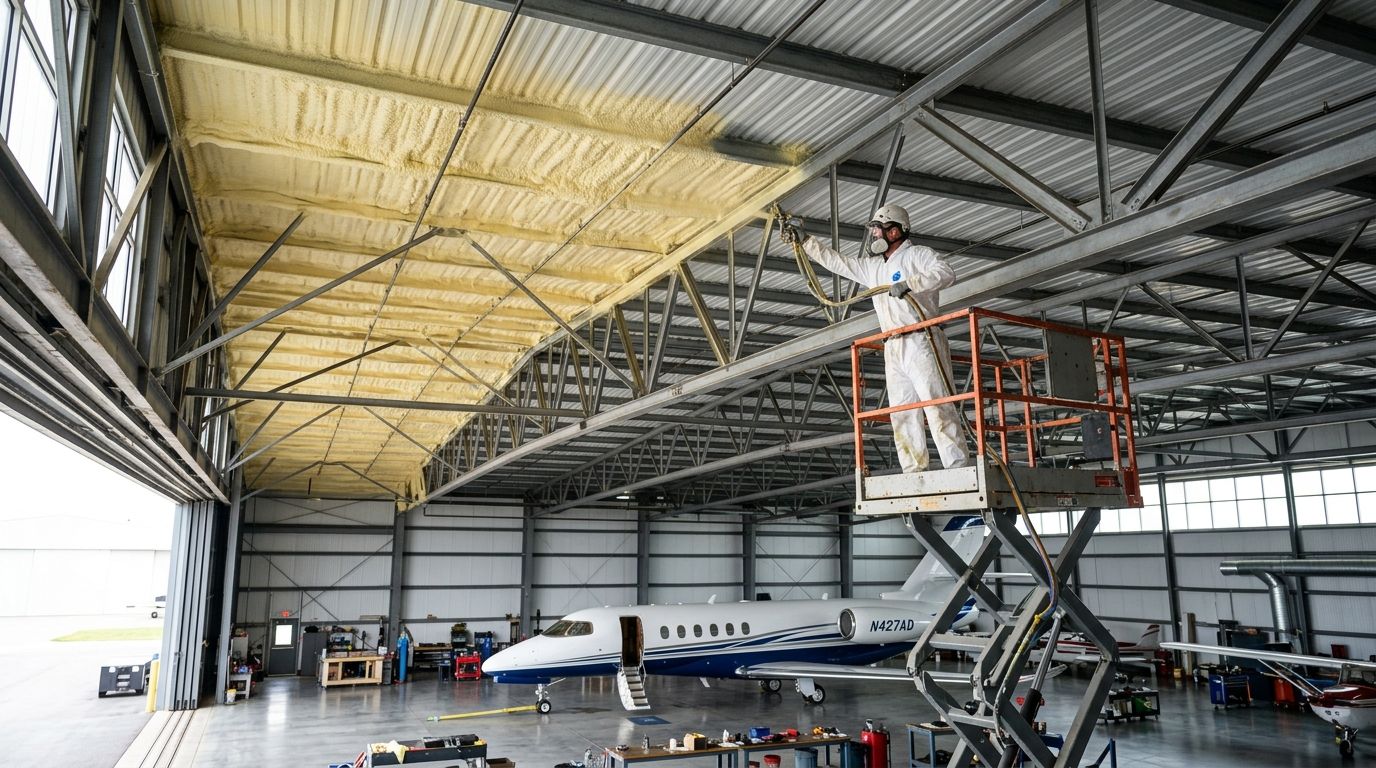
Spray foam insulation for airplane hangars is closed-cell polyurethane foam sprayed directly onto the steel skin, roof deck, and door frame to stop condensation, cut heating costs, and protect aircraft, avionics, and tools from Alberta's temperature swings. A hangar isn't a garage with a bigger door — the clear-span steel structure, the fuel storage rules, and the sheer volume of unconditioned air behind an aircraft mean the insulation approach has to answer different questions than a house or shop does.
- Closed-cell spray foam insulation is the standard choice for airplane hangars in Alberta’s freeze-thaw climate.
- Aztec Spray Systems applies spray foam insulation to hangar roof decks, walls, and door perimeters around Calgary, Okotoks, High River, and Lethbridge.
- Closed-cell foam runs roughly R-6.5 per inch versus R-3.7 for open-cell — a real difference in a heated hangar.
- Skipping the roof deck or leaving the overhead door perimeter unsealed is the most common hangar insulation mistake.
Why spray foam insulation matters for hangar owners
A steel hangar acts like a giant radiator. Warm, moist air inside meets cold steel purlins and roof panels, and the water has nowhere to go but onto whatever sits underneath — usually an aircraft skin, avionics, or a toolbox full of steel that doesn't appreciate rust. Fiberglass batt does nothing to stop that because it doesn't seal the air leaks that carry the moisture to the cold surface in the first place.
Alberta hangars face a wider swing than most: Calgary and Lethbridge both see winter lows well past -20°C and summer days over 30°C, and that swing happens inside a building with a door opening measured in dozens of feet. Closed-cell spray foam solves two problems at once on a metal building like a hangar: it seals the air leaks that let humid air reach cold steel, and it adds enough R-value that the heated portion of the hangar actually holds its temperature between flights.
Closed-cell spray foam insulation is the right call for a heated or semi-heated airplane hangar in Alberta — it stops condensation on the roof deck and keeps fuel and heating costs down through the winter.
Assess your hangar's condensation risk
Start with what's happening in the building now, before spending a dollar on foam.
- Check for rust streaks on steel purlins near the roof peak — early sign of chronic condensation.
- Look for water spots on the aircraft skin or hangar floor after a cold night.
- Run a $20-30 hygrometer for a week and log interior humidity against outdoor temperature swings.
- Inspect the overhead door track and man-doors for daylight gaps.
- Note whether the hangar is heated year-round, seasonally, or only during work sessions — this changes the insulation strategy.
Pick a heating profile before you pick a foam type
An unheated hangar used only for storage doesn't need the same envelope as one with a heated shop bay and office. Decide this first — it drives every step after it.
Choose the right foam type for the structure
Open-cell and closed-cell foam are not interchangeable on a hangar, and the wrong pick shows up as a moisture problem within a year or two.
- Closed-cell foam runs about R-6.5 per inch, adds rigidity to the steel panel it's sprayed to, and resists bulk water — the standard pick for hangar roof decks and any wall facing the outside.
- Open-cell foam runs about R-3.7 per inch and is cheaper per board-foot, but it absorbs moisture and is a poor fit for a cold Alberta roof deck.
- Foam board works for a budget retrofit on interior partition walls that don't touch the building envelope, but it does nothing for air sealing at the seams.
- Fiberglass batt is the cheapest option up front and the worst performer in a hangar — it does not stop air movement, which means it does not stop condensation.
A licensed contractor sprays closed-cell foam directly onto the underside of the roof deck and the interior face of the wall girts, which is the point where the manual approach above (fixing obvious gaps yourself) stops being enough and a professional application starts paying for itself in fewer rust calls and lower heating bills.
Insulate the roof deck and purlins first
The roof deck loses the most heat and collects the most condensation on a clear-span hangar, so it goes first in any real retrofit.
- Spray closed-cell foam directly to the underside of the metal deck, not just between the purlins.
- Cover the purlins themselves — thermal bridging through exposed steel undoes a lot of the R-value gain if it's skipped.
- Target at least 2 inches of closed-cell foam on the roof deck to hit vapor-retarder thickness.
- Check clearance around any skylights or roof vents before spraying — foam needs a clean line, not an obstruction.
Seal the hangar door perimeter and man-doors
The overhead door is the single biggest air leak on most hangars, full stop.
- Weatherstrip the door track top-to-bottom, not just along the bottom seal.
- Foam or caulk the header and jamb gaps where the door frame meets the steel wall panel.
- Add a bottom astragal seal sized to the actual floor gap, not a generic strip.
- Seal man-door thresholds and any pass-through doors the same way.
- Weatherstrip service openings for fuel lines, electrical conduit, or compressed air.
Meet fire code and clearance requirements
A hangar with fuel storage or a heated shop area has code obligations spray foam has to work around, not against.
- Confirm the required thermal barrier or ignition barrier over exposed foam in occupied areas.
- Keep foam clear of any fuel storage or fueling equipment clearance zones set by local fire code.
- Check spray foam fire code requirements before scheduling installation — this is not a step to skip on a commercial structure.
- Document the ignition-barrier product used for future inspections or insurance reviews.
Plan the install around hangar downtime
Spray foam needs the aircraft and anything sensitive moved out and cure time before the space is back in full use.
- Schedule installation during a planned maintenance window when the aircraft is already elsewhere.
- Cover or remove avionics, tools, and anything with exposed electronics before spraying.
- Budget at least a full day of cure and off-gas time before returning equipment to the bay.
- Confirm ventilation requirements during application, especially in a hangar with limited air exchange.
Verify contractor credentials before hiring
A commercial hangar project is not a homeowner-scale job, and the contractor selection should reflect that.
- Ask for proof of licensing and liability insurance specific to commercial spray foam work.
- Confirm WCB coverage for every crew member on site — a hangar is a workplace with its own risk profile.
- Request references from a comparable commercial building, not just residential attic jobs.
- Get a written scope covering roof deck, walls, and door perimeter separately, not one lump-sum line.
Get a hangar insulation quote
Licensed and insured commercial spray foam work across southern Alberta.
Comparison: insulation options for airplane hangars
| Option | Best for | Key limitation |
|---|---|---|
| Closed-cell spray foam | Roof deck, exterior walls, door perimeter | Requires a licensed applicator and cure time |
| Open-cell spray foam | Interior partitions away from the envelope | Absorbs moisture, wrong choice for a cold roof deck |
| Rigid foam board | Budget interior partition retrofit | No air sealing at the panel seams |
| Fiberglass batt | Non-structural interior framing only | Does not stop air movement or condensation |
Common mistakes hangar owners make
- Insulating the walls but not the roof deck. The roof is where most of the condensation forms — skipping it leaves the core problem unsolved.
- Choosing open-cell foam because it's cheaper. It wicks moisture in a cold Alberta winter and can trap water against steel instead of stopping it.
- Leaving the overhead door perimeter unsealed. A fully insulated envelope with an unsealed door still bleeds heat through the biggest opening in the building.
- Skipping the fire-code review on a heated hangar with fuel storage. This is a commercial building — the ignition barrier requirement isn't optional the way it might be on a detached shop.
- Hiring a residential-only crew for a commercial-scale bay. A hangar's ceiling height, door width, and access constraints call for a contractor used to working at that scale.
FAQ
What’s the best insulation for an airplane hangar in Alberta?
Closed-cell spray foam insulation is the best fit for an airplane hangar in Alberta because it seals air leaks and resists moisture on the roof deck and steel walls. Open-cell foam and fiberglass batt both fail to control condensation the way closed-cell foam does in a heated or semi-heated hangar.
Is spray foam insulation better than fiberglass for a hangar?
Yes — spray foam stops air movement and condensation on steel surfaces, while fiberglass batt does neither. A hangar’s biggest problem is moisture on cold steel, and only an air-sealing foam product addresses that directly.
Do airplane hangars need a vapor barrier with spray foam?
Closed-cell spray foam applied at roughly 2 inches or more functions as its own vapor retarder, so a separate poly vapor barrier usually isn’t needed on top of it. Thinner applications or open-cell foam still need a separate vapor control layer.
Can spray foam insulation be used near hangar fuel storage areas?
Spray foam can be used in a hangar with fuel storage, but the fire code requirements for ignition barriers and fuel clearance zones need to be confirmed before installation. This is a code compliance question, not a product limitation.
How long does spray foam insulation take to cure in a hangar?
Plan for at least a full day of cure and off-gas time before returning aircraft or sensitive equipment to a freshly sprayed bay. Ventilation during application also affects how quickly the space is safe to re-enter.
Does spray foam insulation stop rust on steel hangar purlins?
Spray foam stops the condensation that causes rust by sealing the air leaks that carry humid air to cold steel surfaces. It doesn’t remove existing rust, so purlins already corroding need treatment before the foam goes on.
What R-value does a hangar roof deck need in Alberta?
Closed-cell foam at 2 inches or more delivers roughly R-13 and covers the vapor-retarder threshold, though a fully heated hangar may call for more depth depending on use. The right target depends on whether the bay is heated year-round or only seasonally.
One last thing
Most hangar owners fixate on wall insulation and forget the roof deck is where the real condensation problem lives — a hangar with insulated walls and a bare steel roof still drips on the aircraft every cold morning. Foam the roof deck first, at 2 inches minimum, and the wall insulation becomes the easy part.
Related guides
- Best spray foam insulation company for Calgary commercial properties
- Commercial spray foam insulation for warehouses