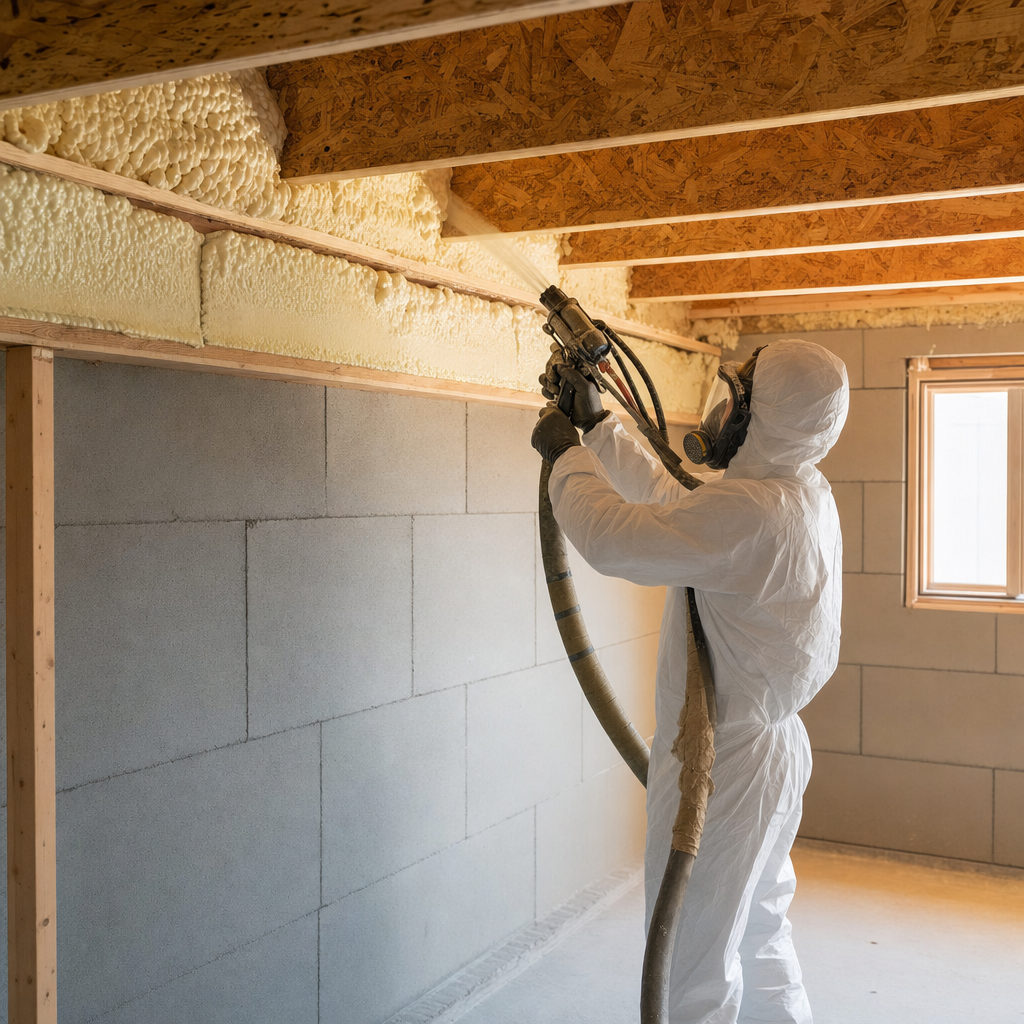
Your furnace has been running flat-out since October, the energy bills are creeping up, and you keep noticing cold spots along the rim joists or in that unfinished basement. Spray foam insulation is the upgrade most Calgary homeowners wish they had done years earlier — but before you commit, you want to know what it will actually cost. This guide breaks down real 2026 prices for open-cell and closed-cell foam, explains every factor that moves the number up or down, and shows you where spray foam pays for itself fastest in a Zone 7A climate like ours.
Quick Answer
In Calgary, spray foam insulation costs roughly $1.50–$3.50/sq ft (open-cell) or $3.00–$5.00/sq ft (closed-cell), installed. Most residential projects run $2,500–$9,000 depending on area and foam type. Closed-cell foam’s R-6/inch rating and built-in vapour barrier make it the standard choice for Alberta’s -30°C winters.
How Much Does Spray Foam Insulation Cost per Square Foot in Calgary?
Spray foam pricing in Calgary falls into two clear tiers based on foam type. Open-cell foam — the softer, air-permeable product — runs approximately $1.50 to $3.50 per square foot installed, while closed-cell foam — the rigid, high-density product — runs $3.00 to $5.00 per square foot installed. Those ranges account for material, equipment, and labour; they do not include optional finishing work like drywall, which is a separate trade. Most Calgary contractors also apply a minimum mobilisation charge of $1,000 to $2,000, so small spot-jobs (just a rim joist or a single wall cavity) will cost more per square foot than a whole-attic or whole-basement project.
The price difference between the two foam types is real but so is the performance gap. Closed-cell spray foam delivers approximately R-6 per inch compared to R-3.7 per inch for open-cell. That means a 3.5-inch closed-cell application reaches roughly R-21 — the same thermal performance would require nearly 6 inches of open-cell foam. In an attic or wall cavity with limited depth, that efficiency advantage is decisive. Closed-cell also acts as both an air barrier and a vapour retarder once it reaches about 38 mm (1.5 inches), which can eliminate the need for a separate polyethylene vapour barrier in many assemblies under the Alberta Building Code.
Here is a quick reference table for the most common Calgary residential applications:
| Application | Foam Type | Typical Thickness | Estimated Cost Range |
|---|---|---|---|
| Rim joists (per lineal foot of perimeter) | Closed-cell | 2–3 inches | $8–$18/lin ft |
| Attic air-sealing top-up | Closed-cell | 1–2 inches at penetrations | $800–$2,500 full attic |
| Unfinished basement walls (per sq ft) | Closed-cell | 3 inches (approx. R-18) | $3.50–$5.00/sq ft |
| Crawlspace (floor and walls) | Closed-cell | 2–3 inches | $3.00–$5.00/sq ft |
| Detached garage (walls + ceiling) | Open- or closed-cell | 2–4 inches | $2,500–$6,000 typical project |
| Cathedral ceiling / flat roof | Closed-cell | 5–7 inches (R-30–R-42) | $5.00–$8.00/sq ft |
What Factors Drive the Final Quote?
Square footage is the biggest lever, but it is far from the only one. Foam thickness matters enormously: every additional inch of closed-cell adds roughly $1.50–$2.00 per square foot to the material cost. The Alberta Building Code’s energy efficiency section (9.36) sets minimum effective R-values for new construction — R-31 for above-grade walls and R-50 for attics in Climate Zone 7A — so thicker applications are often code-driven, not just comfort-driven.
Accessibility also shifts the price. A wide-open unfinished basement is the easiest spray-foam job on the calendar; a finished attic with knee walls and deep eaves is far more labour-intensive. Spraying around existing ductwork, electrical panels, or plumbing takes longer and raises costs. Similarly, any existing insulation that must be removed first — such as old fiberglass batts soaked with decades of moisture — adds a removal and disposal line item, typically $0.50–$1.50 per square foot. If the walls are already drywalled (a common mid-project ask), injection foam or a different product may be needed at a different price point.
Seasonal timing can also influence pricing. Calgary contractors are busiest from October through February, when homeowners finally feel their drafts, and again in May–June pre-summer. Booking a project in the shoulder season (March–April or August–September) sometimes opens up scheduling windows that translate into more competitive quotes, because crews have more flexibility and less overtime. Always get at least two quotes from CUFCA-member contractors (Canadian Urethane Foam Contractors Association) to ensure you’re comparing apples to apples on product type, thickness, and coverage.
Where Does Spray Foam Deliver the Best Return on Investment?
In Calgary’s -30°C cold snaps and Chinook-driven temperature swings, the highest-ROI spray foam applications are almost always rim joists and crawlspaces first, then attic air sealing, then basement walls. Here’s why: rim joists — the band of lumber that sits between your foundation wall and your floor system — are notoriously difficult to seal with batts. A single linear foot of unsealed rim joist can leak as much air as leaving a small window wide open. Closed-cell foam fills every void in the framing, adheres to concrete, and sets up rigid enough to act as structural bracing. Most Calgary homeowners who spray their rim joists see a noticeable drop in cold floors within one heating season.
Attic air sealing is the second-best bang for the dollar. Natural Resources Canada estimates that air leakage accounts for 25–40% of a home’s heat loss. Spraying 1–2 inches of closed-cell foam at every ceiling penetration — pot lights, plumbing stacks, partition top plates — before blowing in extra cellulose or fibreglass dramatically improves performance. This two-step approach is often more cost-effective than filling the entire attic cavity with spray foam, because blown-in insulation is still the cheapest way to achieve R-50 in bulk depth.
For a whole-home perspective, a well-insulated 2,000 sq ft Calgary bungalow with spray-foamed basement walls, rim joists, and attic air sealing can see heating-cost reductions of 20–35%, which at current natural gas prices typically means $600–$1,400 per year in savings. Payback periods of 5–10 years are common, and the improvement adds tangible value at resale. You may also qualify for rebates through Alberta’s insulation rebate programs, which can shave hundreds to a few thousand dollars off the project cost depending on the scope.
Can You DIY Spray Foam to Save Money?
Two-component DIY spray-foam kits are available at big-box stores for $150–$400 per kit, covering 200–600 board feet. For small spot-jobs — sealing around a single basement window, filling a gap at a rim joist corner, or insulating a crawlspace access hatch — they are a reasonable option. But they come with real limitations: the yields are hard to predict, off-ratio mixing from improper temperature control produces foam that won’t cure properly, and the lifetime of the resin cylinders once opened is short. Application technique matters enormously; uneven passes create voids that won’t be visible until the thermal camera goes on.
For whole-wall or whole-basement applications, professional installation almost always wins on cost per R-value delivered. Commercial-grade equipment lets installers dial in precise ratios at the gun, apply in controlled lift thicknesses (typically 2 inches per pass for closed-cell), and maintain drum temperatures in cold Alberta weather — a step that is impossible with a consumer kit sitting in an unheated garage. The foam systems used by professional contractors also carry CCMC evaluations confirming code compliance, which matters for permit inspections and insurance. If your project requires a permit (and most basement and attic work does in Calgary), professionally applied, CCMC-listed foam is the straightforward path. Learn more about our professional process on the Aztec Spray Systems spray foam services page.
Are There Rebates or Incentives That Reduce the Cost?
Yes — and in 2026 there are still meaningful dollars available for qualifying Calgary homeowners. The federal Canada Greener Homes Grant program has supported spray foam upgrades as a core measure, requiring a pre- and post-retrofit EnerGuide evaluation. Rebate amounts vary by measure and province, but insulation upgrades have historically qualified for up to $5,000 in combined federal and provincial support. Alberta’s Emissions Reduction Alberta programs have also offered supplementary incentives for energy-efficiency retrofits in specific categories.
To access most rebates you will need: (1) a pre-retrofit EnerGuide assessment by a registered energy advisor, (2) work completed by a licensed contractor, and (3) receipts for materials and installation. The pre-retrofit assessment costs $300–$600 but is often partially rebated itself. If you are planning a project that involves both insulation and air sealing, bundling the work into a single project scope — rather than piecemealing it over multiple seasons — makes the rebate paperwork far simpler. Our team can walk you through which applications are most likely to qualify; visit our contact page or call (403) 830-7669 for a free assessment conversation.
Frequently Asked Questions
How much does spray foam insulation cost per square foot in Calgary in 2026?
In Calgary, open-cell spray foam costs $1.50–$3.50/sq ft installed; closed-cell foam costs $3.00–$5.00/sq ft installed. Most contractors apply a minimum job fee of $1,000–$2,000. Closed-cell is almost always recommended for Calgary’s Zone 7A climate due to its superior R-value and moisture resistance.
Is spray foam insulation worth the cost in Calgary?
Yes, for most Calgary homes. Properly installed spray foam can reduce heating costs by 20–35%, often paying back the investment in 5–10 years. The combination of air sealing and insulation in one step is uniquely effective in extreme cold climates, and the improvement adds measurable resale value.
What is the cheapest area to spray foam in a Calgary home?
Rim joists and crawlspaces deliver the best cost-to-benefit ratio because they are small, accessible, and typically uninsulated. A full rim joist seal on an average Calgary bungalow can be completed in half a day and cost $1,500–$3,500, yet eliminate one of the biggest air-leakage pathways in the home.
Does spray foam insulation in Calgary qualify for rebates?
Yes. In 2026, eligible projects may qualify for federal Canada Greener Homes rebates and provincial incentives. A pre-retrofit EnerGuide assessment is required. Bundling insulation with air sealing in a single project maximises rebate eligibility. Always confirm current program details with a registered energy advisor before starting work.
How long does a spray foam insulation project take in Calgary?
Most residential spray foam jobs take one to two days. A rim joist seal on a detached house is typically a half-day job. Larger projects — a full unfinished basement or an attic plus basement combination — usually take one to two full days. The foam cures within minutes of application; off-gassing ventilation is advised for 24 hours before re-occupying sprayed areas.
How Aztec Spray Systems Helps Calgary Homeowners
Aztec Spray Systems has been insulating Calgary homes and commercial buildings with closed-cell and open-cell spray foam since before most of our customers realised how badly their rim joists were leaking. We serve Calgary and the surrounding region including Airdrie, Cochrane, Chestermere, Strathmore, High River, and Canmore. Whether you need a targeted rim-joist seal, a full basement retrofit, or a commercial warehouse envelope, our crews use professional-grade, CCMC-listed foam systems applied to exacting thickness — no guesswork, no cold-weather shortcuts. We also offer attic insulation top-ups and commercial spray foam for warehouses and agricultural buildings.
Getting an accurate quote starts with a site visit — square footage alone doesn’t capture everything. Contact us for a free, no-obligation quote: call (403) 830-7669 or fill out our online quote request form. We’ll tell you exactly what you need, what it will cost, and whether your project qualifies for any available rebates — all before you commit to anything.