Spray foam insulation is legal everywhere in Alberta, but it only meets fire code when the foam itself is covered or rated to handle exposure — and that single detail is where most DIY jobs, and a few contractor jobs, fail inspection.
- Spray foam insulation meets Alberta fire code when it’s covered by a thermal barrier (commonly 12.7 mm gypsum board) or a code-listed ignition barrier.
- Exposed foam in living spaces, garages, and unprotected attics is the most common spray foam insulation fire code failure on inspection day.
- Open-cell and closed-cell foam carry different application thickness limits tied to exotherm risk during installation.
- A licensed contractor schedules the barrier inspection before drywall goes up, not after — reversing that order means tearing out finished walls.
Why this matters
Spray polyurethane foam burns differently than the fibreglass batts most Alberta homes were built with. It has a flame-spread and smoke-developed rating that's tested, and every manufacturer's product data sheet spells out exactly how the foam has to be protected once it's in the wall or attic. Skip that step and you don't just risk a failed inspection — you create a real ignition path in a house that's supposed to be safer, not riskier.
Aztec Spray Systems installs spray foam and attic insulation across Calgary, Okotoks, High River, and Lethbridge, and the fire code question comes up on nearly every job, whether it's a bonus room over a garage or a full attic retrofit. Getting the barrier right the first time is cheaper than a re-inspection. Start with the brand's full service overview if you're still deciding whether spray foam is the right call for your project in 2026.
How do you meet fire code requirements for spray foam insulation?
Meeting spray foam insulation fire code in Alberta comes down to six steps, in this order:
- Identify the occupancy of the space. Living rooms, bonus rooms, basements, and finished garages need a thermal barrier. Unoccupied attics and crawl spaces may qualify for a lighter ignition barrier instead.
- Match the barrier to the foam type. Open-cell and closed-cell foam have different exotherm profiles during the exothermic curing reaction, which affects how much can be applied per pass and how quickly it needs to be covered.
- Respect maximum lift thickness. Closed-cell foam is typically applied in passes of roughly two inches to control heat buildup during curing — exceeding that on a single pass is a common cause of scorching and off-gassing, not just a fire code problem.
- Use foam with a current code evaluation and CAN/ULC-S102 flame-spread and smoke-developed classification. Ask any installer for the product data sheet before spraying starts.
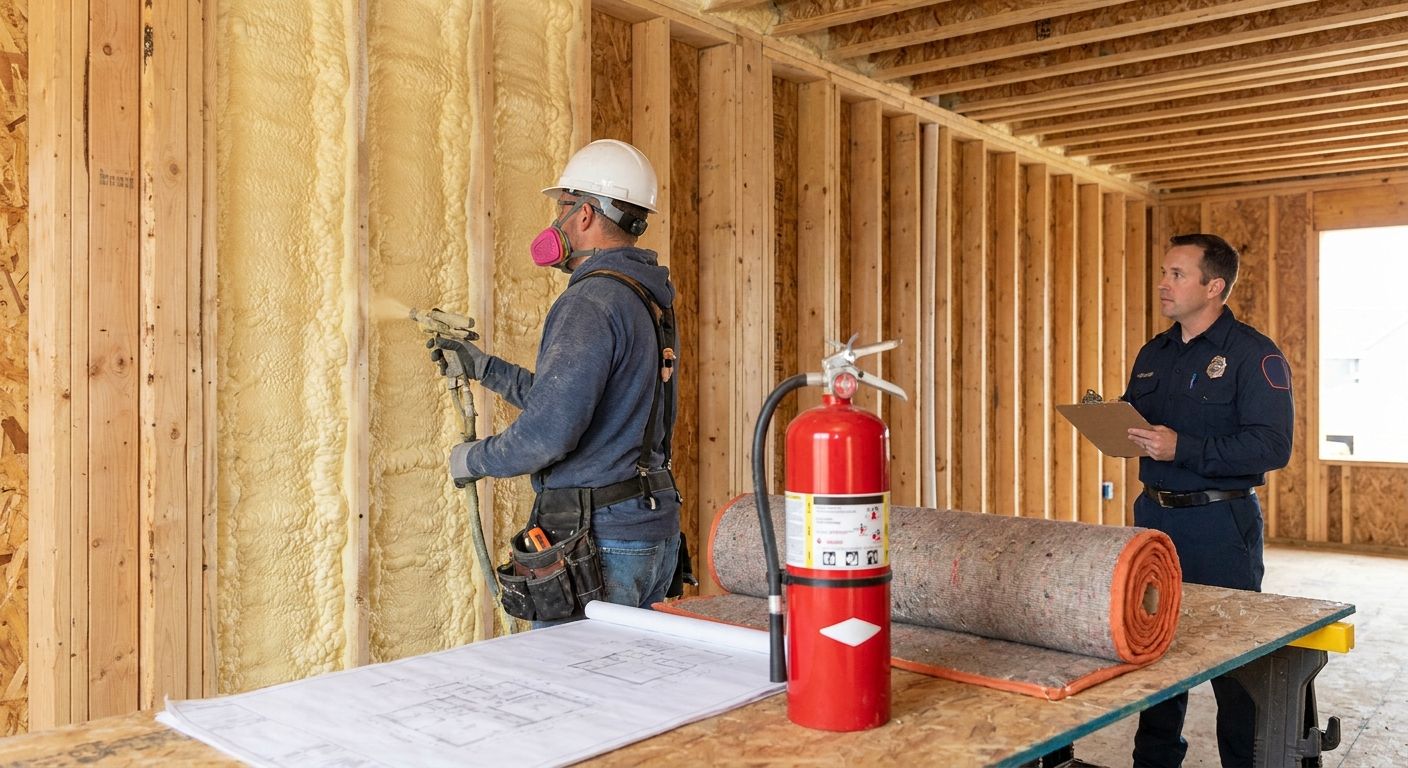
- Schedule the inspection before the barrier goes up. Once drywall or an ignition barrier coating covers the foam, an inspector can't verify thickness or coverage without opening the wall back up.
- Keep the paperwork. Product data sheets, the code evaluation listing, and the inspection sign-off protect you at resale and with insurance.
Barrier requirements by area
| Area | Barrier required | Typical material | Why |
|---|---|---|---|
| Living spaces, basements, bonus rooms | Thermal barrier | 12.7 mm (1/2") gypsum board | Foam is exposed to daily occupancy and ignition sources |
| Attics and crawl spaces (not occupied) | Ignition barrier | Intumescent coating or a code-listed spray-applied barrier | Limited human exposure, but flame spread still has to be slowed |
| Attached and finished garages | Thermal barrier, often Type X | 12.7 mm (1/2") gypsum board | Garages share a fire separation with living space |
| Commercial mechanical rooms and cold storage | Assessed per occupancy classification | Varies by building use | Higher occupancy loads trigger stricter requirements |
Thermal barrier rule: 12.7 mm drywall in living spaces
Any room people actually use — bedrooms, basements, bonus rooms above a garage — needs foam covered by a thermal barrier, and 12.7 mm (half-inch) gypsum board is the material inspectors expect to see. This isn't about hiding the foam for looks. A thermal barrier slows how fast heat from a fire reaches the foam, buying occupants time to get out. Skipping it because the room "isn't finished yet" doesn't hold up if the space is used before the barrier goes up.
Ignition barrier rule: exposed foam in attics and crawl spaces
Attics and crawl spaces that aren't part of the living space sometimes qualify for a lighter-duty ignition barrier instead of full drywall, but only when the specific foam product has a code listing that allows it. That listing matters — not every spray foam on the market is rated to be left with just a coating over it. If your attic retrofit skips drywall, ask your installer to show you the product's evaluation report, not just take their word for it.
Garages and mechanical rooms: stricter fire separation applies
Garages carry their own fire separation requirements because they sit next to living space and store fuel, vehicles, and equipment. Spray foam on garage walls and ceilings almost always needs a thermal barrier, and it's frequently Type X gypsum board rather than standard drywall. Commercial mechanical rooms and rooftop units follow the same logic but get evaluated under a different section of the National Building Code depending on occupancy classification, which is why commercial jobs take longer to permit than a residential attic.
DIY canister spray foam kits are popular for small gaps around doors and rim joists, but they rarely come with the flame-spread documentation an inspector asks for on a larger job. A licensed contractor working under permit carries that paperwork and knows which barrier each municipality expects before drywall closes the wall.
Confirm your project meets Alberta code
Get a code-compliant spray foam plan before installation day.
Why fire code requirements vary
- Occupancy classification — a bedroom and an unfinished crawl space are held to different standards under the same code.
- Foam type — open-cell and closed-cell foam behave differently during curing and combustion, which changes barrier requirements.
- Location relative to living space — foam directly against occupied rooms almost always needs a full thermal barrier.
- Residential vs. commercial — commercial buildings fall under a different part of the National Building Code, with more variables tied to occupancy load.
- Age of the home — older homes being renovated, including homes with knob-and-tube wiring, sometimes trigger additional fire-separation upgrades once walls are opened for insulation work.
- Local inspection practices — Calgary, Okotoks, High River, and Lethbridge all enforce the same provincial code, but scheduling and documentation expectations can differ by municipality.
Is spray foam insulation legal in Alberta?
Yes, spray foam insulation is legal throughout Alberta in 2026, provided it's installed by manufacturer specifications and covered by the correct thermal or ignition barrier for its location. The product itself isn't the issue — how it's covered and inspected is what code enforcement actually checks.
Can you leave spray foam insulation exposed?
No, spray foam insulation generally can't stay exposed in any space people occupy, and even in attics or crawl spaces it can only stay exposed if the specific product carries a code listing allowing it. Leaving foam uncovered past the temporary construction window is the single most common violation on residential jobs.
Do I need a permit for spray foam insulation in Calgary?
Most spray foam insulation jobs in Calgary and the surrounding municipalities require a permit, particularly when the work involves opening walls, converting a space, or insulating a new addition. A licensed contractor pulls the permit and schedules the fire code inspection as part of the job, which is worth confirming before work starts.
FAQ
What is the fire code requirement for spray foam insulation in Alberta?
Spray foam insulation in Alberta must be covered by a thermal barrier, typically 12.7 mm gypsum board, in any occupied space, or by a code-listed ignition barrier in unoccupied attics and crawl spaces. The exact requirement depends on the room’s occupancy and the specific foam product’s code evaluation.
Does spray foam insulation need to be covered by drywall?
Yes, in living spaces, basements, bonus rooms, and garages spray foam insulation needs to be covered by drywall or an equivalent thermal barrier. Unoccupied attics and crawl spaces sometimes qualify for a lighter ignition barrier instead, depending on the product.
Is spray foam insulation a fire hazard?
Spray foam insulation is not inherently more hazardous than other insulation types once it’s properly covered by the required barrier. The fire risk comes from foam left exposed past the temporary construction window or applied in passes thicker than the manufacturer allows.
What’s the difference between a thermal barrier and an ignition barrier?
A thermal barrier, usually 12.7 mm gypsum board, is required over foam in occupied spaces and slows heat transfer during a fire. An ignition barrier is a lighter-duty covering permitted in unoccupied attics and crawl spaces for specific code-listed foam products.
Can I install spray foam insulation myself and stay code compliant?
You can install small canister spray foam kits yourself for gap-filling, but larger jobs that require a permit and a barrier inspection are harder to self-certify without the product documentation a licensed installer carries. Most municipalities expect that paperwork at inspection.
Do garages need the same fire barrier as living rooms for spray foam?
Garages generally need a thermal barrier over spray foam insulation, often Type X gypsum board, because garages share a fire separation with the attached living space. This is usually a stricter requirement than a standalone unoccupied attic.
How do I know if my spray foam product meets fire code?
Ask your installer for the product’s data sheet and code evaluation listing, which will state the required barrier and any flame-spread and smoke-developed classification the foam was tested to. A licensed contractor should provide this documentation before the job starts.
One last thing
The barrier requirement doesn't disappear once the inspection passes — it's a permanent part of the wall assembly. If you ever cut into a wall or ceiling for a renovation years later, whatever thermal or ignition barrier was there in 2026 has to go back the same way, or the space falls out of code again.
Related guides
- Best spray foam insulation contractor for Calgary homeowners
- How much does spray foam insulation cost in Calgary