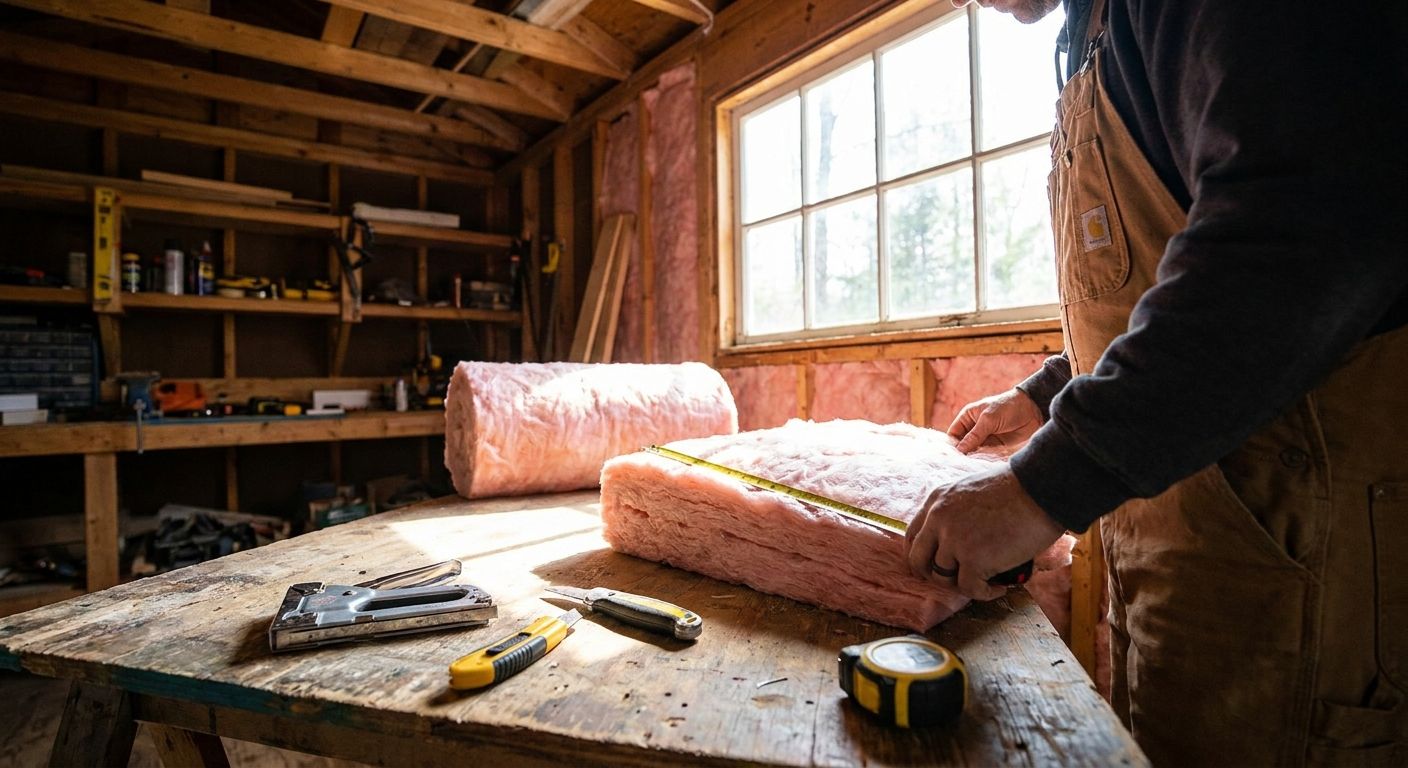
Turning a detached workshop or hobby space into a year-round room means solving the same problem every uninsulated outbuilding has in Alberta: heat loss through walls, ceiling, and the big garage door nobody thinks to seal. This guide walks through the steps that actually hold heat in a shop, not just the ones that look good on a checklist.
- Air-sealing before insulating cuts heat loss more than adding extra batt thickness in a detached shop.
- Spray foam insulation for pole barns and shops holds R-6 to R-7 per inch, beating fiberglass in a small footprint.
- Alberta shops need R-40+ in the ceiling and R-20+ in walls to handle -30C winter nights.
- A standard garage door loses more heat than an insulated wall section — seal it first.
- How to insulate a workshop or hobby space in 2026 starts with sealing, then insulating walls, ceiling, and the slab edge.
Why this matters
A detached shop with no vapor control and thin batt insulation can lose heat faster than the furnace or space heater can replace it once temperatures drop below -20C, which happens most winters in Calgary, Okotoks, High River, and Lethbridge. Insulating it properly isn't about comfort alone — it's about keeping paint, glue, finishes, and tools from freezing or getting damp enough to rust.
The difference between a shop you can work in on a January afternoon and one you avoid until May usually comes down to three things: air sealing, R-value in the right places, and moisture control. Skip any one of those and the other two don't matter much.
What you'll need
- Tape measure and a way to check current insulation depth (or lack of it) in walls and ceiling
- Caulk or expanding foam sealant for air gaps around windows, doors, and wall penetrations
- A target R-value based on Alberta's climate zone — typically R-40+ in the ceiling, R-20+ in walls
- Vapor barrier material if you're going the batt-and-poly route
- Weatherstripping for the man door and garage door
- A decision on insulation type: fiberglass batt, rigid foam board, or spray foam insulation for pole barns and shops
- A ventilation plan if you're running a heater, welder, or any combustion equipment inside
The steps
1. Assess the building envelope and set an R-value target
Walk the shop and note where heat is escaping — uninsulated stud bays, a bare ceiling, gaps around the garage door frame. Alberta's climate zone calls for higher R-values than a lot of pre-built shop kits ship with, so don't assume the factory insulation package is enough.
Set a target before buying material: R-20 to R-24 in 2×6 walls, R-40 or higher in the ceiling. Common mistake: assuming a shop only needs "some" insulation because it's not a living space — a cold shop with damp air ruins tools faster than an unheated garage.
2. Seal air leaks before insulating
Air leaks let more heat escape than gaps in insulation do, so caulk and foam every penetration — electrical boxes, plumbing runs, the seam where the wall meets the slab, and the trim around windows. This step takes an afternoon and costs under $50 in materials but changes how the whole building performs.
Do this before batts or board go up. Once insulation is installed, sealing behind it means tearing it back out. Common mistake: insulating first and sealing "later" — later rarely happens.
3. Choose the insulation type for walls
Fiberglass batt is the cheapest option and works if it's installed without gaps or compression, but it does nothing to stop air movement on its own. Rigid foam board adds an air barrier but needs careful seam taping.
Spray foam fills stud bays completely, air-seals and insulates in one pass, and holds its R-value even in tight cavities where batt gets compressed around wiring and blocking. For a detached workshop where you're paying to heat a small volume of air repeatedly through the day, that combination usually pays back faster than in a house. Verdict: for a shop that gets used daily through winter, spray foam is worth the premium over batt — Buy.
4. Insulate the ceiling or roof deck
Heat rises, and an uninsulated or under-insulated ceiling is usually the single biggest loss point in a detached shop. If there's an attic space above the shop, treat it the same way you'd treat a house attic — target R-40 or better and check for even coverage, not just a thin layer near the access hatch.
If the roof is a vaulted or open-truss design with no attic space, spray foam applied directly to the roof deck avoids the ventilation complications that batt insulation runs into in that configuration. Common mistake: insulating walls well and leaving the ceiling as an afterthought — it's usually the opposite priority that matters more.
5. Handle the garage door and any large openings
A standard uninsulated garage door is close to R-0 and undoes a lot of the work done on the walls around it. Insulated garage door panels or a rigid foam kit cut down on radiant heat loss, and weatherstripping around the perimeter stops the draft that a lot of shop owners mistake for "just how garage doors are."
The same logic applies to windows and the man door — check best insulation for garage doors and walls for what actually holds up through an Alberta winter versus what looks good in a hardware store display.
6. Address the floor or slab edge
Concrete slabs pull heat out of a shop through conduction, especially at the perimeter where the slab meets cold ground. Rigid foam board around the slab edge, or a foam underlayment beneath a wood subfloor if you're building one, closes off a loss point most people never think about.
This step matters more in a shop than a garage because you're standing on that floor for hours at a time, not just walking through it.
7. Plan ventilation and moisture control
A tightly sealed shop with no ventilation plan traps moisture from breathing, from equipment, and from anything wet brought in from outside. That moisture condenses on cold surfaces and causes rust on tools and mold on framing.
A vapor barrier on the warm side of batt insulation, or the inherent vapor-closed nature of closed-cell spray foam, handles most of this — but you still need a way to exchange air, even if it's just a controlled vent or exhaust fan run periodically. Common mistake: sealing a shop completely airtight with no ventilation at all.
8. Schedule professional installation day
If spray foam is the direction you're going, the prep work matters as much as the install itself — clearing walls, protecting equipment from overspray, and confirming access for the crew. How to prepare your home for spray foam insulation day covers the prep checklist, and the same principles apply to a detached shop.
Get your shop insulation quote
Licensed spray foam contractor serving Calgary, Okotoks, High River, and Lethbridge.
Troubleshooting
- Condensation forming on interior walls in winter: usually means the vapor barrier is missing or has gaps — closed-cell spray foam avoids this by acting as its own vapor barrier.
- Shop still feels cold despite new insulation: check the garage door and man door for uninsulated gaps first — they're the most common leftover leak.
- Frost or ice buildup near the ceiling-wall junction: points to an air leak at the top plate that's letting warm, moist air hit a cold surface.
- Batt insulation sagging or compressed in stud bays: happens when batts are cut too short or squeezed around wiring — this is one reason spray foam holds R-value more consistently over time in a shop.
- Space heater running constantly without keeping up: the building envelope likely has an unsealed gap somewhere, not an undersized heater.
- Musty smell after a few months: check for trapped moisture behind insulation on the slab edge or an unventilated corner.
Tools and resources
- Spray foam insulation for metal buildings if your shop is a steel-frame structure
- How much does spray foam insulation cost in Calgary for budgeting before you commit
- Best insulation type for Alberta winters for a broader comparison of material options
What to do next
Once the shop's insulated, the next decision is dialing in the right R-value for your specific ceiling and wall assembly rather than guessing at a round number. How to choose the right spray foam R-value for your attic breaks down how climate zone and building type change that number.
FAQ
What’s the best insulation for a detached workshop in Alberta?
Closed-cell spray foam is the best option for most detached workshops in 2026 because it air-seals and insulates in one step, holding R-6 to R-7 per inch. Fiberglass batt works on a tighter budget but needs a separate vapor barrier and careful installation to avoid gaps.
How much R-value does a workshop need in Calgary?
A Calgary-area workshop needs roughly R-20 to R-24 in the walls and R-40 or higher in the ceiling to handle winter lows near -30C. Under-insulated ceilings are the most common reason a shop still feels cold after wall upgrades.
Is spray foam better than batt insulation for a shop?
Spray foam outperforms batt in a shop because it fills irregular stud bays completely and blocks air movement, which batt alone doesn’t do. Batt costs less upfront but loses R-value faster if compressed around wiring or blocking.
How much does it cost to insulate a workshop in Calgary?
Cost depends on square footage, insulation type, and whether ceiling and slab edges are included, and it varies by project scope in 2026. A detailed cost breakdown is available on the spray foam insulation cost in Calgary page.
Do I need a vapor barrier in an insulated workshop?
Yes, unless you’re using closed-cell spray foam, which acts as its own vapor barrier and eliminates the need for separate poly sheeting. Batt or rigid foam installations still need a vapor barrier on the warm side of the wall.
Should I insulate the garage door on a workshop?
Yes, an uninsulated garage door is close to R-0 and undoes much of the benefit from insulating the surrounding walls. Insulated panels plus weatherstripping around the perimeter close that gap.
Can I insulate a metal building workshop the same way as wood-frame?
Metal buildings need insulation that addresses thermal bridging through the steel framing, which spray foam handles better than batt in most cases. Metal-specific installation details differ from a standard wood-frame shop.
How long does it take to insulate a detached workshop?
A spray foam crew typically completes a standard-size detached shop in a single day, depending on square footage and access. Batt installation can take longer if it’s a DIY project done evenings and weekends.
One last thing
The garage door gets blamed for cold shops more than any other single component, and it's usually deserved — a bare, uninsulated door radiates heat out faster than most people expect once the temperature drops below -20C. Seal and insulate it before spending more on wall upgrades; the payoff shows up faster.
Related guides
- Spray foam insulation for garage walls and ceilings
- Spray foam insulation for acreages and rural properties
- Commercial spray foam insulation for warehouses